0 ITEMS

How to Evaluate a Financial Model Template Before Buying
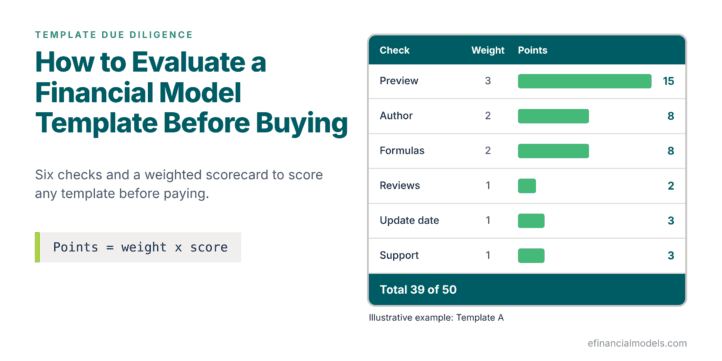
A founder can evaluate a financial model template before buying by checking six things: a preview, a named author, readable formulas, verifiable reviews, a recent update date and a reachable support channel. A short weighted scorecard turns those checks into one comparable score.
Key Takeaways
- A buyer can and should see a preview of a financial model before paying for it.
- Author bios, testimonials, review badges and usage counts earn trust only when each one can be verified independently.
- A 2024 FTC rule bans fake consumer reviews and paid-for review sentiment in the United States, and unverifiable praise remains a warning sign.
- A downloaded file should be opened in Protected View first, and any request to enable macros deserves scrutiny.
- A weighted scorecard ranks two templates transparently because every criterion carries a stated weight and score anchor.
Yes, a Buyer Can and Should Preview a Model First
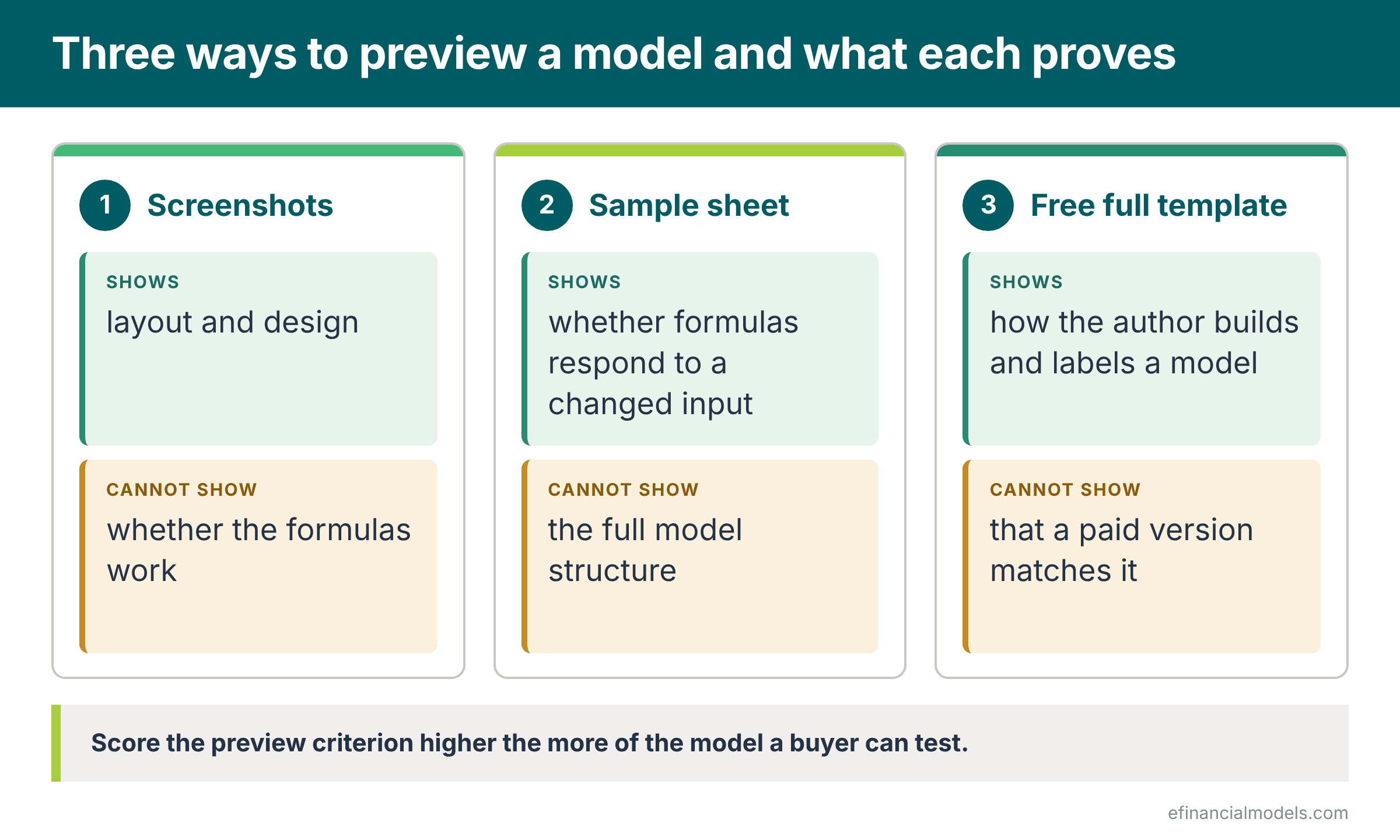
A preview is a reasonable request, and a publisher that refuses one should lose points on the scorecard below. The common buyer question about seeing a model before paying has a practical answer: look for screenshots of every main sheet, a free sample version, or a complete free template from the same author.
Founders in subscription software can test this quickly by opening several previews from the SaaS financial model category side by side.
Trust Elements Show Whether a Publisher Can Be Believed
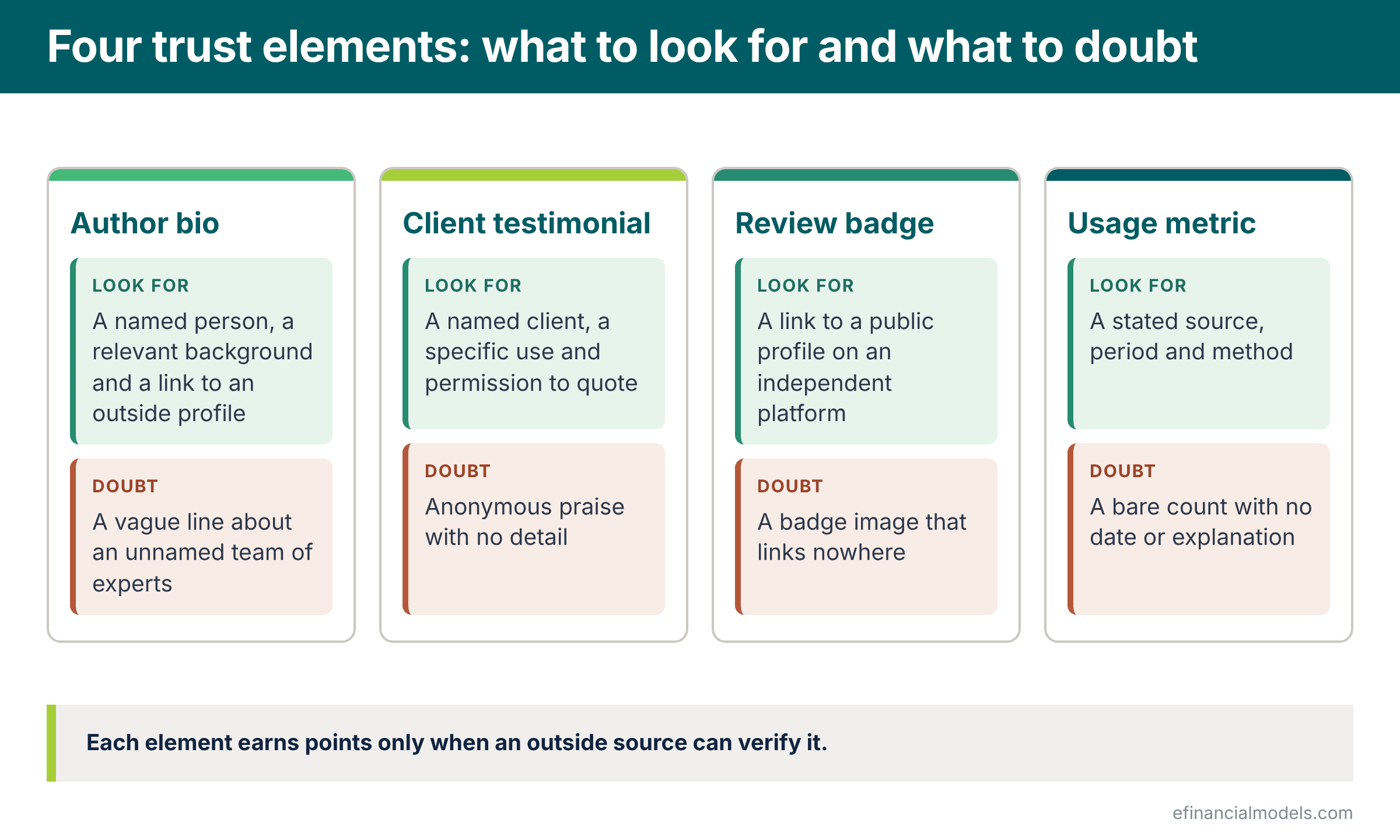
A downloads page usually carries four trust elements: author bios, client testimonials, third-party review badges and usage metrics. Each one helps a buyer only if it can be checked against something outside the page itself. On the scorecard later in this article, bios feed the author credentials criterion, while testimonials, badges and usage metrics feed the verifiable reviews criterion.
Author bios. A useful bio names a real person, states a relevant background and links to a profile elsewhere, such as a professional network page. A vague line about an unnamed team of experts gives a buyer nothing to verify.
Client testimonials. Testimonials work when they name the client, describe a specific use and appear with permission. The Federal Trade Commission (FTC), the US consumer protection agency, publishes endorsement guides stating that endorsements must reflect the honest opinions, findings, beliefs, or experience of the endorser. A separate section, 255.5, requires clear disclosure of a connection between endorser and seller that might materially affect the weight or credibility of the endorsement.
Third-party review badges. A badge carries weight only when it links to a public profile on an independent platform where the buyer can read the underlying reviews. A badge image that links nowhere is decoration. Reviews matter to buyers: a 2024 BrightLocal survey of 1,141 US consumers found that 50% of consumers trust reviews as much as personal recommendations from friends and family.
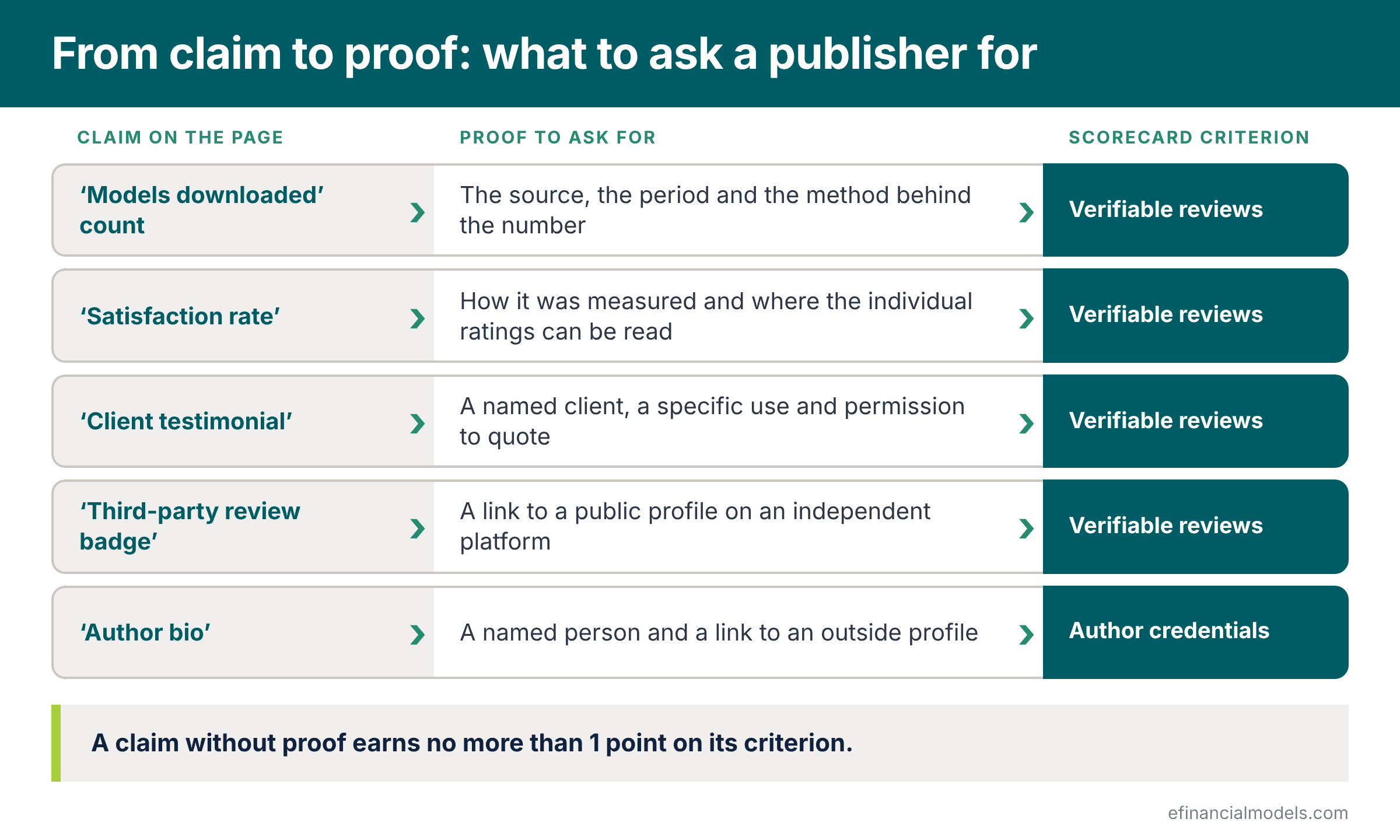
Usage metrics. Statements such as “models downloaded” or “customer satisfaction” persuade only when the publisher explains where the number comes from, what period it covers and how satisfaction was measured. A count with no source, date or method is a claim, not evidence.
Update date and support channel. Two further scorecard criteria cover maintenance and after-sale contact. A visible update date, ideally with a short change log, shows that someone still maintains the file, and a missing date scores 0. A named email address or help page shows where a buyer can ask questions after the purchase, and a listing with no way to reach the author also scores 0.
Why Unverifiable Praise Is a Warning Sign
The same 2024 survey found that 40% of consumers would suspect a review was fake if they felt AI had written it, which is another reason to prefer named, specific testimonials.
In August 2024 the FTC finalised a rule against fake reviews and testimonials. Under section 465.2 a business may not write, create or sell a fake or false consumer review or testimonial, and under section 465.4 it may not pay for reviews that express a particular sentiment. A publisher that shows only glowing, unattributed quotes therefore asks the buyer to accept exactly the kind of content regulators now target. Publishers should display only real feedback, and buyers should treat anonymous praise with caution.
A Short File Test Catches Most Template Problems
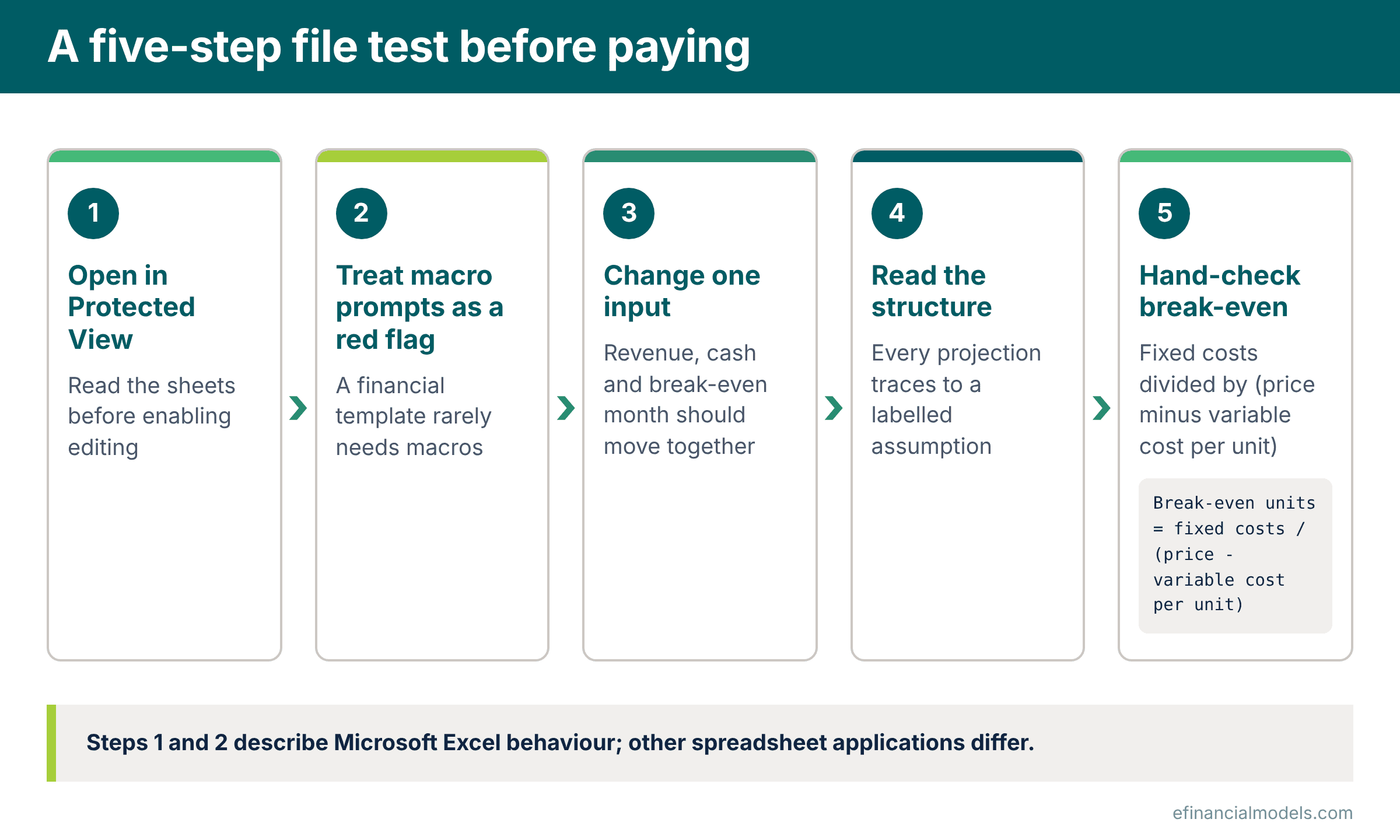
A short test of the file itself catches many common problems before they cost money. The test needs only a spreadsheet application, and steps 1 and 2 describe Microsoft Excel, since other applications handle downloaded files differently.
- Open the file in Protected View. Protected View is a read-only mode that Microsoft applies to files from the internet, because such files can contain viruses or other malware, according to Microsoft’s explanation of Protected View. Inspect the sheets there before enabling editing.
- Treat macro prompts as a red flag. A macro is a small program stored inside a workbook that automates tasks. Microsoft now blocks macros in files from the internet by default in supported versions of Office, so a financial template that insists on enabling them needs a strong reason.
- Change one input and watch the outputs. Altering a growth assumption should move the revenue forecast, the cash balance and the break-even month together. A result that stays frozen suggests a hardcoded number, which is a typed value sitting where a formula belongs.
- Read the structure. Inputs, calculations and outputs should sit on clearly separated sheets, and every projection should trace back to a labelled assumption. Templates built around financial projections benefit most from this discipline.
- Check the arithmetic of one key result by hand. Recompute the break-even quantity, which equals fixed costs divided by the gap between the selling price and the variable cost per unit. A 2009 university study of operational spreadsheets in organisations concluded that errors are commonplace, which suggests a hand check is worth the effort for purchased templates too.
A Weighted Scorecard Turns Checks Into One Comparable Number
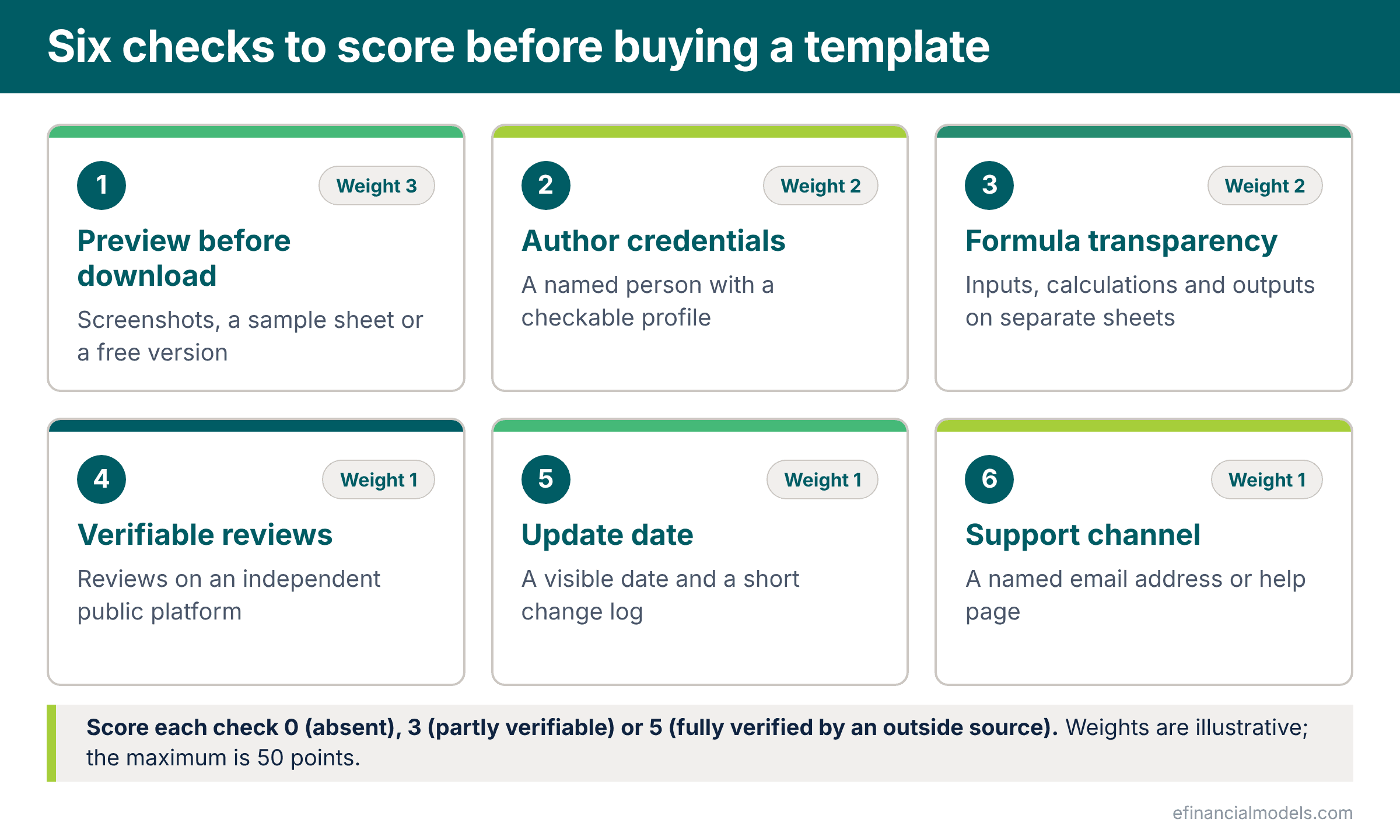
A weighted scorecard converts the checks above into a single score so that two templates can be compared. Each criterion receives a weight that reflects its importance, and each template receives a score from 0 to 5 on every criterion. The anchors are simple: 0 means the element is absent, 3 means it is present but only partly verifiable, and 5 means an outside source fully verifies it. Scores of 1, 2 and 4 are judgement calls between the nearest anchors.
In this illustrative example, the criteria carry these assumed weights: preview before download 3, author credentials 2, formula transparency 2, verifiable reviews 1, update date 1 and support channel 1. The weights add up to 10, so the maximum total is 10 times 5, which equals 50 points. The scores for two hypothetical templates follow.
| Criterion | Weight | Template A score | Template B score | Template A points | Template B points |
|---|---|---|---|---|---|
| Preview before download | 3 | 5 | 2 | 15 | 6 |
| Author credentials | 2 | 4 | 1 | 8 | 2 |
| Formula transparency | 2 | 4 | 2 | 8 | 4 |
| Verifiable reviews | 1 | 2 | 5 | 2 | 5 |
| Update date | 1 | 3 | 1 | 3 | 1 |
| Support channel | 1 | 3 | 4 | 3 | 4 |
| Total | 10 | 39 | 22 |
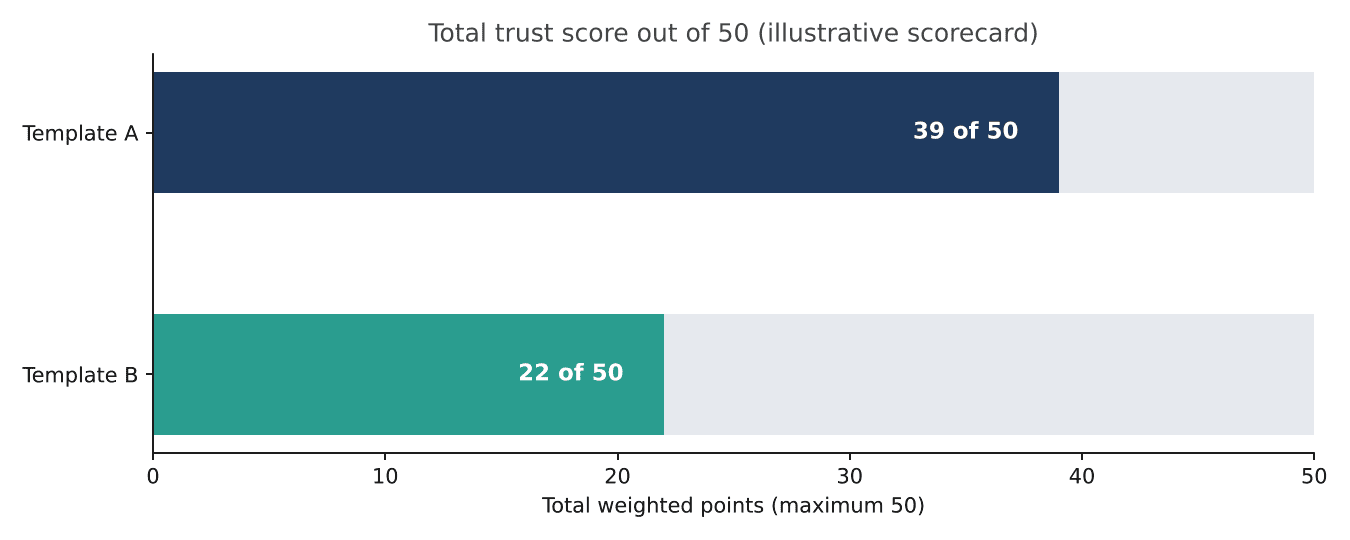
Points equal weight multiplied by score. Template A totals 39 points and Template B totals 22 points.
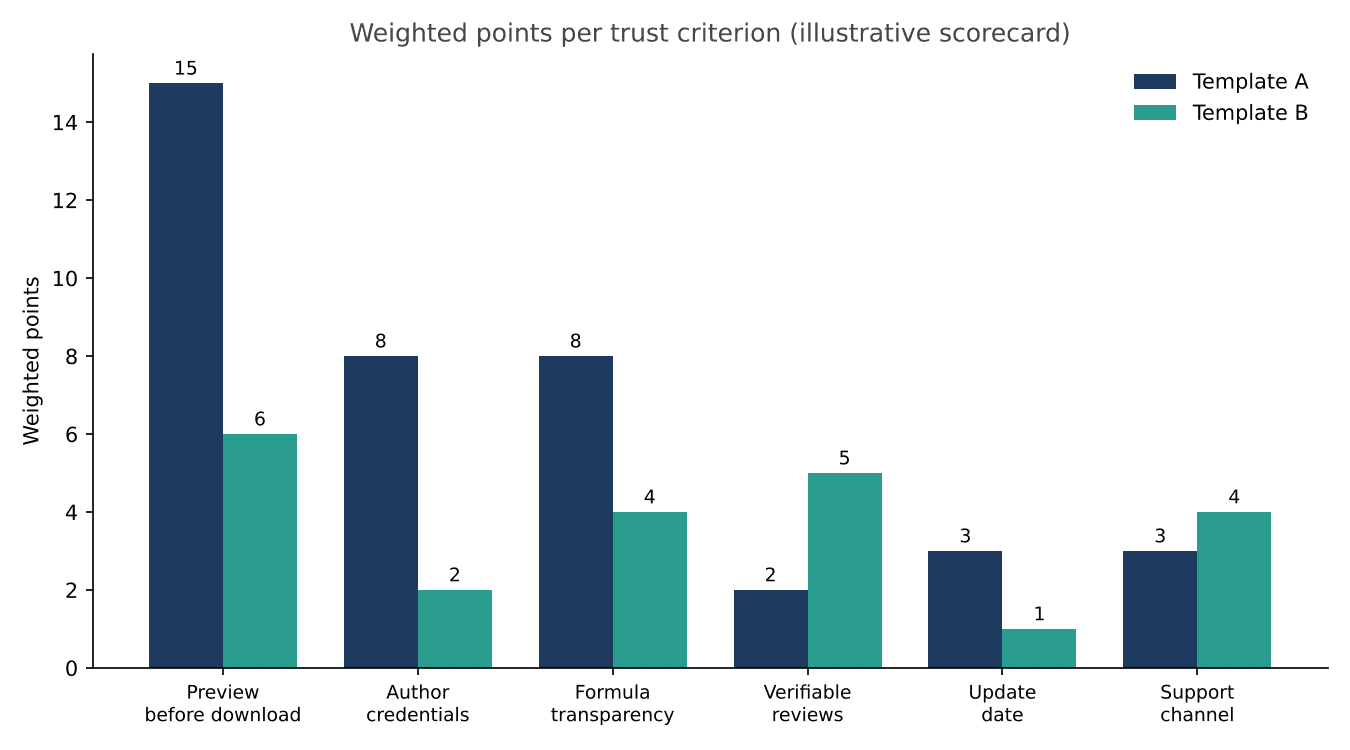
Template B has the better review score, yet Template A wins by 17 points because it leads on the three heavily weighted criteria: preview, author and formulas. Weights keep a single flattering criterion from outvoting the checks that protect a buyer most.
Conclusion
A founder can see a model before buying, and six checks separate a trustworthy template from a risky one: a preview, a verifiable author, readable formulas, checkable reviews, a recent update date and a reachable support channel. Scoring those elements on a weighted scorecard replaces a gut feeling with a number that a co-founder or investor can follow.
Founders who want to practise the method can start with the Free Three Statement Financial Model from eFinancialModels, whose listing shows preview images of the income statement, balance sheet, cash flow statement, key ratios and assumptions. Scoring its listing against a second template shows how the scorecard works before any paid model is considered.
Frequently Asked Questions
What should a founder do when a template offers no preview at all?
A missing preview removes the cheapest form of protection, so the founder should ask the publisher directly for a sample sheet or a short screen recording of the file in use. A quick reply that shows real formulas counts in the publisher’s favour, while a refusal justifies moving on. Where a refund policy exists, reading it before paying also limits the downside.
Are paid templates automatically safer than free ones?
Price says little about quality. A free template from a named author with a transparent structure can be sounder than a paid file with hidden sheets and locked cells. The scorecard never asks what a template costs, only what the buyer can verify. Cost enters afterwards, as a tiebreaker between two files whose scores sit within 3 points of each other, an assumed band that readers can set.
How recent should a template update be?
Recency matters most where rules or conventions change, such as tax treatment, interest assumptions or reporting layouts. A template for a stable calculation, like a simple loan schedule, can stay useful for years, while a forecasting file tied to current market assumptions goes stale quickly. A missing date scores 0 on that criterion, whatever the template does, so the date is worth checking before anything else on the listing.
Can a download count or satisfaction rating be trusted?
Only when the publisher shows the source, the period and the method behind it. A satisfaction rating that comes from a public review platform lets the buyer read the individual comments behind the average. A figure typed into a page by the publisher, with no explanation, cannot be checked and should score no higher than 1 on the reviews criterion, because it is present but cannot be verified.