
0 ITEMS

Pharmaceutical Manufacturer Financial Model Template
Excel-based financial model designed to value pharmaceutical manufacturing companies.
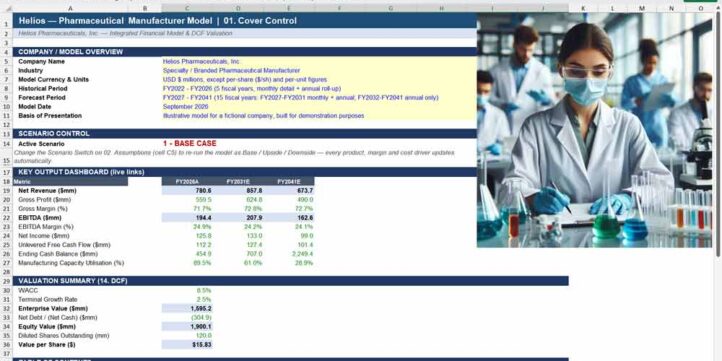
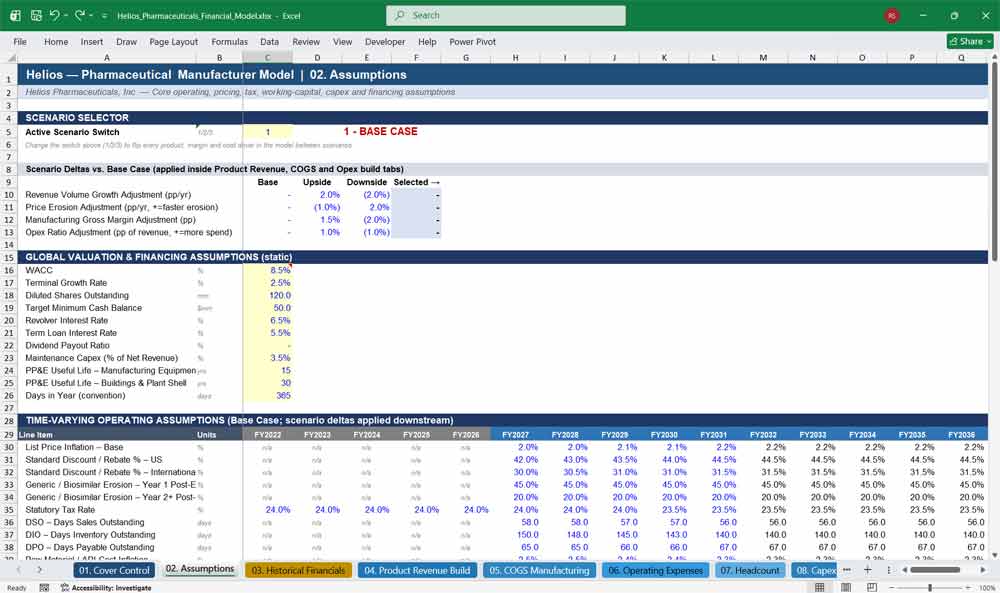
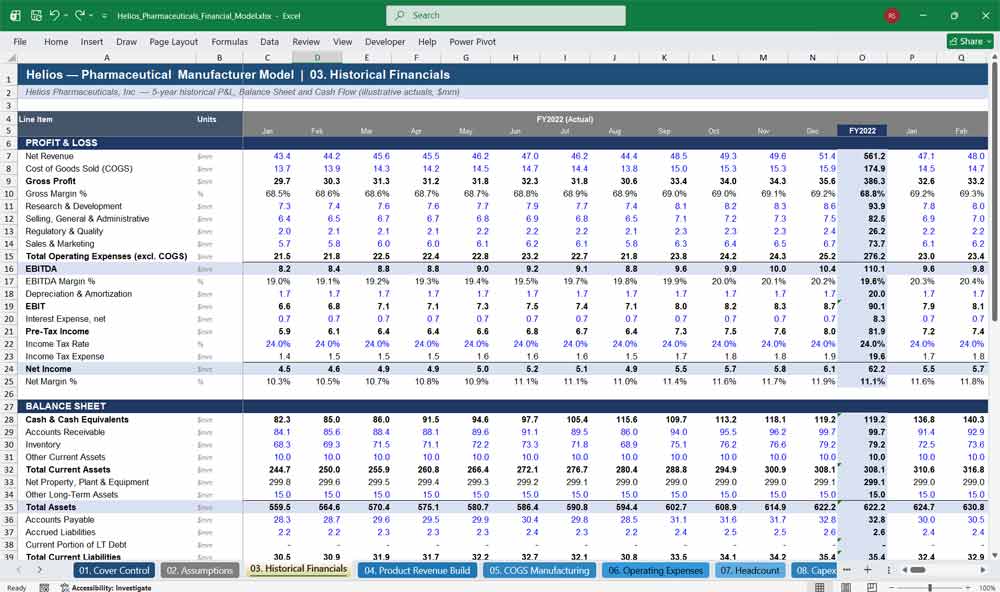
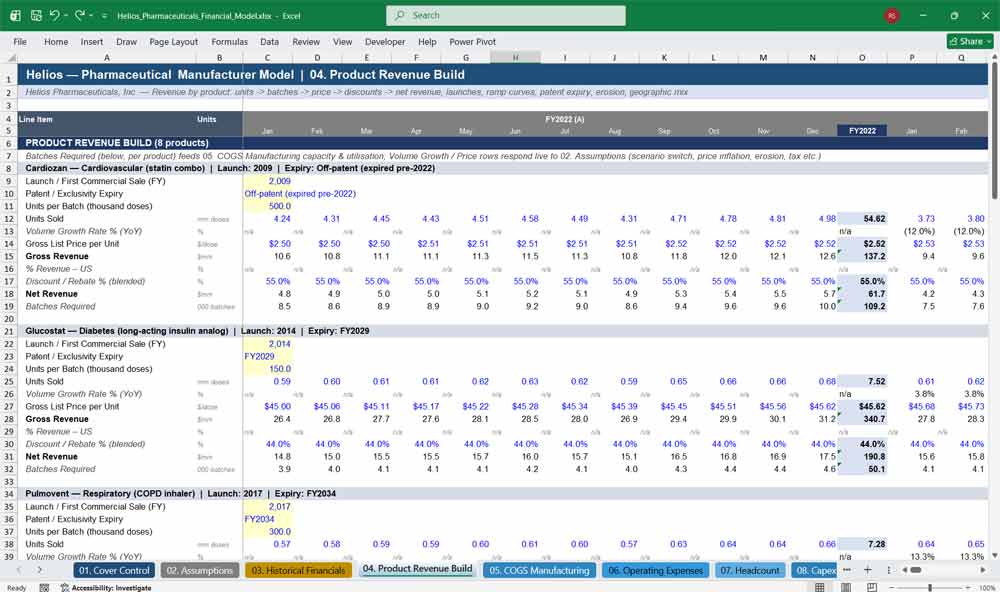
15 Year Pharmaceutical Manufacturer Financial Model
This model is aimed at financial analysts, investors, investment bankers, private equity professionals, corporate development teams, pharmaceutical executives, and students.
The model uses a bottom-up financial forecasting approach, starting with individual drug products and their sales drivers, then calculating manufacturing costs, operating expenses, financial statements, cash flows, and company valuation.
Product-level revenue forecasting
Models eight individual pharmaceutical products, incorporating sales volumes, batch sizes, pricing, discounts, rebates, geographic markets, product launches, patent expirations, and generic or biosimilar competition.
Manufacturing costs and capacity
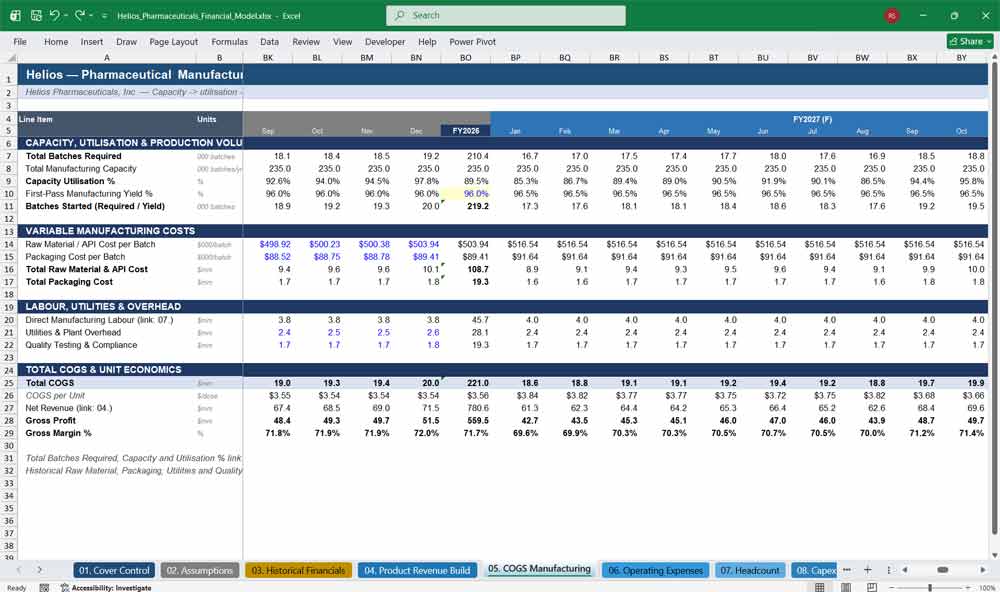
Calculates cost of goods sold (COGS) based on production volume, raw materials, packaging, labor, utilities, quality costs, plant capacity, and utilization. It also models factory expansion and capital expenditure.
Integrated financial statements
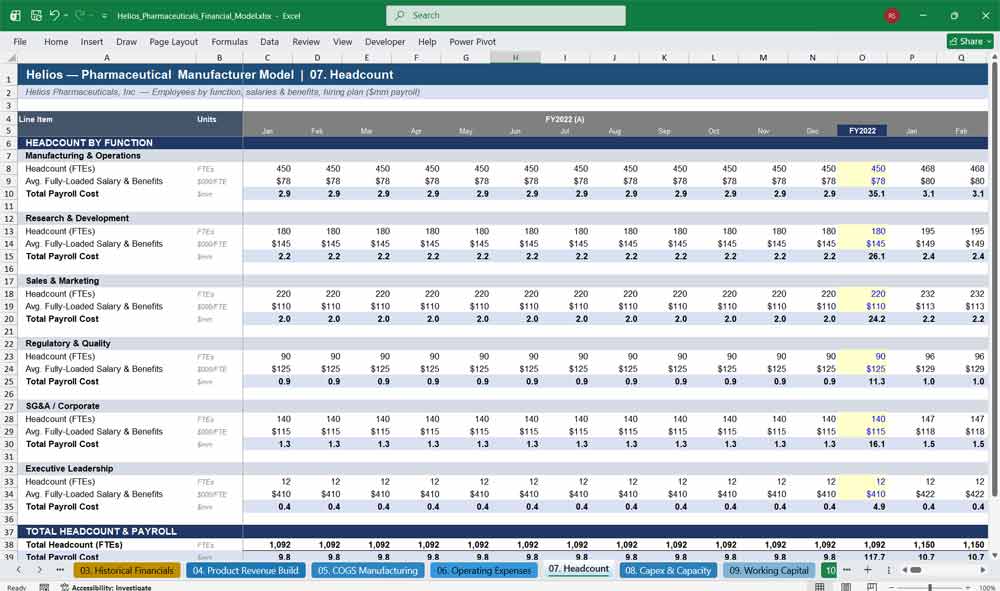
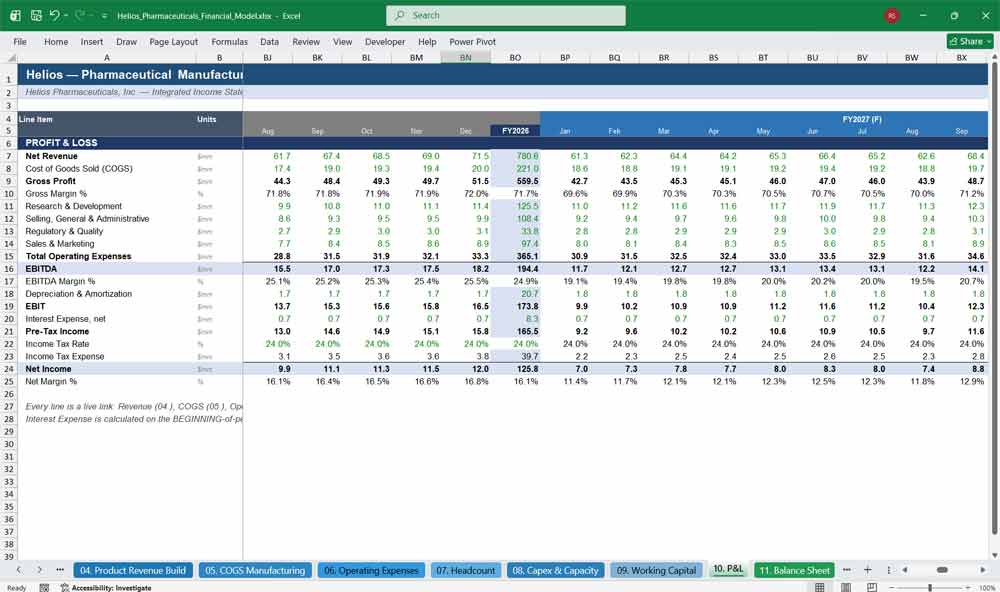
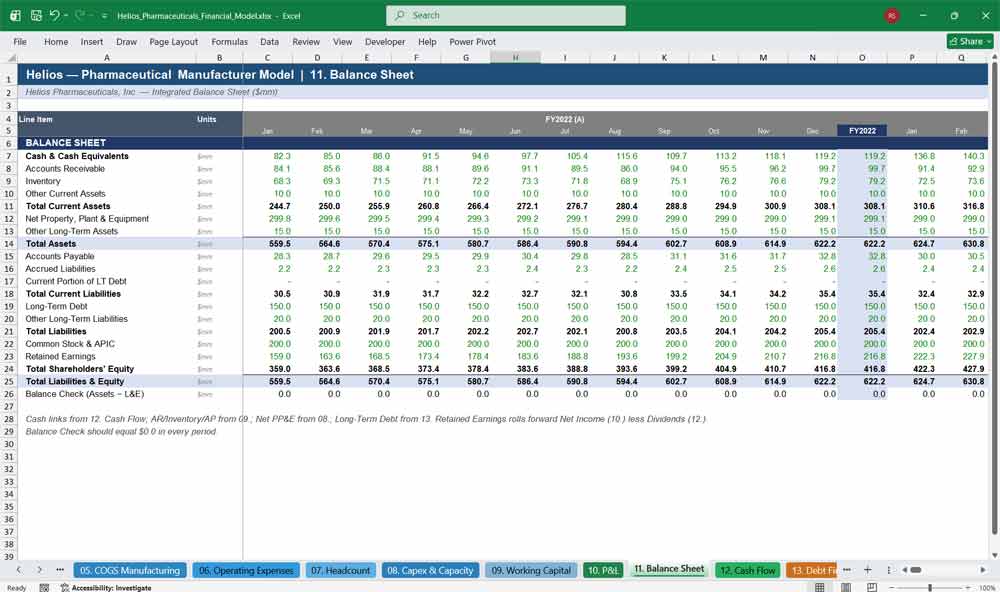
Connects the income statement, balance sheet, and cash flow statement, including working capital, payroll, depreciation, debt financing, interest expense, and cash management.
Company valuation and sensitivity analysis
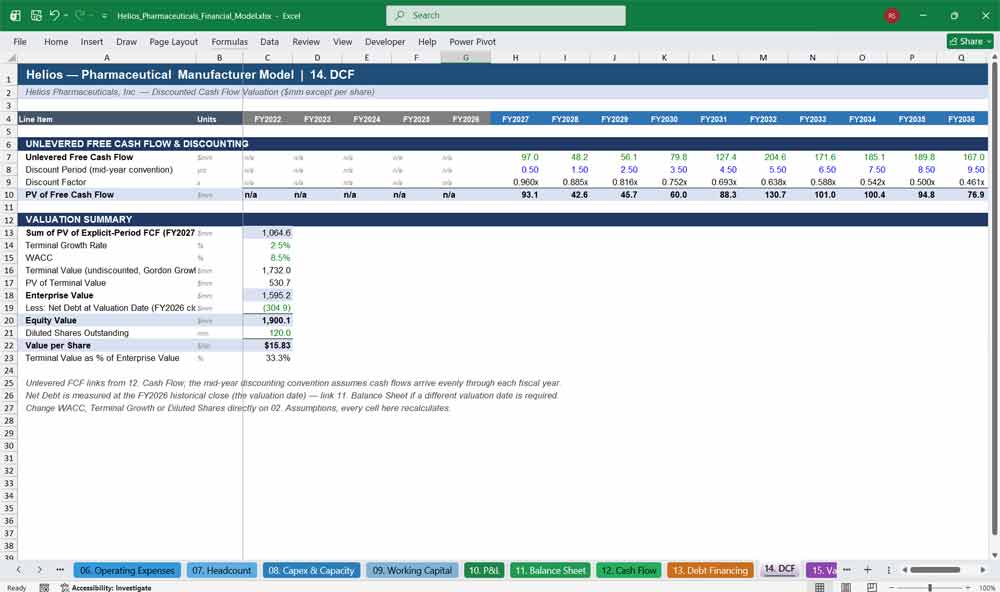
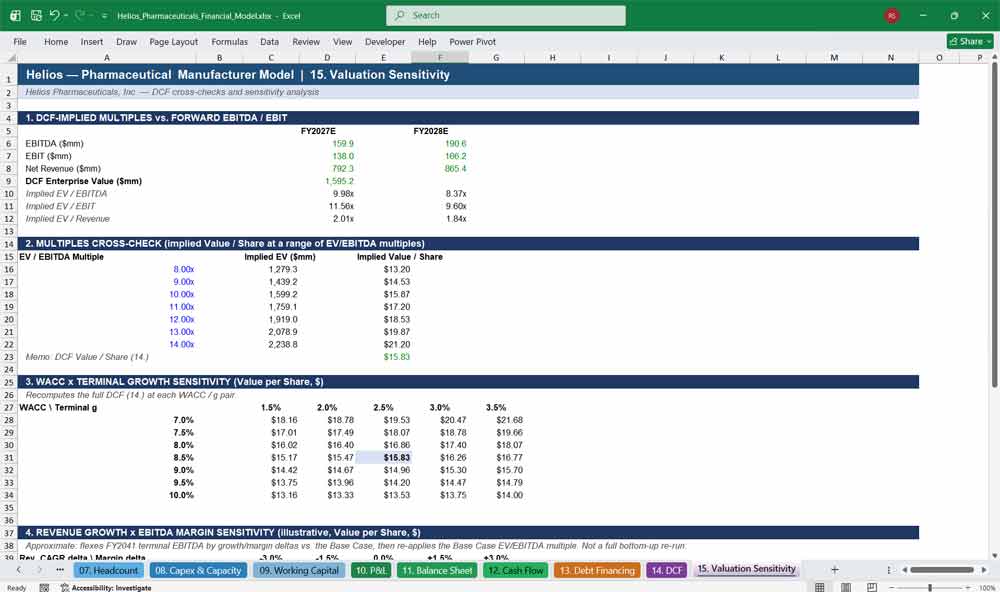
Uses discounted cash flow (DCF) valuation, weighted average cost of capital (WACC), terminal growth assumptions, enterprise value, equity value per share, and valuation sensitivity tables.
The workbook contains 15 interconnected tabs, organized into five main areas.
Forecasting period
- Historical period: FY2022–FY2026, covering 60 months of historical financial data.
- Forecast period: FY2027–FY2041, covering 15 years.
- The first five forecast years are modeled monthly, with annual summaries; the remaining ten years are modeled annually.
Valuation methodology
The webpage highlights three important financial modeling concepts.
Discounted cash flow (DCF)
The model forecasts future unlevered free cash flow and discounts it to present value to estimate the company’s intrinsic enterprise value. It accounts for drug launches, patent expirations, research and development expenditure, and changes in commercial performance.
Weighted average cost of capital (WACC)
WACC represents the required return from debt and equity investors. Pharmaceutical-specific risks—including regulatory approvals, clinical development uncertainty, patent protection, and competition—can influence the appropriate discount rate.
Sensitivity and scenario analysis
The workbook tests how valuation changes under different assumptions, including:
- Revenue growth and EBITDA margins.
- WACC and terminal growth rates.
- EV/EBITDA, EV/EBIT, and EV/Revenue multiples.
- Downside, base-case, and upside scenarios.
Practical applications
The model can be used to:
- Investment analysis: Evaluate a pharmaceutical company’s financial performance and investment potential.
- Mergers and acquisitions: Support acquisition valuations, deal analysis, and due diligence.
- Fundraising: Develop financial projections for investors and lenders.
- Strategic planning: Assess the impact of new drug launches, patent expirations, pricing pressure, and factory expansion.
- Financial education: Learn integrated three-statement modeling, DCF valuation, and scenario analysis.
- Risk assessment: Identify the key factors affecting profitability, liquidity, and enterprise value.
Similar ProductsOther customers were also interested in...



 eFinancialModels
Electric Vehicle (EV) Charging Station Financial M...
With this comprehensive 5- or 10-year monthly tool, investors can assess the viability of setting up... Read more

Financial Model for Mobile App | Mobile App Busine...
The Mobile App Financial Plan Template in Excel allows you to develop financial projections when lau... Read more

 HenrySheykin
Food Truck Financial Model Excel Template
The Food Truck Financial Model helps entrepreneurs, founders, business owners, consultants, and anal... Read more

Green Hydrogen Production from Wind Energy Financi...
The Green Hydrogen from Wind Financial Model aims to comprehensively forecast a horizon of 40 years ... Read more

Simple Mutual Non-Disclosure Agreement Template
Protect your business secrets with ease using our Simple Mutual Non-Disclosure Agreement Template. S... Read more

Solar Energy Financial Model
The Solar Energy Financial Model Spreadsheet Template in Excel assists you in preparing a sophistica... Read more

 Peter Graf
The Customer-Centric Financial Model for Restauran...
Starting a restaurant without a financial plan is like driving a car blindfolded. You wouldn´t do i... Read more
You must log in to submit a review.