0 ITEMS

Dual-Family Business Valuation: 7 Frameworks That Prevent Succession Disputes

When two family branches co-own a business and one wants out, the valuation question stops being purely mathematical and starts being deeply personal. Getting it right requires both technical rigor and a governance structure built before the conflict arrives.
Key Takeaways
- Family businesses with two or more co-owning family branches face 3 distinct valuation conflicts not present in single-family transitions: control premium disputes, divergent liquidity timelines, and competing succession visions.
- Only about 30% of family businesses have a formal, funded buy-sell agreement in place according to the Family Business Alliance, leaving the majority exposed to valuation disputes at transition.
- Control premiums in privately held businesses typically range from 20% to 40% above minority-interest value, while marketability discounts commonly run 15% to 35%, creating a combined swing of up to 75% in perceived business value.
- NACVA and ASA professional standards both require valuators to disclose conflicts of interest and, in dual-family scenarios, often mandate separate independent appraisals for each branch.
- IRC Section 2703 and Section 2704 govern how buy-sell agreement prices and valuation restrictions are treated for gift and estate tax purposes, directly affecting which formula approaches survive IRS scrutiny.
- Pre-emptive governance tools, including formula-based pricing, periodic independent appraisals every 3 to 5 years, and binding arbitration clauses, reduce the probability of litigation by establishing agreed methodology before emotions run high.
- Normalization adjustments for family compensation, perquisites, and related-party transactions are the single most contested technical element in dual-family valuations, often shifting EBITDA by 10% to 25%.
Why Dual-Family Ownership Creates Distinct Valuation Challenges
Dual-family ownership creates valuation complexity that single-family transitions rarely face, because the two branches often hold legitimately different views of what the business is worth and what it should become. Branch A may want liquidity to fund retirement; Branch B may want to reinvest for growth. Neither position is wrong, but they produce radically different valuations under the income approach (which values future cash flows) versus the asset approach (which values net assets on the balance sheet today).
Three structural tensions drive most dual-family valuation disputes:
- Divergent succession timelines. One branch may be two generations into the business; the other may have joined more recently. The branch closer to retirement typically prefers a higher current valuation, while the continuing branch prefers a lower one to reduce buyout cost.
- Control premium controversies. When one branch holds 51% and the other holds 49%, the majority branch may argue its stake commands a control premium (an upward adjustment reflecting the ability to make binding business decisions). The minority branch disputes the size of that premium.
- Minority discount controversies. Conversely, the majority branch may argue the minority stake deserves a discount for lack of control and lack of marketability. Minority discounts of 15% to 35% are common in privately held companies according to the American Society of Appraisers, but their application in family contexts is frequently litigated.
According to the Conway Center for Family Business, roughly 70% of family businesses do not survive the transition from the second to the third generation, and valuation disagreements are among the most cited causes of failed transitions.
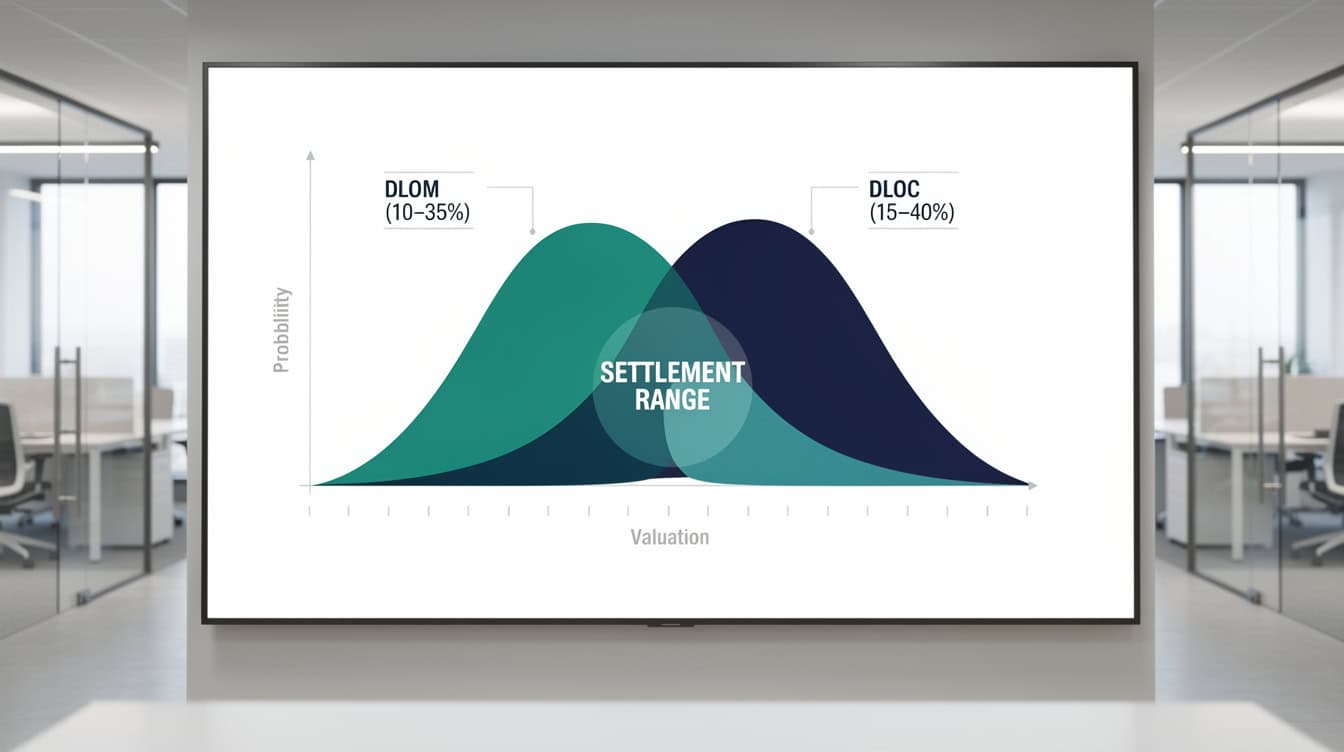
Three structural tensions drive most dual-family valuation disputes: divergent timelines, control premium controversies, and minority discount disagreements.
The Buy-Sell Agreement Framework: Structuring Fair Exit Mechanisms
A buy-sell agreement is a legally binding contract that pre-defines the price, method, and terms under which one owner can sell their interest to the other owners or to the entity itself. In dual-family scenarios, the agreement must address three structural models.
Cross-purchase agreements require each family branch to buy the departing branch’s interest directly. This works well when both branches have comparable liquidity and when the tax basis step-up (an increase in the cost basis of the purchased shares, reducing future capital gains tax) benefits the continuing owners.
Entity redemption agreements have the business itself buy back the departing branch’s shares. This simplifies execution but can create a disproportionate benefit for the remaining branch if the redemption is funded with pre-tax corporate dollars.
Hybrid (wait-and-see) agreements give the entity the first right of redemption, with the other family branch stepping in if the entity declines. This flexibility is valuable in dual-family scenarios where liquidity positions may shift over time.
Pricing Formulas in Buy-Sell Agreements
The pricing formula is the most consequential clause in any buy-sell agreement. Three approaches dominate:
- Book value: Simple but often understates true economic value because it ignores intangibles and goodwill.
- Capitalized earnings: Divides normalized EBITDA (earnings before interest, taxes, depreciation, and amortization, adjusted for non-recurring items and family compensation) by a capitalization rate. Example: $2M normalized EBITDA divided by a 20% cap rate equals a $10M indicated value.
- Revenue multiple: Common in service businesses. A 1.5x revenue multiple on $8M in revenue yields $12M. Industry-specific multiples vary widely: professional services firms often trade at 0.8x to 1.5x revenue, while manufacturing businesses may trade at 4x to 7x EBITDA according to Duff & Phelps industry transaction data.
For IRS compliance, the pricing formula must meet the requirements of IRC Section 2703, which disallows buy-sell agreement prices for estate and gift tax purposes unless the agreement is a bona fide business arrangement, not a device to transfer value to family members for less than full consideration, and comparable to arm’s-length terms.

The three buy-sell agreement structures each carry different tax and liquidity implications for dual-family ownership transitions.
NACVA and ASA Standards for Family Business Valuation Conflicts
Professional valuation standards provide the ethical and methodological backbone for dual-family engagements. Two bodies set the primary standards in the United States.
The National Association of Certified Valuators and Analysts (NACVA) publishes its Professional Standards, which require members to maintain independence and objectivity, disclose any relationships that could impair independence, and decline engagements where independence cannot be maintained. In dual-family scenarios, a valuator who has previously advised one branch faces a presumptive conflict that requires disclosure and, in most cases, withdrawal from serving the other branch.
The American Society of Appraisers (ASA) Business Valuation Standards require appraisers to disclose all prior relationships with any party to the transaction and to issue a written statement of independence in every appraisal report. The ASA’s Principles of Appraisal Practice and Code of Ethics explicitly prohibit contingent fees tied to valuation outcomes, a provision especially important in family disputes where one branch might offer a higher fee for a higher valuation.
When both family branches are clients of the same advisory firm, best practice under both NACVA and ASA standards is to engage separate, independent valuators for each branch, then use a pre-agreed arbitration process to resolve differences. This dual-appraisal structure adds cost (typically $15,000 to $50,000 per appraisal for lower-middle-market businesses) but dramatically reduces litigation risk.

NACVA and ASA standards require separate independent appraisals when family branches have directly opposing economic interests in a valuation.
Technical Valuation Adjustments in Family Business Contexts
Family businesses require specific normalization adjustments that arm’s-length transactions do not. Normalization means restating the financial statements to reflect what the business would earn under hypothetical arm’s-length conditions, removing the distortions created by family relationships.
The Three Most Contested Adjustments
1. Family compensation normalization. Family members are frequently paid above or below market rates. A family CEO earning $800,000 in a business where a comparable non-family CEO would earn $450,000 requires a $350,000 downward adjustment to EBITDA. Conversely, a family member working full-time but drawing no salary requires an upward adjustment. The Bureau of Labor Statistics Occupational Employment and Wage Statistics program provides benchmark compensation data by industry and role that valuators use to support these adjustments.
2. Non-operating assets. Family businesses often hold assets unrelated to operations: vacation properties, excess cash, personal vehicles, or investment portfolios. These assets must be separated from the operating business value and valued independently, then added back to the enterprise value. Failing to separate them inflates or deflates the operating multiple.
3. Related-party transactions. Rent paid to a family-owned real estate entity, management fees paid to a family holding company, or below-market loans between family branches all require adjustment to market rates. The IRS scrutinizes these transactions under IRC Section 482, which allows it to reallocate income between related parties to reflect arm’s-length pricing.
Here’s the math on a normalization example:
- Reported EBITDA: $3,200,000
- Less: excess family compensation adjustment: ($350,000)
- Less: personal vehicle expenses run through the business: ($45,000)
- Plus: below-market rent paid to family entity (adjustment to market): $120,000
- Normalized EBITDA: $2,925,000
Applying a 5.5x EBITDA multiple (a common lower-middle-market manufacturing multiple) to reported EBITDA yields $17.6M. Applying the same multiple to normalized EBITDA yields $16.1M. That $1.5M difference is the normalization gap that dual-family branches will fight over.
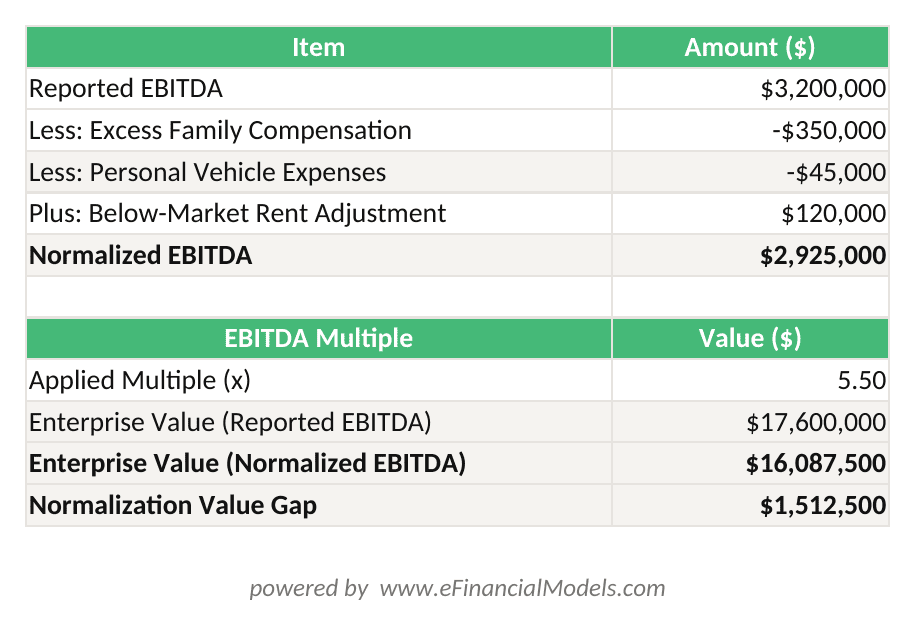
A $275,000 normalization gap on $3.2M EBITDA translates to a $1.5M difference in enterprise value at a 5.5x multiple.
Case Study: When Divergent Liquidity Needs Triggered a Valuation Crisis
Consider a composite scenario drawn from common dual-family transition patterns. Two founding families, call them the Alderton branch and the Mercer branch, each own 50% of a regional distribution business generating $18M in revenue and $2.8M in normalized EBITDA. The Alderton branch, now in its third generation, wants to sell its entire stake to fund retirement and estate planning. The Mercer branch, in its second generation, wants to continue growing the business and has no liquidity to fund a buyout.
The Alderton branch commissioned an appraisal using the income approach with a 4.5x EBITDA multiple, yielding a 50% stake value of approximately $6.3M. The Mercer branch’s advisor applied a 3.8x multiple (citing higher risk and lower growth), yielding a 50% stake value of approximately $5.3M. The $1M gap felt insurmountable until both parties agreed to a structured process: a third independent valuator selected jointly, with the final value set as the average of the three appraisals.
The lesson: the absence of a pre-agreed valuation methodology in the shareholder agreement forced a costly, emotionally charged negotiation. The total advisory cost exceeded $180,000. A pre-emptive formula clause would have cost roughly $8,000 to draft.

Without a pre-agreed valuation methodology, a $1M gap between two appraisals forced a $180,000 advisory process that a $8,000 formula clause could have prevented.
Case Study: How Pre-Emptive Governance Prevented a Succession Dispute
A second composite scenario illustrates the alternative. Two co-founder families in a professional services firm agreed at founding to include three provisions in their shareholder agreement: a formula-based pricing clause using 5x trailing twelve-month normalized EBITDA, a mandatory independent appraisal every four years (with costs shared equally), and a binding arbitration clause specifying a single NACVA-credentialed arbitrator.
When one family branch triggered the buy-sell provision 12 years later, the formula produced a clear number within 30 days. The continuing branch exercised its right of first refusal, the transaction closed in 90 days, and both families remained on speaking terms. Total advisory cost: under $40,000.
The difference between these two scenarios is not the complexity of the business. It’s the presence of a pre-agreed framework.

Pre-emptive governance reduced total advisory cost to under $40,000 and closed the transaction in 90 days with both families intact.
Control Premiums and Minority Discounts in Family Succession Scenarios
Control premiums and minority discounts are the two most technically contested elements in dual-family valuations. Understanding both is essential for any family business owner or advisor.
A control premium reflects the additional value a buyer pays to acquire a controlling interest, gaining the ability to set strategy, declare dividends, and direct management. In publicly traded company acquisitions, control premiums have historically averaged 20% to 40% above pre-announcement share prices according to data compiled by Kroll (formerly Duff & Phelps) in its annual Control Premium Study.
A discount for lack of marketability (DLOM) reflects the reduced value of an interest that cannot be easily sold. Private company interests have no public market, so buyers demand a discount. Empirical studies, including restricted stock studies and pre-IPO studies, support DLOM ranges of 15% to 35% for minority interests in closely held businesses.
In dual-family scenarios, these discounts interact in ways that can produce dramatically different values for the same underlying business:

Control premiums and marketability discounts can produce a $4.2M valuation gap between majority and minority stakes in the same $10M business.
| Scenario | Base Value | Control Premium | DLOM | Indicated Value |
|---|---|---|---|---|
| Majority (51%) stake | $10M | +30% | -10% | $11.7M |
| Minority (49%) stake | $10M | None | -25% | $7.5M |
| Negotiated 50/50 split | $10M | None | -15% | $8.5M |
This table illustrates why the majority branch and minority branch in a dual-family scenario can look at the same business and arrive at valuations that differ by more than $4M. Neither is wrong on the math. They’re applying different, defensible assumptions.
For business valuation purposes, the choice of discount and premium levels must be supported by empirical data, not negotiating position.
Pre-Emptive Mechanisms: Formula Approaches and Independent Appraisal Clauses
The most effective conflict-prevention tools are built into governance documents before any transition event occurs. Three mechanisms work best in dual-family structures.
Formula pricing clauses lock in a methodology (not a number) at the time of drafting. Common formulas include a multiple of trailing EBITDA, a multiple of revenue, or book value plus a goodwill premium. The formula should specify: the look-back period (trailing 12 months vs. 3-year average), the normalization adjustments to apply, and the source for the multiple (e.g., the median EBITDA multiple from a specified industry transaction database).
Periodic independent appraisal requirements mandate a full appraisal every 3 to 5 years, regardless of any pending transaction. This keeps both branches anchored to current market reality and prevents the shock of a first-ever appraisal arriving in the middle of a dispute.
Binding arbitration clauses specify the arbitration body (American Arbitration Association is common), the credentials required of the arbitrator (NACVA or ASA certification), the timeline for the process (typically 90 to 180 days), and how costs are allocated. Arbitration is typically 60% to 80% less expensive than litigation according to the American Arbitration Association.
For pre-money valuation and post-money valuation frameworks that can be adapted to family business contexts, structured templates provide a useful starting point.

Formula pricing, periodic appraisals, and binding arbitration clauses form the three-layer conflict-prevention framework for dual-family businesses.
Tax Implications of Valuation Choices in Family Transitions
Valuation decisions in family business succession carry direct tax consequences that can dwarf advisory fees. Four tax dimensions matter most.
Gift tax (IRC Section 2512): When one family branch transfers shares to the next generation, the IRS values the gift at fair market value on the transfer date. A higher valuation means a larger taxable gift. Minority discounts and DLOMs can legitimately reduce the taxable value of gifted minority interests, a strategy that has survived IRS challenge when supported by a qualified appraisal.
Estate tax (IRC Section 2031): At death, business interests are included in the taxable estate at fair market value. The federal estate tax exemption is $13,610,000 per individual for 2024 (IRS), but this exemption is scheduled to revert to approximately $7 million (inflation-adjusted) after 2025 unless Congress acts, making current valuation planning especially urgent.
IRC Section 2703 disallows buy-sell agreement prices for estate and gift tax purposes if the agreement fails the three-part test described earlier. Agreements drafted before 1990 are grandfathered, but any material modification resets the clock.
IRC Section 2704 limits the use of certain valuation discounts when family members control the entity and the restrictions lapse after the transfer. Treasury regulations under Section 2704 have been contested and partially withdrawn, but the underlying statute remains a risk for aggressive discount strategies.
Income tax consequences also matter: the departing branch pays capital gains tax on the difference between sale proceeds and their adjusted tax basis. The long-term capital gains tax rate for most high-income taxpayers is 20% (IRS), which on a $6M gain represents $1.2M in federal tax alone — a figure that underscores why valuation methodology and deal structure must be considered together. Installment sale structures under IRC Section 453 can spread the gain over time, reducing the annual tax burden.
For valuation models that incorporate these tax dimensions, purpose-built templates save significant time and reduce the risk of omitting a critical adjustment.

IRC Sections 2512, 2031, 2703, and 2704 directly govern how valuation choices affect gift, estate, and income tax outcomes in family transitions.
Frequently Asked Questions
What is dual-family governance in a business context?
Dual-family governance refers to ownership and management structures where two distinct family groups, whether co-founders or families that merged through acquisition or marriage, share equity in a business and must make collective decisions about strategy, compensation, and succession. Unlike single-family businesses, dual-family structures require explicit governance agreements because the two branches may have different risk tolerances, liquidity needs, and succession timelines. A formal shareholder agreement with defined decision-making rights, buy-sell provisions, and dispute resolution mechanisms is essential. Without these, a single disagreement about valuation can escalate into litigation that destroys the business entirely. Most governance advisors recommend revisiting these agreements every 5 years or after any major ownership change.
How do NACVA and ASA standards apply when both family branches want to use the same valuator?
Both NACVA and ASA standards require valuators to maintain independence and disclose any relationships that could impair objectivity. When both family branches approach the same valuator, the professional must assess whether a conflict of interest exists. In most dual-family buyout scenarios, serving both branches simultaneously is not permissible under these standards because the branches have directly opposing economic interests. The valuator must either decline one engagement or withdraw from both and recommend that each branch retain independent counsel. The cost of two separate appraisals, typically $15,000 to $50,000 each for lower-middle-market businesses, is far less than the cost of a valuation dispute that reaches litigation, which can exceed $500,000 in legal and expert fees.
What normalization adjustments matter most in a family business valuation?
The three most impactful normalization adjustments in family business valuations are: compensation normalization (adjusting family member salaries to market rates using BLS or comparable data), non-operating asset separation (removing personal or investment assets from the operating business), and related-party transaction adjustments (restating rent, management fees, and intercompany loans to arm’s-length terms). In a typical lower-middle-market family business, these adjustments can shift normalized EBITDA by 10% to 25% relative to reported EBITDA. For example, a business reporting $3.2M in EBITDA might normalize to $2.9M after removing $350,000 in excess family compensation and $45,000 in personal expenses, while adding back $120,000 in below-market rent. That $300,000 normalization gap, multiplied by a 5x EBITDA multiple, produces a $1.5M difference in indicated enterprise value.
How does IRC Section 2703 affect buy-sell agreement pricing?
IRC Section 2703 prevents family members from using artificially low buy-sell agreement prices to reduce estate and gift tax liability. For a buy-sell agreement price to be respected by the IRS for tax purposes, it must satisfy three conditions: the agreement must be a bona fide business arrangement (not primarily a tax-avoidance device), it must not be a device to transfer value to family members for less than full consideration, and its terms must be comparable to those in arm’s-length agreements between unrelated parties. Agreements that fail this test are ignored for estate and gift tax purposes, meaning the IRS will substitute fair market value regardless of what the agreement says. Valuators and attorneys drafting buy-sell agreements should document the arm’s-length comparability of the pricing formula at the time of drafting, using industry transaction data to support the chosen multiple or methodology.
What is the typical range for control premiums and minority discounts in private family businesses?
Control premiums in privately held businesses typically range from 20% to 40% above the pro-rata value of a minority interest, reflecting the economic value of controlling strategic decisions, dividend policy, and management appointments. Discounts for lack of marketability (DLOM) for minority interests in closely held companies typically range from 15% to 35%, supported by restricted stock studies and pre-IPO studies. These two adjustments interact: a 49% minority stake in a $10M business might be valued at $4.9M on a pro-rata basis, then reduced by a 25% DLOM to approximately $3.7M. The majority 51% stake might carry a 30% control premium, yielding approximately $6.6M. The combined indicated value of both stakes ($10.3M) exceeds the enterprise value ($10M) because the control premium and minority discount are applied asymmetrically. This mathematical reality is a frequent source of confusion and dispute in dual-family negotiations.
When should dual-family businesses use a formula approach versus a full independent appraisal?
Formula approaches work best when the business is relatively stable, the industry has well-established transaction multiples, and both family branches trust the methodology. A formula clause in a shareholder agreement, such as 5x trailing twelve-month normalized EBITDA, provides speed and certainty at low cost. Full independent appraisals are necessary when the business has complex intangibles (patents, customer relationships, brand value), when the transaction size is large enough to justify the cost, when the IRS requires a qualified appraisal for gift or estate tax purposes, or when the family branches have materially different views of the business’s risk profile. For businesses with enterprise values above $5M, most advisors recommend a full appraisal at least every 3 to 5 years, with the formula approach serving as a pricing floor or ceiling between appraisal cycles rather than the sole determinant.
What happens if the two family branches cannot agree on a valuation?
When dual-family branches cannot agree on valuation, the outcome depends entirely on what their shareholder agreement says. If the agreement includes a binding arbitration clause with a specified methodology and arbitrator credentials, the process is clear and typically resolves within 90 to 180 days. If no such clause exists, the branches face three options: negotiate a settlement (often requiring a mediator), pursue litigation (expensive, slow, and destructive to business value), or agree to a dual-appraisal process where each branch commissions an independent appraisal and the final value is set as the average or as determined by a third neutral appraiser. Litigation over family business valuation disputes can take 3 to 7 years and cost both branches more in legal fees than the valuation difference they were fighting over. Pre-emptive governance is almost always the better investment.
Conclusion
Dual-family business valuation sits at the intersection of financial rigor and human complexity. The technical tools, normalization adjustments, discount frameworks, and buy-sell structures, are well-established. What fails most dual-family transitions is not a lack of valuation methodology but a lack of pre-agreed governance that applies that methodology before emotions and competing interests make agreement impossible.
The families that navigate succession successfully share one trait: they built the framework before they needed it. They agreed on a pricing formula, scheduled periodic appraisals, and embedded arbitration clauses in their shareholder agreements when everyone was still aligned. The families that end up in litigation typically had none of those structures in place.
I recommend downloading the EFM Business Valuation Framework Template, which includes buy-sell agreement formula structures, normalization adjustment checklists, and dual-family governance provisions designed specifically to prevent succession conflicts before they start.