0 ITEMS

Selling a Business: Valuation to Closing in 9 Steps

Selling a business is a multi-stage financial transaction, not a single event, and the difference between a well-prepared exit and a rushed one can easily be 30-50% of your final proceeds.
Key Takeaways
- Start exit planning 12-24 months before listing to optimize EBITDA and remove operational dependencies that suppress valuation.
- Private company EBITDA multiples range from 3x-4x for manufacturing to 8x-12x for SaaS and technology businesses, depending on growth rate and customer concentration.
- Deal structure (asset sale vs. stock sale) can shift your net proceeds by 15-30% due to differing tax treatment for C-corps and pass-through entities.
- Approximately 30-50% of mid-market deals include earnout provisions, typically covering 10-30% of total deal value, to bridge valuation gaps between buyer and seller.
- The average small business sale (under $2M) takes 6-12 months from listing to close; mid-market transactions ($5M-$50M) typically take 9-18 months.
- M&A advisors use a modified Lehman formula for fees, often 5-8% on the first $1M of deal value, stepping down to 1-2% on amounts above $10M.
- Roughly 20-25% of deals that reach the letter of intent stage fail during due diligence, most commonly due to financial restatements, customer concentration, or undisclosed liabilities.
When to Start Planning Your Business Exit
The best time to begin planning a business sale is 2-3 years before you intend to close, not when you’re ready to leave. Most sellers who maximize value start preparing 12-24 months in advance, using that window to clean financials, reduce owner dependency, and document repeatable processes that make the business transferable to a new owner.
According to the Exit Planning Institute, only 20-30% of businesses that go to market actually sell, and poor preparation is the leading cause of failed transactions. Source Buyers pay for predictable, transferable cash flow. If your business can’t run without you for 30 days, that’s a valuation discount, not a selling point.
Key triggers that signal it’s time to begin exit planning:
- You’ve hit a growth plateau that requires capital or expertise you don’t want to deploy.
- A strategic acquirer has approached you unsolicited (the best time to negotiate is before you need to sell).
- Industry consolidation is accelerating and multiples are at a cyclical high.
- Personal liquidity needs, health, or succession considerations create a defined timeline.
Starting exit planning 12-24 months before listing gives sellers time to optimize EBITDA and reduce owner dependency.
Preparing Your Business for Sale: The 12-24 Month Roadmap
Pre-sale preparation directly determines the multiple a buyer will pay. The goal is to present a business that looks like a well-oiled machine: clean financials, diversified revenue, documented processes, and a management team that doesn’t depend on the founder.
Months 18-24 before listing:
- Recast your financials. Recasting (also called normalization) means adjusting your income statement to remove owner-specific expenses, one-time costs, and non-recurring items. A buyer’s accountant will do this anyway; doing it first gives you control of the narrative.
- Reduce customer concentration. If your top 3 customers represent more than 40% of revenue, buyers will apply a concentration discount. Diversifying to below 20% per customer meaningfully improves your multiple.
- Separate personal and business expenses. Personal vehicles, family salaries, and owner perks buried in operating expenses reduce reported EBITDA (earnings before interest, taxes, depreciation, and amortization, the most common valuation base for private companies).
Months 6-18 before listing:
- Document standard operating procedures (SOPs) for every key function. Buyers want to see that the business runs on systems, not on the owner’s memory.
- Lock in key employees with retention agreements or equity participation. Employee flight risk during a sale is a top due diligence concern.
- Resolve any pending litigation, regulatory issues, or deferred maintenance on equipment or facilities.
- Renew long-term customer contracts and supplier agreements. Contracts with remaining terms of 2+ years are a valuation asset.
Months 1-6 before listing:
- Prepare 3 years of audited or reviewed financial statements. Compiled statements (the lowest level of CPA assurance) are often insufficient for mid-market buyers.
- Build a data room: a secure, organized repository of all financial, legal, operational, and HR documents a buyer will request during due diligence.
- Engage your transaction team (see below).
Sellers who complete all six preparation steps before listing typically achieve 20-40% higher multiples than unprepared sellers.
Business Valuation Methods and Multiples
Private company valuation is a range, not a single number, and that range shifts based on deal structure, buyer type, and market conditions. The four primary methods used in private M&A are EBITDA multiples, revenue multiples, discounted cash flow (DCF), and asset-based valuation.
EBITDA Multiples (most common for profitable businesses)
EBITDA multiples express enterprise value (the total value of the business, including debt) as a multiple of annual EBITDA. A business generating $2M in EBITDA at a 5x multiple has an enterprise value of $10M.
Here’s the math for a worked example:
- Revenue: $8,000,000
- Operating expenses (excluding owner add-backs): $6,200,000
- Reported EBITDA: $1,800,000
- Owner add-backs (personal vehicle, above-market owner salary, one-time legal fee): $400,000
- Adjusted EBITDA: $2,200,000
- Industry multiple (professional services): 5.5x
- Indicated enterprise value: $2,200,000 x 5.5 = $12,100,000
- Less: outstanding debt: $1,500,000
- Indicated equity value: $10,600,000
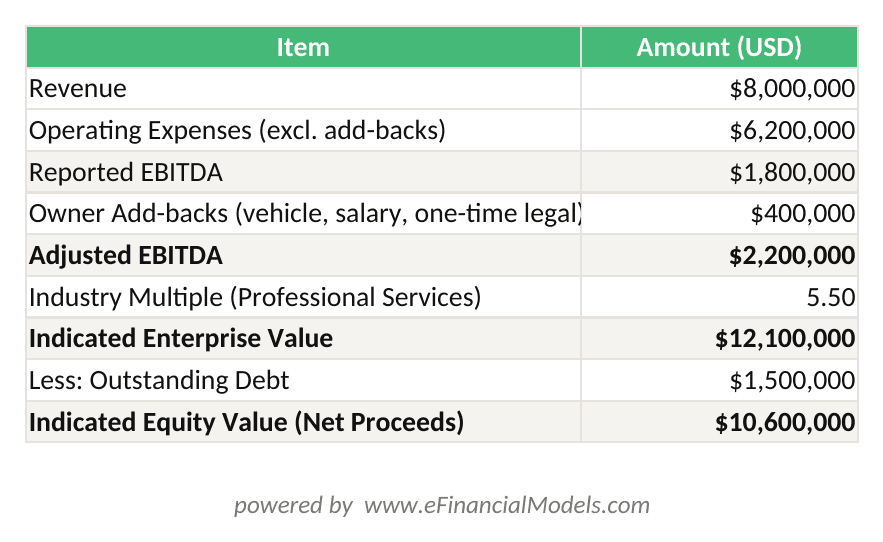
Adjusted EBITDA of $2.2M at a 5.5x professional services multiple yields $12.1M enterprise value and $10.6M equity value after debt payoff.
Industry EBITDA multiples for private companies vary significantly. According to Pepperdine University’s Private Capital Markets Report, typical ranges by sector are:
| Industry | EBITDA Multiple | Revenue Multiple |
|---|---|---|
| SaaS / Technology | 8x-12x | 3x-6x |
| Healthcare Services | 6x-10x | 1.5x-3x |
| Professional Services | 4x-7x | 0.8x-1.5x |
| Distribution / Wholesale | 4x-6x | 0.3x-0.6x |
| Manufacturing | 3x-5x | 0.4x-0.8x |
| Retail | 2x-4x | 0.2x-0.5x |
Source
Discounted Cash Flow (DCF)
DCF (a method that calculates the present value of projected future cash flows using a discount rate that reflects risk) is more common in larger transactions where buyers have high confidence in multi-year projections. For most small and mid-market businesses, EBITDA multiples dominate because projections are less reliable.
Asset-Based Valuation
Asset-based approaches (net asset value or liquidation value) apply when a business has significant tangible assets but low profitability. Manufacturing companies with heavy equipment or real estate holdings sometimes see asset-based floors that exceed their earnings-based value.
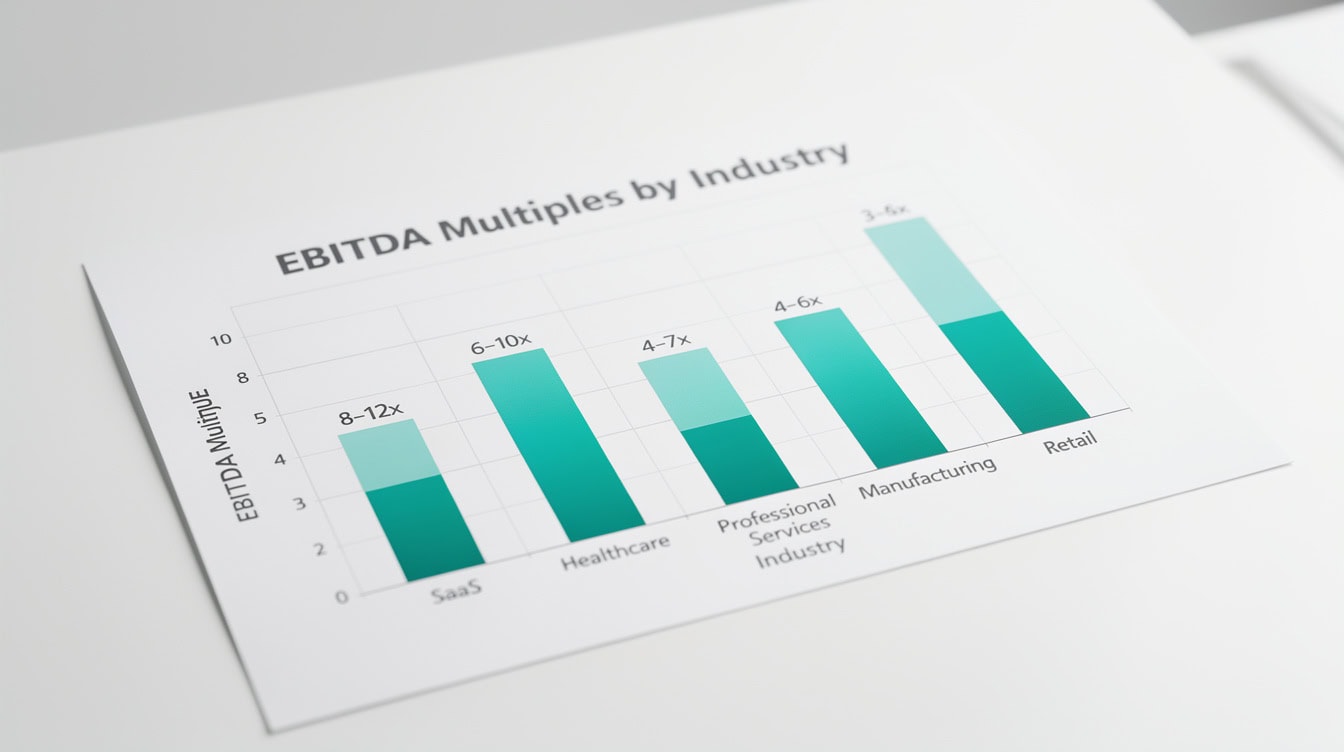
SaaS businesses command 3-4x the EBITDA multiple of retail businesses, reflecting recurring revenue and scalability premiums.
Assembling Your Transaction Team
You need a team of specialists, not generalists, to run a competitive sale process. The three core advisors are your M&A advisor (or business broker for smaller deals), your transaction attorney, and your CPA.
M&A Advisor vs. Business Broker: Business brokers typically handle transactions under $2M in enterprise value and work on commission (8-12% of sale price). M&A advisors and investment bankers handle larger deals, run structured auction processes, and charge a retainer plus a success fee based on a modified Lehman formula. For a $10M transaction, a typical success fee might be 5% on the first $1M ($50,000) plus 4% on the next $4M ($160,000) plus 3% on the remaining $5M ($150,000), totaling approximately $360,000 or 3.6% of deal value.
Transaction Attorney: Your attorney negotiates the purchase agreement, representations and warranties, indemnification caps, and escrow terms. Don’t use your general business attorney for this; use a specialist in M&A transactions.
CPA / Tax Advisor: Deal structure decisions (asset vs. stock sale, installment sales, opportunity zone reinvestment) can shift your after-tax proceeds by hundreds of thousands of dollars. Engage your CPA before you sign a letter of intent, not after.

The three-advisor model (M&A advisor, transaction attorney, CPA) is standard for mid-market transactions above $5M.
Understanding Deal Structure: Asset vs. Stock Sales
Deal structure is where sellers most commonly leave money on the table. The two primary structures are asset sales and stock sales, and they have fundamentally different tax consequences.
Asset Sale: The buyer purchases specific assets and liabilities of the business (equipment, inventory, customer contracts, goodwill) rather than the legal entity itself. For C-corporations, this creates double taxation: the corporation pays tax on the gain, and shareholders pay tax again on the distribution. For pass-through entities (S-corps, LLCs, partnerships), asset sales are generally taxed once at the individual level, often at long-term capital gains rates of 20% plus the 3.8% net investment income tax. Source
Stock Sale: The buyer purchases the seller’s shares in the legal entity. Sellers prefer stock sales because gains are taxed at long-term capital gains rates (typically 20% + 3.8% NIIT for high earners). Buyers prefer asset sales because they get a stepped-up tax basis in the acquired assets, generating future depreciation deductions.
| Feature | Asset Sale | Stock Sale |
|---|---|---|
| Buyer preference | High | Low |
| Seller preference | Low (C-corps) | High |
| Tax basis step-up | Yes | No |
| Liability transfer | Selected only | All liabilities |
| C-corp tax impact | Double taxation | Single tax |
| Pass-through tax | Capital gains | Capital gains |
| Typical premium | Buyer pays more | Seller accepts less |
Other Structural Elements:
- Earnouts: A portion of the purchase price paid contingent on future performance. Common when buyer and seller disagree on valuation. Earnouts typically cover 10-30% of deal value and run 1-3 years. According to SRS Acquiom’s M&A Deal Terms Study, approximately 30% of private company M&A deals include earnout provisions. Source
- Seller Financing: The seller carries a note for part of the purchase price, typically 10-30% of deal value at 5-8% interest. Common in smaller transactions where bank financing is limited.
- Rollover Equity: The seller reinvests a portion of proceeds (typically 10-30%) into the acquiring entity, usually a private equity-backed platform. This aligns incentives and gives the seller a second bite at the apple if the combined entity is later sold at a higher multiple.

Deal structure choice can shift net proceeds by 15-30%; C-corp sellers face double taxation in asset sales that pass-through entity sellers avoid.
The Sell-Side M&A Process Step-by-Step
A structured sell-side process creates competitive tension among buyers, which is the single most effective way to maximize price. Here’s how a professional process runs:
- Prepare the Confidential Information Memorandum (CIM): The CIM is a 30-60 page document describing the business, its financials, market position, growth opportunities, and management team. It’s distributed only to buyers who sign a non-disclosure agreement (NDA).
- Identify and contact buyers: Your M&A advisor maintains a database of strategic acquirers and financial buyers (private equity firms). Strategic buyers (competitors, suppliers, customers) often pay higher multiples because they capture synergies. Financial buyers (PE firms) focus on cash flow and growth potential.
- Manage the indication of interest (IOI) process: Buyers submit non-binding IOIs with preliminary valuation ranges. You select the most attractive buyers for a management presentation.
- Management presentations: You present the business to 3-6 shortlisted buyers. This is your opportunity to sell the growth story and management depth.
- Request final bids (LOIs): Buyers submit detailed letters of intent with price, structure, and key terms.
- Select preferred buyer and negotiate LOI: You enter exclusivity with one buyer (typically 45-90 days) to complete due diligence and finalize the purchase agreement.
- Due diligence and purchase agreement negotiation: The buyer’s team reviews your data room. Your attorneys negotiate the definitive agreement.
- Closing: Funds transfer, documents are signed, and ownership changes hands.
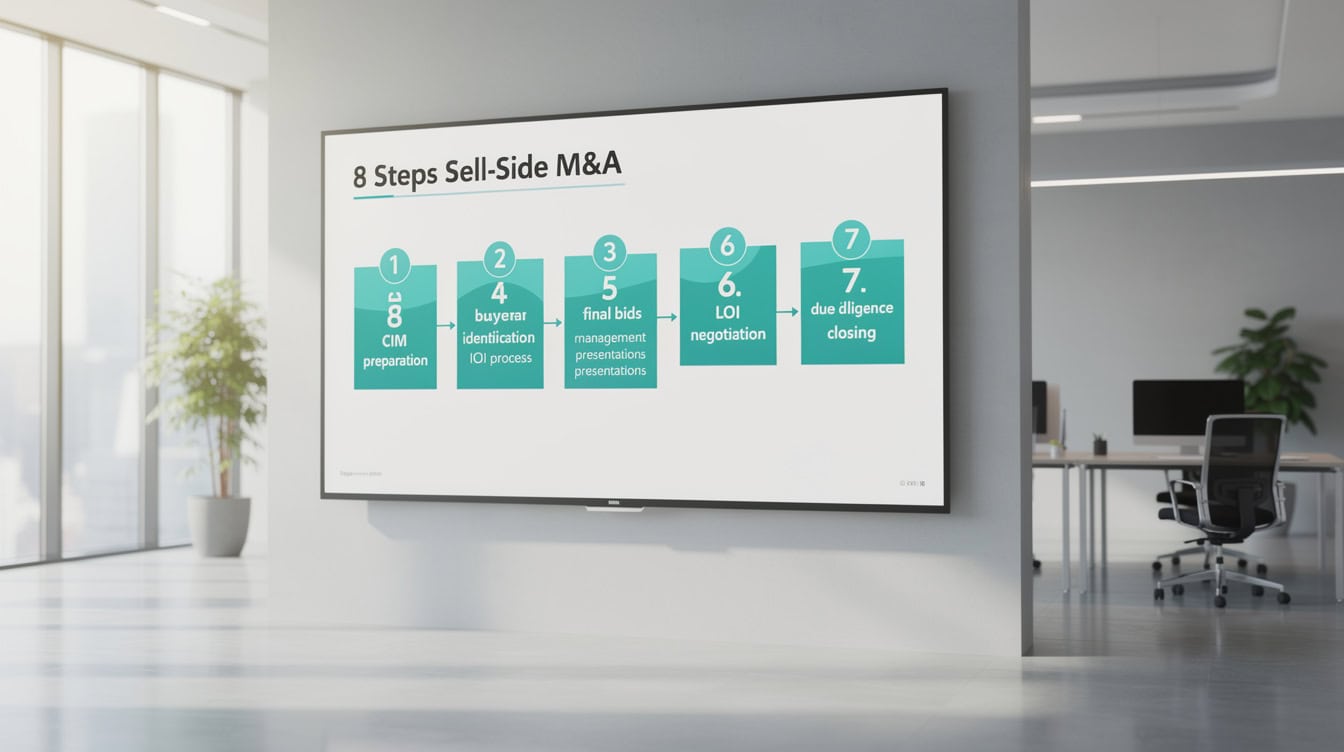
A structured 8-step sell-side process creates competitive tension among buyers, the most effective lever for maximizing sale price.
Letter of Intent: Negotiating Beyond Purchase Price
The LOI (letter of intent) is a non-binding agreement that sets the framework for the deal. Most sellers focus only on the headline price, but the other terms can be equally consequential.
Key LOI terms to negotiate carefully:
- Working capital peg: The buyer will specify a target level of working capital (current assets minus current liabilities) to be delivered at closing. If actual working capital falls short, the purchase price adjusts down dollar-for-dollar. Working capital adjustments are a common source of post-closing disputes; negotiate the peg and the calculation methodology explicitly.
- Exclusivity period: Buyers want 60-90 days of exclusivity. Sellers should push for 45-60 days with a right to terminate if the buyer re-trades the price without cause.
- Indemnification caps: The seller’s liability for post-closing claims is typically capped at 10-20% of purchase price for general representations and 100% for fundamental representations (title, authority, taxes). Negotiate these caps before signing the LOI.
- Conditions precedent: What must happen before the buyer is obligated to close? Financing contingencies, regulatory approvals, and key employee retention conditions all create deal risk.
- Earnout mechanics: If the LOI includes an earnout, define the measurement metric (revenue, EBITDA, gross profit), the measurement period, and the buyer’s obligations to operate the business in a way that gives the earnout a fair chance to be achieved.
Managing the Due Diligence Phase
Due diligence is the buyer’s systematic verification of everything you’ve represented about the business. Roughly 20-25% of deals that reach the LOI stage fail during due diligence, most often because of financial restatements, undisclosed liabilities, or customer concentration issues that weren’t disclosed upfront.
Organize your data room into these categories before the process begins:
- Financial: 3 years of P&L, balance sheets, cash flow statements, tax returns, accounts receivable aging, and monthly revenue by customer.
- Legal: Corporate formation documents, all material contracts, IP registrations, litigation history, and regulatory licenses.
- Operations: Organizational chart, key employee agreements, SOPs, technology systems, and facility leases.
- Customer and sales: Customer list with revenue history, contract terms, renewal rates, and pipeline.
- HR: Employee census, compensation structure, benefit plans, and any pending HR claims.
The best defense against due diligence surprises is a sell-side quality of earnings (QoE) report, commissioned from an independent accounting firm before going to market. A QoE validates your adjusted EBITDA and identifies issues before a buyer’s accountant does, giving you time to address or disclose them proactively.
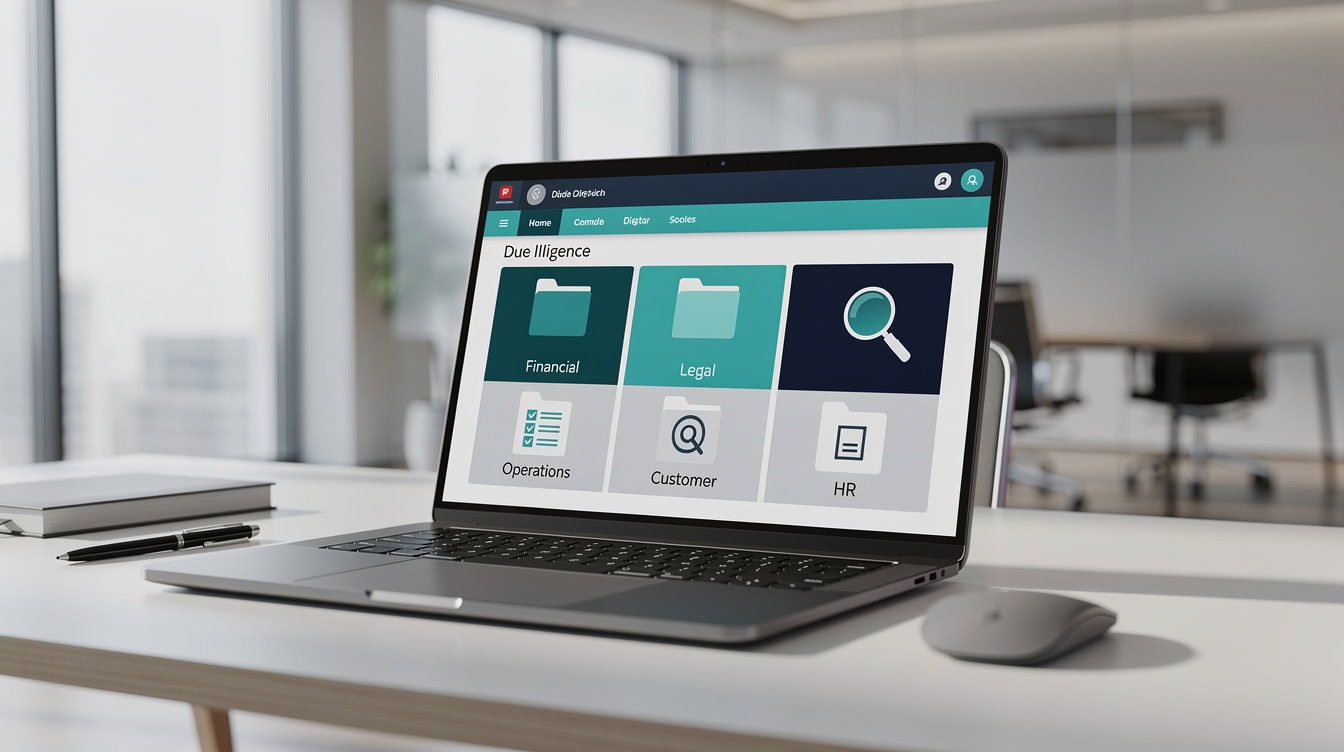
A well-organized data room with five category folders reduces due diligence timelines by 30-50% and signals seller professionalism to buyers.
Closing the Transaction and Post-Sale Transition
Closing involves executing the definitive purchase agreement, transferring funds through escrow, and satisfying all conditions precedent. Several post-closing obligations typically survive the closing date.
Representations and Warranties (Reps and Warranties): These are the seller’s factual statements about the business in the purchase agreement. If a rep is later found to be inaccurate, the buyer can make an indemnification claim. Reps and warranties insurance (RWI), a policy that covers indemnification claims, has become standard in mid-market transactions above $20M and is increasingly common in smaller deals. RWI shifts risk from the seller’s escrow to an insurance policy, allowing sellers to receive more of their proceeds at closing.
Escrow: Buyers typically require 5-15% of purchase price held in escrow for 12-18 months to cover potential indemnification claims. Negotiate the escrow amount, duration, and release conditions in the LOI.
Transition Services Agreement (TSA): Most buyers require the seller to provide transition support for 30-180 days post-closing. Define the scope, duration, and compensation for this period explicitly. Many sellers underestimate how demanding this period can be.
Non-Compete Agreement: Buyers require sellers to sign non-compete agreements, typically covering the same industry and geography for 2-5 years. The geographic and industry scope should be negotiated carefully, especially if you plan to start another business.
Tax Planning and Proceeds Management
Tax strategy for business sale proceeds deserves the same rigor as the deal itself. The structure of your transaction, the timing of the closing, and how you deploy proceeds all affect your after-tax outcome.
For a seller receiving $10M in proceeds from an asset sale as a pass-through entity owner, federal long-term capital gains tax (20%) plus the net investment income tax (3.8%) equals 23.8%, or approximately $2.38M in federal tax before state taxes. Source Installment sales (receiving proceeds over multiple years) can spread the gain across tax years, potentially keeping income below thresholds that trigger the NIIT or higher capital gains rates.
Post-sale reinvestment options worth evaluating with your advisor:
- Qualified Opportunity Zone (QOZ) investments: Reinvesting capital gains into a QOZ fund within 180 days of the sale can defer and potentially reduce federal capital gains tax (Internal Revenue Code Section 1400Z-2). The 180-day reinvestment window is a firm statutory deadline established by the Tax Cuts and Jobs Act of 2017, and missing it forfeits all QOZ tax benefits.
- Charitable Remainder Trust (CRT): Donating appreciated business interests to a CRT before the sale can eliminate capital gains tax on the donated portion while providing an income stream and a charitable deduction.
- Diversified investment portfolio: Most financial advisors recommend against concentrating post-sale proceeds in a single asset class, particularly real estate or a new operating business, without a comprehensive financial plan.
For business valuation modeling, business plan preparation, and service business financial models, EFM offers templates built specifically for sellers preparing for exit.

Closing mechanics include escrow (5-15% of purchase price held for 12-18 months) and reps and warranties insurance for mid-market deals.
Common Mistakes Sellers Make (and How to Fix Them)
Even sophisticated business owners make avoidable errors that cost them value at closing.
- Waiting too long to prepare. Sellers who list without preparation accept whatever multiple the market offers. Fix: Start the 12-24 month preparation roadmap described above, even if you’re not sure you’ll sell.
- Accepting the first offer. A single buyer has no incentive to pay a premium. Fix: Run a structured process with at least 3-5 qualified buyers to create competitive tension.
- Ignoring working capital mechanics. Sellers often don’t understand the working capital peg until post-closing adjustments reduce their proceeds. Fix: Model your normalized working capital before signing the LOI and negotiate the peg explicitly.
- Signing an LOI without tax advice. Deal structure decisions made at the LOI stage are very difficult to reverse. Fix: Engage your CPA before you sign anything.
- Underestimating the transition period. Many sellers are surprised by how much time and energy the post-closing transition requires. Fix: Negotiate TSA scope and compensation explicitly, and plan your personal schedule accordingly.

The five most costly seller mistakes are all avoidable with 12-24 months of preparation and the right advisory team.
Frequently Asked Questions
How long does it take to sell a business?
The timeline depends heavily on business size and preparation. Small businesses under $2M in enterprise value typically take 6-12 months from listing to close, including 3-6 months to find a buyer and 2-4 months to complete due diligence and close. Mid-market transactions in the $5M-$50M range typically take 9-18 months when run through a structured M&A process. Preparation time (12-24 months before listing) is separate from the active sale timeline. Sellers who skip preparation often extend the active sale period because buyers find issues during due diligence that require remediation. The total time from decision to close, including preparation, is realistically 2-4 years for an optimized exit.
What is a realistic EBITDA multiple for my business?
EBITDA multiples for private companies range from 2x-4x for low-growth retail and distribution businesses to 8x-12x for high-growth SaaS and technology companies. The specific multiple your business commands depends on five factors: revenue growth rate (faster growth = higher multiple), customer concentration (lower concentration = higher multiple), management depth (owner-independent = higher multiple), recurring revenue percentage (higher recurring = higher multiple), and industry tailwinds. A professional services firm with $2M in EBITDA, 15% annual growth, and no customer over 15% of revenue might command 6x-7x, yielding $12M-$14M in enterprise value. The same firm with 40% customer concentration might trade at 4x-5x.
What’s the difference between a business broker and an M&A advisor?
Business brokers typically handle transactions under $2M in enterprise value. They work on commission (8-12% of sale price), list businesses on public marketplaces like BizBuySell, and work with individual buyers. M&A advisors and investment bankers handle larger transactions, run confidential structured auction processes, maintain relationships with private equity firms and strategic acquirers, and charge a retainer plus a success fee (typically 3-6% of deal value for transactions in the $5M-$50M range). For transactions above $2M, a qualified M&A advisor almost always generates enough additional value through competitive tension to more than offset their higher fees. The choice of advisor is one of the highest-leverage decisions a seller makes.
Should I accept an earnout?
Earnouts are useful tools for bridging valuation gaps, but they carry real risk. If a buyer offers $10M upfront plus $3M in earnout contingent on hitting $5M in EBITDA over the next two years, you need to evaluate: How confident are you in hitting that target? What control will you have over the business post-closing? How is EBITDA defined in the earnout agreement? Buyers can influence EBITDA through overhead allocations, integration costs, and management decisions. Negotiate earnout protections including: a definition of EBITDA that excludes buyer-imposed costs, a covenant requiring the buyer to operate the business in a manner consistent with achieving the earnout, and a dispute resolution mechanism. Earnouts are most appropriate when you’re confident in near-term performance and have negotiating leverage to include strong protective covenants.
How do I handle key employee retention during a sale process?
Employee retention is a top due diligence concern for buyers, particularly for businesses where key employees hold customer relationships or specialized knowledge. Best practices include: keeping the sale process confidential until the LOI stage (limit knowledge to the owner and essential advisors), implementing retention bonuses payable at closing or 6-12 months post-closing (typically 10-25% of annual compensation), and structuring equity or phantom equity plans that vest at a change of control. According to a survey by the Association for Corporate Growth, employee retention risk is cited as a top-3 concern by acquirers in over 60% of mid-market transactions. Source Buyers will often require key employee retention agreements as a condition precedent to closing.
What happens to my business’s debt at closing?
In most transactions, the seller’s existing debt is paid off at closing from the gross proceeds. The purchase price is typically stated as an enterprise value (the total value of the business including debt), and the equity value (what the seller actually receives) equals enterprise value minus net debt (total debt minus cash). For example, if the enterprise value is $10M and you have $1.5M in outstanding debt and $200,000 in cash, your equity value at closing is $10M minus $1.5M plus $200,000 = $8.7M. Some buyers assume specific liabilities (particularly in asset sales where they’re selecting which liabilities to take on), but the general rule is that the seller clears their debt from proceeds. Confirm the debt payoff mechanics with your transaction attorney before signing the LOI.
Do I need audited financial statements to sell my business?
For transactions under $2M, compiled or reviewed financial statements (lower levels of CPA assurance than a full audit) are often sufficient. For transactions in the $5M-$50M range, buyers typically require at least reviewed financial statements and often request audited statements for the most recent fiscal year. For transactions above $50M, audited financials are standard. Even if a full audit isn’t required, commissioning a sell-side quality of earnings (QoE) report from an independent accounting firm is strongly recommended for any transaction above $3M. A QoE validates your adjusted EBITDA, identifies accounting issues before the buyer’s team does, and significantly accelerates the due diligence process. The cost of a QoE (typically $15,000-$50,000 depending on business complexity) is almost always recovered through a smoother, faster process and reduced buyer price adjustments.
Conclusion
Selling a business rewards preparation, process discipline, and professional execution. The sellers who achieve the highest multiples aren’t necessarily the ones with the best businesses; they’re the ones who prepared their financials 18 months in advance, ran a competitive process with multiple buyers, understood their deal structure options before signing the LOI, and engaged the right advisors at every stage.
I recommend downloading the Business Valuation template from eFinancialModels to begin modeling your adjusted EBITDA, testing different multiple scenarios, and building the financial narrative that will support your asking price when you go to market. Pair it with a business plan template to document your growth story for the CIM, and explore the service business financial models if you’re in a professional or service-based industry. The preparation you do today is the premium you capture at closing.