
0 ITEMS

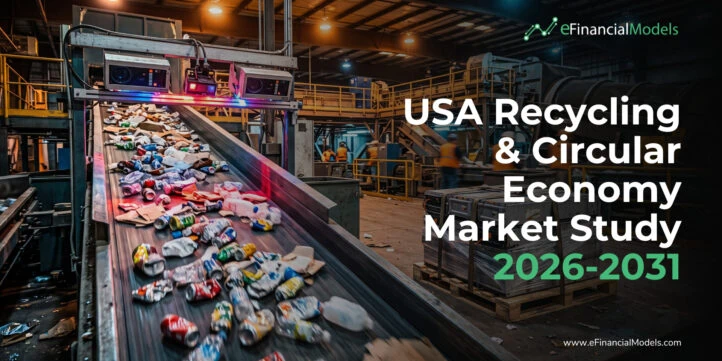
US Recycling & Circular Economy Market Study 2026–2031
| Recycling |
| Financial Model, Financial Modeling, Free Financial Model Templates, Market Studies, PDF |


Overview
The US recycling sector is at an inflection point. For the first time, a durable, producer-funded layer — Extended Producer Responsibility (EPR) for packaging — is being built underneath an industry that spent four decades hostage to commodity cycles and thin municipal budgets. This eFinancialModels Market Study maps the opportunity across four sub-segments held at equal weight — materials recovery facilities (MRFs), EPR policy, plastics recycling, and battery recycling — through an investor’s lens, and translates each into modeling-ready assumptions.
It is written for infrastructure and private-equity investors, project developers, and financial-modeling professionals, with recycling operators and producers facing EPR obligations as secondary audiences. The central argument: across the circular economy, revenue quality now varies far more than headline growth rate, and capital should price that variance.
What you get
- A 36-page, chart-rich research report (12 EFM-branded charts, 11 data tables).
- Three quantified scenarios (Bear, Base, Bull) with explicit probabilities and 2031 outcomes.
- A source-verification workbook mapping every claim to a cited, verifiable reference.
- Modeling-ready pricing assumptions, including the regulation-backed vs commodity-exposed revenue split.
Key findings
- EPR is the structural game-changer. Seven states have enacted packaging EPR; six are collecting or preparing producer fees through a single national PRO, Circular Action Alliance. Oregon’s live program is projected to route roughly $190M in year one; California’s SB 54 adds a statutory $500M-a-year producer remittance from 2027.
- Plastics ambition has outrun reality. The overall plastics recycling rate sits at 5–9%, and even PET bottles recycled at just 30.2% in 2024 — while major brands rolled back voluntary recycled-content targets in 2024–2025, leaving state mandates as the firmest demand floor.
- Lead-acid is the benchmark; lithium-ion is the frontier. Lead-acid batteries recycle at 99% in an established closed loop, while lithium-ion recycling grows near 20% a year but is loss-making for many operators after the 2024–2025 metal-price slump and Li-Cycle’s bankruptcy.
- The battery capacity–feedstock gap is the near-term risk. Announced US Li-ion recycling capacity far exceeds available end-of-life feedstock through 2030, forcing recyclers to compete for manufacturing scrap and run below nameplate.
- Federal policy turned into a 2025 headwind. The One Big Beautiful Bill Act sunset the 30D EV credit and began phasing down the Section 45X credit for recycled critical minerals — modeled with the phasedown built in.
Data sources
US EPA, CalRecycle, NAPCOR, The Recycling Partnership, the Association of Plastic Recyclers, the American Chemistry Council, Battery Council International, the International Energy Agency, Circular Action Alliance, company and PRO disclosures, and market-research houses (Frost & Sullivan, Grand View, Technavio) used as ranges. Every chart and table carries a specific source line; forward-looking figures are labeled as eFinancialModels Base Case projections.
Who it’s for
Infrastructure and PE investors, recycling project developers, financial modelers, MRF and waste operators, plastics and battery recyclers, and producers or brand owners planning for EPR and recycled-content compliance.
Methodology
Produced under the eFinancialModels Market Study methodology: AI-assisted research and drafting combined with human research, source verification, and editorial review. Every claim, statistic, source, chart, and recommendation was reviewed and verified before publication. Cross-references in this study use “Section N” notation (for example, Section 10 for the best-practice benchmark); regulatory instruments are named in full, such as Section 45X of the Internal Revenue Code and California SB 54.
Pair it with a model
This study provides the sector context; to build project-level cash flows, pair it with an eFinancialModels recycling or waste-management financial model template. See the recycling template category and the Recycling Company, Recycling Centre, and Waste Management Company models linked in the study.
This market study is provided for informational and strategic-planning purposes only and does not constitute investment, financial, legal, or tax advice. Readers must conduct their own due diligence.
Similar ProductsOther customers were also interested in...


 eFinancialModels
Electric Vehicle (EV) Charging Station Financial M...
With this comprehensive 5- or 10-year monthly tool, investors can assess the viability of setting up... Read more

Financial Model for Mobile App | Mobile App Busine...
The Mobile App Financial Plan Template in Excel allows you to develop financial projections when lau... Read more

 HenrySheykin
Food Truck Financial Model Excel Template
The Food Truck Financial Model helps entrepreneurs, founders, business owners, consultants, and anal... Read more

Green Hydrogen Production from Wind Energy Financi...
The Green Hydrogen from Wind Financial Model aims to comprehensively forecast a horizon of 40 years ... Read more

Simple Mutual Non-Disclosure Agreement Template
Protect your business secrets with ease using our Simple Mutual Non-Disclosure Agreement Template. S... Read more

Solar Energy Financial Model
The Solar Energy Financial Model Spreadsheet Template in Excel assists you in preparing a sophistica... Read more

 Peter Graf
The Customer-Centric Financial Model for Restauran...
Starting a restaurant without a financial plan is like driving a car blindfolded. You wouldn´t do i... Read more
You must log in to submit a review.