
0 ITEMS

RV Park, Campground & Glamping Development Financial Model + 44-Page Feasibility Workbook
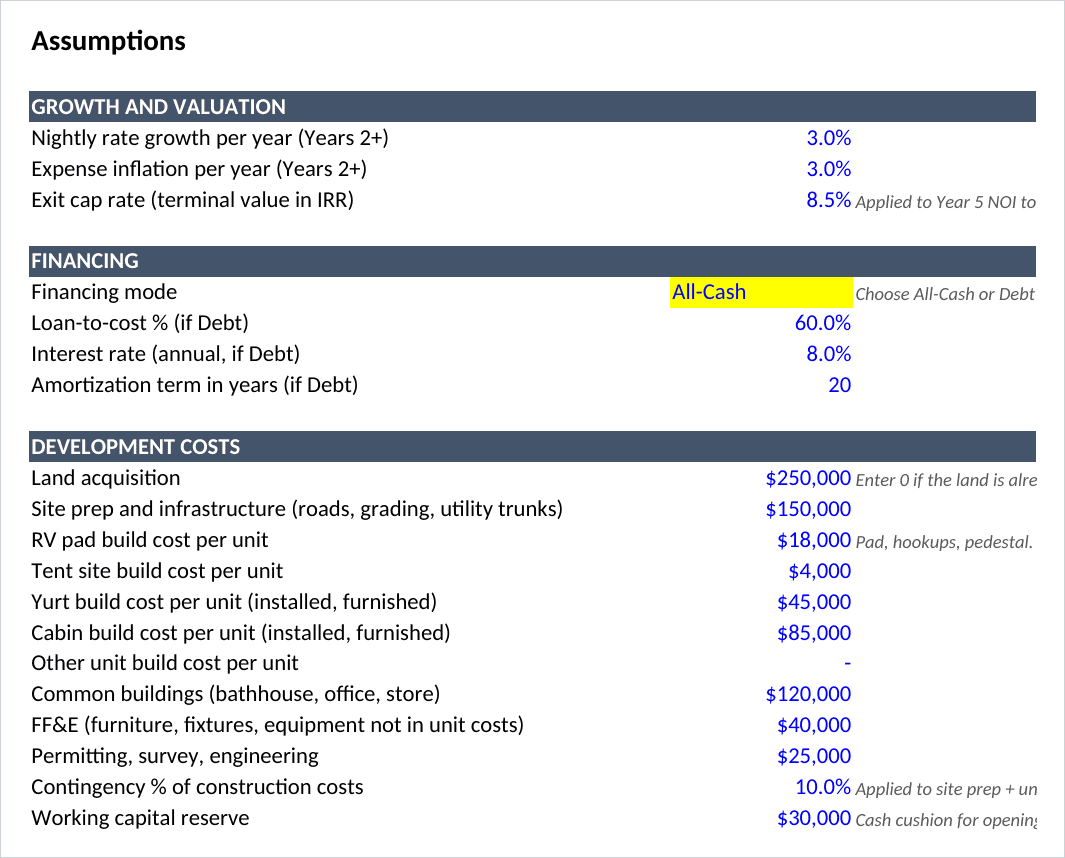
This is a comprehensive 5-year pro forma model built for anyone looking to develop an RV park, campground, or glamping property from the ground up. Included is a 44-page feasibility workbook that walks you through every step, from screening potential locations to making your final go or no-go decision. Unlike most models out there that assume you’re buying an existing property, this one is designed for those starting with raw land, a vision for how many units you want, and a construction budget. The tool is organized into eleven easy-to-navigate tabs. You can customize your unit mix across five different types, see how demand changes month to month with three preset curves, and track your occupancy as it ramps up to stabilization. There are sections for ancillary revenue, a full development budget (including contingency), and a phased opening schedule. Financials are clear and detailed. You’ll find monthly P&L for Year 1, annual summaries for Years 1 through 5, and a returns page that breaks down your breakeven occupancy, simple payback, and a 5-year equity IRR, including the terminal value at an exit cap rate. There are also two handy 5×5 sensitivity tables that show how Year 3 NOI and cash-on-cash change with shifts in occupancy and nightly rates (plus or minus 20 percent). Switching between all-cash or debt financing is as simple as a dropdown. There are no macros, external links, or circular references. Every formula is open and easy to audit.
What is this model template used for?
This template is designed to help you evaluate the development of a new outdoor hospitality property. Whether that’s an RV park, a campground, a glamping site, or a combination of these. It tackles the big questions that every developer faces before investing their time and money: With this many units, at these nightly rates, and in a market with this kind of seasonality, will the project meet your required returns? And how much wiggle room do you have in your assumptions before the numbers stop working?
This model is built for making decisions before you ever break ground, not for analyzing an existing business. You’ll enter your planned unit count and construction budget, instead of a purchase price or existing rent roll. The template is ideal for developers considering a new project, landowners weighing the potential for recreational use, glamping operators planning their first build, or lenders and brokers who need to stress-test the numbers.
What are the main features of this template?
The template is organized into eleven tabs, laid out from left to right, taking you smoothly from initial inputs to final results.
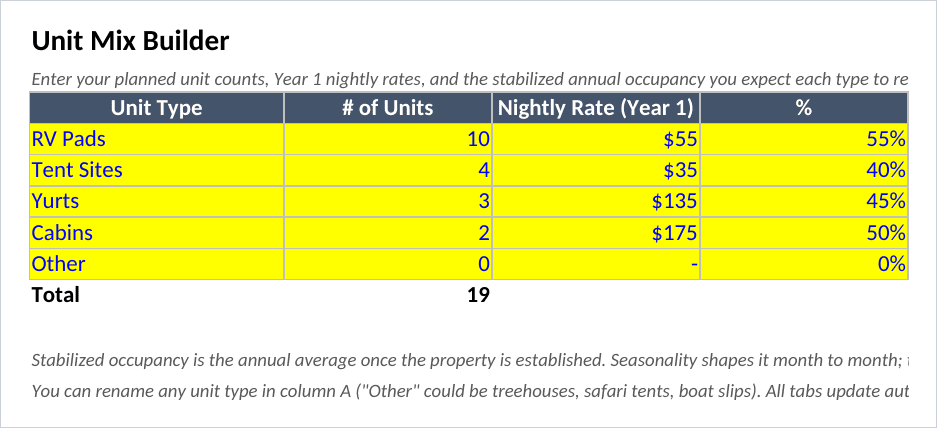
The Unit Mix tab lets you define up to five different unit types, and you can easily rename them to fit your needs. For example, you could change “Other” to treehouses, safari tents, or boat slips. Each type gets its own unit count, Year 1 nightly rate, and target occupancy, and these details automatically flow through the rest of the model.
The Seasonality tab helps you model how demand changes throughout the year. You can choose from three preset demand curves: summer-peak, shoulder-season, and year-round, or create your own custom curve. Every preset is balanced so the annual occupancy stays accurate, no matter how you shape the year.
Revenue Ramp lets you set how quickly each unit type fills up over the first five years. It also tracks revenue from things like store sales, equipment rentals (calculated per occupied night), and events, which you can enter annually.
The CapEx & Phasing tab helps you build your development budget right from your unit counts. It takes into account site preparation, common buildings, FF&E, permitting, contingency, and working capital. You can even plan for a phased opening, spreading out the launch over up to three phases with custom start months. The model reflects these phases month by month, so your projections are as accurate as possible.
OpEx gives you control over eight different expense categories. For each one, you can set it as a fixed dollar amount (with built-in inflation for future years) or as a percentage of total revenue.
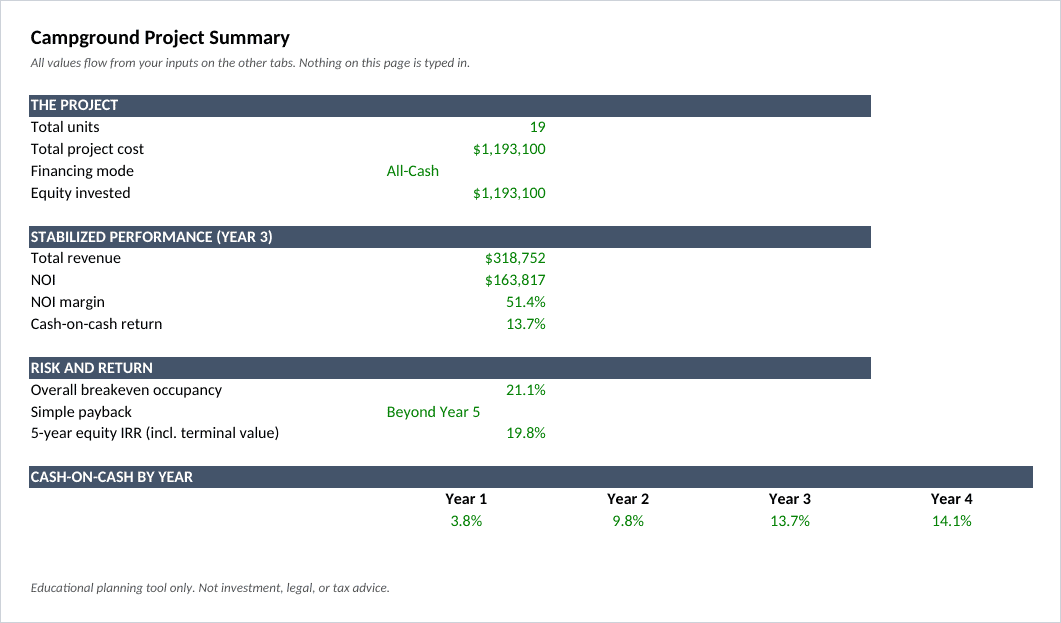
The Returns tab shows the big picture: capital structure, annual cash flow after debt service, cash-on-cash returns by year, cumulative cash flow, simple payback period, breakeven occupancy, and a 5-year equity IRR that includes terminal value based on your exit cap rate. Whether you’re running an all-cash deal or using debt, just pick your option with a simple dropdown, and the model adjusts all the calculations for you.
The Sensitivity tab wraps things up with two 5×5 tables that show how your Year 3 NOI and cash-on-cash returns would change with different occupancy rates and nightly rates, from 20% below to 20% above your base case.
How do you best work with this template?
To get the most out of this template, begin with the Instructions tab, where a quick 10-minute guide will get you oriented. Enter your unit mix, nightly rates, and target occupancy in the Unit Mix tab. Add your land and construction costs, plus your financing method, on the Assumptions tab. Select a demand curve for each unit type in Seasonality, set your occupancy ramp in Revenue Ramp, and plug in your own operating expense quotes in OpEx. If you’re planning a phased launch, use CapEx & Phasing to map it out. Once your info is entered, review the Summary, P&L, Returns, and Sensitivity tabs to see your results.
The model uses color conventions to make editing safe and intuitive: blue text means it’s an input you can change, black is a formula, green is a value pulled from another tab, and yellow highlights the most important inputs that drive your results. There are no macros to enable, no hidden sheets, and no external links to worry about.
Why do you need this template?
The alternative to this template is often a blank spreadsheet or hiring a consultant for thousands of dollars. Lender-grade third-party feasibility studies for RV parks can easily cost $4,900 or more. While this template isn’t a replacement for those lender-required reports, it’s the essential first step to help you decide if your project even warrants that level of investment.
What really sets this product apart is the included 44-page feasibility workbook. This guide takes you through the entire diligence process, step by step: parcel screening, site assessment, permitting, utilities, layout, market and demand analysis, unit mix, revenue projections, capital budgeting, operating expenses, returns, and a final go/no-go scorecard. Twelve fill-in worksheets at the back clearly show where to input your answers in the model or flag items that need further research. The workbook also covers practical considerations that go beyond any spreadsheet, like RV pad sizes for big rigs, maximum density per acre, road layouts, and utility questions you need to ask before you start building.
In short, the model shows you how the numbers work, while the workbook helps you understand where the numbers come from.
A note on the defaults
Every number pre-filled in the model is simply a neutral starting point, not market data. Build costs, payroll, and insurance vary enormously by state and by site. Replace all of them with your own quotes and comparable research before relying on any output. This is a planning and screening tool. It is not investment, legal, or tax advice.
Similar ProductsOther customers were also interested in...



 eFinancialModels
Electric Vehicle (EV) Charging Station Financial M...
With this comprehensive 5- or 10-year monthly tool, investors can assess the viability of setting up... Read more

Financial Model for Mobile App | Mobile App Busine...
The Mobile App Financial Plan Template in Excel allows you to develop financial projections when lau... Read more

 HenrySheykin
Food Truck Financial Model Excel Template
The Food Truck Financial Model helps entrepreneurs, founders, business owners, consultants, and anal... Read more

Green Hydrogen Production from Wind Energy Financi...
The Green Hydrogen from Wind Financial Model aims to comprehensively forecast a horizon of 40 years ... Read more

Simple Mutual Non-Disclosure Agreement Template
Protect your business secrets with ease using our Simple Mutual Non-Disclosure Agreement Template. S... Read more

Solar Energy Financial Model
The Solar Energy Financial Model Spreadsheet Template in Excel assists you in preparing a sophistica... Read more
 Peter Graf
The Customer-Centric Financial Model for Restauran...
Starting a restaurant without a financial plan is like driving a car blindfolded. You wouldn´t do i... Read more
You must log in to submit a review.