
0 ITEMS

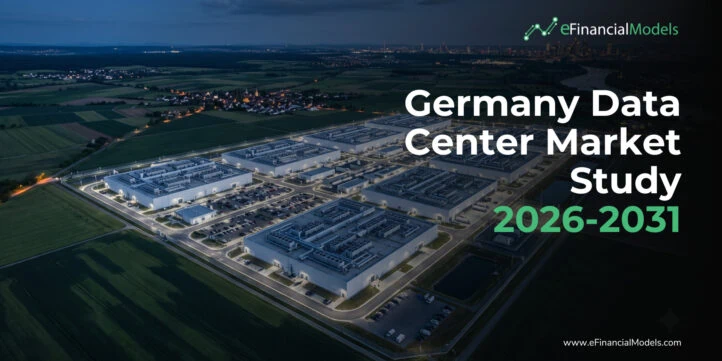
Germany Data-Center Market Study 2026–2031 | Capacity, Capex & Investment
A 27-page, chart-rich market study on building and developing data centers in Germany, 2026–2031 — capacity in MW, capex per MW, and the ~USD 50 billion build-out investment opportunity. Frankfurt and the FLAP-D hub, AI demand, grid and permitting constraints. Free dataset included.
| Financial Model, Fintech |
| Financial Model, Financial Modeling, Free Financial Model Templates, Market Studies, PDF |


The build behind the boom
Germany is Europe’s largest data-center market — and in 2026, its busiest construction site. This study measures the opportunity the way an investor or developer does: in megawatts of capacity, in capex per megawatt, and in total build-out investment. It cuts through the services-revenue framing that dominates most market reports to answer the question that actually underwrites a project: how much data-center capacity will Germany build between 2026 and 2031, where, at what cost, and against which constraints?
We estimate roughly USD 50 billion of facility build-out investment over 2026–2031 in the base case (range USD 40–65 billion), on top of a market already spending a record EUR 15.5 billion a year. But capital is not the constraint — power and permitting are.
What you get
- A 27-page Word/PDF study with 16 EFM-branded charts and 11 data tables
- A free reusable dataset (Excel): capacity, supply pipeline, demand drivers, capex benchmarks, scenarios and a full assumption set — built to drop straight into a data-center financial model
- A source-verification workbook with 40 cited, verified sources
Key findings
- Europe’s biggest, still doubling. Germany runs about 3.3 GW of installed IT load across 2,000+ facilities; federal policy targets doubling capacity and quadrupling AI capacity by 2030, with 70+ announced projects totaling around 5,500 MW.
- A ~USD 50 billion build-out opportunity. We model USD 40–65 billion of facility build-out investment over 2026–2031, excluding IT and GPU hardware (which would add well over USD 100 billion).
- Frankfurt leads but is power-bound. Frankfurt passed 1 GW of operational colocation in 2025 (about 59% of German capacity), yet grid saturation and 7–10-year connection queues are pushing new build to secondary metros and brownfield coal-transition corridors.
- AI is the swing driver. AI-related connected load is set to rise 4× to 2,020 MW by 2030; 132 kW AI racks are forcing liquid cooling and lifting fitted capex toward USD 15–20 million per MW.
- Capex is rising and diverging. Frankfurt’s fitted build cost is about USD 11.6 per watt; AI-ready high-density facilities run to USD 20 million per MW and beyond.
- Sustainability is now hard law. The Energy Efficiency Act mandates PUE at or below 1.2 (a draft amendment eases this to 1.3), 10–20% waste-heat reuse, and 100% renewable power by 2027.
Who it is for
Institutional investors and infrastructure funds sizing the German opportunity; data-center developers planning new-build and expansion; and financial modelers building data-center project and development models. Corporate off-takers, lenders and policy readers will also find it useful.
Data sources and methodology
Built from institutional and regulatory sources (the Federal Data Centre Strategy, the Energy Efficiency Act, the IEA), specialist advisers (CBRE, Cushman & Wakefield, JLL, Turner & Townsend, Prime East), market-research houses (Mordor Intelligence, ResearchAndMarkets, nextMSC) and operator disclosures. Figures are stated in US dollars with euro noted where natural. Modeled and estimated figures are labeled; every source is verified in the accompanying workbook. Scenario probabilities reflect senior-analyst judgment.
Pair this study with a template
Turn the dataset into a decision. eFinancialModels offers purpose-built templates:
- Data Center Development 10-Year Financial Model
- Data Center 10-Year Financial Model
- Data Center (Co-Location) Development Model
- Data Center Financial Model — 10-Year DCF and Valuation
Similar ProductsOther customers were also interested in...


 eFinancialModels
Electric Vehicle (EV) Charging Station Financial M...
With this comprehensive 5- or 10-year monthly tool, investors can assess the viability of setting up... Read more

Financial Model for Mobile App | Mobile App Busine...
The Mobile App Financial Plan Template in Excel allows you to develop financial projections when lau... Read more

 HenrySheykin
Food Truck Financial Model Excel Template
The Food Truck Financial Model helps entrepreneurs, founders, business owners, consultants, and anal... Read more

Green Hydrogen Production from Wind Energy Financi...
The Green Hydrogen from Wind Financial Model aims to comprehensively forecast a horizon of 40 years ... Read more

Simple Mutual Non-Disclosure Agreement Template
Protect your business secrets with ease using our Simple Mutual Non-Disclosure Agreement Template. S... Read more

Solar Energy Financial Model
The Solar Energy Financial Model Spreadsheet Template in Excel assists you in preparing a sophistica... Read more

 Peter Graf
The Customer-Centric Financial Model for Restauran...
Starting a restaurant without a financial plan is like driving a car blindfolded. You wouldn´t do i... Read more
You must log in to submit a review.