0 ITEMS

When Does an SME Founder Actually Need a Model?

Financial models get recommended to SME founders far more often than they are genuinely needed — and occasionally far too late. What decides it is not your revenue size but whether the choices in front of you are expensive enough that guesswork starts costing real money. Use the framework below to work out where you stand: the five trigger scenarios, a five-minute cash confidence test, and the lighter-weight alternatives that are often enough.
Key Takeaways
- 55% of small businesses operate without a documented budget (U.S. Bank via SCORE, 2023) — running without a formal model is the majority behaviour, not a failure.
- 82% of business failures trace back to poor cash flow management (U.S. Bank, 2019) — the stakes for getting visibility right are genuinely high.
- Five specific trigger scenarios create genuine model need: fundraising, multi-product unit economics, seasonal cash volatility, hiring with 6+ month payback, and capex decisions over £50K.
- The 3-month cash reserve benchmark is the quantitative threshold where model-building shifts from optional to urgent: only 40% of small businesses currently clear it (Federal Reserve, 2023).
- An SME financial model is not a 200-line DCF — it’s a 12-month rolling forecast with 3 scenario toggles that you can update in under an hour per month.
- If you spend more than 4 hours monthly trying to understand your cash position from accounting exports, you need a model — the opportunity cost already exceeds the build cost.
- Three alternatives can solve the visibility problem without a full model: a better monthly reporting cadence, forecast-enabled accounting software, or a fractional CFO engagement.
Most SME founders don’t need a financial model right now. That’s not a provocation — it’s the honest starting point for a useful decision. The question isn’t whether models are valuable in the abstract; it’s whether your specific business, at its current stage, has crossed the threshold where informal tracking stops being adequate.
This article gives you a decision framework, not a prescription.
The Financial Visibility Spectrum: Tracking vs. Budgeting vs. Modelling
Financial visibility exists on a spectrum, and most SMEs sit somewhere in the middle — not at the bottom, not at the top. Understanding where you sit is the first step toward knowing whether you need to move.
Tracking means recording what happened: bank statements, accounting software exports, monthly P&L from Xero or QuickBooks. It answers the question ‘what did we earn and spend?’ It’s backward-looking by design.
Budgeting means setting forward targets and measuring variance against them. A budget tells you whether January’s £85,000 revenue was good or bad relative to your plan. It’s forward-looking but static — you set it once and compare against it.
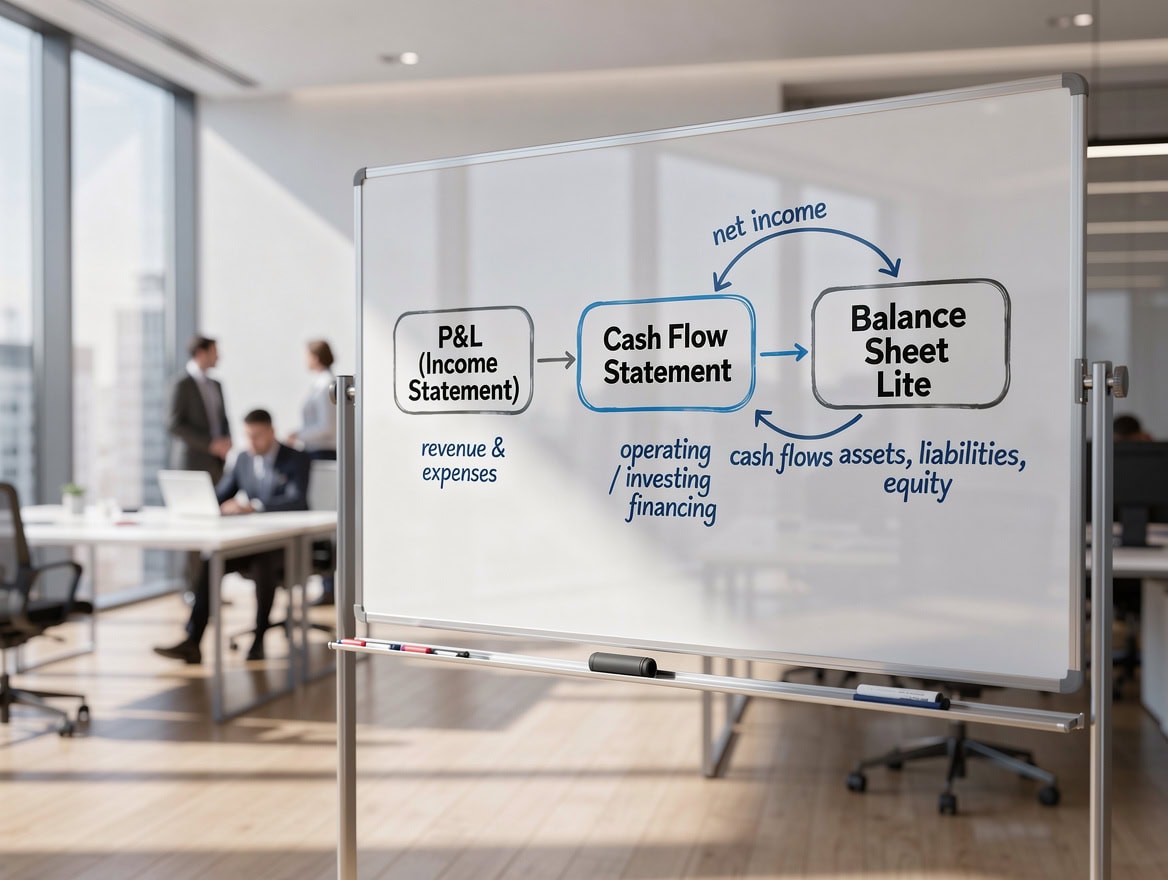
Modelling means building a dynamic, interconnected forecast where you can change an assumption (say, a 15% drop in average order value) and immediately see the downstream effect on cash, headcount capacity, and runway. A model is forward-looking and responsive.
Many founders who think they need a model actually need better budgeting. Many who think they need better budgeting actually need a model. The distinction matters because the time investment is very different. Comparing the two side by side — which is exactly what a budgeting and forecasting model template forces you to do — usually makes the answer obvious.
Five Trigger Scenarios That Create Genuine Model Need
You need a financial model when the cost of a wrong decision exceeds the cost of building the model. Five specific scenarios reliably cross that threshold.
1. You’re raising external funding. Any investor, bank, or grant body will ask for a forward-looking financial projection. More importantly, you need to stress-test your own assumptions before you walk into that room. A model isn’t optional here — it’s the minimum entry requirement.
2. You run multiple products or revenue streams with different unit economics. Unit economics means the revenue and cost structure of a single unit of sale (one product, one customer, one contract). When your gross margin on Product A is 68% and Product B is 31%, blended P&L hides the story. You need a model to understand which revenue is actually worth chasing.
3. You have significant seasonal cash volatility. If your revenue swings more than 30% between your peak and trough months, annual averages are actively misleading. A rolling 13-week cash flow forecast — the core of any SME model — shows you the specific weeks where you’ll need a buffer or a facility.
4. You’re making a hiring decision with a 6+ month payback period. Hiring a £45,000 sales executive who takes 7 months to reach quota is a £26,250 cash commitment before you see a return. Without a model, you’re guessing whether you can absorb that. With one, you can see the exact month the hire becomes cash-flow positive.
5. You’re evaluating capex over £50,000. Capital expenditure (capex) means spending on assets: equipment, fit-out, vehicles, technology infrastructure. At £50K+, the decision materially affects your cash runway. A model lets you compare lease-vs-buy, assess payback period, and confirm you don’t breach your cash reserve threshold in the process.

The Cash Confidence Test: Can You Answer These 3 Questions in 5 Minutes?
Here’s a fast diagnostic. Open your current financial tools — accounting software, spreadsheets, whatever you use — and time yourself answering these three questions:
- How many months of cash runway do you have right now, assuming revenue stays flat?
- If your largest customer (or revenue stream) dropped 20%, when would you run out of cash?
- If you hired one additional person at your average salary cost, what month does your cash balance hit its lowest point?
If you can answer all three in under 5 minutes, your current setup is probably adequate. If any answer requires more than 5 minutes of manual calculation, or if you genuinely don’t know, you’ve identified the gap a model closes.
This isn’t a trick. 47% of small business owners report they are not very confident or not at all confident in managing their business finances (Federal Reserve Small Business Credit Survey, 2022). That confidence gap isn’t usually a knowledge problem — it’s a visibility problem. A model gives you the visibility.
Worked Example: When Spreadsheet Exports Stop Being Enough
Here’s the math for a real scenario. A B2B services business turns over £1.14M annually. The founder tracks finances via monthly Xero exports and a simple spreadsheet. Revenue is growing, the business is profitable, and the founder feels broadly in control.
Then three things happen simultaneously: a key client delays a £38,000 invoice by 45 days, the founder wants to hire a project manager at £42,000 per year, and a piece of equipment needs replacing at £55,000.
Without a model, the founder has to manually calculate each scenario separately, then try to combine them — a process that typically takes 3-4 hours and still produces a static answer. With a model, all three variables feed into a single cash flow projection that updates in real time.
In this example, the business has £180,000 in opening cash and a monthly net burn of £42,000 (costs of £137,000 against revenue of £95,000 in a slow month). That gives 4.3 months of runway — above the 3-month threshold, but not by much. The model immediately shows that the equipment purchase alone would drop runway to 3.0 months, and combining all three scenarios drops it to 2.1 months — below the safety threshold. Without a model, the founder might have approved all three decisions sequentially without seeing the combined effect.
That’s the moment spreadsheet exports stop being enough: when you have more than one moving variable and the interactions between them matter. Our guide to cash flow forecasting for small business survival walks through building that view month by month.
What an SME Financial Model Actually Looks Like
An SME financial model is not a 200-row DCF (discounted cash flow analysis) with Monte Carlo simulations. At SME scale, a model that actually gets used has three components:
- A 12-month rolling P&L forecast with revenue built up from drivers (units sold, average order value, customer count) rather than just a single revenue line.
- A 13-week rolling cash flow that translates P&L timing into actual bank movements, accounting for payment terms, VAT, payroll dates, and loan repayments.
- 3 scenario toggles: a base case, a downside (typically 20-25% revenue reduction), and an upside. Each toggle should update the entire model automatically.
Building this from scratch in Excel or Google Sheets takes an experienced finance person 8-15 hours. Excel supports up to 64 nesting levels for IF functions (Microsoft), which means even complex scenario logic can be handled within a single workbook without resorting to macros. Maintaining it takes 1-2 hours per month. Using a pre-built template cuts the initial build to 2-4 hours of customisation.
The model doesn’t need to be beautiful. It needs to answer the three cash confidence questions in under 5 minutes.
The 3-Month Cash Reserve Threshold and Model Relevance
The 3-month cash reserve is the most widely cited benchmark for SME financial resilience, and it’s a useful trigger for model-building decisions. Only 40% of small employer firms reported having sufficient cash reserves to cover more than 3 months of expenses (Federal Reserve Small Business Credit Survey, 2023), which means 60% of businesses are operating in the zone where a single bad month can create a crisis.
If you’re above the 3-month threshold and your business is simple (one revenue stream, stable costs, no major decisions pending), you may not need a model yet. If you’re below it, a model isn’t a luxury — it’s the tool that tells you how to get back above it and how long that will take.
29% of small businesses fail specifically because they run out of cash (CB Insights, 2021). That’s a preventable failure mode. A model doesn’t prevent it automatically, but it gives you enough lead time to act: cut costs, accelerate collections, draw on a facility, or delay capex. Faster collections and tighter payment terms buy some of that lead time on their own, and this primer on working capital management explains the levers.
Alternative Solutions: When You Don’t Need a Full Model
A full financial model isn’t always the right answer. Three alternatives can close the visibility gap at lower time cost.
Better monthly reporting cadence. If you’re currently reviewing finances quarterly, moving to monthly management accounts (P&L, balance sheet, cash flow statement reviewed within 10 days of month-end) solves a large portion of the visibility problem without building anything new. This works when your business is simple and stable.
Forecast-enabled accounting software. Tools like Xero’s cash flow forecasting, Float, or Futrli connect directly to your accounting data and generate rolling cash flow projections automatically. These cost £30-£80 per month and require minimal setup. They’re not as flexible as a custom model, but they answer the runway question without a build project. A standard Excel workbook can contain up to 1,048,576 rows and 16,384 columns per worksheet (Microsoft), meaning even the most data-intensive SME cash flow model will never come close to hitting spreadsheet capacity limits.
Fractional CFO engagement. A fractional CFO (a part-time finance director who works across multiple businesses) typically charges £1,500-£4,000 per month for 2-4 days of work. They’ll build and maintain the model for you, interpret it, and advise on decisions. This is the right path when your business complexity is high but your finance bandwidth is low.
The decision cost framework is simple: if you’re spending more than 4 hours per month trying to understand your cash position from accounting exports, the opportunity cost of that time already exceeds the cost of a template or a software subscription. Act on that signal.
Build, Buy, or Hire: Implementation Paths
Choose your implementation path based on complexity, not revenue size.
| Path | Best For | Time to Implement | Ongoing Cost |
|---|---|---|---|
| DIY Excel/Sheets template | 1-2 revenue streams, stable costs, founder has basic Excel skills | 2-4 hours setup | £0-£300 one-off |
| Forecast software (Float, Futrli, Causal) | Connected to accounting data, limited customisation needed | 1-2 hours setup | £30-£150/month |
| Custom Excel model (self-built) | Complex unit economics, multiple scenarios, high customisation | 8-15 hours build | £0 + 1-2 hrs/month maintenance |
| Fractional CFO-built model | High complexity, fundraising imminent, founder time-constrained | 1-2 weeks | £1,500-£4,000/month |
If a template turns out to be the right path for you, this comparison of the best financial model templates for small business is a sensible place to start.
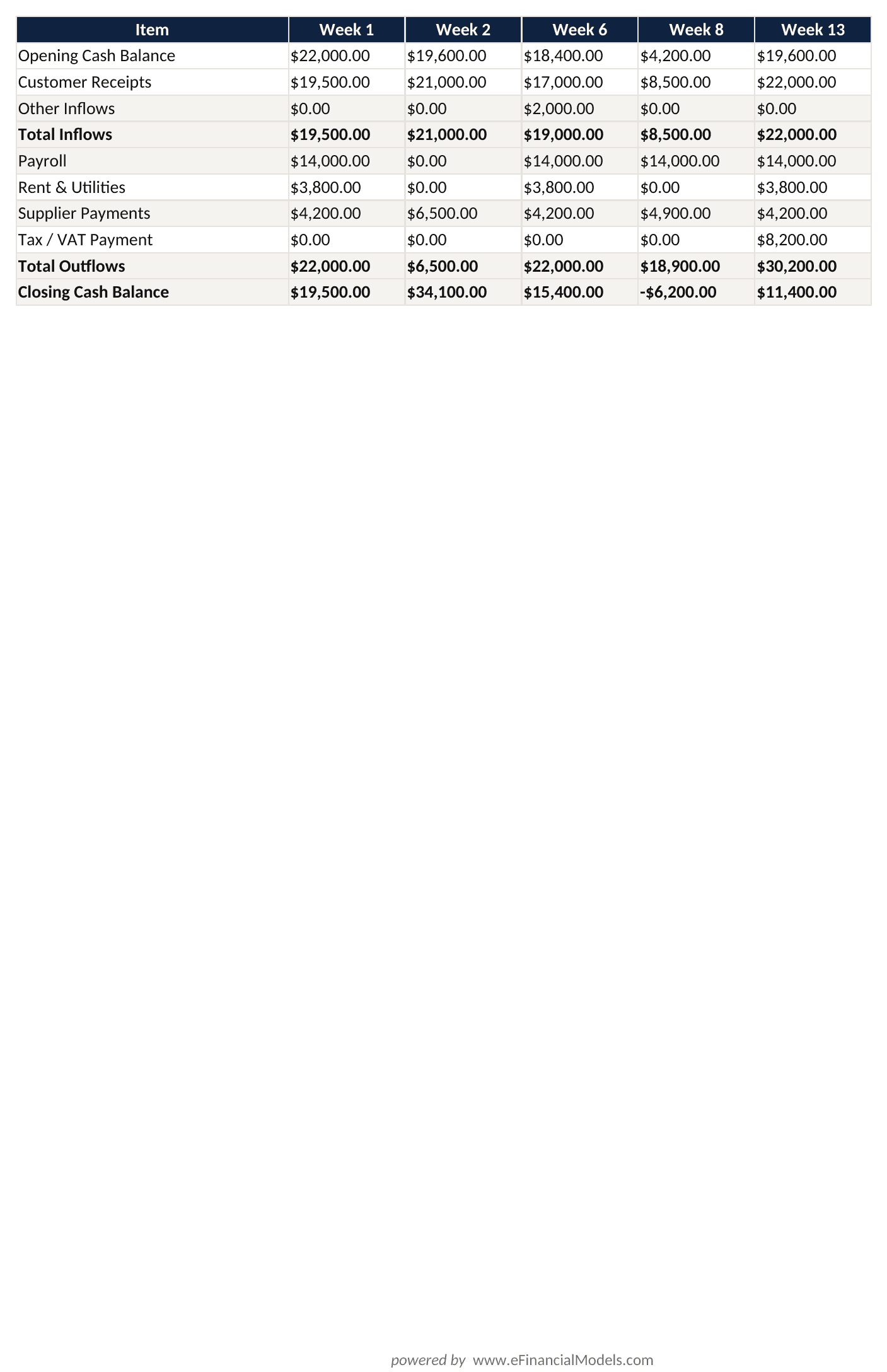
69% of small businesses that apply for financing do so to cover operating expenses and cash-flow shortfalls rather than to fund growth (Federal Reserve Small Business Credit Survey, 2021). That’s a reactive pattern. A model shifts you from reactive to proactive: you see the shortfall coming 8 weeks out and arrange the facility before you need it, rather than applying under pressure.
The Decision Framework: Does Your Business Pass the Model-Need Threshold?
You need a financial model if you answer yes to any of the following:
- You’re raising funding in the next 12 months.
- You have 2+ revenue streams with materially different margins.
- Your revenue varies by more than 30% between peak and trough months.
- You’re planning a hire with a payback period longer than 6 months.
- You’re evaluating capex over £50,000.
- You can’t answer the 3 cash confidence questions in under 5 minutes.
- Your cash reserves are below 3 months of operating expenses.
- You’re spending more than 4 hours monthly on manual cash position analysis.
If none of these apply, you probably don’t need a model right now. Better reporting or forecast software will serve you adequately. Revisit the checklist when your circumstances change.
Frequently Asked Questions
How long does it actually take to build an SME financial model?
Building a functional SME model from scratch in Excel or Google Sheets takes an experienced finance person 8-15 hours. If you’re doing it yourself without a finance background, budget 15-25 hours for the initial build. Using a pre-built template cuts that to 2-4 hours of customisation. Monthly maintenance, once the model is built, runs 1-2 hours per month — primarily updating actuals and reviewing the rolling forecast. The total first-year time investment for a self-built model is roughly 30-40 hours, which is why the 4-hours-per-month opportunity cost threshold matters: at that rate, you break even on the build within 8-10 months.
What’s the difference between a cash flow forecast and a financial model?
A cash flow forecast (a forward-looking projection of cash in and out) is one component of a financial model, not the whole thing. A full SME model also includes a P&L forecast (revenue and costs) and ideally a balance sheet projection. The critical difference is integration: in a model, changing a revenue assumption automatically updates both the P&L and the cash flow. In a standalone cash flow forecast, you’d have to update each manually. For most SMEs, the integrated 3-statement model is overkill — a linked P&L and cash flow with scenario toggles is sufficient.
Can I use QuickBooks or Xero instead of building a model?
Yes, for many businesses. Accounting software like Xero and QuickBooks records actuals and can generate basic cash flow projections using your historical data. Add-on tools like Float (which connects to Xero) extend this into rolling 13-week forecasts for around £49-£99 per month. The limitation is flexibility: these tools project forward based on your existing patterns and can’t easily model ‘what if I hire two people and revenue drops 20%?’ scenarios. If your business is stable and you’re not facing major decisions, accounting software plus a monthly reporting cadence is often enough.
At what revenue level should I start thinking about a financial model?
Revenue level is the wrong trigger. A £400,000 business with three revenue streams, seasonal volatility, and a hiring decision pending needs a model more urgently than a £2M business with one steady contract and predictable costs. The right triggers are complexity and decision stakes, not size. That said, most founders find the model-need threshold arrives somewhere between £300,000 and £800,000 in annual revenue — the point where informal tracking starts producing surprises. The 5-question cash confidence test is a more reliable indicator than any revenue threshold.
What does a ‘scenario toggle’ mean in an SME model?
A scenario toggle is a single input cell (usually a dropdown or a number between 1 and 3) that switches the entire model between different sets of assumptions. In a base case scenario, revenue grows at 8% per month. In a downside scenario, revenue is flat. In an upside scenario, revenue grows at 15%. When you change the toggle, every downstream calculation — gross profit, headcount capacity, cash runway, loan covenant compliance — updates automatically. Building this into a model takes about 2-3 additional hours but transforms it from a static spreadsheet into a genuine decision tool. Most SME templates include this functionality out of the box.
Is a fractional CFO worth the cost for a small business?
For businesses between £500,000 and £3M in revenue facing a specific high-stakes decision (fundraising, acquisition, rapid hiring), a fractional CFO engagement typically pays for itself. At £1,500-£4,000 per month for 2-4 days of work, you’re getting a model built to professional standard, interpreted by someone who has seen dozens of similar businesses, and maintained without consuming your own time. The break-even case is straightforward: if the CFO’s model helps you avoid one bad £50,000 decision per year, the engagement cost is covered. The harder question is whether you need that level of ongoing support or whether a one-time model build (£2,000-£5,000 as a project) serves you better.
What’s the minimum viable SME model I can build in a weekend?
A minimum viable SME model has four components: (1) a revenue forecast built from 2-3 drivers (units, price, customer count), (2) a cost forecast separating fixed costs from variable costs, (3) a monthly cash flow that adjusts for payment terms (e.g., 30-day debtor days), and (4) a single scenario toggle switching between base and downside assumptions. In Google Sheets, an experienced Excel user can build this in 6-8 hours. The result won’t be presentation-ready, but it will answer the 3 cash confidence questions in under 5 minutes — which is the only performance standard that matters at this stage.
The Bottom Line
Most SMEs don’t need a model. 55% operate without even a documented budget (U.S. Bank via SCORE, 2023) and many of them are fine. The question is whether your business has crossed one of the five trigger thresholds where informal tracking stops giving you the answers you need.
If you’re below the 3-month cash reserve threshold, facing a major hiring or capex decision, or preparing to raise funding, the cost of not having a model is higher than the cost of building one. If none of those apply, better reporting or forecast software will serve you adequately for now.
If you would rather not start from a blank sheet, this walkthrough of the best financial model templates for small business shows what a workable starting point looks like and which structure suits your stage. Run the checklist above first, though — it takes ten minutes and tells you whether you need a model at all.