0 ITEMS

Italy Luxury Hospitality: 3.4% RevPAR Growth to 2031

Italy’s luxury lodging market is not a demand story — it’s a scarcity story, and that distinction changes how you model it.
Key Takeaways
- Italy recorded more than 185 million tourist arrivals in 2025, up 7.1%, with foreign arrivals rising 8.7% to over 104 million — the demand base is deep and globally sourced.
- Rome’s city-wide RevPAR reached approximately €183 in 2025 on 74% occupancy and an ADR of roughly €247, ranking fourth among European markets.
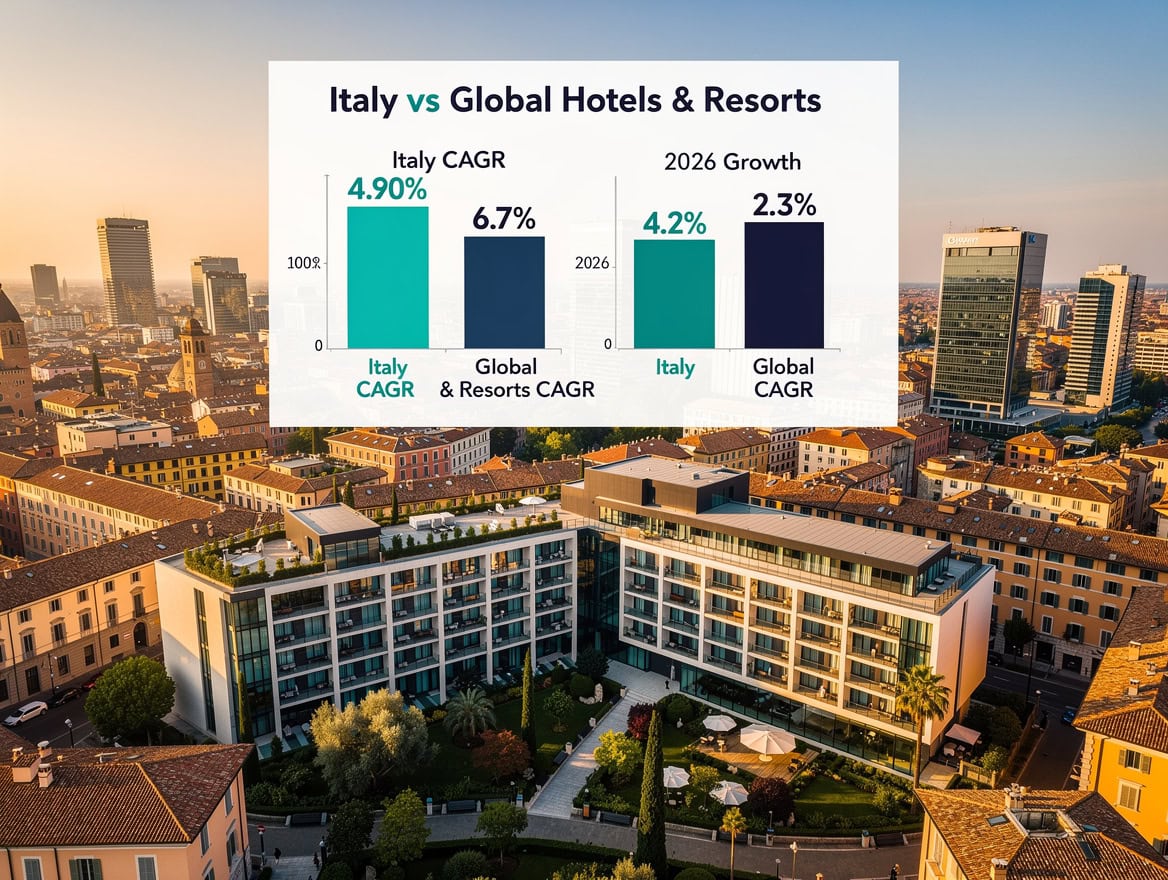
- The Base Case projects luxury RevPAR CAGR of 3.4% per year through 2031; the Bull Case reaches 5.6% and the Bear Case 1.2%.
- Italy had approximately 26,129 registered agriturismi in 2024, nearly double the 2014 count, generating around 15.5 million overnight stays — the luxury tier is a small but high-premium subset.
- Branded residences command a premium of roughly 30% in cities like Milan and 39% in resort markets over unbranded prime, stacked on a base where Milan’s Quadrilatero already exceeds €15,000 per square meter.
- Italy’s neo-resident flat-tax regime, raised from €200,000 to €300,000 for 2026, draws an estimated 3,000 to 4,000 high-net-worth relocations per year — a policy-driven demand tailwind for branded residential.
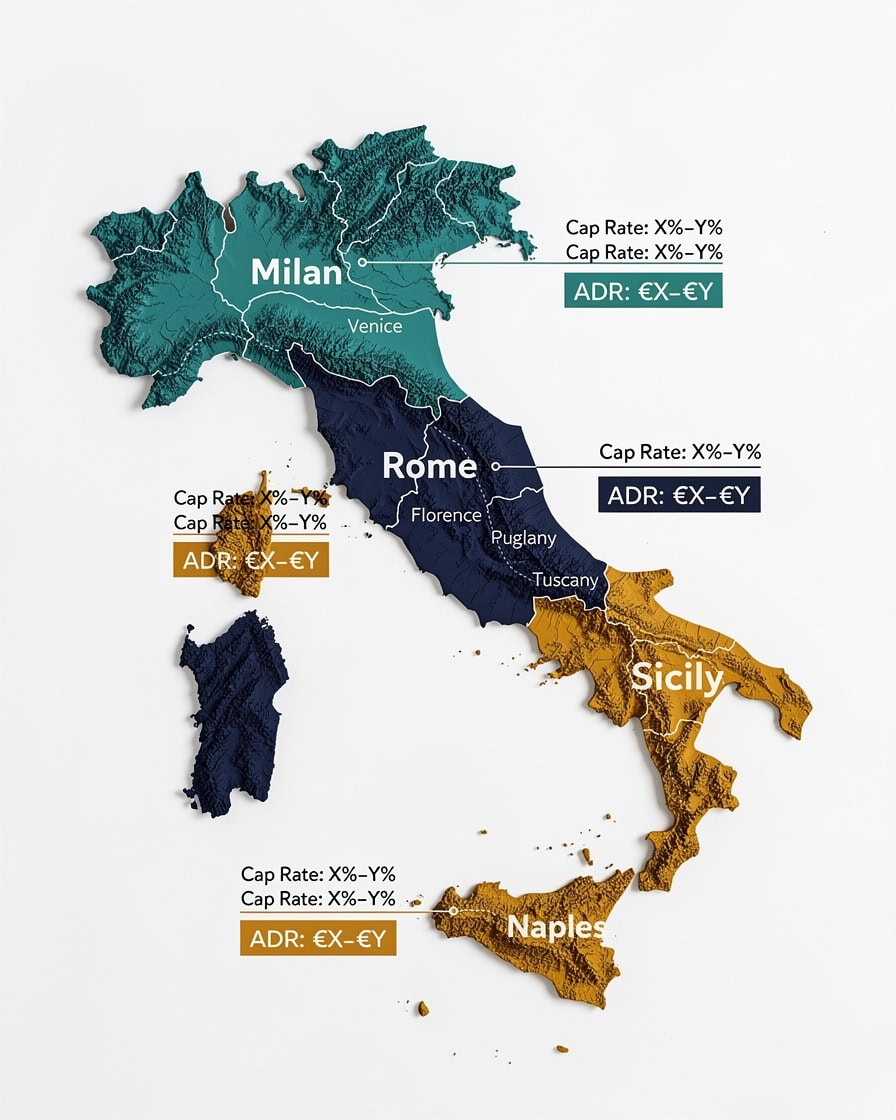
- Prime hotel yields have stabilized at approximately 3.8% in Milan and 4.3% in Rome, meaning rate growth — not yield compression — must drive investor returns from here.
Why Italy’s Luxury Hospitality Market Is Different
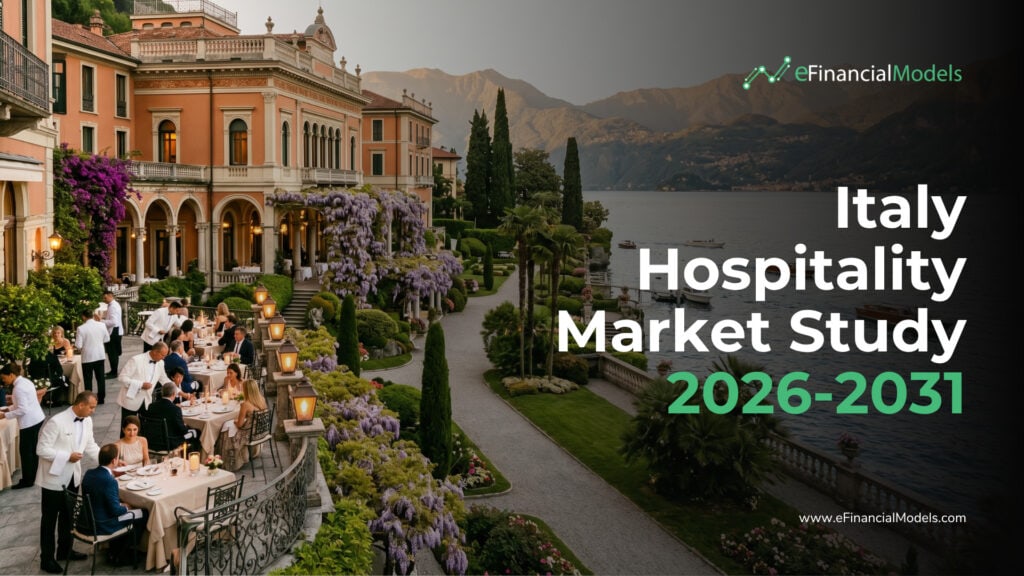
Italy is one of the few markets where three distinct ultra-luxury business models — the boutique city and resort hotel, the luxury agriturismo estate, and branded residential real estate — compete for the same scarce land, the same global clientele, and the same brand partnerships. That convergence is the central investment thesis and the central modeling challenge.
The binding constraint across all three sub-segments is supply, not demand. Demand is abundant and globally sourced. What is scarce is genuine ultra-luxury product: boutique five-star rooms in Rome, Milan, and Venice; brand-grade estates in the Tuscan and Umbrian countryside; and branded homes in the few Italian addresses the world’s wealthy will accept. Because occupancy in the gateway cities is already high and resort and rural luxury runs near its seasonal ceiling, average rate carries most of the growth. The assets that can raise rate without losing guests are those with the strongest brand equity and the most irreplaceable locations.
The Italy Luxury Hospitality Market Study 2026–2031 from eFinancialModels provides the full quantitative framework behind the analysis in this article.
The Three Sub-Segments: Profiles and Underwriting Logic
Each of the three Italian luxury sub-segments carries a distinct cash-flow profile, a distinct risk driver, and a distinct modeling approach. Blending them into a single pro forma hides the dynamics that drive returns.
Boutique Luxury Hotels: Rate-Led, Year-Round
Boutique luxury hotels (five-star, small-format, design- and service-led properties) are the rate and investment engine of the Italian market. Rome led Italy in 2025 with city-wide RevPAR near €183 on approximately 74% occupancy and an ADR of roughly €247, according to eFinancialModels Research based on CoStar/STR data. Milan posted record performance through its event calendar: September 2025 occupancy reached 82.2%, ADR hit €292, and RevPAR reached €240, with peak nights during the Italian Grand Prix touching 93% occupancy and ADRs above €410.
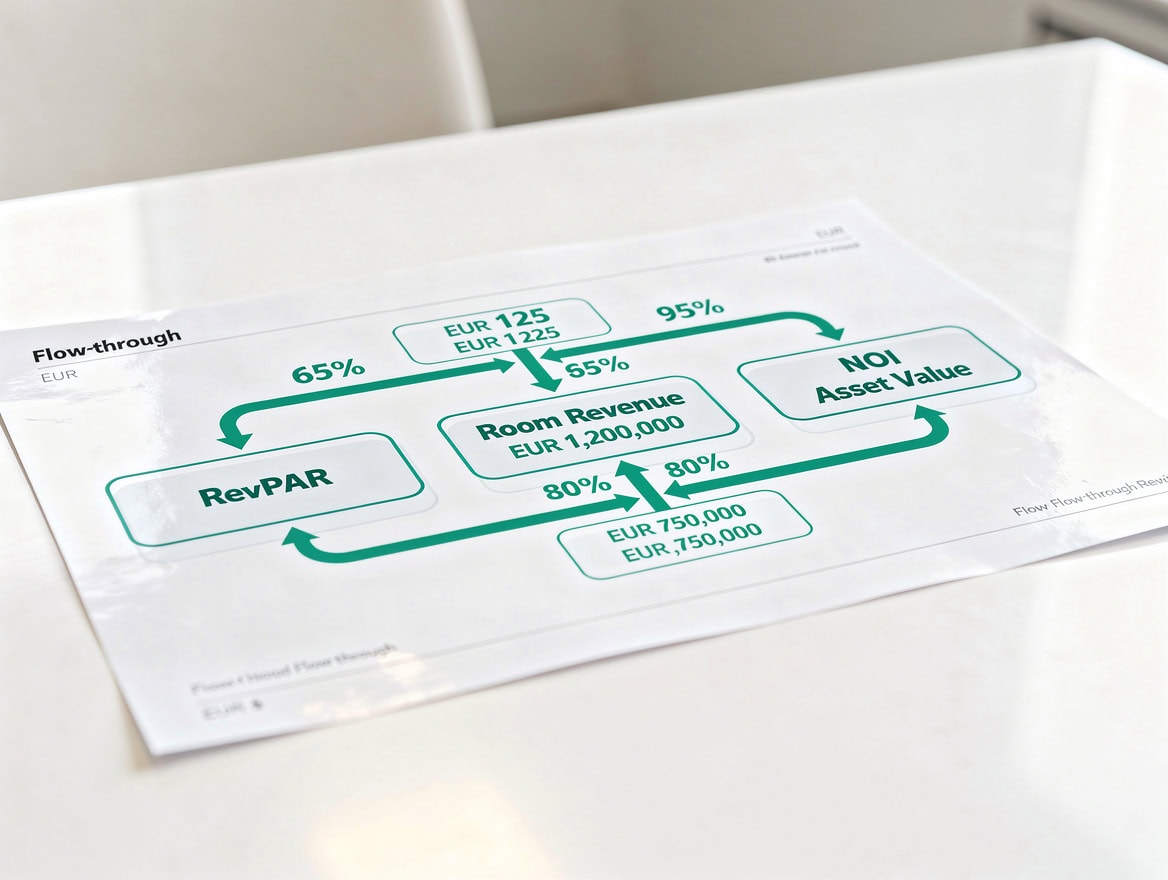
RevPAR (Revenue Per Available Room) equals ADR multiplied by occupancy rate. It is the standard hotel performance metric because it captures both pricing power and room utilization in a single number. With occupancy already near structural ceilings in the gateway cities, RevPAR growth through 2031 will come almost entirely from ADR expansion, not from filling more rooms.
The 2026 pipeline is exceptional. Mandarin Oriental Rome opens across ten 19th-century villas with 108 keys. The Danieli in Venice reopens as a Four Seasons in August 2026 under owner Gruppo Statuto. Six Senses Milan, J.K. Place Milano, Airelles Palladio Venezia, and Mandarin Oriental Cristallo in Cortina (timed to the Milano-Cortina 2026 Winter Olympics) all add named, high-conviction inventory. Each is a discrete, financeable event rather than a volume of commodity rooms.
Luxury Agriturismo Estates: Seasonal, Multi-Revenue, Defensible
Luxury agriturismo is Italy’s distinctive third pillar and, for the financial modeler, its least-benchmarked asset class. An agriturismo is a farm-stay lodging operation governed by Law 96/2006, which requires farming to remain the principal activity measured by labor hours. Regional rules typically cap bed counts at 20 to 30 and require that 50% to 80% of food served comes from the farm or local area. These constraints limit supply and protect the authenticity the luxury guest pays for.
Italy had approximately 26,129 registered agriturismi in 2024, nearly double the 2014 base, generating roughly 15.5 million overnight stays (ISTAT agritourism statistics). The luxury tier is a small named-asset subset: Rosewood Castiglion del Bosco in the Val d’Orcia, Belmond Castello di Casole, Borgo Egnazia in Puglia, and COMO Castello del Nero in Chianti pair five-star service and Michelin dining with working vineyards and farms.
For the modeler, the estate is a multi-revenue business: room nights at a high ADR, Michelin and farm-to-table dining, wine production and direct-to-consumer sales, weddings and events, and curated experiences — all underpinned by appreciating agricultural land. Model it as a blended operating-and-agricultural asset, not as a hotel alone. Many luxury estates operate a true agriturismo alongside a separately licensed five-star hotel to escape the bed-count cap while retaining the agricultural identity.
Branded Residences: Development Asset, Premium-Driven
A branded residence is a for-sale home carrying a hotel or lifestyle brand, either attached to a hotel or estate or delivered as a standalone building. The brand is paid through some combination of up-front key money, a licensing fee on sales (typically 3% to 6% of net sales), and a recurring service fee from residents.
Globally, the branded-residence scheme count grew from 169 in 2011 to approximately 611 in 2025, with a forecast of more than 1,000 by 2030 (Savills GRDC Branded Residential Track Record, June 2025). Standalone residences now account for about a third of the global pipeline. The Euro-Mediterranean region is growing at roughly 16%, and Italy is increasingly named alongside Spain and Greece as a regional hub.
In Italy, the premium stacks on already-extreme prime values. Milan’s Quadrilatero exceeds €15,000 per square meter; Lake Como villas reach €20,000. A 30% branded premium in Milan and a 39% premium in resort markets produce some of the largest absolute euros-per-square-meter uplifts in Europe. Italy’s neo-resident flat-tax regime — raised from €200,000 to €300,000 for 2026 — draws an estimated 3,000 to 4,000 high-net-worth relocations per year, a flow amplified by the United Kingdom’s abolition of non-dom status in April 2025 (IMI Daily, 2025). According to the United Nations World Tourism Organization, international tourist arrivals globally reached 1.4 billion in 2023 (UNWTO), underscoring the scale of the global travel demand pool from which Italy draws its luxury visitors.
Sub-Segment Comparison: Underwriting Profiles
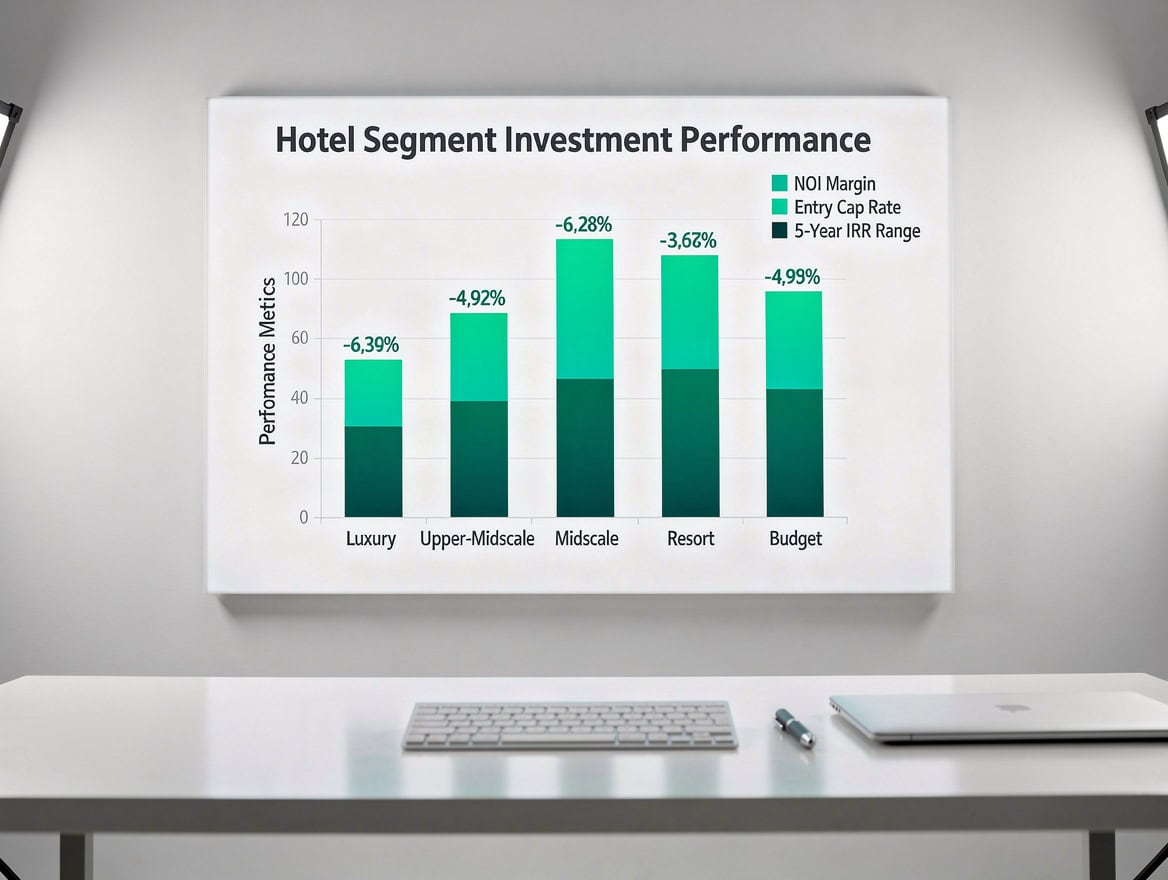
The table below summarizes the key modeling inputs across all three sub-segments. Use it as a starting framework, then tailor each assumption to the specific asset and location.
| Dimension | Boutique Hotel | Agriturismo Estate | Branded Residence |
|---|---|---|---|
| Primary return driver | ADR / RevPAR growth | Blended revenue + land value | Sales premium + absorption speed |
| Occupancy range | ~73–76% (gateway) | ~85–94% (peak season) | N/A (development asset) |
| RevPAR CAGR (Base) | ~3.4%/yr | Rate-led; seasonal | N/A |
| Yield / cap rate | ~3.8% Milan / ~4.3% Rome | Land + operating blend | ~20% developer margin hurdle |
| Branded premium | N/A | N/A | ~30% city / ~39% resort |
| Key risk | Rate shock / yield rise | Seasonality / climate | Absorption speed / policy reversal |
| Modeling approach | Rate-led, year-round P&L | Multi-line seasonal + land | Development pro forma + pre-sales |
Worked Example: Base Case RevPAR Projection to 2031
Here’s the math for a gateway-city boutique luxury hotel using the Base Case assumptions.
Starting point: Rome city-wide luxury ADR of approximately €247 in 2025, with occupancy at 74%. The five-star boutique tier prices above the city aggregate, so assume a luxury-tier ADR of €320 and occupancy of 76% as the 2026 entry point.
Step 1: Calculate entry RevPAR.
RevPAR = ADR × Occupancy = €320 × 0.76 = €243.20
Step 2: Apply Base Case CAGR of 3.4% per year for 5 years (2026 to 2031).
RevPAR at 2031 = €243.20 × (1.034)^5
(1.034)^5 = 1.1837
RevPAR at 2031 = €243.20 × 1.1837 = €287.87
Step 3: Interpret the result.
Over five years, the Base Case adds approximately €44.67 per available room per night in RevPAR — a gain driven almost entirely by ADR expansion, since occupancy moves only from 76% to approximately 74% to 76% across the scenario range. Under the Bull Case (5.6% CAGR), RevPAR reaches approximately €319. Under the Bear Case (1.2% CAGR), it reaches only approximately €258.
The gap between Bear and Bull at 2031 is roughly €61 per available room per night. For a 50-key boutique hotel running 300 operating days, that gap translates to approximately €915,000 in annual revenue — enough to move the asset from below-hurdle to well-above-hurdle returns. This is why stress-testing the rate assumption, not the occupancy assumption, is the central modeling task for Italian luxury hotels.

Three Scenarios to 2031: What Changes the Outcome
The scenario framework rests on two variables that move together: global ultra-high-net-worth (UHNW) demand and the euro exchange rate. A weak euro makes Italian luxury effectively discounted for dollar-, dirham-, and yen-denominated guests and buyers, supporting both ADR and branded-residence absorption. A strong euro reverses that tailwind. Europe welcomed approximately 748 million international tourist arrivals in 2023 (UNWTO), making it the world’s most visited region and reinforcing the structural depth of demand that underpins the Base Case scenario.
| Variable at 2031 | Bear (25%) | Base (50%) | Bull (25%) |
|---|---|---|---|
| Luxury RevPAR CAGR | ~1.2%/yr | ~3.4%/yr | ~5.6%/yr |
| Gateway-city occupancy | ~72% | ~74% | ~76% |
| Prime Milan hotel yield | ~4.5% | ~3.8% | ~3.4% |
| Branded-residence premium | ~28% | ~34% | ~42% |
| Developer margin | Below hurdle | Above hurdle | Well above hurdle |
The dominant downside is a global wealth-and-travel slowdown amplified by a currency reversal. The dominant upside is sustained UHNW demand combined with the flat-tax relocation wave and a weak euro. The prudent approach: underwrite branded-residence demand on base international wealth and treat the relocation wave as upside rather than as the central case.
Common Modeling Mistakes and How to Fix Them
Financial modelers working on Italian luxury hospitality consistently make five errors that distort returns.
Mistake 1: Modeling occupancy growth as the primary return driver.
Gateway-city occupancy is already near its structural ceiling (74% to 76%). Projecting occupancy to 85% overstates returns. Fix: drive RevPAR through ADR growth of 2.5% to 3% per year; hold occupancy flat or allow only marginal improvement.
Mistake 2: Treating the agriturismo estate as a hotel.
An estate with 20 rooms, a Michelin restaurant, a winery, and a wedding venue has five or six revenue lines. Modeling only room revenue understates EBITDA and misses the land-value component of total return. Fix: build a multi-line P&L with rooms, F&B, wine, events, and experiences as separate lines, underpinned by an agricultural land value.
Mistake 3: Applying a generic branded premium without checking the local prime base.
A 30% premium on a €5,000 per square meter base is very different from a 30% premium on a €15,000 per square meter base. Fix: anchor the premium to the verified local unbranded prime price per square meter, then apply the city (30%) or resort (39%) premium on top.
Mistake 4: Ignoring the Law 96/2006 bed-count cap.
A modeler who projects 60 rooms for a luxury agriturismo without a separate hotel license will hit a regulatory wall. Regional caps commonly sit at 20 to 30 beds. Fix: check the regional implementing rules for the specific location and model the hybrid hotel-license structure if scale is required.
Mistake 5: Underwriting yield compression as the exit mechanism.
Prime Milan hotel yields are already at approximately 3.8%. Projecting compression to 3.0% to justify an entry price is aggressive and fragile. Fix: underwrite the exit on rate growth and NOI expansion, not on cap-rate compression; stress-test against a yield rise to 4.5% (the Bear Case). Italy’s tourism sector generated approximately €84 billion in direct travel and tourism GDP contribution in 2023 (World Travel & Tourism Council), illustrating the macroeconomic scale that supports sustained hotel investment fundamentals across all three sub-segments.
Tools and Templates for Italian Hospitality Modeling
Building a credible Italian luxury hospitality model requires separate pro formas for each sub-segment. A single consolidated model hides the seasonal, regulatory, and premium dynamics that drive returns in each.
For the hotel component, you need a RevPAR-driven revenue build, a GOP (Gross Operating Profit) margin waterfall, a management-agreement fee structure (the dominant operating model in Italian luxury), and a yield-based exit. For the agriturismo estate, you need a multi-line revenue schedule, an agricultural income and cost module, a land-value component, and a seasonal demand calendar. For the branded residence, you need a development pro forma with pre-sales phasing, a branded-premium assumption anchored to local prime, a brand fee stack (key money plus license fee plus service fee), and an absorption schedule.
The Italy Luxury Hospitality Market Study 2026–2031 includes the Base Case assumptions, scenario sensitivity tables, and a quick-reference action checklist designed to pair directly with financial model templates. For broader hospitality modeling resources, the EFM Hospitality Financial Model Bundle covers the full range of property types. If you’re building a market-entry or feasibility model, the EFM Hospitality Financial Model Template Bundle provides ready-to-use structures for hotel and resort assets.
Frequently Asked Questions
What is RevPAR and why does it matter more than occupancy for Italian luxury hotels?
RevPAR stands for Revenue Per Available Room and equals ADR (Average Daily Rate) multiplied by occupancy rate. It matters more than occupancy alone because it captures both pricing power and room utilization in a single number. In Italian gateway cities, occupancy is already near its structural ceiling: Rome ran at approximately 74% city-wide in 2025, and Milan hit 82.2% in September 2025 during peak events. There is little room to grow occupancy further. That means RevPAR growth must come from ADR expansion. The Base Case projects luxury ADR growth of 2.5% to 3% per year, producing a RevPAR CAGR of approximately 3.4% through 2031. A model that projects occupancy rising from 74% to 85% is almost certainly wrong for a gateway-city asset.
How does the Law 96/2006 agriturismo framework affect financial modeling?
Law 96/2006 requires that farming remain the principal activity of an agriturismo by labor hours, not just by revenue. Regional implementing rules typically cap bed counts at 20 to 30 and require that 50% to 80% of food served comes from the farm or local area. For the modeler, these constraints have two direct effects. First, they cap room revenue at a level that makes the estate unviable if modeled as a hotel alone. Second, they require a multi-line revenue build: rooms, Michelin and farm-to-table dining, wine production and direct sales, weddings and events, and curated experiences. Many luxury estates add a separately licensed five-star hotel to escape the bed cap while retaining the agricultural identity. The agricultural income is both a revenue line and a regulatory prerequisite — remove it and the agriturismo license is at risk.
What branded-residence premium should I use for an Italian project?
The premium depends on location type. For city schemes like Milan, use approximately 30% over unbranded prime in the same locality. For resort markets — Lake Como, Amalfi Coast, Tuscany — use approximately 39%. These figures come from Savills global branded-residence research and are consistent with the Base Case in the Italy Luxury Hospitality Market Study 2026–2031. The critical step is to anchor the premium to the verified local unbranded prime price per square meter before applying the percentage. Milan’s Quadrilatero already exceeds €15,000 per square meter, so a 30% premium produces an absolute uplift of more than €4,500 per square meter — among the largest in Europe. Under the Bull Case scenario, the premium firms toward 42%; under the Bear Case, it compresses to approximately 28%.
How does Italy’s neo-resident flat tax affect demand for branded residences and estates?
Italy’s neo-resident flat-tax regime (Article 24-bis of the Italian Tax Code) allows individuals who transfer their tax residence to Italy to pay a substitute tax of €200,000 per year on all foreign-source income, regardless of the amount. For 2026, the Italian Budget Law raised this to €300,000 per year. This regime draws an estimated 3,000 to 4,000 high-net-worth individuals per year to evaluate or carry out a move to Italy, according to IMI Daily (2025). Milan in particular has become a magnet for relocating wealth, especially after the United Kingdom abolished its non-dom regime in April 2025. For the modeler, the prudent approach is to underwrite branded-residence demand on base international wealth and treat the relocation wave as upside rather than as the central case, since a policy reversal or dilution of the regime is a material risk.
What are the key risks to stress-test in an Italian luxury hospitality model?
Five risks deserve explicit stress-testing. First, a global wealth-and-travel slowdown: because Italian luxury is underwritten by UHNW international demand, a sharp slowdown hits guest demand, relocation flows, and cross-border buyer appetite simultaneously. Second, a strong-euro reversal: a meaningful strengthening of the euro against the dollar, dirham, and Asian currencies erodes the effective discount that drives North American and Gulf demand. Third, resort and rural seasonality: an agriturismo or coastal resort makes most of its annual result in approximately 100 summer days, and a soft summer cannot be recovered later in the year. Fourth, a flat-tax policy reversal: the neo-resident regime is a genuine demand driver for branded residential, and any dilution softens that tailwind. Fifth, a rate shock on low-entry yields: prime Milan hotel yields at approximately 3.8% are vulnerable to a rise in Italian BTP (government bond) rates, which currently sit at approximately 3.4% to 3.5%.
Which operators dominate the Italian luxury hospitality competitive landscape?
The Italian luxury field is contested by a small group of global operators and a distinctive set of Italian owners. Belmond (owned by LVMH) anchors the trophy end with the Cipriani in Venice, the Splendido in Portofino, and Castello di Casole. Marriott operates Bulgari, St. Regis, and Ritz-Carlton flags and is among the most active branded-residence developers globally. Four Seasons is entering Venice through the Danieli with owner Gruppo Statuto in August 2026. Mandarin Oriental, Six Senses (IHG), Aman, Rosewood, and the Orient Express revival under Accor and Arsenale complete the operating field. Gruppo Statuto is the dominant Italian owner, partnering with international brands across Venice, Milan, and Taormina. Independents — Passalacqua and Villa d’Este on Lake Como, J.K. Place, Le Sirenuse, and the great Tuscan estates — hold some of the most coveted assets and the highest scarcity value.
How should I structure the exit underwriting for a boutique Italian luxury hotel?
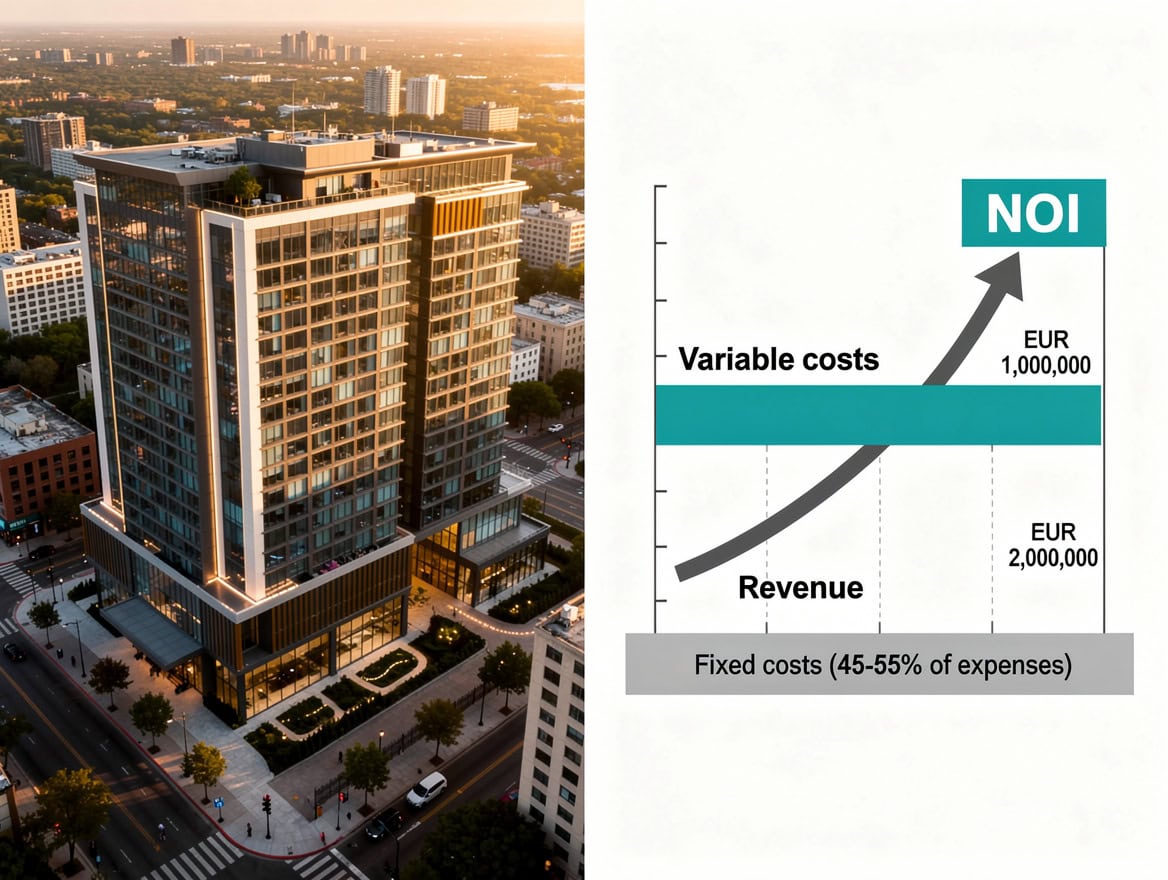
Do not underwrite the exit on yield compression. Prime Milan hotel yields are already at approximately 3.8%, and the Bear Case projects them rising to 4.5% — meaning compression to 3.0% is not a credible exit assumption. Instead, underwrite the exit on NOI (Net Operating Income) growth driven by ADR expansion. Here’s the math: if a 50-key hotel generates €3.5 million NOI at entry on a 3.8% yield, the implied value is approximately €92 million. If NOI grows at 3.4% per year for five years to approximately €4.1 million and the exit yield holds at 3.8%, the exit value reaches approximately €108 million — a 17% capital gain from income growth alone, before any repositioning capex benefit. Stress-test by applying a 4.3% exit yield (the Rome prime level): exit value falls to approximately €95 million, still above entry. Fix debt at entry to protect against rate shock.
Conclusion
Italy’s luxury hospitality market offers a genuinely rare combination: deep, globally sourced demand meeting structurally constrained supply across three distinct asset classes. The boutique city hotel, the luxury agriturismo estate, and the branded residence each carry different cash-flow profiles, different risk drivers, and different modeling requirements. The central discipline is to underwrite them separately, drive returns from rate growth and branded premiums rather than yield compression or occupancy expansion, and stress-test against the two scenarios that matter most: a global wealth slowdown and a strong-euro reversal.
I recommend starting with the Italy Luxury Hospitality Market Study 2026–2031 from eFinancialModels, which provides the full Base Case assumptions, three-scenario sensitivity tables, and a quick-reference action checklist designed to pair directly with hotel and real-estate financial model templates. It’s the most efficient way to build a credible, market-calibrated pro forma for any of the three Italian luxury sub-segments.