0 ITEMS

Nigeria Beverage Market: 32,000 Producers, One Tipping Point

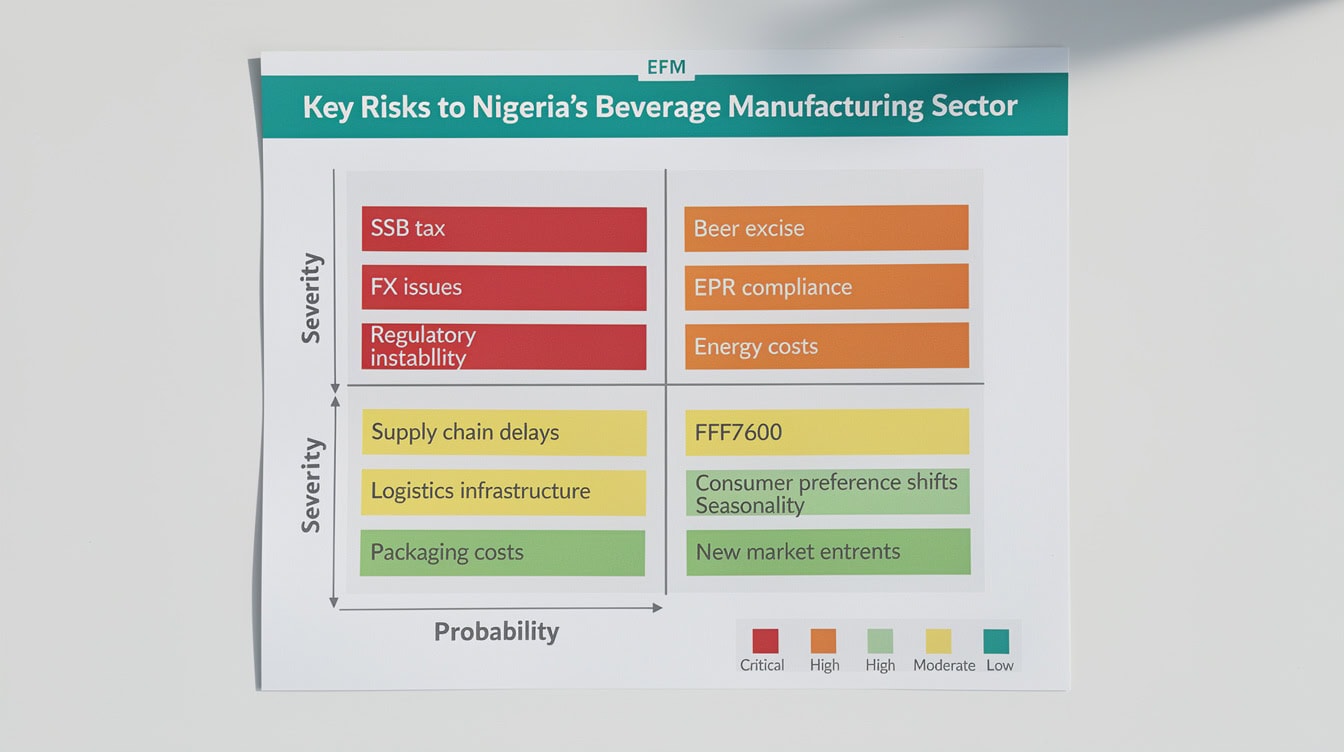
Nigeria’s beverage manufacturing sector enters 2026 at a genuine inflection: a new consolidated tax law, a floating Naira that has lost more than 70% of its value since 2023, and a packaging regulation that could wipe out tens of thousands of micro-producers.
Key Takeaways
- Nigeria produced 17.7 million hectolitres of beer in 2024, making it Africa’s second-largest beer market behind South Africa (Kirin Holdings Global Beer Survey 2024).
- The sachet “pure water” segment exceeds 2.5 billion liters per year across 32,000+ producers, the largest single packaged-beverage format in Nigeria by volume.
- Beer excise duty rises from approximately ₦40/L in 2023 to ₦72/L in 2026, ₦76/L in 2027, and ₦80/L in 2028 under the Nigeria Tax Act 2025.
- The SSB (sugar-sweetened beverage) tax trajectory is the single most important pricing variable for 2026–2031: a Bear-case escalation to ≥20% ad-valorem could destroy ₦400–500 billion of annual industry value.
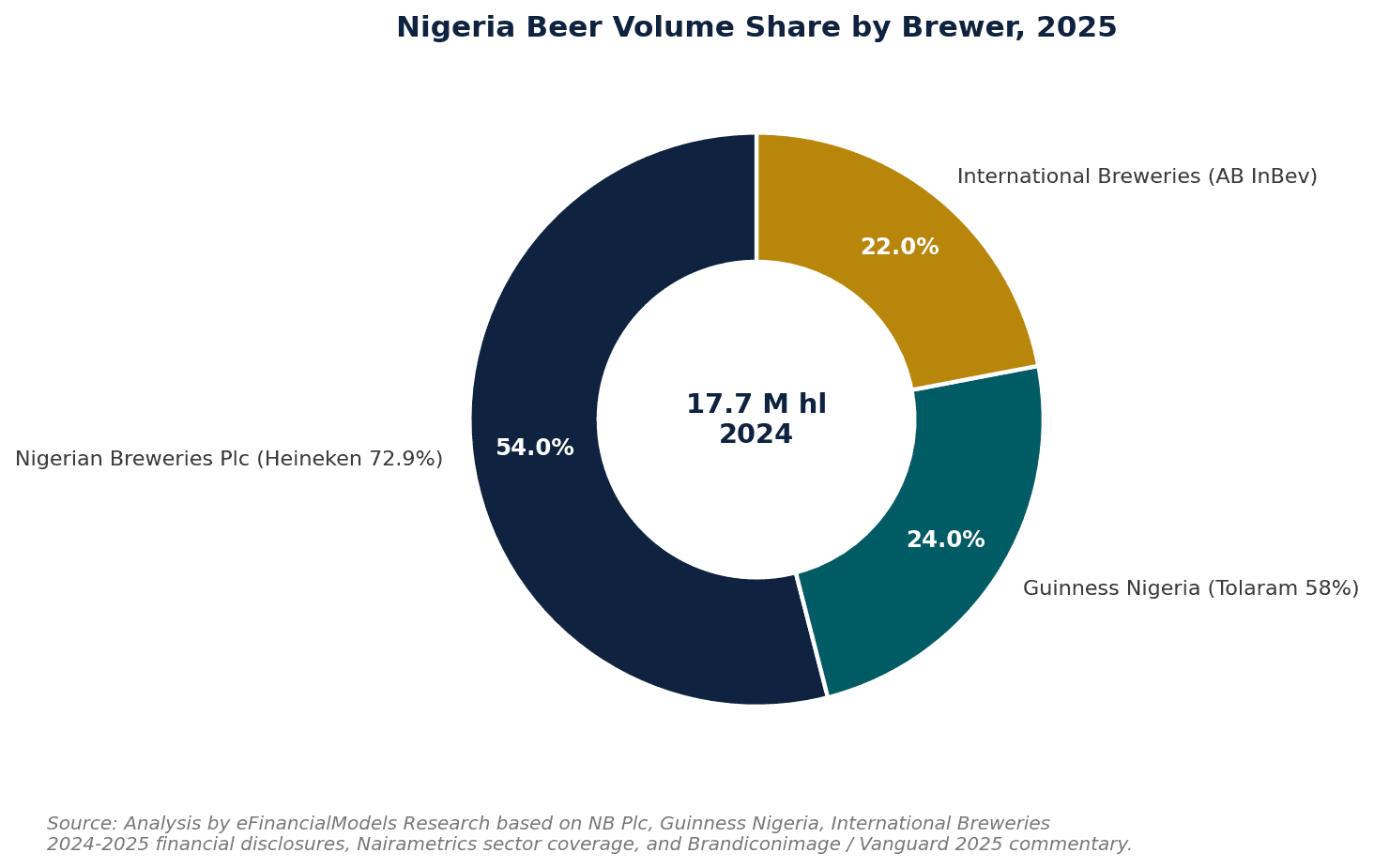
- Three brewers control approximately 98% of formal beer volume: NB Plc/Heineken (~54%), Guinness Nigeria/Tolaram (~24%), and International Breweries/AB InBev (~22%).
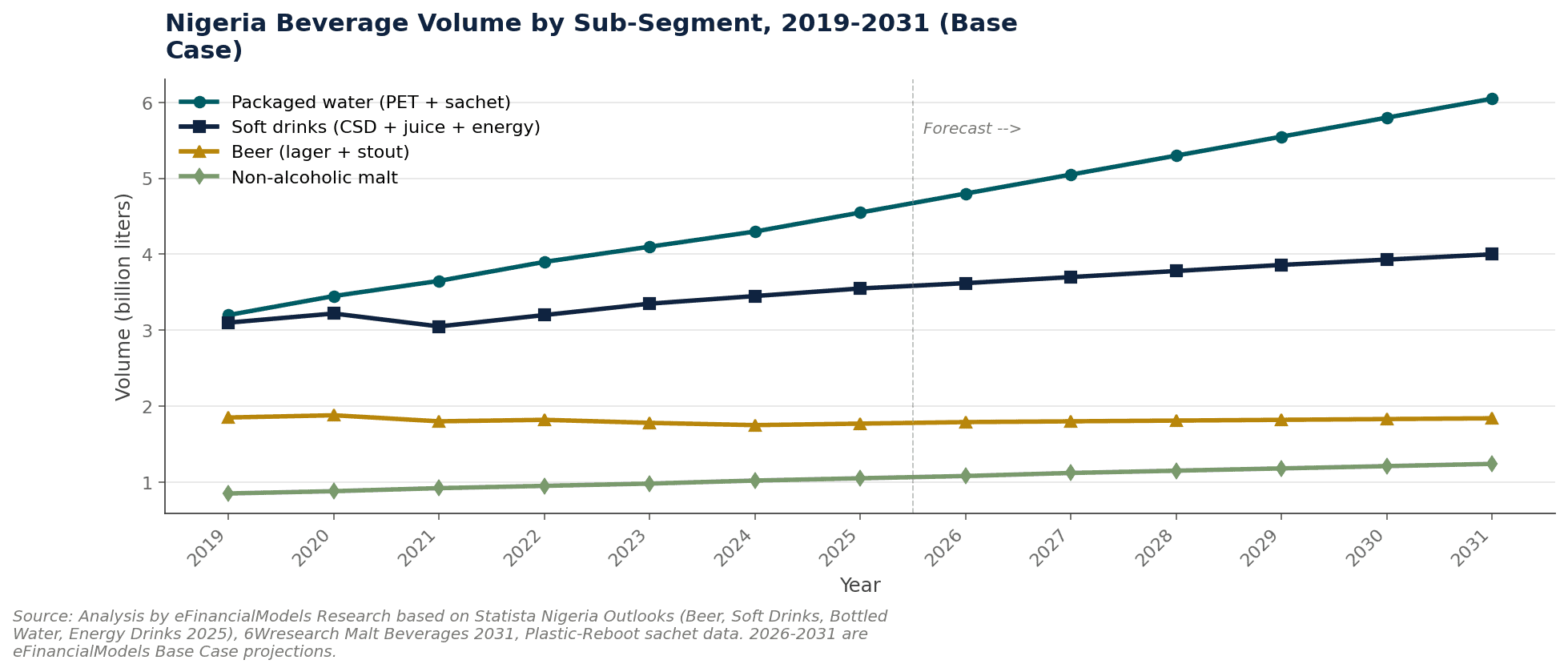
- Base-case projections show bottled water reaching 6.05 billion liters by 2031 (+33% vs 2025), driven by population growth and urbanisation.
- Energy drinks are the fastest-growing sub-segment, valued at US$250 million in 2024 with a 14.14% projected volume CAGR through 2030 (eFinancialModels Research, Vyansa Intelligence 2025).
The Industry Today: Scale, Structure, and Sub-Segments
Nigeria’s beverage manufacturing complex is Africa’s most structurally complex: a formal oligopoly in beer and carbonated soft drinks (CSDs) sitting alongside the world’s largest sachet-water informal sector. Three sub-segments define the market: beer and malt drinks, CSDs, and packaged water (PET bottles plus sachets).
On the beer side, Nigerian Breweries Plc (NB Plc), majority-owned by Heineken at 72.9% after the September 2024 ₦599 billion rights issue, holds approximately 54% of beer volume share (NB Plc Rights Issue Circular, September 2024). Guinness Nigeria, acquired by Singapore-headquartered Tolaram Group at ₦81.60 per share for a total of ₦103.7 billion with completion on 30 September 2024, holds approximately 24%. International Breweries (AB InBev, 75.9% stake) holds approximately 22%. Together these three control roughly 98% of formal beer volume.
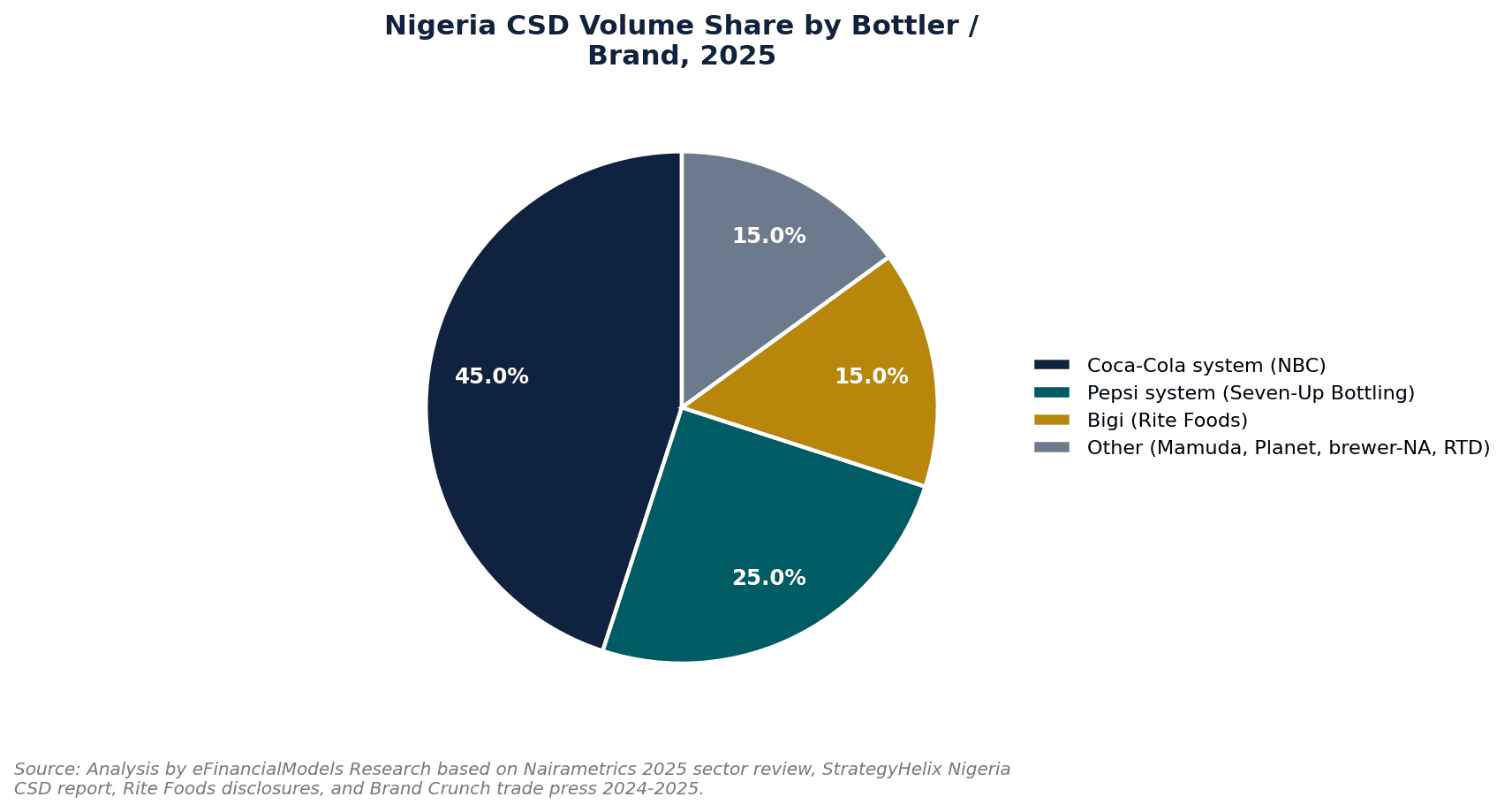
In CSDs, the Coca-Cola system via Nigerian Bottling Company (NBC) holds approximately 45% volume share. Seven-Up Bottling Company (SBC), owned by the Affelka/El-Khalil family since 2018, holds approximately 25%. Indigenous challenger Rite Foods, with its Bigi brand, has built approximately 15% share through aggressive 60cl pricing.
Packaged water is structurally different. The formal PET tier (Eva, Nestlé Pure Life, Aquafina, Ragolis, Cway) competes with a sachet “pure water” segment that exceeds 2.5 billion liters per year across more than 32,000 producers. Sachet water, the 50–60cl LDPE-film water pouch sold for ₦20–30 each, is the dominant beverage format by volume in Nigeria.
The Triple Inflection: Tax, FX, and Regulation
Three simultaneous shocks define the 2026–2031 window for Nigeria’s beverage manufacturers.
Nigeria Tax Act 2025 (NTA 2025): Signed by President Tinubu on 26 June 2025 and effective 1 January 2026, the NTA 2025 consolidates six prior tax statutes into a single framework and introduces a stepped beer excise schedule. Beer and stout duty rises from approximately ₦40/L in 2023 to ₦72/L in 2026, ₦76/L in 2027, and ₦80/L in 2028 (Nigeria Tax Act 2025, CITN portal). This step-up compresses operator EBITDA margins by an estimated 200–400 basis points absent price pass-through.
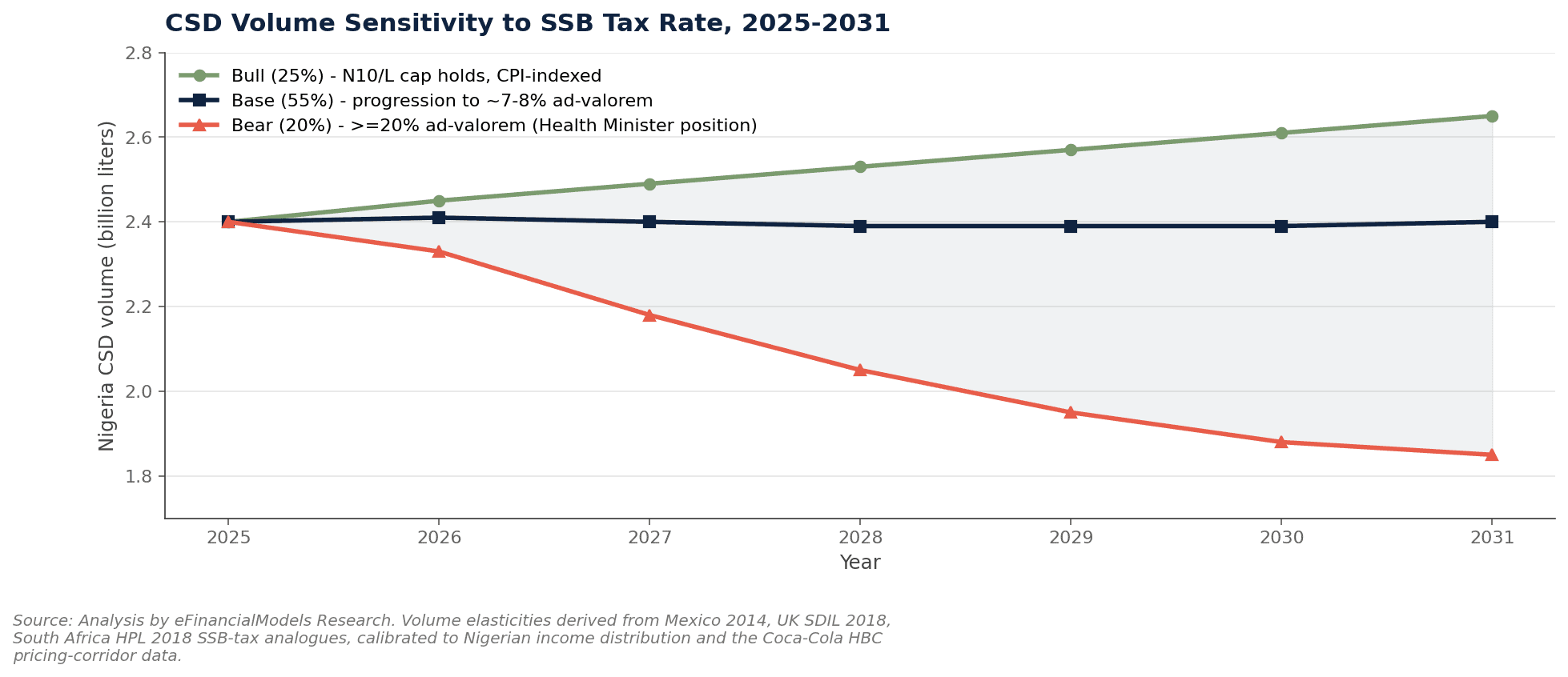
SSB Tax Escalation: The ₦10/L sugar-sweetened beverage (SSB) tax introduced in the Finance Act 2021 is under active legislative review. A Senate bill proposes replacing the flat specific levy with an ad-valorem rate of at least 20% of retail price. The Coordinating Minister of Health, the World Bank, and NGO CAPPA (Corporate Accountability and Public Participation Africa) all support sharper escalation. The Manufacturers Association of Nigeria (MAN) opposes. At the Base case (7–8% ad-valorem, approximately ₦25–40/L incidence), the SSB increase adds approximately ₦12–18 per 60cl PET bottle to shelf prices and triggers an estimated 4–6% CSD volume contraction by 2028. The Bear case (≥20% ad-valorem) is volume-destructive at 15–18% contraction.
Naira Float: The Central Bank of Nigeria (CBN) unified the NAFEM (Nigerian Autonomous Foreign Exchange Market) rate in June 2023, floating the Naira from a managed approximately ₦460/USD to market-determined rates. The Naira touched ₦1,800+ in mid-2024 before settling near ₦1,580 by May 2026 (CBN NAFEM data). For PET-resin-intensive bottlers, landed input costs have risen 250–300% in Naira terms since 2022. Malt and hops represent approximately 22% of beer COGS; PET/film represents 18–32% of CSD and sachet COGS — both are the FX-exposed lines that drove the 2023–2025 margin compression.
Demand Fundamentals: 242 Million People, Bifurcated Geography
Nigeria’s demand side is unusually complex because geography and religion create structurally different beverage mixes across the country’s six geopolitical zones.
Nigeria’s population reached 242.4 million at mid-2026 with a 2.03% annual growth rate and a median age of 18.3 years (UN/Worldometer projection). The drinking-age (18+) population is approximately 140 million; the alcohol-permissive subset, excluding residents of the 12 Sharia-law northern states, is approximately 100–110 million. Per-capita beer consumption stands at 8.15 liters on a total-population basis (Statista 2024), rising to approximately 14–16 liters on the alcohol-permissive-population basis. Per-capita CSD consumption is approximately 16 liters; per-capita packaged water (PET plus sachet combined) is approximately 21 liters.
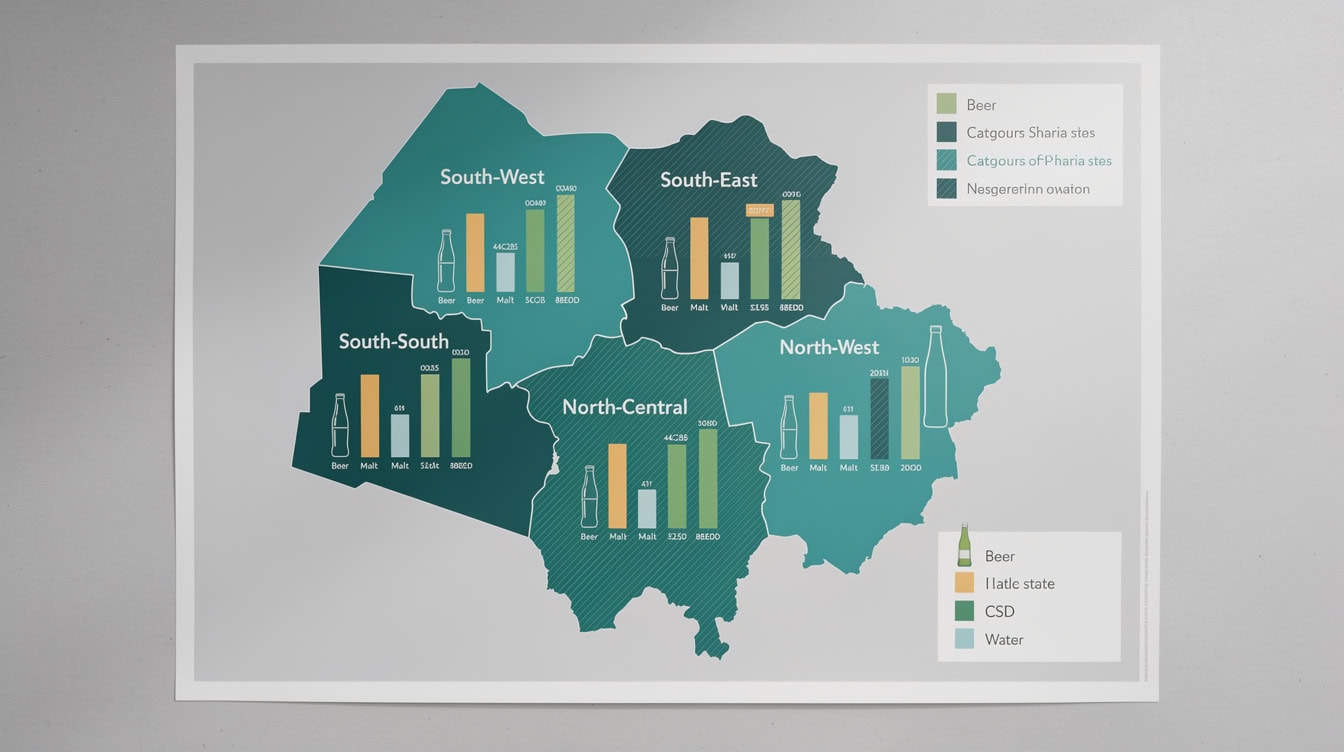
The North-East and North-West zones, where alcohol restriction applies, show beer at only approximately 4% of zone beverage volume. Non-alcoholic malt rises to 23–24% in these zones, the highest in Africa. Nigeria accounts for 74% of African malt drink sales precisely because northern demand substitutes non-alcoholic malt for beer. The South-West (Lagos plus Ogun, Oyo, Ondo, Osun, Ekiti) is the alcohol-permissive commercial heartland, with beer at approximately 28% of zone volume and Lagos State alone accounting for 30–35% of national beverage manufacturing capacity.
Demand fundamentals are challenged by purchasing-power compression. Nigeria’s headline inflation peaked above 33% in 2024 before easing to approximately 22–26% in 2025–2026 (eFinancialModels Research, NBS data). Real wage erosion has pushed beverage volume into trade-down behavior: sachet water substitutes for PET water; Bigi 60cl substitutes for Coca-Cola 50cl; non-alcoholic malt substitutes for beer in price-sensitive segments.
Worked Example: SSB Tax Impact on a 60cl CSD Bottle
Here’s the math on how the SSB tax trajectory flows through to shelf price for a standard 60cl CSD bottle.
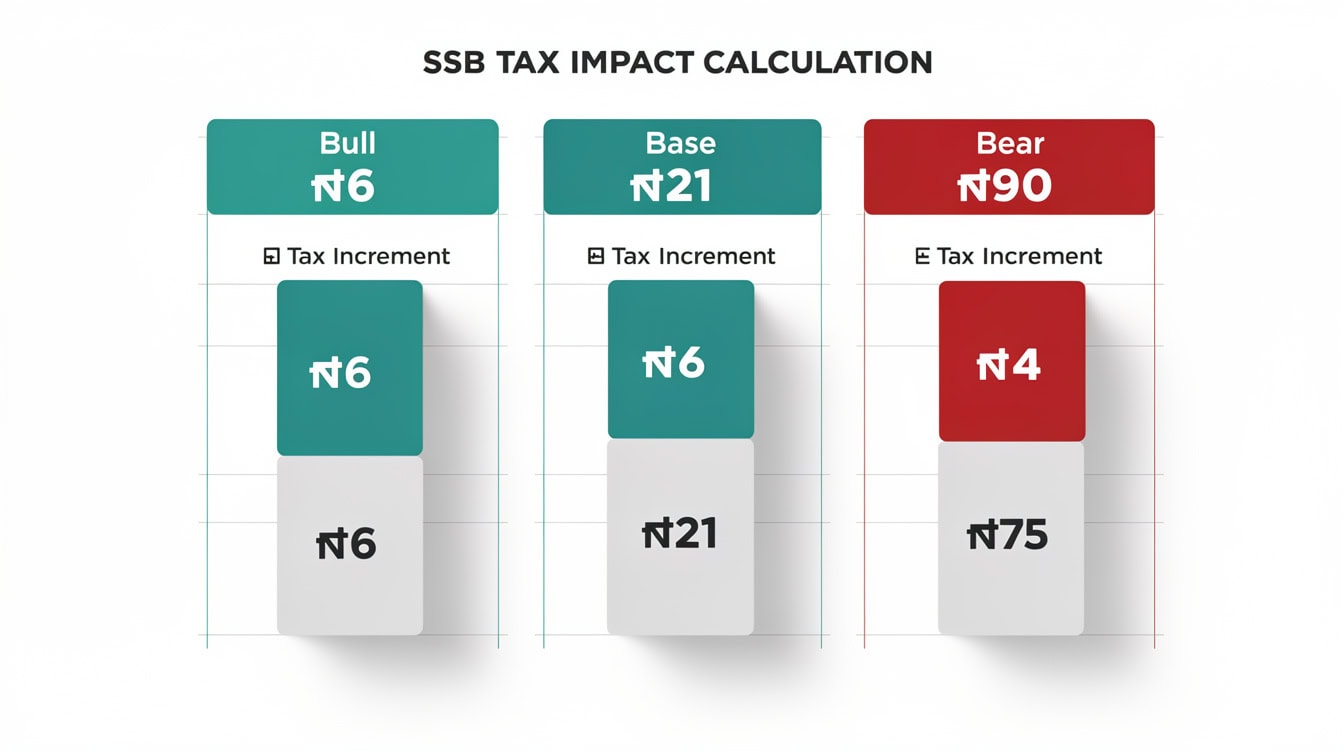
Starting point: a 60cl Coca-Cola PET bottle retailed for approximately ₦150 in early 2022 and approximately ₦400–500 in mid-2026. The SSB tax at ₦10/L (current flat rate) adds ₦6 per 60cl bottle (₦10 × 0.6L = ₦6). At the Base-case escalation to approximately ₦35/L ad-valorem equivalent by 2028, the tax adds ₦21 per bottle (₦35 × 0.6L = ₦21). At the Bear-case ≥20% ad-valorem on a ₦450 retail price, the tax incidence reaches approximately ₦90 per bottle (20% × ₦450 = ₦90), before any volume-driven price response.
The Base-case incremental SSB cost of ₦15 per bottle (₦21 minus ₦6) represents a 3–4% shelf-price increase on a ₦450 bottle. Operators typically pass through 75–85% of input-cost increases (eFinancialModels Base Case assumptions). At 80% pass-through, the consumer sees approximately ₦12 of additional shelf cost. Estimated volume elasticity for CSDs in Nigeria is approximately -0.6 to -0.8 (comparable to South African and Mexican SSB tax studies), implying a 4–6% volume contraction at Base-case SSB escalation.
Three Scenarios: Bear, Base, and Bull to 2031
The 2031 outlook brackets across three scenarios with assigned subjective probabilities.
| Metric | Bear (25%) | Base (55%) | Bull (20%) |
|---|---|---|---|
| NGN/USD 2031 | ₦2,400 | ₦1,750 | ₦1,400 |
| SSB ad-valorem | ≥20% | 7–8% | ₦10/L cap |
| Beer excise 2031 | ₦100+/L | ₦80/L | ₦72/L |
| EPR enforcement | Full | Selective | Deferred |
| Beer volume 2031 | 1.60 bn L | 1.84 bn L | 2.05 bn L |
| CSD volume 2031 | ~3.3 bn L | 4.0 bn L | 4.25 bn L |
| Bottled water 2031 | ~4.5 bn L | 6.05 bn L | ~6.8 bn L |
| Sachet producers 2031 | 7,500 | 22,000 | 30,000 |
| NB Plc revenue 2031 (₦bn) | 1,650 | 2,950 | 3,650 |
Source: eFinancialModels Research, Nigeria Beverage Manufacturing Market Study 2026–2031.
The Base case (55% probability) assumes SSB tax progresses to approximately 7–8% ad-valorem by 2028, beer excise tracks the published NTA schedule, NAFEM-rate FX averages ₦1,500–1,800/USD, and NESREA EPR enforcement targets the formal sector while tolerating informal sachet producers. In this scenario, total beer volume reaches 1.83–1.84 billion liters in 2031 (approximately +3% vs 2025), CSD reaches 4.0 billion liters (+13%), and bottled water reaches 6.05 billion liters (+33%).
Supply Side: Capacity Pipeline and Capex
The formal sector is investing despite the macro headwinds. Key announced capacity additions for 2026–2027 include NB Plc’s Iganmu modernisation (+50 million liters/year, ₦12 billion, Lagos), NBC’s Asejire expansion (+120 million liters/year, ₦20 billion, Oyo), Rite Foods’ Ososa expansion (+150 million liters/year, ₦25 billion, Ogun), and Seven-Up Bottling’s Aspen PET facility upgrade (+100 million liters/year, ₦18 billion, Lagos).
A new 100 million-hectolitre/year brewery in Nigeria requires US$200–280 million (₦300–450 billion at NAFEM rates) over a 24–30 month construction window. Approximately 65–75% of capex is import-dependent, covering German, Italian, and Chinese brewhouse vendors plus Krones/KHS PET bottling equipment. For CSD bottling, a new 200 million liter/year PET line requires US$35–55 million. Sachet-water entry-level form-fill-seal (FFS) machines cost US$8,000–25,000 each, which explains why the segment fragmented to 32,000+ producers.
Common Pitfalls in Nigeria Beverage Market Modeling
Modellers and investors consistently make five errors when building Nigeria beverage forecasts.
1. Using a single SSB tax point estimate. The spread between Bear (≥20% ad-valorem, approximately ₦100–130/L incidence) and Bull (₦10/L flat cap) is too wide to ignore. Every CSD model must run all three scenarios. The Bear-case alone destroys an estimated ₦400–500 billion of annual industry value.
2. Treating sachet water as a monolith. Sachet water is not one market. The top 200 producers operate at industrial scale; the remaining 31,800+ are micro-producers with 1,000–10,000 sachets per day per machine. NESREA EPR enforcement affects these groups very differently. Bear-case full enforcement consolidates the segment to under 5,000 producers by 2029.
3. Applying total-population beer per-capita. Nigeria’s 8.15 liters per capita (Statista 2024) is calculated on 242 million people. The relevant denominator for beer-market sizing is the approximately 100–110 million alcohol-permissive population, which implies approximately 14–16 liters per capita, a materially different base for growth projections.
4. Ignoring FX on capex. Approximately 65–75% of brewery capex is import-dependent. The difference between ₦1,500/USD and ₦2,200/USD on a US$200 million brewery is ₦140 billion in additional Naira cost. Models that use a single FX assumption for capex understate project risk.
5. Conflating beer excise and SSB tax timelines. Beer excise follows the published NTA 2025 schedule (₦72/76/80/L for 2026/27/28). SSB tax is under active legislative review with no fixed schedule. These are two separate regulatory variables with different probability distributions and different affected sub-segments.
Competitive Landscape and Recent Strategic Moves
The Nigerian beverage industry is consolidated at the top with extreme long-tail fragmentation in sachet water. Four strategic moves in 2024–2025 have reset the competitive map.
First, Tolaram acquired 58.02% of Guinness Nigeria from Diageo at ₦81.60/share (₦103.7 billion total, completed 30 September 2024), immediately integrating Tolaram’s Indomie/Power Oil distribution network into Guinness Nigeria’s route-to-market. Guinness Nigeria revenue jumped 144% year-on-year to ₦731 billion in 2025 on Tolaram-era pricing and platform integration.
Second, Heineken lifted its NB Plc stake from 56.7% to 72.9% via the September 2024 ₦599 billion rights issue (92% success rate), simultaneously clearing foreign-currency debts and converting NB Plc’s balance sheet from a net liability of ₦217.9 million at end-2023 to a net asset of ₦42.1 million at end-2024.
Third, Coca-Cola HBC announced on 21 October 2025 the acquisition of 75% of Coca-Cola Beverages Africa (CCBA) for US$2.6 billion at a US$3.4 billion enterprise value, targeting end-2026 close. NBC Nigeria is not part of CCBA but becomes the anchor Nigerian asset within an expanded continental network spanning 14 additional African markets.
Fourth, Rite Foods’ Bigi brand grew CSD volume share from approximately 10% in 2020 to approximately 15% in 2025 through its 60cl-at-50cl-price strategy, with production rising more than 300% from 30,000 to 120,000+ packs per day.
Frequently Asked Questions
What is the SSB tax and how does it affect Nigeria’s beverage manufacturers?
The SSB (sugar-sweetened beverage) tax is a levy on beverages with added sugar, first introduced in Nigeria’s Finance Act 2021 at a flat rate of ₦10 per liter. It applies to carbonated soft drinks, energy drinks, and similar products. For a standard 60cl CSD bottle, the current ₦10/L rate adds ₦6 to the cost stack. The critical issue for 2026–2031 is that a Senate bill proposes replacing this flat rate with an ad-valorem levy of at least 20% of retail price. At a ₦450 retail price, that would add approximately ₦90 per bottle, compared to ₦6 today. The Base-case assumption is a compromise at approximately 7–8% ad-valorem (₦25–40/L incidence) by 2028, which adds ₦12–18 per bottle and triggers an estimated 4–6% CSD volume contraction. Every beverage financial model for Nigeria must run all three SSB scenarios because the value spread between Bear and Bull is approximately ₦400–500 billion of annual industry value.
Why does Nigeria account for 74% of African malt drink sales?
Nigeria’s dominance of African malt drink sales is a direct consequence of the 12 Sharia-law northern states, which impose alcohol restrictions on their residents. Beer-equivalent consumption in these states shifts into non-alcoholic malt drinks: Maltina (NB Plc), Amstel Malta (NB Plc), Malta Guinness (Guinness Nigeria), Hi-Malt, Grand Malt (International Breweries), and Beta Malt. These products are brewed on the same production lines as beer but without fermentation. The North-East and North-West zones show non-alcoholic malt at 23–24% of zone beverage volume, the highest concentration in Africa. Nigeria’s per-capita non-alcoholic malt consumption is approximately 5.4 liters, also the highest in Africa. This structural demand is why brewers invest in malt-drink capacity alongside beer capacity, and why the malt segment is relatively insulated from beer excise escalation.
What is NESREA EPR and why does it matter for sachet water producers?
NESREA stands for the National Environmental Standards and Regulations Enforcement Agency. EPR stands for Extended Producer Responsibility, a regulatory framework that requires producers to take financial responsibility for the end-of-life management of their packaging. Nigeria’s NESREA EPR framework, formalised through a September 2024 National Stakeholders’ Meeting with UNEP and World Bank support, requires 25% PET recycled content by 2029 and participation in a Producer Responsibility Organization (PRO). For the 32,000+ sachet-water micro-producers, PRO participation costs are punitive. The Base-case assumption is selective enforcement targeting the formal sector while tolerating informal sachet producers for political-economy reasons. The Bear case assumes full enforcement, which would consolidate the sachet segment to under 5,000 producers by 2029. The Bull case assumes regulatory rollback. Investors considering sachet-water rollup strategies should pre-position ahead of the EPR enforcement curve.
How has the Naira float affected beverage manufacturing unit economics?
The CBN unified the NAFEM rate in June 2023, floating the Naira from a managed approximately ₦460/USD to market-determined rates. By mid-2024 the Naira had touched ₦1,800+/USD before settling near ₦1,580 by May 2026, a depreciation of more than 70% from the pre-reform rate. For beverage manufacturers, the impact is concentrated in two COGS lines: malt and hops (approximately 22% of beer COGS) and PET/film (18–32% of CSD and sachet COGS). Landed input costs rose 250–300% in Naira terms between 2022 and 2025. NB Plc raised list prices approximately 30% in 2023 and a further approximately 25% across 2024. A 50cl Coca-Cola PET bottle that retailed for approximately ₦150 in early 2022 retailed for approximately ₦400–500 in mid-2026. The difference between ₦1,500/USD and ₦2,200/USD on PET resin is the difference between sustainable and distressed operating margins for bottlers.
Who are the key players in Nigeria’s CSD market and what are their market shares?
Nigeria’s CSD market has three dominant players. Nigerian Bottling Company (NBC), the wholly-owned Coca-Cola HBC subsidiary, holds approximately 45% of CSD volume and operates 10 plants with a portfolio including Coca-Cola, Fanta, Sprite, Schweppes, Five Alive, Eva water, and Predator energy drink. Seven-Up Bottling Company (SBC), owned by the Affelka/El-Khalil family since a US$60 million privatisation in 2018, holds approximately 25% of CSD volume across 9 plants with Pepsi, 7Up, Mirinda, Mountain Dew, Teem, Aquafina, and Supa Komando energy. Rite Foods, a private indigenous operator, holds approximately 15% of CSD volume through its Bigi brand, which grew from approximately 10% share in 2020 by offering 60cl bottles at the price point of competitors’ 50cl bottles. Production at Rite Foods rose more than 300% from 30,000 to 120,000+ packs per day. The remaining approximately 15% is split among smaller regional players including Mamuda Beverages and Planet Bottling Company.
What investment opportunities does the Nigeria beverage market offer for private equity?
Four specific opportunities stand out for private-equity and strategic acquirers in the 2026–2031 window. First, the sachet-water rollup: 32,000+ informal producers represent the largest single consolidation opportunity in African FMCG, conditioned on NESREA EPR enforcement timing. A well-capitalized acquirer that sponsors PRO formation and absorbs the top 200 producers could build a dominant formal-sector platform. Second, Rite Foods/Bigi: the indigenous CSD challenger has demonstrated 300%+ production growth and 15% market share from a standing start in 2017, making it a credible growth-equity target. Third, energy drinks: the segment is valued at US$250 million in 2024 with a 14.14% projected volume CAGR through 2030, with Predator (Coca-Cola), Fearless, and Supa Komando competing in the value tier. Fourth, the NBC/CCBA integration: Coca-Cola HBC’s pending US$2.6 billion acquisition of CCBA (end-2026 target close) may unlock further consolidation in the formal CSD and water tier.
How does Nigeria’s beer per-capita compare to other African markets?
Nigeria’s per-capita beer consumption of 8.15 liters (Statista 2024) looks low against African peer South Africa at approximately 55 liters and Vietnam at approximately 41 liters, a 5–6x underpenetration gap. However, the correct comparison base for Nigeria is the approximately 100–110 million alcohol-permissive population (excluding Sharia-state residents), which implies approximately 14–16 liters per capita, narrowing but not closing the gap. The underpenetration signals long-term volume potential but also reflects structural constraints: purchasing-power compression, the Sharia-state alcohol restriction covering approximately 12 states, and beer excise escalation that compresses affordability. Nigeria’s 17.7 million hectolitres of beer production in 2024 (Kirin Holdings Global Beer Survey) already makes it Africa’s second-largest beer market by volume, ahead of Ethiopia and Kenya, despite the per-capita gap.
Conclusion
Nigeria’s beverage manufacturing sector offers genuine scale, a young population, and a structural demand base that no other African market replicates. The 2026–2031 window is defined by three variables that every investor and operator must model explicitly: the SSB tax trajectory (₦10/L flat to ≥20% ad-valorem), the Naira exchange rate (₦1,400 to ₦2,400/USD across scenarios), and NESREA EPR enforcement intensity on the 32,000+ sachet-water producers. The Bear-case combination of all three adverse outcomes destroys approximately ₦400–500 billion of annual industry value. The Bull case, where SSB is capped, FX stabilises, and EPR is deferred, supports beer reaching 2.05 billion liters and CSD reaching 4.25 billion liters by 2031.
I recommend pairing this analysis with the Beverage Manufacturing Start-Up Financial Model from eFinancialModels, which lets you run the Bear/Base/Bull SSB and FX scenarios directly against your unit economics. For broader manufacturing cost benchmarking, the Manufacturing Cost and Profit per Unit template provides the COGS decomposition framework that maps directly to the beer, CSD, and sachet-water cost stacks described in this study. Investors screening the full Nigerian FMCG opportunity should also review the Market Studies library for comparable sector analyzes.