
0 ITEMS

Unravelling the Development of a Solar Photovoltaic Power Plant

This article is written by AUT Financial Modeling
Understanding the financial aspects of solar power plants is crucial for investors and project developers.
- Photovoltaic (PV) power plants convert sunlight into electricity through solar panels and benefit from low maintenance and environmental advantages.
- Key features include inverter systems, mounting structures, grid connection, energy storage, and monitoring systems that optimize performance.
- Financial analysis involves 25-year projections, analyzing income, balance sheets, cash flow, and calculating metrics like NPV and IRR for investment decisions.
- A detailed construction schedule and debt repayment plan help manage project timelines and financial risks.
- Effective use of financial models supports strategic planning and assessing long-term profitability of solar projects.
This overview helps you navigate the essential components and financial considerations involved in solar power plant development.
Why You Should Read This Blog
Whether you are an environmentally-conscious individual intrigued by solar power or a prospective investor seeking lucrative opportunities, this blog will equip you with essential knowledge about the financial planning and analysis of a photovoltaic power plant development. Understanding the features and intricacies of a solar power plant is crucial for making informed decisions and contributing positively to the world’s sustainable energy transition. Additionally, we will delve into a comprehensive solar power plant financial model that will empower you to assess potential solar projects effectively.
Benefits You Will Get:
In-depth Knowledge: You will gain a profound understanding of solar photovoltaic power plant development, its components, and its advantages in addressing environmental challenges.
Photovoltaic power plants have revolutionized the way we harness energy from the sun. These plants consist of photovoltaic solar panels that capture sunlight and convert it into electricity through the photovoltaic effect. The photovoltaic effect occurs when photons from sunlight strike the solar cells in the panels, exciting electrons and allowing them to flow as an electric current. This conversion of solar energy to electrical energy occurs silently, without moving parts, making it an environmentally friendly and low-maintenance energy solution.
One of the most significant advantages of a solar photovoltaic power plant lies in its potential to generate clean and renewable energy. Unlike fossil fuels, solar energy does not produce harmful greenhouse gas emissions or contribute to air pollution. By harnessing solar power, we can significantly reduce our carbon footprint and combat the adverse effects of climate change.
Investment Insights: Investors will learn about the financial planning and analysis of a solar power plant, including projections, analysis, valuation metrics, and calculation of Net Present Value & Internal Rate of Return to make informed and confident investment decisions.
Investing in photovoltaic power plants offers a unique set of financial advantages. The initial setup cost may seem substantial, but the return on investment (ROI) can be highly rewarding over time. Photovoltaic power plants have a long lifespan, often exceeding 25 years, and their maintenance costs are relatively low compared to conventional power plants. Technological advancements and economies of scale have significantly decreased the cost of solar panels and related components, making solar power an increasingly cost-effective energy solution.
In addition to direct financial benefits, investing in solar power plants allows investors to diversify their portfolios and align their investments with sustainability goals. Many governments and organizations have recently introduced various incentives, such as tax credits, subsidies, and feed-in tariffs, to encourage investments in renewable energy projects. These incentives improve the financial viability of solar power plants and contribute to energy security and job creation in the renewable energy sector.
Sustainable Impact: By grasping the intricacies of solar power plant development, readers will contribute to promoting clean energy, reducing carbon emissions, and safeguarding our planet.
The development and widespread adoption of photovoltaic power plants play a vital role in mitigating the environmental impacts of traditional energy sources. Fossil fuels, such as coal, oil, and natural gas, are the primary sources of electricity generation worldwide. However, their combustion releases significant amounts of carbon dioxide and other greenhouse gases into the atmosphere, contributing to global warming and climate change.
By transitioning to solar power, we can reduce our dependence on fossil fuels and curb greenhouse gas emissions. The sun’s energy is a virtually inexhaustible resource, providing an abundant and renewable power source for future generations. Embracing solar energy also enhances energy security by diversifying the energy mix and reducing reliance on imported fossil fuels.
Moreover, solar power plants have a minimal environmental footprint regarding land use. Unlike large-scale hydroelectric projects or fossil fuel extraction, solar power plants can be installed in many locations, from rooftops to vast open fields, without causing significant disruptions to ecosystems. Furthermore, floating solar power plants on water bodies are innovative in maximizing energy generation without occupying valuable land.
Features of a Solar Power Plant

1. Solar Panels:
At the heart of a solar power plant are photovoltaic solar panels that capture sunlight and convert it into usable electricity through the photovoltaic effect. These solar panels consist of interconnected solar cells made of semiconductor materials, such as silicon. When sunlight strikes the solar cells, it excites the electrons, causing them to flow as an electric current. The direct current (DC) generated by the solar panels is then sent to the inverter for conversion into alternating current (AC) for grid integration.
The efficiency and capacity of solar panels are critical factors in determining the overall performance of a solar power plant. Advances in technology have led to improved solar panel efficiency, enabling more electricity to be generated from the same amount of sunlight. Additionally, the size and design of solar panels play a role in optimizing their placement and orientation to maximize sunlight exposure, ultimately impacting the energy output of the entire power plant.
2. Inverter Systems:
Inverter systems are essential components of a solar power plant as they convert the DC electricity produced by the solar panels into AC electricity, which is compatible with the grid and can be used by consumers. Inverters come in various types, including string, central, and microinverters. Each type has its advantages and is chosen based on the specific requirements and scale of the solar power plant.
String inverters are commonly used in small to medium-sized installations, where multiple solar panels are connected in series to form strings. These strings are then connected to the string inverters. On the other hand, central inverters are used in larger installations, where multiple strings are combined and connected to a central inverter. Conversely, microinverters are attached to each solar panel individually, enabling better performance monitoring and increasing overall system efficiency.
3. Mounting Structures:
Mounting structures play a crucial role in a solar power plant, providing a stable and secure foundation for the solar panels. These structures must be designed to withstand various weather conditions, including wind, snow, and extreme temperatures. They must also be oriented at the optimal angle to capture the maximum sunlight.
The two primary types of mounting structures used in solar power plants are fixed-tilt and tracking systems. Fixed-tilt systems are stationary and positioned at a fixed angle relative to the sun’s path. While simpler and more cost-effective, they may not capture sunlight optimally throughout the day.
On the other hand, tracking systems are designed to follow the sun’s movement throughout the day, adjusting the angle of the solar panels for maximum exposure. Single-axis and dual-axis tracking systems are available, with dual-axis trackers offering higher energy yield but at a higher cost. These tracking systems significantly improve the overall energy output of the solar power plant, making them more suitable for larger installations and areas with varying sun angles throughout the year.
4. Grid Connection:
For a solar power plant to contribute its generated electricity to the power grid and supply energy to consumers, it must be efficiently connected to the electrical grid. The grid connection process involves transformers, switchgear, and other electrical equipment to integrate solar power with the existing electrical infrastructure seamlessly.
The electricity generated by the solar panels is in the form of AC or DC, depending on the type of inverters used. This electricity is then stepped up or down in voltage using transformers to match the grid’s voltage levels. The switchgear allows the plant operator to control the flow of electricity between the solar power plant and the grid, ensuring a stable and reliable power supply to consumers.
The grid connection also enables any excess electricity generated by the solar power plant to be fed back into the grid, often through net metering or feed-in tariff arrangements. It promotes efficient energy use and provides opportunities for the solar power plant owner to earn revenue by selling surplus electricity to the grid operator.
5. Energy Storage:
While solar power plants primarily rely on grid connection to supply electricity, energy storage systems are becoming increasingly popular to store excess energy for later use. Energy storage can enhance the flexibility and reliability of a solar power plant, especially in areas with intermittent sunlight or during peak energy demand periods.
Energy storage systems, commonly in the form of batteries, store the excess electricity solar panels generate during ample sunlight. This stored energy can then be discharged when the sun is not shining or during periods of high electricity demand. By utilizing energy storage, solar power plants can optimize their energy output, reduce dependence on grid electricity during peak hours, and improve the grid’s stability by providing ancillary services, such as frequency regulation and voltage control.
Various types of batteries, such as lithium-ion, lead-acid, and flow batteries, are used for energy storage in solar power plants, each offering different capacity, efficiency, and cycle life characteristics. Proper sizing and management of energy storage systems are crucial to achieving the desired level of energy resilience and maximizing the overall economic benefits of a solar power plant.
6. Monitoring and Control:
An efficient monitoring and control system is essential for a solar power plant’s optimal operation and performance. This system continuously monitors various parameters, such as solar irradiance, panel temperature, voltage, and current, to ensure the solar panels operate efficiently.
Monitoring systems provide real-time data that allows plant operators to identify and address issues promptly, such as panel malfunctions or shading caused by debris or nearby structures. By promptly resolving these issues, the solar power plant’s overall energy production and revenue generation can be maximized.
Moreover, remote monitoring capabilities allow plant operators to access critical data and performance insights from anywhere, enabling them to make informed decisions and take appropriate actions for efficient plant management. By leveraging data analytics and predictive maintenance, solar power plant operators can optimize their plant’s performance, reduce downtime, and extend the lifespan of the equipment.
In conclusion, a solar photovoltaic power plant comprises various essential features that harmonize the sun’s energy and transform it into clean, renewable electricity. Solar panels are the system’s foundation, converting sunlight into electricity through the photovoltaic effect. Inverter systems ensure this electricity is compatible with the grid, allowing seamless integration. Mounting structures optimize the solar panels’ orientation and angle, while energy storage systems enable the storage and usage of excess energy when needed. Grid connection facilitates the flow of electricity between the solar power plant and the grid, supporting a stable energy supply and potential revenue generation. A robust monitoring and control system ensures efficient operation, maintenance, and performance optimization.
By understanding these features in detail, individuals and investors can appreciate the potential of solar power plants to contribute to a greener and more sustainable future. Additionally, this knowledge enables them to make informed decisions, whether as responsible consumers, project developers, or investors seeking sustainable and profitable ventures. Embracing solar power and its features empowers us all to proactively combat climate change and create a brighter tomorrow for generations to come.
Solar Power Plant Financial Model

If you want to venture into a Solar Power Plant project, this Solar Power Plant Financial Model Template is just right for you! To assess the financial viability of a Solar power plant project, this template will help estimate the anticipated financials and computes the relevant project indicators. This solar power plant financial model will be your flexible tool to run scenarios by modifying the input assumption and producing the key financial ratios investors and banks require.
1. 25-Year Projections:
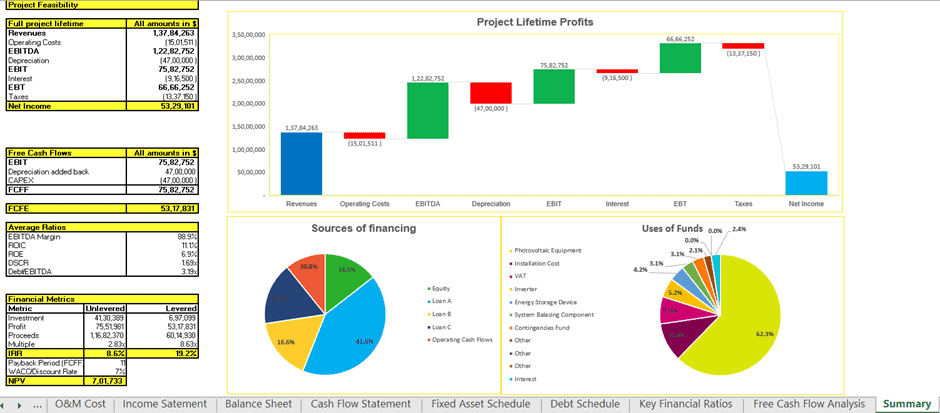
The solar power plant Excel model provides comprehensive 25-year projections of the project’s financial performance. These projections are essential for evaluating the long-term sustainability and profitability of the solar power plant investment. The model considers energy generation, operational costs, maintenance expenses, and revenue projections over 25 years. This extended projection horizon allows investors to assess the project’s financial viability over its entire lifecycle, considering various market conditions and potential fluctuations in energy prices.
Investing in a solar photovoltaic power plant is a long-term commitment, and having 25-year projections provides a clearer picture of the project’s financial trajectory, helping investors make informed decisions and identify potential risks and opportunities that may arise over time.
2. 3 Statements Analysis:
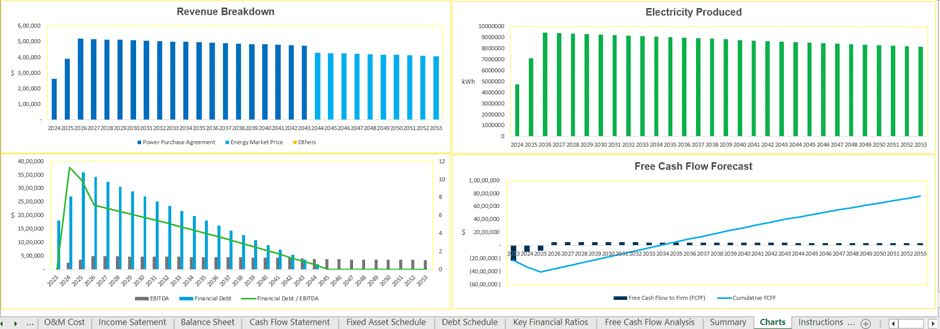
The solar power plant Excel model includes a comprehensive analysis of the three financial statements: Income Statement, Balance Sheet, and Cash Flow Statement. This Analysis allows investors to gain insights into the project’s financial health and performance.
The Income Statement summarizes the solar power plant’s revenues, expenses, and profits over a specific period. It gives a clear understanding of the project’s profitability, cost structure, and potential sources of revenue. The Balance Sheet reflects the project’s assets, liabilities, and shareholders’ equity, providing a snapshot of the project’s financial position at a specific time.
The Cash Flow Statement reveals the project’s cash inflows and outflows, including operating, investing, and financing activities. This statement is crucial for understanding the project’s cash flow management, liquidity, and ability to meet its financial obligations.
By analyzing these financial statements, investors can assess the solar power plant’s financial performance, stability, and ability to generate sustainable returns over time.
3. Financial Planning and Analysis:
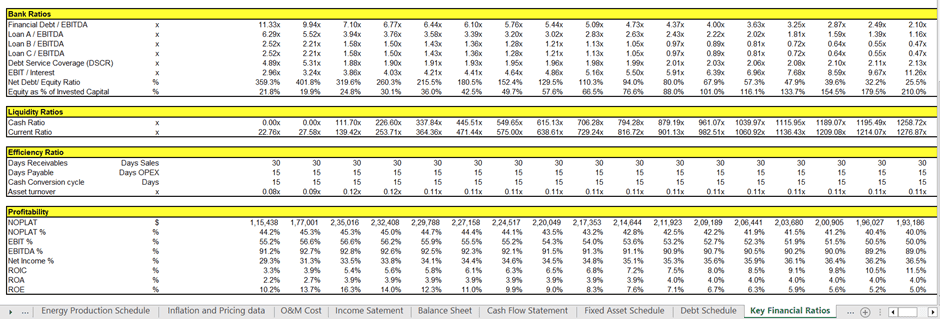
The solar power plant Excel model’s financial planning and analysis feature provides various metrics and ratios that help evaluate the project’s financial performance and attractiveness. Key financial metrics such as Return on Investment (ROI), Payback Period, and Debt Service Coverage Ratio (DSCR) are calculated to assess the project’s profitability, risk, and debt repayment capacity.
- Return on Investment (ROI) is a fundamental metric that measures the project’s profitability by comparing the net income generated to the initial investment. A higher ROI indicates a more lucrative investment opportunity.
- The Payback Period represents the time it takes for the project to recover its initial investment. A shorter payback period implies a faster return on investment and reduced financial risk.
- The Debt Service Coverage Ratio (DSCR) is a critical ratio for projects with debt financing. It shows the project’s ability to cover its debt obligations through operating income. A DSCR greater than 1 indicates sufficient cash flow to service debt.
Financial planning and analysis provide investors with quantitative insights into the financial viability of the solar power plant investment, helping them make informed decisions and compare different investment opportunities.
4. Construction Phases:

The solar power plant Excel model includes detailed construction phases that outline the development timeline and associated costs. Each construction phase represents a crucial stage in the solar power plant’s establishment, such as land acquisition, equipment procurement, installation, and commissioning.
Understanding the construction phases helps investors anticipate the project’s timeline and budget requirements, enabling effective planning and resource allocation. Additionally, it aids in identifying potential bottlenecks or delays that may impact the project’s overall timeline and financial performance.
Properly managing the construction phases ensures timely completion of the solar power plant, enabling early revenue generation and faster return on investment.
5. Debt Schedule:
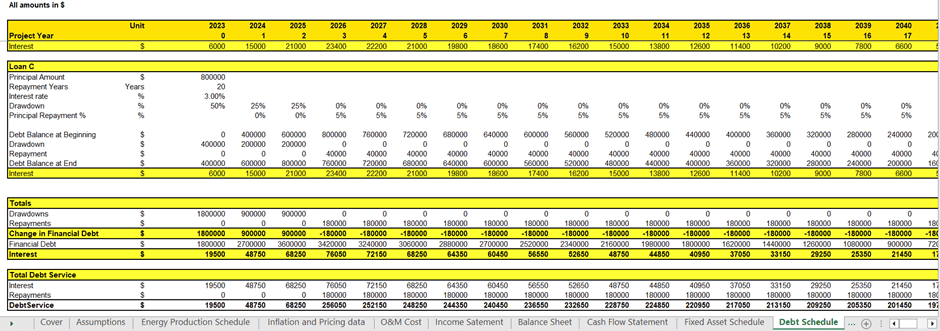
For solar power plant projects financed through debt, the Excel model includes a comprehensive debt schedule that outlines the repayment timeline and calculates the interest and principal payments.
The debt schedule assists investors in understanding the project’s debt obligations, including the periodic payments, interest rates, and maturity dates. This information is crucial for assessing the project’s financial stability and capacity to service its debt.
Moreover, the debt schedule helps optimize debt management strategies, such as refinancing or early repayment options, which can significantly impact the project’s overall financial performance and risk profile.
6. Valuation, IRR, NPV, etc.:
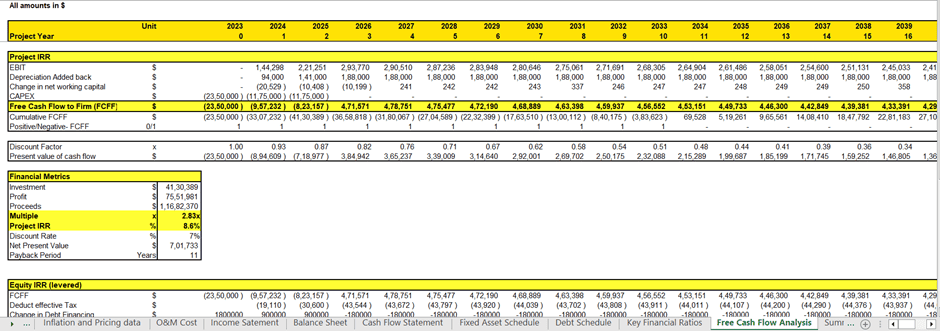
The solar power plant Excel model offers sophisticated valuation techniques, such as Discounted Cash Flow (DCF) analysis, to estimate the project’s intrinsic value based on future cash flows. DCF considers the time value of money, providing a more accurate calculation of the net present value of the solar power plant investment.
Calculation of Net Present Value (NPV) and Internal Rate of Return (IRR) are essential metrics that assess the project’s financial attractiveness. IRR calculates the project’s expected rate of return. At the same time, the calculation of Net Present Value (NPV) measures the project’s net cash inflows after accounting for the initial investment and ongoing expenses.
Using these valuation metrics, investors can determine whether the solar power plant investment aligns with their financial goals and compare it to other potential investment opportunities.
Conclusion:

The solar power plant Excel model is a powerful tool that provides investors with comprehensive and detailed financial planning and analysis of the solar photovoltaic power plant investment. With features like 25-year projections, three statements analysis, financial analysis, construction phases, debt schedule, valuation, calculation of Net Present Value (NPV), and Internal Rate of Return (IRR), the model equips investors with valuable insights to make informed decisions and evaluate the long-term profitability and sustainability of their solar power plant venture.
Investing in solar power plants not only presents an opportunity to contribute to a greener and more sustainable future but also offers the potential for attractive returns and diversification of investment portfolios. The solar power plant Excel model empowers investors to navigate the complexities of solar energy projects, optimize their financial performance, and positively impact the world.
By embracing the Solar Energy Power Plant Financial Model, investors can confidently embark on their solar power plant journey, confident in their ability to analyze and capitalize on this thriving renewable energy market. The future is solar, and the solar power plant Excel model opens the door to a brighter and more sustainable tomorrow.
About AUT Financial Modeling
Welcome to AUT Financial Modeling, your trusted partner for cutting-edge, comprehensive, and user-friendly financial models. With a strong focus on corporate finance, valuation, and private equity, we bring together expertise, innovation, and precision to deliver the highest standard of financial modeling solutions.
At AUT Financial Modeling, we understand that accurate and reliable financial models are the backbone of informed decision-making. We are committed to empowering our clients with the tools they need to navigate the complex world of finance.
Our team of seasoned professionals combines deep industry knowledge with advanced technical skills, enabling us to craft financial models that are tailored to the unique needs of your business. We take pride in our attention to detail, ensuring that every aspect of the model is meticulously crafted to reflect the intricacies of your specific situation.
Partner with us today and unlock the full potential of your financial analysis.
Feel free also to check out the full list of industry-specific templates by AUT Financial Modeling here:











Looking for more financial model templates for Solar Energy Industry? Check out our list of financial model templates for Solar projects here:


































Please also have a look at our list of financial model templates for Renewable Energy here:












You might also like:
- How to Evaluate a New Solar Park for Investment?
- Understanding the Levelized Cost of Energy Formula
- Renewable Energy Financial Model Bundle
- An Easy Beginner’s Guide to Solar Power Plants
- How Does Solar Radiation Affect the Returns of Your Solar Park?
- 8 Key Metrics for Assessing a Solar Project
- Solar Energy Financial Model
- How to Make a Startup Financial Plan for Fundraising?
- Renewable Energy
- How to Prepare a Financial Feasibility Study?
- Financial Modeling for Startups and Small Businesses
- Common Challenges in Solar Project Financing
- Financial Forecasting Models by eFinancialModels
- 10 Tips to Develop a First Class Business Valuation Report
- Best in Class Property Appraisal Methods and What to Look Out for
- Understanding the Debt Service Coverage Ratio: An Essential Metric for Financial Analysis
- 5 Practical Tips to Help Raise Funds For Startups
- Project Finance
- Financial Projections Templates – The Easy Way
- What Are the Best Business Planning Apps?


