0 ITEMS

How to Compare Financial Modeling Consultant Quotes: A Toolkit

Founders compare modeling consultant quotes best by putting every quote on the same footing: one written scope, one pricing model, one deliverables list and one red-flag check. The toolkit below supplies that checklist and a comparison matrix, so three quotes that look different on price can be read side by side.
Key Takeaways
- Write the scope first, because quotes are only comparable when every consultant prices the same decision, horizon, statements, scenarios and dates.
- Fixed fee and hourly pricing differ in who carries the cost risk of a misjudged scope; a retainer risks paying for quiet months.
- A strong quote lists deliverables: separated sheets, documentation inside the file, a review record, a handover session, revision terms and ownership.
- Marketplace rates show a typical freelancer range on one platform, so a higher quote needs a stated reason rather than an automatic rejection.
- Score each quote line by line, set aside any quote with a zero on the scope, review or handover line, and compare price last.
What does a founder need in hand before quotes arrive?
A written scope, because a quote can only be compared with another quote when both price the same job. The Head Start website, in a guide for nonprofits that hire technology consultants, calls for “a detailed agreement that outlines the scope of work and estimates timelines and costs” when working with a consultant, in its guide to working with technology consultants, updated in December 2023. The advice is written for another sector, but it carries over, and for a financial model that agreement fits on one page.
The scope checklist below turns that advice into five lines a founder can send to every consultant:
- The decision the model supports, such as a fundraising round, an annual budget or a loan application.
- The forecast horizon and period, for example five years, monthly in year one and quarterly after that.
- The statements required: income statement, balance sheet and cash flow statement, or a simpler cash view.
- The scenarios required, such as a cautious, a base and an optimistic case.
- The date a working draft is needed and the date the final file is needed.
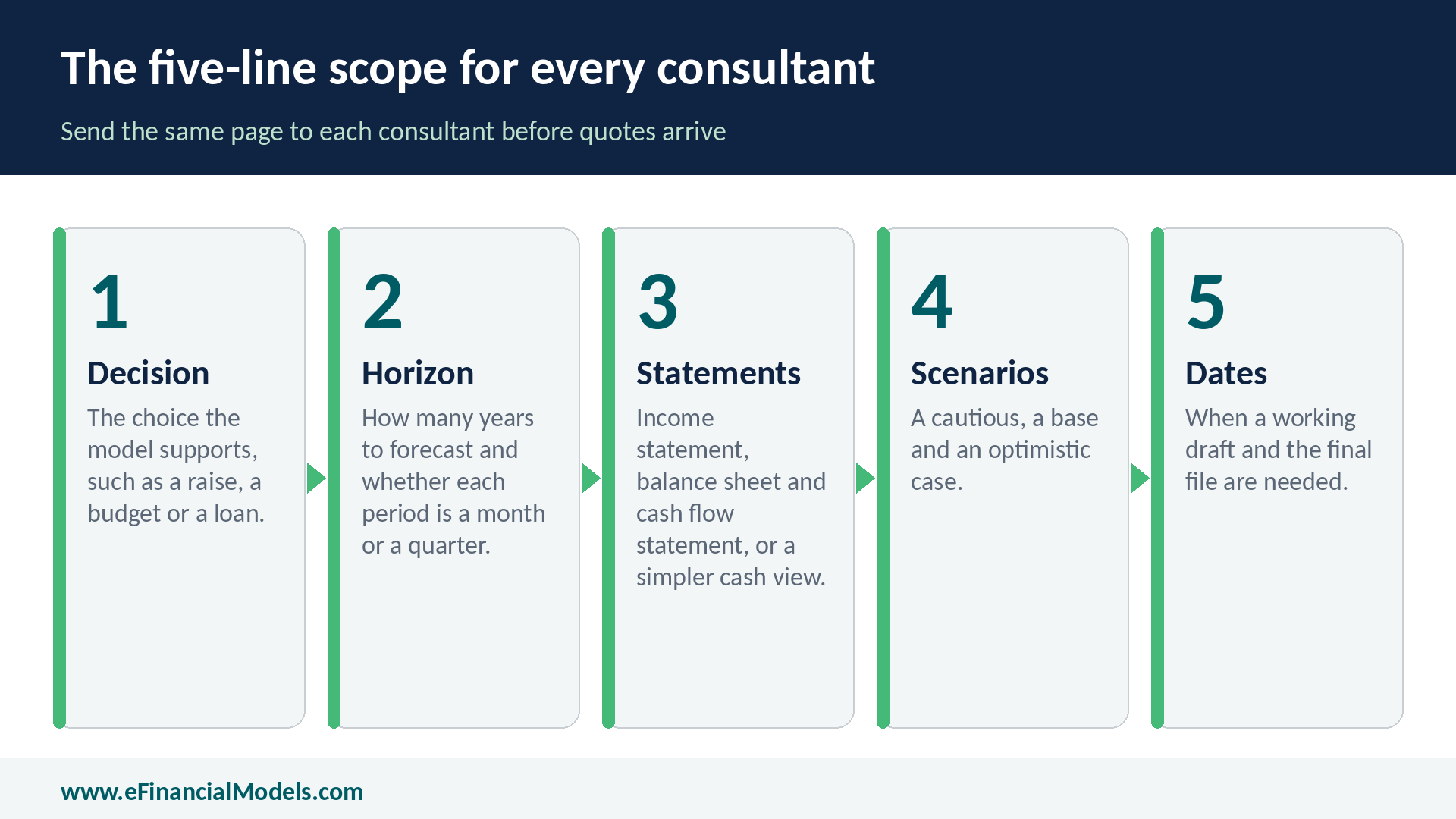
The five scope lines to send to every consultant before quotes arrive.
A consultant who receives these lines quotes the same job as the next one. A consultant who receives only “build me a financial model” quotes a guess, and the guesses cannot be compared. Founders still choosing a starting point can browse the startup financial model collection to see which statements and scenarios a typical startup file contains before writing the five lines.
How do fixed fee, hourly and retainer pricing differ?
Fixed fee and hourly pricing differ mainly in who carries the risk that the work takes longer than expected, while a retainer adds the risk of paying for quiet months. Public purchasing rules show the logic clearly. The Federal Acquisition Regulation (FAR), the rulebook the US government follows when it buys services, says a firm-fixed-price contract “places upon the contractor maximum risk and full responsibility for all costs and resulting profit or loss” in FAR 16.202-1. The same rulebook says a time-and-materials contract “provides no positive profit incentive to the contractor for cost control or labor efficiency” in FAR 16.601. The rules are written for government buyers, so they work here as an analogy rather than a requirement, but the risk logic carries over to a founder hiring a modeler.
Hourly pricing suits work whose size cannot be estimated, and fixed pricing suits work with a defined scope, which is why the scope page comes first. A retainer, a standing monthly fee, suits ongoing updates once actuals arrive. The matrix below sets the three side by side.
| Pricing model | Fits best when | Main risk for the buyer | Question to ask |
|---|---|---|---|
| Fixed fee | The scope is written and stable | Extra work is billed as a change request | What counts as a change request? |
| Hourly rate | The size of the work is unclear | The bill grows with every revision | Is there a ceiling the bill cannot pass without approval? |
| Monthly retainer | The model needs regular updates | Paying for months with little work | What is included each month? |
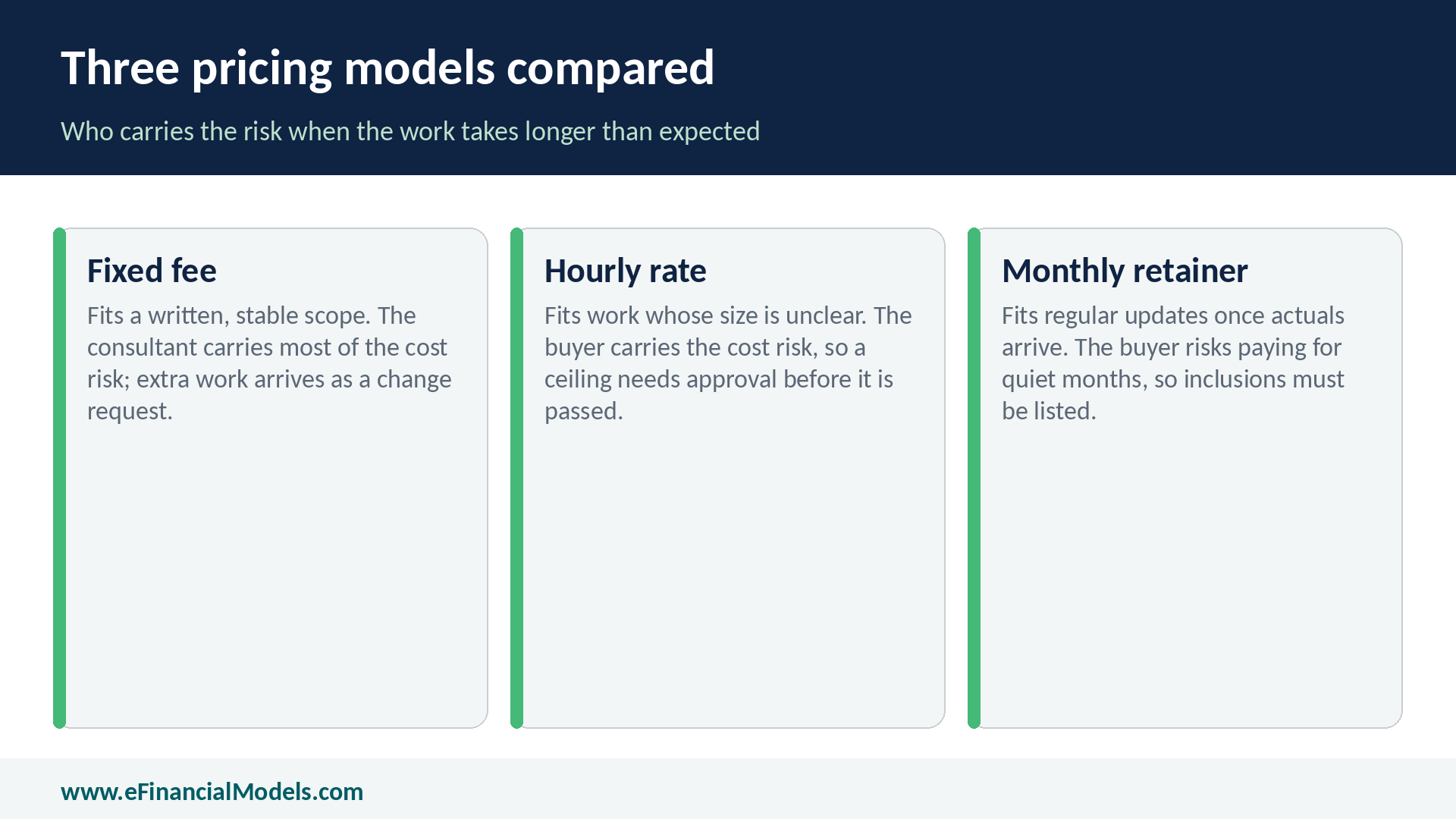
The three pricing models and the risk each one leaves with the buyer or the consultant.
Price levels vary widely by who is hired. Upwork’s hire page for financial modelers says that “freelance financial modeling consultants on Upwork typically charge $25-65 per hour”. That is a marketplace freelancer figure, not a boutique-firm fee, so a quote above it is not automatically overpriced, but it should arrive with a stated reason.
What should the deliverables list contain?
Six items: a split between inputs, calculations and outputs; documentation inside the file; a review record; a handover session; revision terms; and written ownership of the finished file. A quote that names only “a financial model” leaves every one of them to chance.
The checklist below turns the earlier sections into lines the quote should answer:
- Inputs, calculations and outputs sit on separate sheets, so the founder can change an assumption without touching a formula.
- A user guide and an assumptions list live inside the workbook, not in a separate email.
- A review record shows who checked the model, what was tested and what was found.
- A handover session of agreed length teaches the founder to update the file alone.
- Revision terms state how many rounds are included and what a further round costs.
- Ownership of the finished file passes to the founder on payment, stated in writing.
Ownership and contract terms carry legal consequences, so a lawyer should read them before signing; the checklist shows what to ask, not what the law requires.
Handover matters because a model file stays in use long after delivery. TechRadar Pro reported on 12 February 2025 that “Almost all (90%) organizations are still relying on outdated spreadsheets and similar forms for some of their most vital business data,” according to a study from AutoRek, in its article on spreadsheet reliance. The figure covers organizations in general, not startups, but it shows why a founder needs a file that can be updated without the consultant.
Founders who want a reference point for the layout can compare a quote against the files in the financial model category.
Which red flags should stop a consultant conversation?
Five signs matter, because each one removes a protection the earlier sections built, and each is a question to put to the consultant in writing:
- No written scope. A consultant who starts pricing before a scope exists will fill the gaps with assumptions that favor the consultant.
- One lump price with no assumptions behind it. The founder cannot tell what is included, so cannot compare it with anything.
- No review step. A model nobody else has checked carries every formula error to the first investor meeting.
- A locked file. Passwords or hidden sheets mean the founder cannot update the model without paying again.
- Pressure to sign today. A quote that expires before the comparison is finished is built to prevent the comparison.
A consultant who answers the question in writing, within the quote, has often fixed the flag, and one who declines to answer has given the founder a reason to stop.
The review flag carries weight because spreadsheet errors are common. Phys.org reported in 2024 that “A recent study has found that 94% of spreadsheets used in business decision-making contain errors,” in its report on a spreadsheet quality study. That figure describes business spreadsheets in general, not consultant-built models, so it supports caution and not a verdict on any consultant.
How can three quotes be scored side by side?
Give each line a mark of 0 (missing), 1 (partly stated) or 2 (clear), then compare the sheets. The matrix below uses the lines from the sections above, and every quote gets the same one.
| Line | A strong quote shows | Mark 0, 1 or 2 |
|---|---|---|
| Scope | The decision, horizon, statements, scenarios and dates in writing | |
| Pricing model | Fixed, hourly or retainer, with the reason for the choice | |
| Price ceiling | A cap or change-request rule | |
| Deliverables | Separated sheets and a user guide inside the file | |
| Review | A named check and a written record | |
| Handover | A training session of agreed length | |
| Revisions | Rounds included and the price of more | |
| Ownership | Written transfer of the finished file on payment |
Price is compared last, after the marks, because the lowest quote with the most zeros can cost more by the time the gaps are filled, which is an editorial judgment rather than a measured result. A zero on the scope, review or handover line removes a quote until the consultant fills that line in writing, since those three protect the founder most.
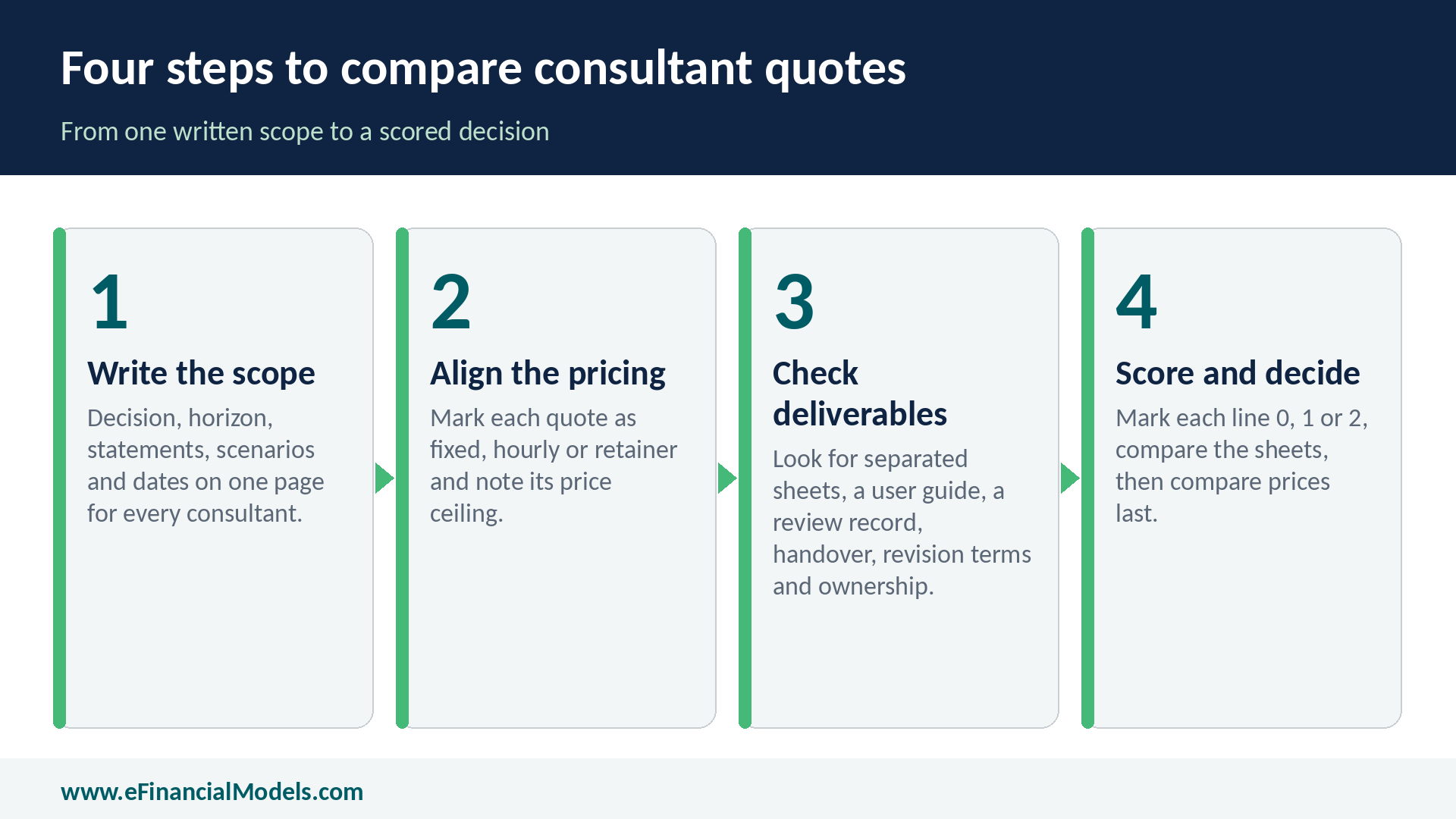
The comparison in four steps, from the written scope to the scored decision.
Conclusion
Comparing consultant quotes comes down to writing the scope once and holding every consultant to it. Founders can start from the Free Three Statement Financial Model from eFinancialModels and apply the five scope lines and the scoring matrix above to every quote.
Frequently Asked Questions
Should a first-time founder pick the cheapest quote?
Not automatically. The cheapest quote often leaves out the lines that cost money later, such as a review, a handover or extra revision rounds, so its real price appears only after the gaps are filled. A better rule is to set aside any quote with a zero on the scope, review or handover line first and then compare prices among the rest, asking the cheaper consultant in writing what the lower fee leaves out.
How many quotes are enough?
Three is usually enough to see the spread without burying the founder in paperwork. Fewer than three gives no sense of what is normal, and more than five turns the comparison into a second project. Because every consultant receives the same one-page scope, three quotes can be marked in a single sitting, and a further consultant joins only when all three leave the same line empty.
Who should own the model file after the project ends?
The founder should own it, and the quote should say so. Ownership that passes on payment lets the founder hand the file to an accountant, a new hire or an investor without asking permission. A consultant who wants to keep ownership, or who locks the file, is selling a subscription rather than a model, which counts as a red flag from the list above.
Can a template replace a consultant for a first model?
Sometimes. A template suits a simple business with one product line and a short horizon, because the layout already exists and the founder fills in assumptions. A consultant suits cases where the revenue logic is unusual, the model must go to a lender, or nobody on the team can review the formulas. The scope page shows which case applies: if most lines fit a ready layout, a template is enough.