0 ITEMS

Paid vs Free Financial Models: The ROI of Professional Templates

A paid template earns its price when the checking and rebuilding time it saves is worth more than it costs, and published evidence shows why that time matters: audited spreadsheets are full of errors and general-purpose chatbots score poorly on finance tasks. Free templates and chatbots still make sensible learning tools, but a model that a lender or investor will read deserves a reviewed, supported file.
Key Takeaways
- A paid template pays back when the hours it saves, valued at the founder’s own rate, exceed its price; four hours break even in the example.
- Audits of real spreadsheets found errors in most of them, so every model, free or paid, needs checking before anyone relies on it.
- AI models missed many questions in finance benchmarks, so their formulas and figures need the same review as any other draft.
- The sources reviewed here include no benchmark of paid against free template errors, so buyers should ask each seller about testing and support.
- Free templates and chatbots suit learning and rough drafts; paid templates suit models that lenders or investors will read.
Why pay for a template when free ones and ChatGPT exist?
Paying makes sense when the file saves more of the buyer’s time than it costs, because the return on investment (ROI), meaning the net gain divided by the cost, turns positive as soon as saved hours outweigh the price. A free file costs nothing to download but still costs hours to inspect, adapt and trust, and a chatbot draft costs minutes to produce but hours to verify.
Public guidance shows how much there is to build. For a traditional business plan, the U.S. Small Business Administration (SBA) gives three instructions: provide a prospective financial outlook for the next five years; include forecasted income statements, balance sheets, cash flow statements and capital expenditure budgets; and be more specific in the first year, using quarterly or even monthly projections, in its business plan guide. The 2025 Report on Employer Firms: Findings from the 2024 Small Business Credit Survey, published by the Federal Reserve Banks, found that more than half of firms cited paying operating expenses (56%) or uneven cash flows (51%) as challenges. That survey covers U.S. employer firms and does not rank model components, so the inference that a working cash flow forecast is the part of a model founders most need to get right is the article’s own.
How do paid, free and chatbot-built models compare?
The table below compares the three routes on the factors that decide whether a model can be trusted. The sources cited here do not include a certified public accountant (CPA) verified benchmark that compares paid and free templates directly, so each row either rests on evidence discussed in this article or names a check the buyer can run.
| Factor | Free template | Chatbot-built model | Paid professional template |
|---|---|---|---|
| Scope against SBA guidance | Can be a single sheet or a short horizon | Depends on the prompt; statements may not link | Can be built to the multi-statement, five-year scope SBA guidance describes; ask for a sample sheet |
| Error exposure | Unknown author checks; every cell needs inspecting | Benchmarks show frequent wrong answers | Same spreadsheet risk, but the author carries a reputation and can fix faults |
| Testing and review | Left to the user | Left to the user | Ask for the checks the author ran and the balance check cell |
| Support and updates | Check whether any support is offered | None; each chat starts again | Questions answered and files updated by the seller, if the policy says so |
| Industry alignment | Generic layout | Generic unless the prompt is detailed | Can be built around one industry’s revenue and cost logic; ask which logic is included |
| Audit trail | May not document assumptions | Reasoning is not stored in the file | Assumptions and sources can be listed on a sheet |
The advantages in the last column are things to verify before paying, because a price tag alone proves none of them.
What do spreadsheet error studies say about free and paid files?
They say that any spreadsheet may be wrong, which is a cost that every file, free or paid, leaves with the buyer. Researcher Raymond Panko’s 2015 paper on spreadsheet errors reported that the studies it reviews collectively found errors in 94% of the spreadsheets studied, and that commercial inspections found cell error rates of 1.2%, 2.2% and 2.5%. The 94% figure pools field audits of many kinds of spreadsheet, so it points to a general risk and not to a rate for any single template.
The UK National Audit Office (NAO) made the same point about public money in 2023, writing in its guide to quality assurance of models that errors in government models have directly caused significant losses of public money and delays to critical public programmes.
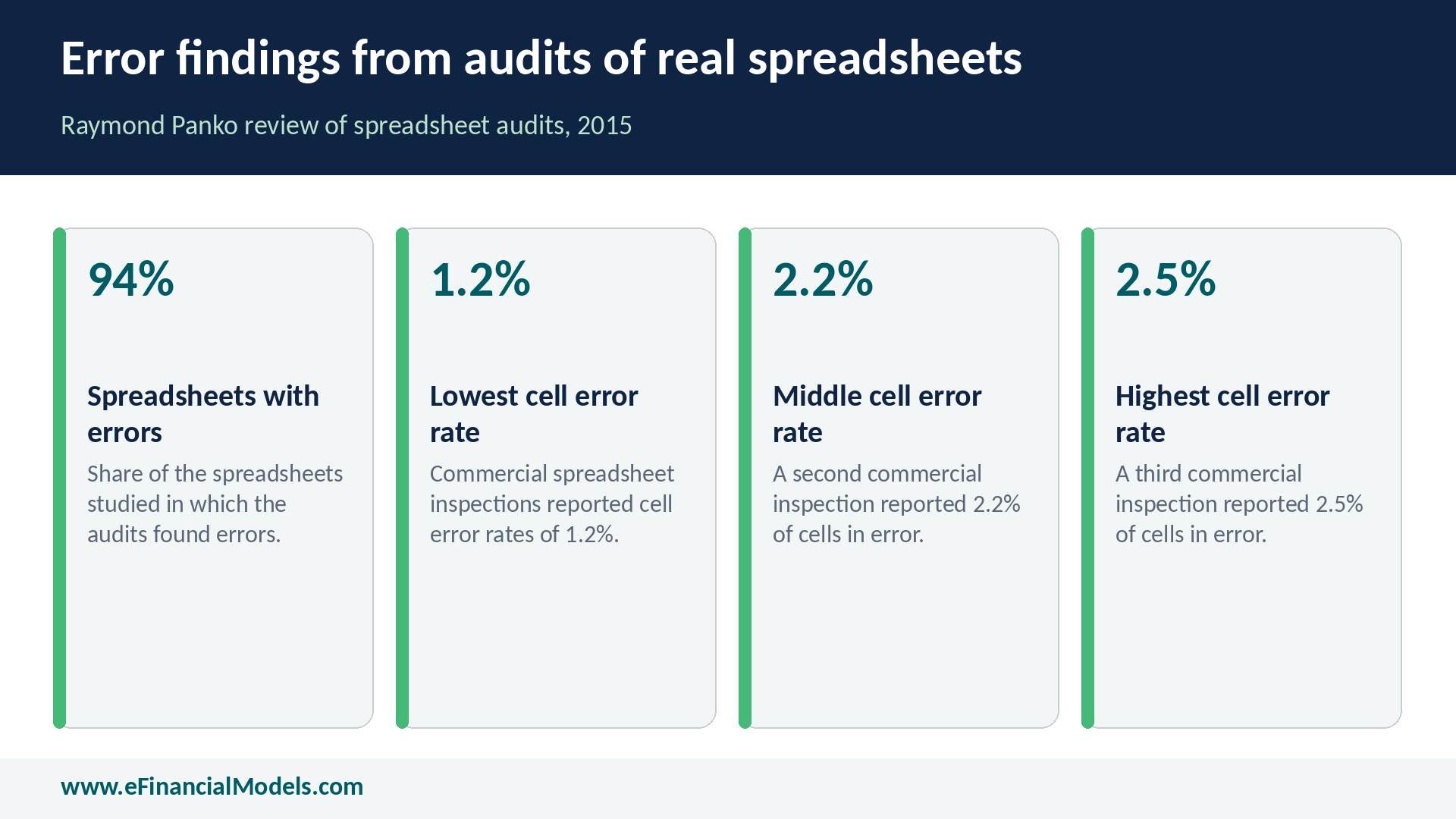
Four findings from Raymond Panko’s 2015 paper on spreadsheet errors, showing the share of spreadsheets and of cells in error.
A paid template does not escape this risk, since it is also a spreadsheet. What it can offer is an author who tested the file, a reputation at stake and a person to ask when a result looks wrong.
How accurate are chatbots at finance work?
Large language models (the systems behind tools such as ChatGPT) and the agents built on them are not yet reliable enough to be trusted without review on finance tasks, according to three published benchmarks that tested different setups. A 2023 benchmark from Patronus AI about questions on public company filings, called FinanceBench, reported that OpenAI’s generative pre-trained transformer (GPT) model GPT-4-Turbo, used with a retrieval system, incorrectly answered or refused to answer 81% of questions.
A 2025 Finance Agent Benchmark of 537 expert-authored questions reported that even the best-performing model, OpenAI o3, achieved only 46.8% accuracy. A 2024 spreadsheet test, SpreadsheetBench, built from 912 real questions gathered from online Excel forums, reported that Copilot in Excel, the most advanced spreadsheet agent it tested, achieved an accuracy of roughly 20%.
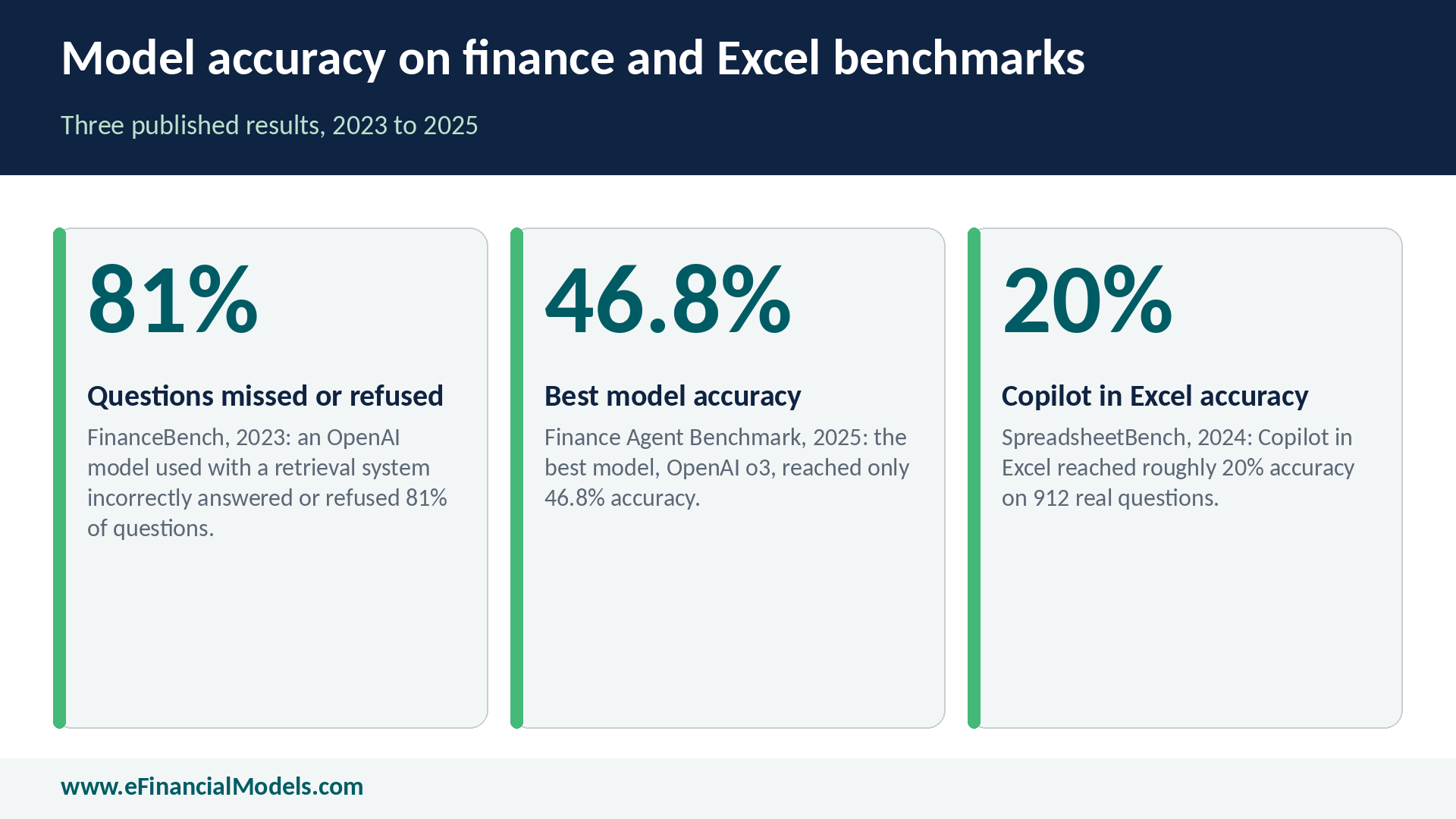
Three published benchmark results for language models and agents on finance and Excel questions, from 2023 to 2025.
These benchmarks measure question answering and spreadsheet editing, not the building of a complete financial model, and newer models may score higher. They still show why a chatbot draft needs the same line-by-line review as a free download.
What does the return on investment look like in a worked example?
Assume a founder buys a paid template for USD 200 and values an hour of their own time at USD 50. Assume, as an illustration and not a measured figure, that the template saves 20 hours of building, formula checking and layout work compared with starting from a free file.
The time saved is worth 20 hours × USD 50 = USD 1,000. The net gain is USD 1,000 − USD 200 = USD 800. The ROI is then USD 800 / USD 200 = 4, which is 400% when written as a percentage, and the break-even point is USD 200 / USD 50 = 4 hours, so the template pays for itself once it saves more than four hours.
The same logic applies to a chatbot draft, whose cost is the hours spent verifying every formula, so it beats a paid template only when verification takes fewer hours than the template would have saved. The result depends entirely on the hours saved, so a buyer who expects to save two hours should not buy on ROI grounds. The example also leaves out the cost of an error reaching a lender, which is why the four checks in the next section matter more than the price.
When is a free template or a chatbot enough?
A free template or a chatbot draft is enough when the model is for learning, for a rough single-product estimate or for a first conversation, and a paid template is the better choice when a lender, investor or partner will rely on the numbers. Buyers can try the idea cheaply by downloading from the free financial model templates collection and checking how many rows match their business, then comparing with ready-made options in the financial model category.
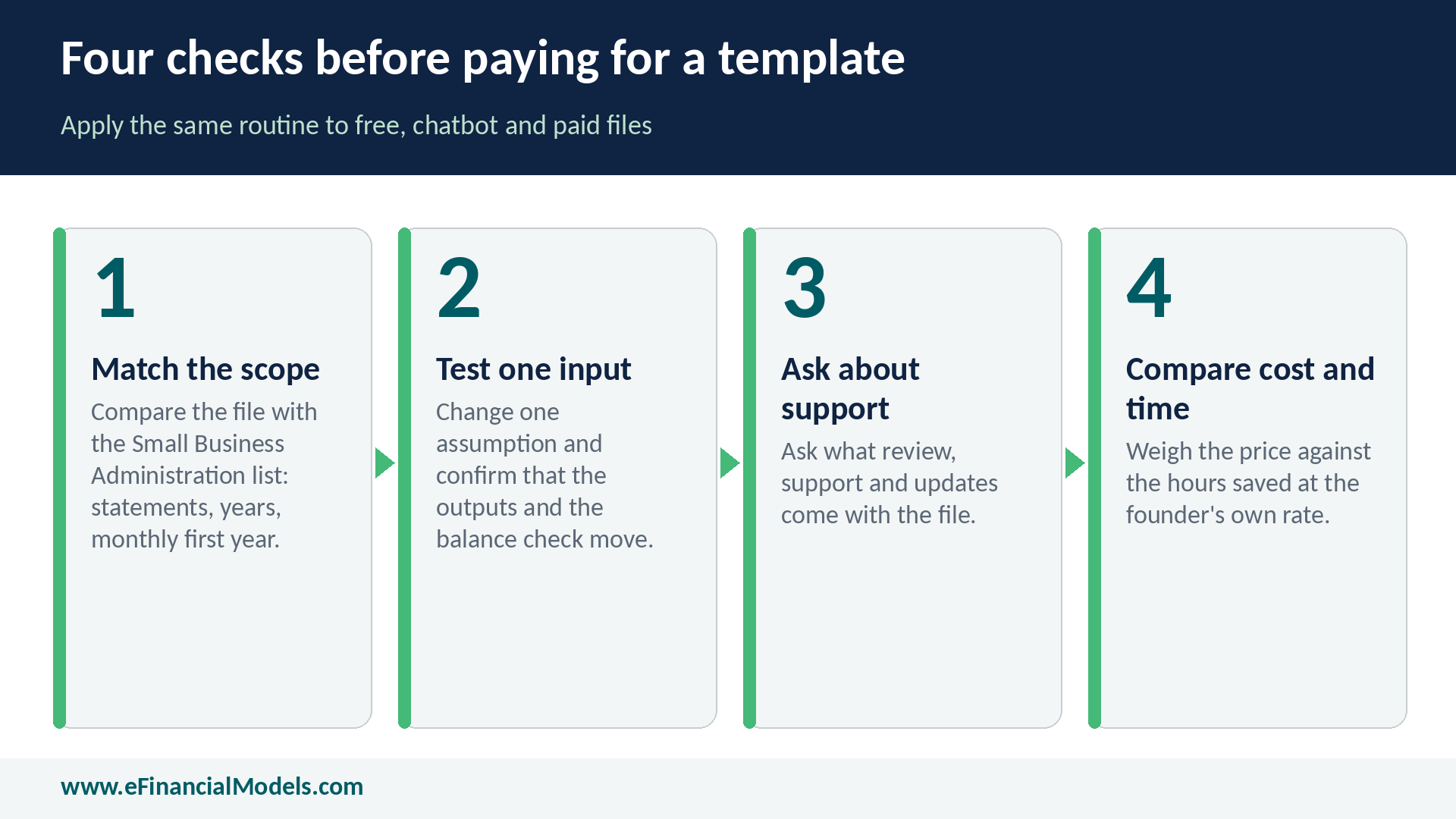
A four-step routine for testing any template, free or paid, before paying or relying on it.
The four checks are to match the scope to the Small Business Administration list, to change one input and confirm that the outputs and the balance check move, to ask what review, support and updates come with the file, and to compare the price with the hours saved at the founder’s own rate. They work for every route, which keeps the comparison fair: a file that passes them earns trust, and a file that fails them is expensive at any price.
Conclusion
A paid template is worth its price when it saves more hours than it costs and arrives with testing and support, and a free file or chatbot draft is worth keeping for learning and quick estimates. Founders of subscription software businesses can continue with the eFinancialModels SaaS Business Financial Model, which its product page says “comes in three different versions, each as a fully editable Excel file”, and run the four checks above before sharing it.
Frequently Asked Questions
Can ChatGPT build a financial model from a prompt?
It can produce a layout and some formulas, which is useful for brainstorming the structure of a model. The problem is reliability: the draft has to be rebuilt cell by cell to confirm that the statements link, the balance sheet balances and each assumption is stated. A founder who cannot do that check yet gains little from the speed, and a founder who can do it may find that starting from a tested file is quicker still.
What should a founder ask a template seller before paying?
These four questions expand the third check above. Which checks did the author run, and is there a cell that confirms the balance sheet balances? What does the support policy say about questions and fixes after purchase? How are updates delivered when tax rules or layouts change? Which industry logic is built in, and can the seller show a sample sheet? Clear, specific answers are a stronger signal than a long feature list.
Does a higher price mean fewer errors in a template?
Not by itself. Price reflects the author’s time, the industry depth and the support promised, and none of those guarantees a flawless file, because the spreadsheet risk described earlier applies to every workbook. Buyers get better evidence from a documented test routine, a visible assumptions sheet and a seller who answers questions quickly than from the number on the checkout page.
Who should review the model before it goes to investors?
A second person who did not build it. That reader can be an accountant, an advisor or an experienced colleague, and the task is to trace a few results back to their inputs, try extreme assumptions and confirm that the figures agree with the pitch materials. Reviewing a bought template can be faster than reviewing a scratch build, because the structure may be familiar, but the assumptions still belong to the founder and still need a reader.