0 ITEMS

Financial Model Templates: Fast-Track Your Analysis
A ready-made template usually reaches a working model sooner than a scratch build, because its layout, links and formulas already exist, while building wins only when a template would need rewriting. The sections below put both routes into hours and cost, then show which checks to schedule before anyone relies on the result.
Key Takeaways
- A template is usually faster because its sheets, links and formulas exist, so the first hours go on the business’s own numbers.
- The U.S. Small Business Administration advises business plans to carry a five-year financial outlook with forecast income statements, balance sheets and cash flows.
- In the worked example, assuming wage cost only, a template saves 42 hours, worth $2,100 at an assumed $50 an hour.
- Building from scratch wins when the template needs rewriting, because rework hours can erase the whole saving.
- Review time belongs in both estimates, because the UK National Audit Office reports that errors in government models have caused significant losses of public money.
How fast can a template get a working model?
A template gets a working model fastest because the work a builder would do first is already finished. Its sheets are laid out, its statements are linked and its formulas are written, so the first day goes on entering the business’s own numbers. A scratch build starts earlier in the process: the builder designs the layout, writes every formula, links the statements so the balance sheet balances, and only then begins entering assumptions.
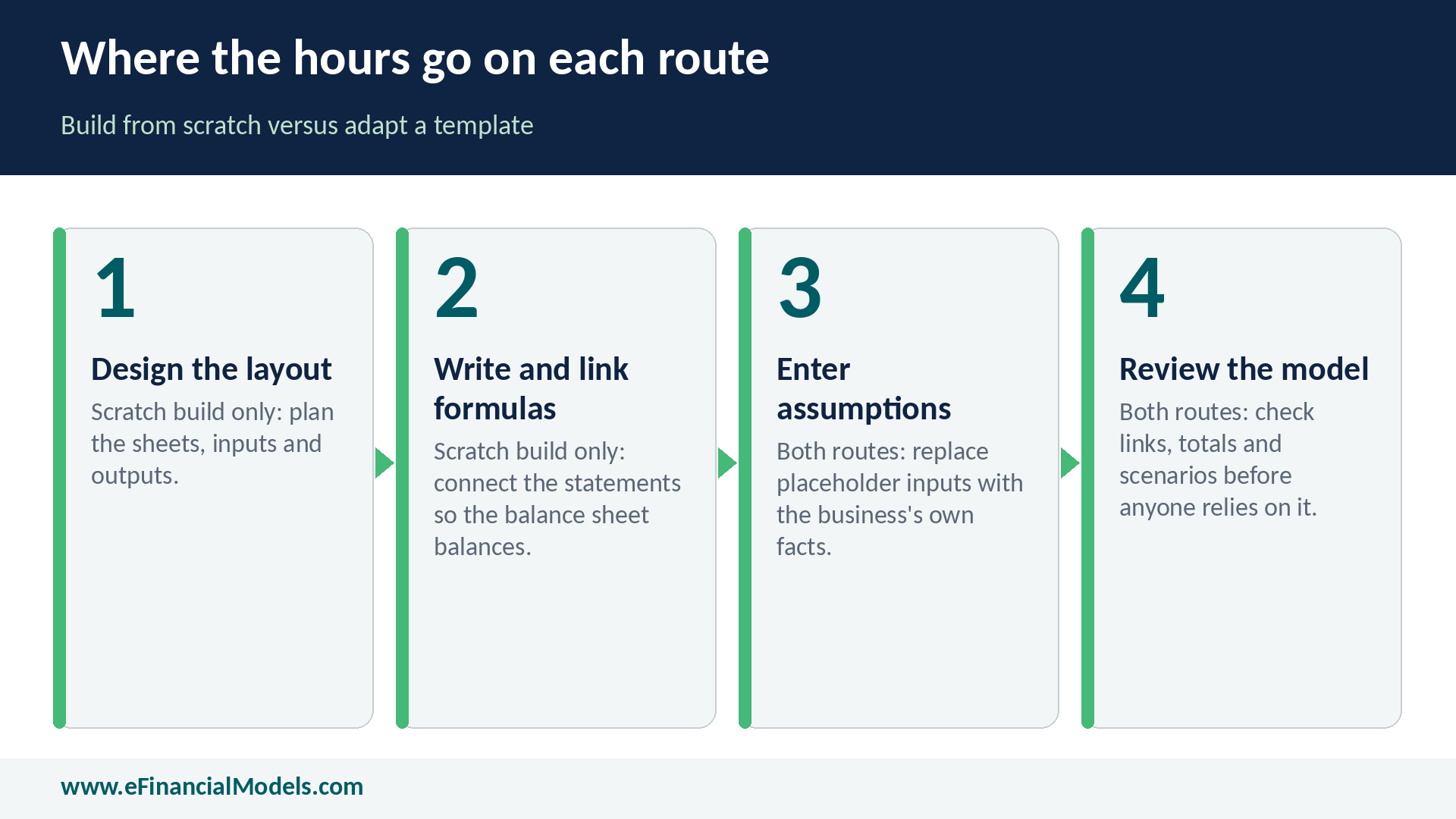
Four work blocks of a financial model, showing which two a template removes from the schedule.
Published sources give no standard build time for a financial model, so any hour count is an estimate that depends on the builder’s skill and the complexity of the business. What public guidance does fix is the scope that both routes must reach when the model feeds a business plan. The U.S. Small Business Administration tells owners to provide a financial outlook for the next five years, to include forecast income statements, balance sheets, cash flow statements and capital expenditure budgets, and to use quarterly or even monthly projections for the first year, according to its business plan guide. A model with that scope contains many linked cells, which is exactly the part a template supplies in advance. A model built for a narrower purpose may need less.
Planning is also a gap for many owners. A Gallup poll published in May 2026 found that 71% of business owners do not have a business plan, according to its report on business planning. A template gives such an owner a finished structure to fill in rather than a blank file.
Worked example: what do the saved hours cost?
In this example, assume a scratch build takes 60 hours, adapting a template takes 18 hours, review takes 6 hours on either route, and a modelling day holds 6 productive hours. Time is valued at an assumed $50 an hour, a figure readers should replace with their own hourly cost including benefits and overheads. These are illustrative assumptions, not measured averages, and the example covers wage cost only: it leaves out the template’s purchase price.
| Route | Build or adapt hours | Review hours | Total hours | Working days | Labour cost |
|---|---|---|---|---|---|
| Build from scratch | 60 | 6 | 66 | 11 | $3,300 |
| Adapt a template | 18 | 6 | 24 | 4 | $1,200 |
The arithmetic follows from the stated inputs. Sixty hours of building plus six of review makes 66 hours, which at $50 an hour costs $3,300. Eighteen hours of adapting plus six of review makes 24 hours, which costs $1,200. Dividing each total by six productive hours a day gives 11 working days for the build and 4 for the template. The gap between the routes is 42 hours, which at $50 an hour is $2,100, the same as $3,300 minus $1,200. So in this example a template priced below $2,100 costs less than the build.
The saving depends on fit. If the template needed 55 hours of rework instead of 18, its total would be 61 hours, the gap would shrink to 5 hours, worth $250 at $50 an hour, and any template priced above $250 would cost more than the build. Rework hours and template price together decide the result.
When does building from scratch still win?
Building wins when adapting the template means replacing its logic rather than filling it in. Three cases stand out: revenue that follows unusual rules, such as milestone payments or usage tiers that no template models; a group with several legal entities or currencies that must be consolidated; and a builder who will reuse one custom structure across many projects. Consolidation cases fall outside the worked example, and a modelling consultant or accountant is the right person to scope them.
A simple fit test settles most cases before any money is spent. Count the template’s input rows and mark how many already match facts the business knows. As a rule of thumb, not a measured threshold, a template where more than half the rows match is worth filling in, and one where most of the revenue and cost logic must be replaced is a scratch build with extra reading. Buyers who want to compare candidates quickly can scan a template bundle or the financial model category from eFinancialModels and see how many rows their own business maps onto.
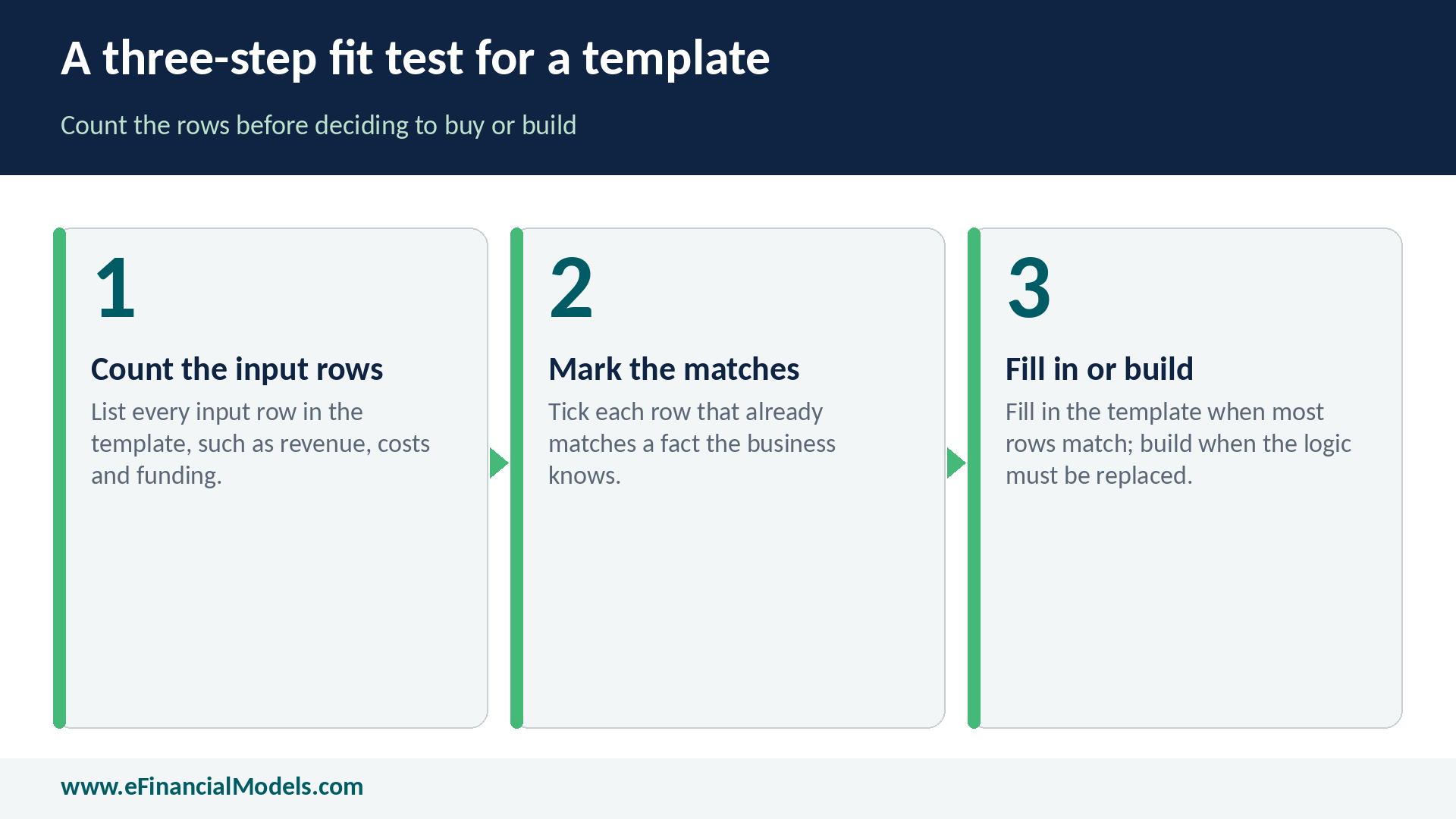
A three-step fit test that turns the buy-or-build question into a count of matching input rows.
Why must checking time sit inside both estimates?
Checking adds time to both routes, and skipping it is how a fast file becomes a slow one. A 2024 study, reported by Phys.org, found that 94% of spreadsheets used in business decision-making contain errors.
The UK National Audit Office wrote in May 2023 that errors in government models have directly caused significant losses of public money and delays to critical programmes, in its guide to quality assurance of models.
Structure also affects review time. The Flexible, Appropriate, Structured and Transparent (FAST) Standard, a rule set for the structure and design of efficient spreadsheets, states that a consistent approach to structuring workbooks, worksheets and formulas saves time when building, learning or maintaining a model, on its rules page. Buyers can check whether a template follows a consistent structure of this kind, because a consistent layout shortens a second reader’s job.
What is the quickest route to a trusted model?
The quickest trusted model comes from a short fixed sequence that treats checks as part of the schedule. Each step below has a defined output, so progress can be measured in finished sheets rather than in effort.
- Scope the model: list the statements, the years and the scenarios that readers expect.
- Fit-test the template: count the input rows that already match the business.
- Fill and link: enter the business’s own assumptions and confirm every link still works.
- Check before sharing: have someone other than the builder confirm that the balance sheet balances in every period, recompute one period by hand and change one input to watch the outputs respond.
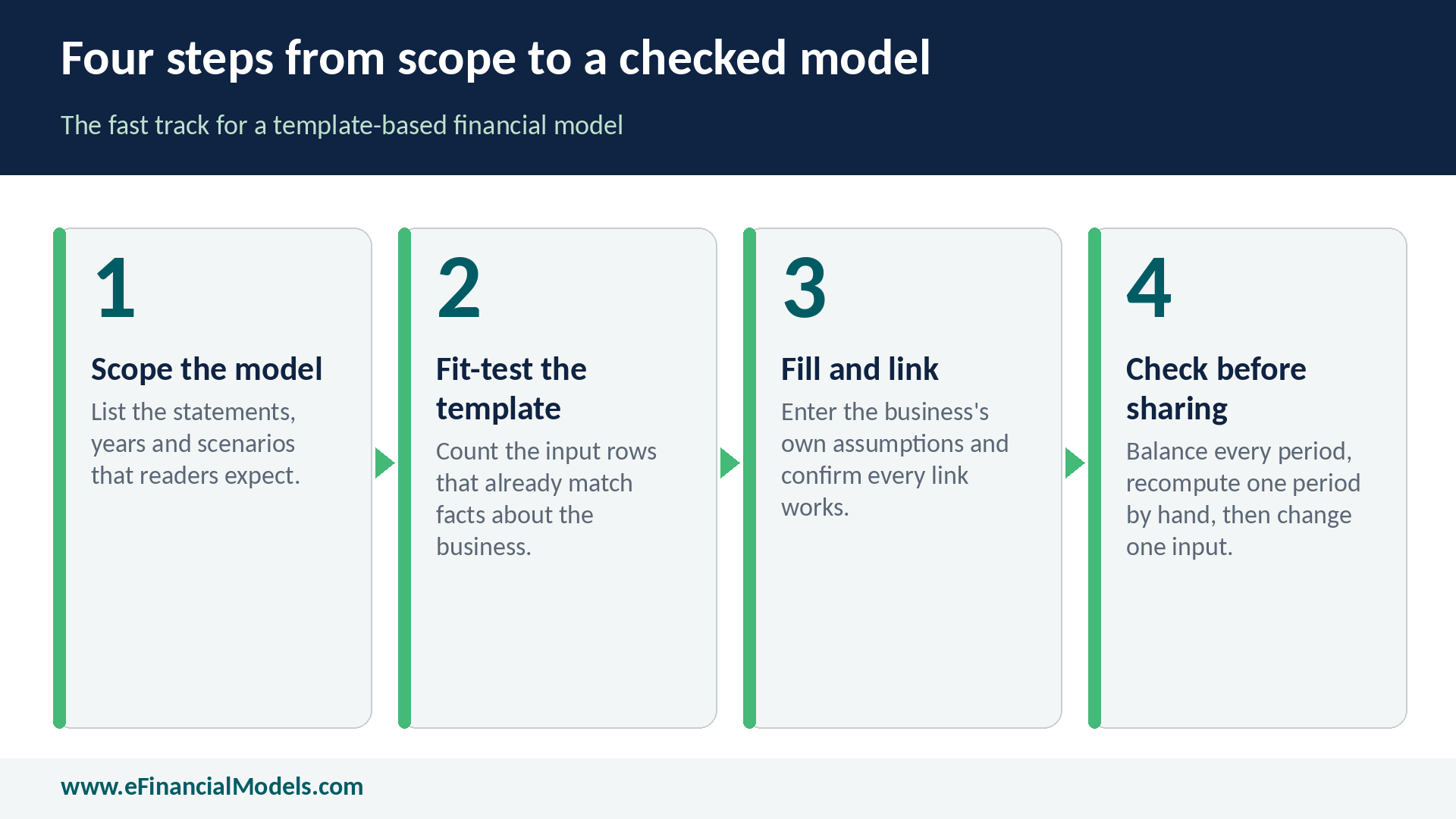
A four-step path that puts the audience’s needs first and the checks last, so review time is part of the schedule.
Conclusion
A template is the faster path to a working model whenever the business fits its structure, and the worked example shows why: 42 saved hours are worth $2,100 in wage cost under the example’s assumed hours, before the template’s price, and only while rework stays small. Readers can continue with the eFinancialModels Free Three Statement Financial Model, which its product page describes as a “5-Year Three Statement Financial Model Excel Template” that is “fully editable and unlocked”.
Frequently Asked Questions
How can the time estimate be tested in one hour?
Open the candidate template and spend one hour entering real figures into its input sheet, starting with revenue and the largest cost lines. Record how many rows accepted data without changes and how many needed new logic. Divide the hours spent by the rows completed, then multiply by the rows remaining to extrapolate the adaptation time, and count rows that need new logic separately, with a higher hours-per-row figure than rows that only need data entry. A trial hour costs little and replaces a guess with a measurement, which makes the later buy or build decision far easier to defend.
Who should review the finished model?
A second person who did not build or fill in the file should review it, because the author tends to read the logic they intended rather than the logic on the screen. The reviewer needs the assumptions list, a short description of the structure and about an hour per major sheet as an illustrative rule of thumb. Naming the reviewer in the model’s notes also records who checked the numbers, which shortens later questions from anyone relying on the file.
What happens to the time saving when the business changes?
The saving carries over only while changes stay inside the template’s design. Adding a product line to an existing structure is usually quick, while changing how revenue is recognised can mean editing linked sheets across the file. Each structural edit reintroduces checking time, so a business that expects frequent changes should weigh how often it will need to open the formulas, not only how fast the first version is finished.
Is a free template fast enough for a first draft?
For a first draft, often yes. A free file suits a single product line, a short horizon and a reader who wants only a rough picture, and it teaches what a full model contains before any money is spent. The U.S. Small Business Administration guide advises business plans to carry a five-year financial outlook, so a free file that stops short of that horizon works as a learning draft that a fuller model later replaces.