0 ITEMS

Financial Modeling Best Practices: Beyond the Spreadsheet

A reliable financial model is one whose inputs sit apart from its calculations, whose results can be traced and checked, whose scenarios have been tested and whose assumptions are written down, so that a second person gets the same answers. Polish shows none of that, because a handsome file can still hold errors nobody has looked for.
Key Takeaways
- Reliability means a second reader can trace, test and reproduce every result; formatting and charts do not prove it.
- Separate inputs, calculations and outputs, as the Institute of Chartered Accountants in England and Wales code advises, so every number has one visible home.
- Spreadsheet errors are widespread in business use, so built-in checks are a requirement, not an extra.
- Flexibility means one changed assumption updates every output and scenarios run without rebuilding, which testing proves and typed-over numbers quietly break.
- Documentation names an owner, lists each assumption with its source and logs every change, so the model survives staff turnover.
What makes a financial model reliable and not just good-looking?
A reliable model produces the same answer for anyone who follows its logic, and it shows where each number comes from. A good-looking model has clean fonts, tidy charts and consistent colours, which help readers but say nothing about whether the arithmetic is right. Three tests separate the two: accuracy (the formulas calculate what they claim), flexibility (assumptions can change without breaking anything) and documentation (a stranger can understand and check the file).
The Institute of Chartered Accountants in England and Wales (ICAEW) turns this into a rule in its Financial Modelling Code (2024 edition), which tells modellers to “Segregate inputs (assumptions), calculations and outputs (results)”. The rule matters because a reviewer can then change an input in one place and see the effect in another, instead of hunting through formulas for a typed-over value.
How common are errors in spreadsheet models, and what do they cost?
Errors are common enough that every model needs built-in checks. A recent study found that 94% of spreadsheets used in business decision-making contain errors, according to Phys.org’s 2024 report on the literature review. Raymond Panko’s 2015 paper reviews audits of real spreadsheets and reports errors in 94% of the spreadsheets studied, according to his paper on spreadsheet errors. Neither finding proves that any single file is wrong.
Reliance keeps the risk live. The Association for Financial Professionals’ 2025 benchmarking survey, which drew 362 responses from planning and analysis practitioners worldwide, found that 96% of respondents use spreadsheets for planning, according to its 2025 survey report.
Cell-level rates are smaller but add up in a large file. The same paper tabulates intensive inspections of operational spreadsheets, in which Hicks (1995) found a cell error rate of 1.2% and Lukasic (1998) found rates of 2.2% and 2.5%, as its published table shows, and as an illustration, a model with 2,000 formula cells at the 1.2% rate would hold about 24 faulty cells. The consequences can be public: Public Health England said that 15,841 positive coronavirus cases from 25 September to 2 October 2020 had been left out of its figures, and reporting traced the omission to an older Excel file format that holds at most 65,536 rows, as iTnews reported.
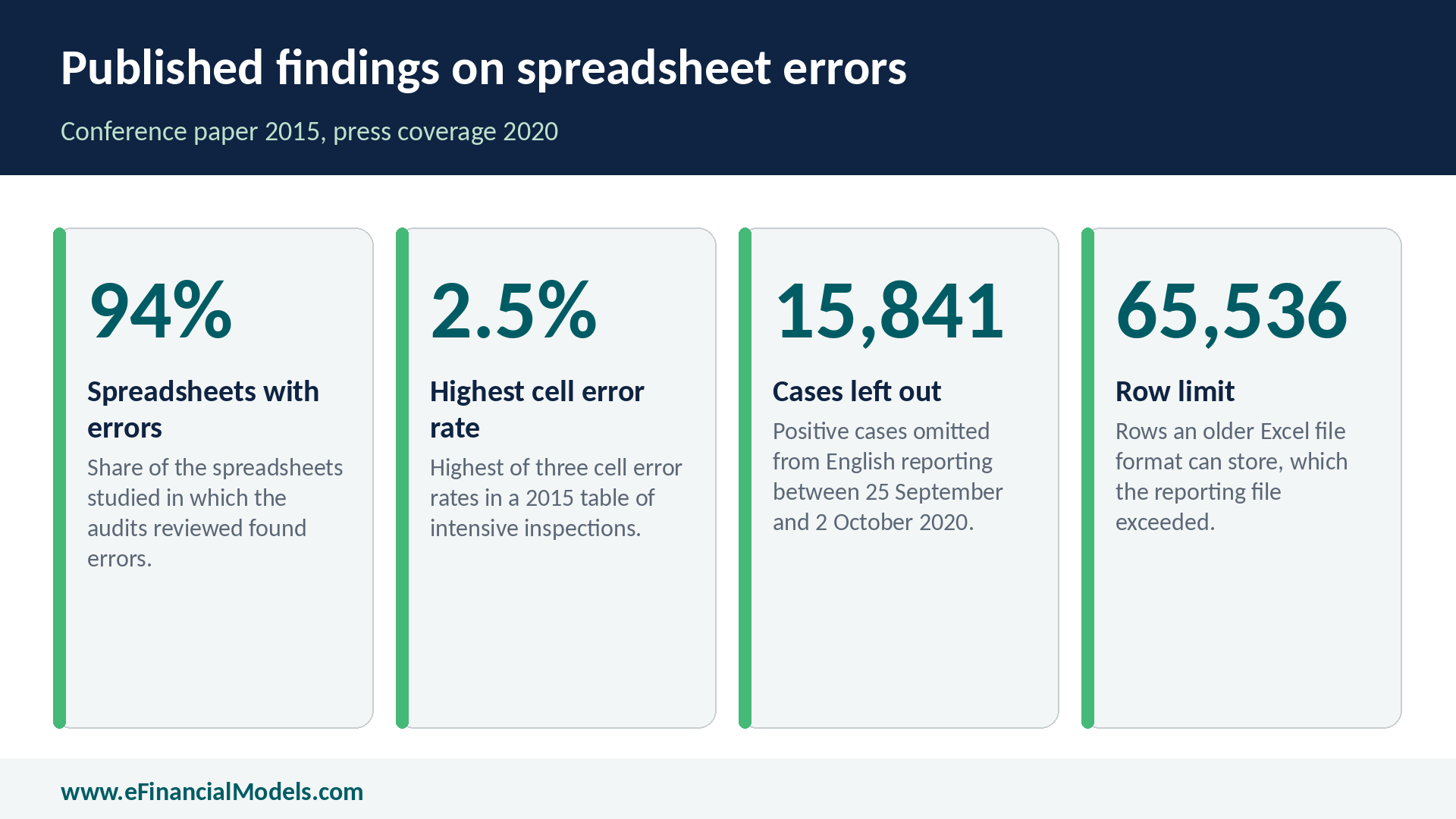
Four published findings on spreadsheet error, drawn from a 2015 conference paper and 2020 press coverage.
What does accuracy require? A checklist
Accuracy requires a structure that makes errors visible, then checks that catch the ones that remain.
- Inputs: keep every assumption on one sheet, with a unit, a source and a date beside it.
- Calculations: write one formula per row and copy it across every period, with no typed numbers inside formulas.
- Checks: confirm that the balance sheet balances in every period, that balance sheet cash equals closing cash on the cash flow statement and that subtotals equal the sum of their parts, then roll the results into one summary check cell.
- Independent review: have a person who did not build the file trace a sample of results back to inputs.
What does flexibility mean in a financial model?
A flexible model changes every dependent result when one assumption changes, and it runs best, base and worst cases without anyone rebuilding the file. The test is sensitivity analysis, which means changing one input at a time and watching how the outputs move; scenario analysis then changes several inputs together to build best, base and worst cases.
An illustrative example shows why small input changes deserve their own scenario. Assume a business with annual revenue of 120,000 USD and costs of 90,000 USD, so profit is 30,000 USD. If costs rise 10%, they become 99,000 USD and profit falls to 21,000 USD, a drop of 30%. A model that stores the cost growth rate as a single input on the inputs sheet answers that question in seconds, while a model with typed-over costs cannot.
Why does documentation decide whether a model survives?
Documentation lets a person who did not build the model use it, check it and update it. Without it, the model can become unusable once its author leaves. The UK Treasury’s 2013 review of quality assurance in government analytical models said that each business critical model should have clear documentation and recommended a single Senior Responsible Owner for each model, in its final report.
A short documentation set is enough for most businesses:
- Purpose: one paragraph stating the decision the model supports and who reads it.
- Assumption list: each input with its source, date and the person who approved it.
- Change log: the date, author and reason for every edit after the first release.
- Owner: one named person who approves changes and decides when actuals replace forecasts.
How do industry examples change the checklist?
The structure stays the same across industries, but the inputs that need the most scrutiny differ.
In a renewable energy project, the inputs to isolate are panel or turbine output decline, the power price and the loan terms. The check to add is the debt service coverage ratio, which measures the cash available to pay loan interest and principal divided by those scheduled payments, tested in the worst case as well as the base case. The renewable energy category groups models built for this kind of project.
In real estate, rent growth, vacancy and the capitalisation rate (annual net operating income divided by property value) carry most of the risk, so each belongs on the inputs sheet with a stated source. A sensible check is that the valuation falls when the capitalisation rate rises. The real estate category lists models for property investment and development.
In a subscription software business, churn, price changes and billing timing dominate, so each belongs on the inputs sheet with a stated source, and the useful check is that revenue recognised, cash received, receivables and deferred revenue reconcile.
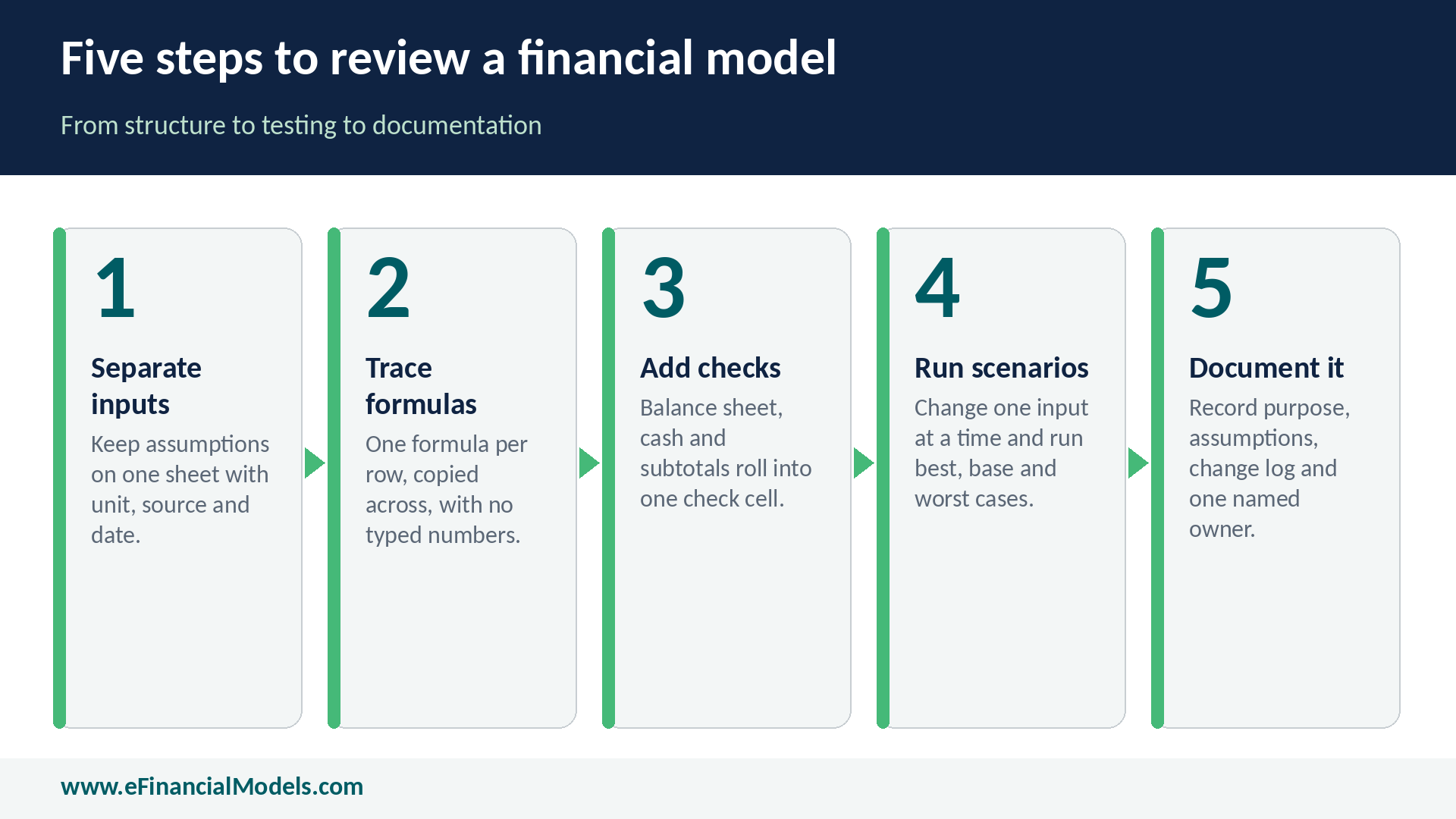
Five review steps in the order a reviewer follows, from structure through testing to documentation.
What pitfalls should a final review catch?
A final review should hunt for the faults that look harmless in a screenshot. Five recur in everyday models:
- Typed-over formulas: a hard-coded number inside a row of formulas; compare each row’s formula across periods.
- Profit mistaken for cash: free cash flow, which is operating cash flow minus capital expenditure, differs from profit, so the model needs its own cash flow statement.
- Hidden limits: row caps, hidden sheets and ranges that stop one row short of new data, as in the Public Health England case.
- Mixed units and periods: thousands added to millions, or monthly rates inside annual formulas.
- A single case: one forecast with no downside, so a plausible shock can never be tested.
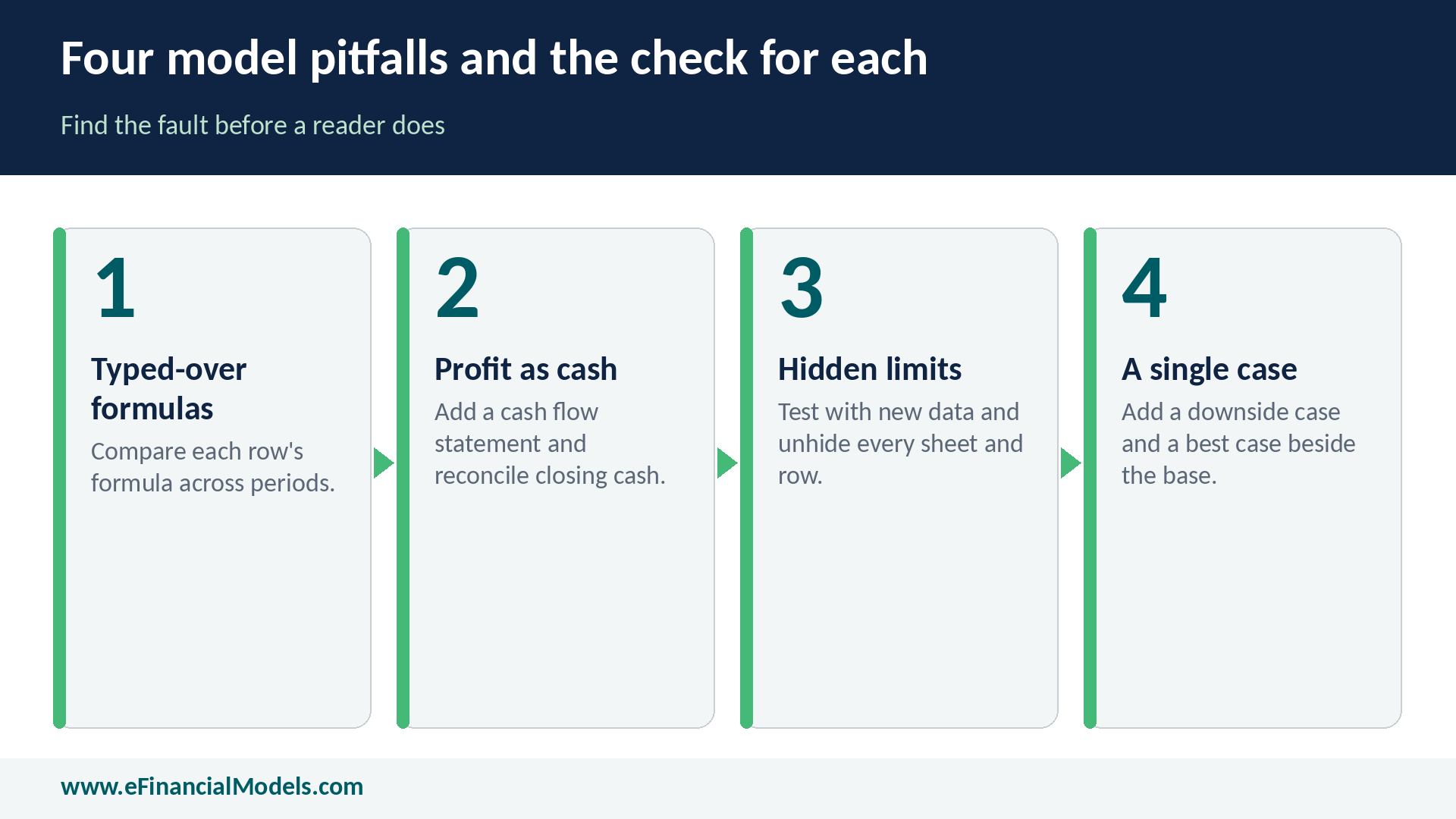
Four of the five pitfalls above, each paired with the check that exposes it.
Conclusion
A reliable model earns trust through structure, checks and records, not appearance: separate the inputs, test the formulas, run scenarios and write the assumptions down. Readers who want a model to test against this checklist can open the Free Three Statement Financial Model from eFinancialModels and run the checks above before relying on its numbers. Before buying any model, a visible inputs sheet, check cells and a documentation tab are quick signs to look for.
Frequently Asked Questions
How often should a financial model be reviewed?
A model deserves a full review before each major use, such as a funding round, a bank application or an annual budget, and a lighter review whenever actual results arrive. The lighter pass compares forecast with actual figures, updates the assumption list and confirms that every check cell still reads clean. A model that nobody has touched for a year probably rests on stale prices and growth rates, so a calendar reminder tied to the owner is worth setting.
Can software replace spreadsheets and make a model reliable automatically?
Dedicated planning software can enforce structure, permissions and audit trails that a loose workbook cannot, and it removes some copy-paste risk. It does not decide whether the assumptions are sensible or whether the logic matches the business, so the same questions apply: who owns the model, who checks it and where the assumptions are recorded. For many small businesses a disciplined workbook with checks is enough, and a bad model migrated into new software stays bad.
Who should check a model when its builder is the only finance person?
An outside reader is still possible. A bookkeeper, an accountant, an advisor or a peer founder can trace three or four results back to the inputs in an hour, which catches many structural faults. Where nobody is available, the builder can leave the file for a few days, then test it as a stranger would: change each input by ten percent, confirm that the outputs move in the expected direction and read the assumption list aloud for anything that sounds wrong.
What is the minimum documentation a small business model needs?
Four items cover most needs: a purpose statement, an assumption list with sources and dates, a change log and one named owner. The purpose statement keeps the model from drifting into questions it was never built to answer. The assumption list lets a lender or investor challenge the numbers directly. The change log explains why one version differs from the next, and the owner decides which version is current.