0 ITEMS

Outsourcing Financial Modeling: Complete Guide for Real Estate

Yes, a financial modeler can build a real estate or project model for a founder, and hiring one pays when lenders expect a structured model sooner than the founder can learn to build it. The sections below cover when to hire, what each route costs, how providers compare and how to brief and check the work.
Key Takeaways
- Outsourcing suits projects where lenders or investors expect a structured model and the founder lacks the build hours.
- Public sources show wide price spreads: freelance financial analysts charge $35 to $300 an hour worldwide, according to goLance.
- A vague brief tends to add scope changes and cost, so a written scope and input list belong before the first invoice.
- Studies of spreadsheets found errors in 94% of those examined, so every outsourced model needs independent review.
- In the worked example, an adapted template costs least when the project fits its structure, and hired help suits the rest.
When does outsourcing a real estate model make sense?
Outsourcing makes sense when a lender or investor will read the model and the founder cannot build or defend it alone. Real estate lenders commonly set limits that a model must prove, such as a maximum loan to cost (LTC) ratio, which divides the loan by the total project cost, and a minimum debt service coverage ratio (DSCR), which divides a year’s net operating income by that year’s loan payments.
Net operating income (NOI) is the rent and other income left after operating costs and before loan payments. A model that gets NOI, debt service and the resulting ratio right in every year is the part a first-time founder most often cannot check personally, and it is the part a hired modeler is paid to get right.
Hiring also fits three situations: a deadline shorter than the learning curve, a structure beyond a standard template such as several phases or an investor profit split, and a decision where a lender will question the numbers. Hiring fits less well when the project is a single simple rental property that a ready-made template already covers.
What do outsourced modelers charge?
Outsourced modelers charge anywhere from tens to hundreds of dollars an hour, and no public source sets a standard price for a real estate model build. The freelance marketplace goLance reports that freelance financial analysts charge $35 to $300 an hour worldwide, depending on experience, in its 2026 hourly rate guide. That guide covers financial analysts in general, so it indicates the spread and not a quote for a real estate model.
A second data point comes from advertised contract work. The job-vacancy tracker ITJobsWatch reports a median daily rate of £575 for United Kingdom contract vacancies that mention financial modelling, across the six months to November 2026, on its financial modelling contracts page. Those are advertised rates for roles, not fees paid for finished models, so the figure shows market level and not a project price.
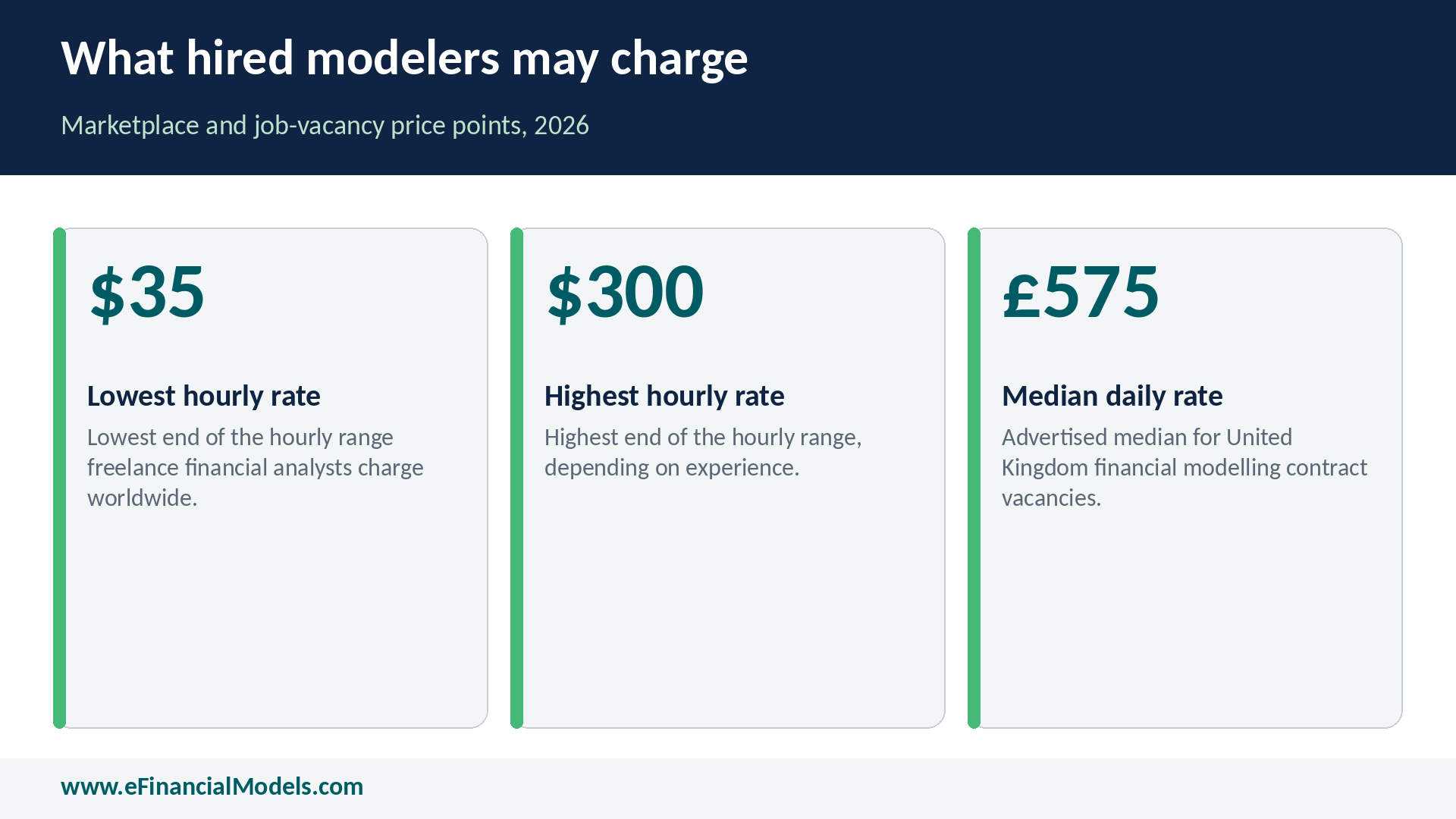
Hourly and daily price points from a freelance marketplace and a job-vacancy tracker, which bracket what a hired modeler may charge.
What does hiring cost against a template? A worked example
Under the assumptions below, hiring costs more than adapting a template, and the gap grows with the provider’s rate. In this example, assume a development model takes 40 hours to build and 8 hours of independent review, so a hired build uses 48 hours. Assume the founder adapts a template in 16 hours, a separate reviewer checks it in 8 hours, all template-route hours are valued at $50 an hour, and the template budget is $300. On the hired routes, a separate reviewer also takes the 8 review hours and is assumed to charge the same rate as the builder. Every route therefore includes independent review. The hourly rates for hired work are illustrative assumptions, with the freelance rate inside the $35 to $300 range above and the consulting rate set higher for the example, and the example prices time and the template budget only, leaving out the founder’s briefing time and other costs.
| Route | Total hours | Assumed rate | Time cost | Template budget | Total cost |
|---|---|---|---|---|---|
| Founder adapts a template | 24 | $50 an hour | $1,200 | $300 | $1,500 |
| Freelance modeler | 48 | $100 an hour | $4,800 | none | $4,800 |
| Consulting firm | 48 | $200 an hour | $9,600 | none | $9,600 |
The hours come from the assumptions: 16 adapting plus 8 reviewing on the template route, and 40 building plus 8 reviewing on the hired routes. Time cost is hours multiplied by the rate, so the template route totals $1,500 once the $300 budget is added, while the hired routes cost $4,800 and $9,600.
Cost is not the only measure when the founder’s own time is scarce. If the founder cannot find the 16 adaptation hours before a lender deadline, the freelance cost buys time, not only a model. The example also assumes the template fits the project, and a poor fit adds rework hours that can erase the saving.
How do the providers compare?
Providers differ most in who carries the risk of a wrong model and how much of the build is already done. The table puts the four routes side by side as general characteristics.
| Route | Best fit | Main cost driver | Main risk |
|---|---|---|---|
| Template from eFinancialModels | Standard project types, founder able to fill inputs | Founder’s adaptation hours plus a listed template or bundle price | Structure may not match the project |
| Freelance modeler | Custom structure, fast turnaround | Hourly rate and scope changes | Quality varies and review may be missing |
| Consulting firm | Lender-facing models needing a named reviewer | Higher hourly rate and fixed minimums | Cost may exceed the project’s budget |
| In-house hire | Ongoing deal flow | Salary and time to hire | Idle capacity between projects |
In the worked example above, the template route costs least when the project fits. The eFinancialModels page for its Real Estate Industry Template Bundle lists financial model templates for the real estate industry and its related sectors, so a founder can review the listed templates before hiring a modeler. The wider real estate financial model category on eFinancialModels lists models for related property sectors. Founders who need custom work can also browse the custom financial modeling service tag, a collection of custom modeling listings.
How should the work be briefed and checked?
A good brief and an independent review matter more than the provider’s name, because review is where errors are caught. Raymond Panko’s paper on spreadsheet errors states: “Collectively, these studies found errors in 94% of the spreadsheets studied.” The finding comes from research on spreadsheets in general, not on real estate models, so it supports a general caution.
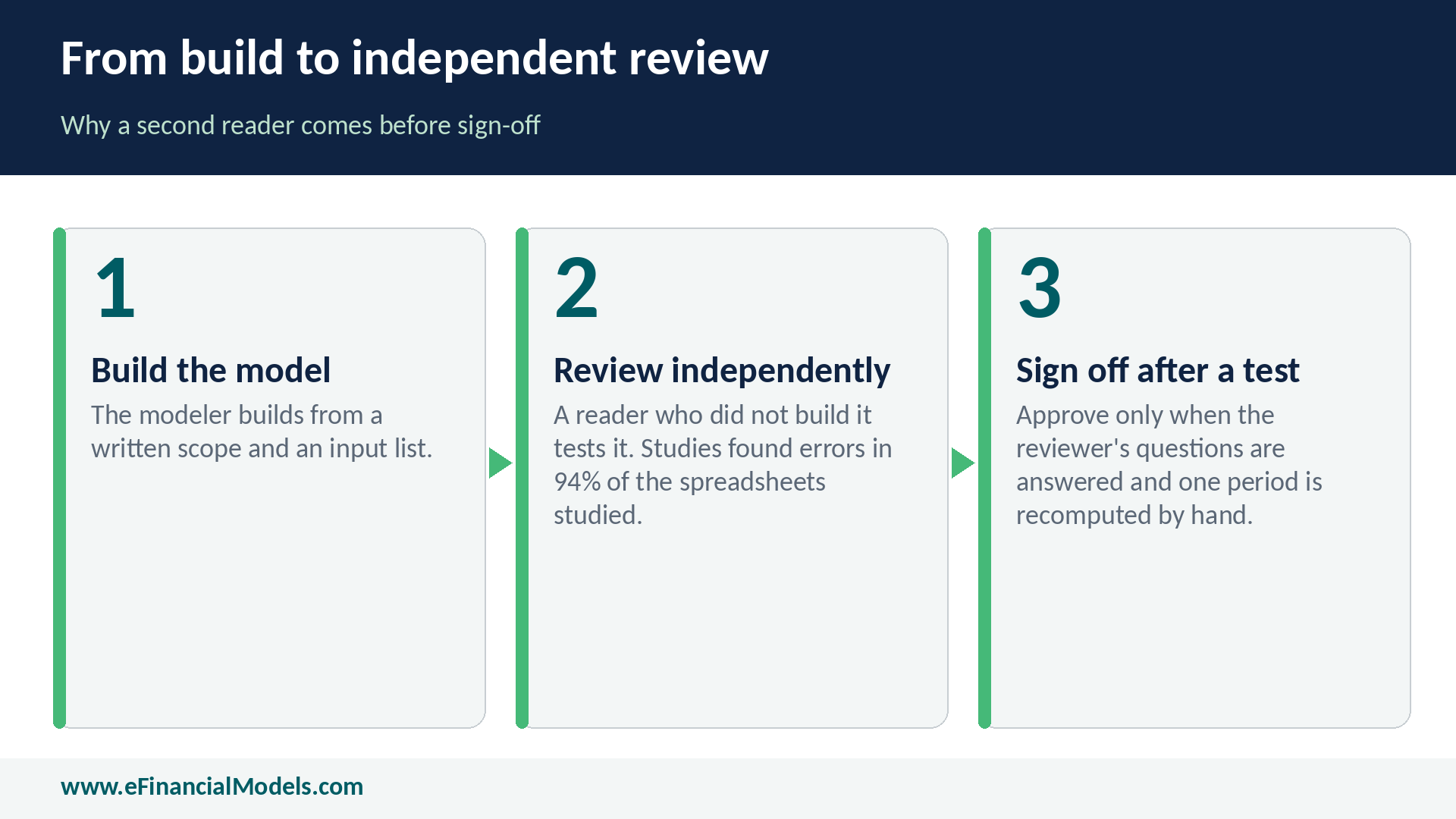
Build, independent review and sign-off in order, with the research finding that explains why review comes second.
UK government guidance sets the same expectation for analysis. The Aqua Book, the government’s guidance on quality assurance of analysis, states: “The assurer and the analyst shall be independent.” That sentence appears in its published guidance. For spreadsheet structure, the Institute of Chartered Accountants in England and Wales (ICAEW) issued the 2024 edition of its Financial Modelling Code to provide “essential guidance to standard-setters, procurers and modellers on good practice”, according to the ICAEW code. A founder can name that code in the brief and ask the modeler to follow it.
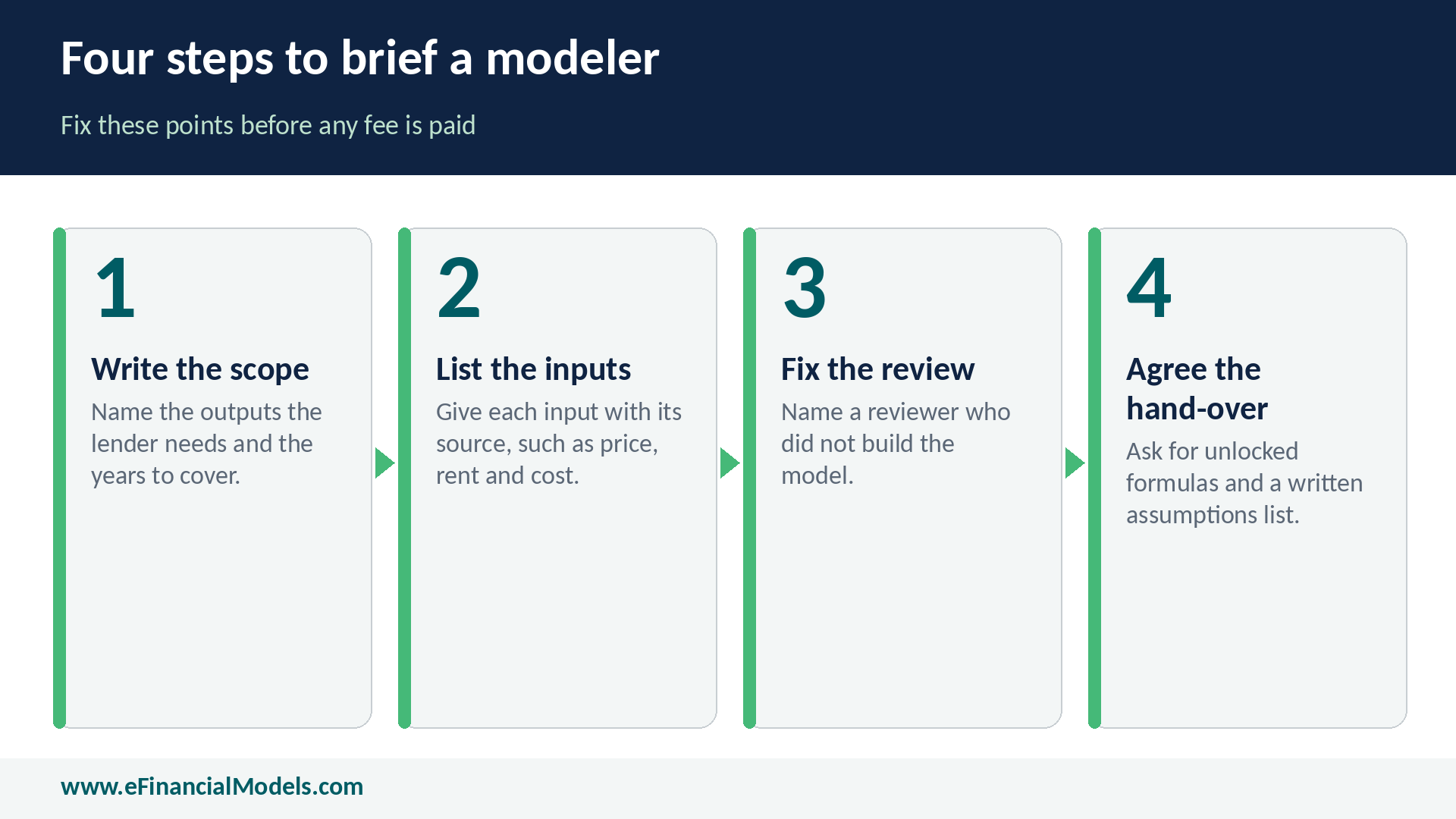
A four-step brief that fixes scope, inputs, review and hand-over before any fee is paid.
A brief of that kind turns a vague request into something a reviewer can test. It names the outputs the lender needs, such as DSCR by year, lists the founder’s inputs with sources, and asks for a sensitivity analysis, which shows how results change when one input such as rent or build cost moves. It also names a reviewer who did not build the model and agrees that the modeler hands over unlocked formulas and an assumptions list.
Conclusion
Outsourcing a real estate model suits founders who face a lender deadline or a structure no template covers, and the worked example puts a freelance build at $4,800 against $1,500 in founder time, reviewer time and template budget under the stated assumptions. Founders who want to test the cheaper route first can open the Real Estate Industry Template Bundle from eFinancialModels, check its structure against the project and brief a modeler only for the gaps.
Frequently Asked Questions
What should a founder prepare before contacting a modeler?
A modeler can only price work that is described, so the founder should gather the site or project facts, the funding plan and the outputs a lender expects before any call. Useful items include a land or purchase price, a construction budget with dates, expected rents or sale prices, the loan terms offered and any investor agreement. A short list of questions the model must answer, such as how large a loan the project can carry, gives the modeler a target and gives the founder a way to judge the result.
Who owns the model after delivery?
Ownership depends on the contract, so it should be settled before work starts. A founder normally wants the finished workbook with unlocked formulas, a written list of assumptions and the right to edit and reuse it for later phases. Some providers keep the underlying template and license a copy, which can limit reuse. Asking one question in writing, whether the founder may change and reuse the file without the provider, avoids a dispute when the project changes.
Can a modeler also check a model someone else built?
Yes, and a review can cost less than a full build because the modeler reads and tests the existing file instead of constructing it. A reviewer typically traces links between sheets, checks that sources and uses of funds, and the balance sheet where there is one, balance in every period, recomputes a sample year by hand and changes inputs to see whether outputs respond sensibly. A founder holding a model from a template or a former colleague can buy this service alone before submitting the file to a lender.
How long does an outsourced real estate model take?
Public sources give no standard turnaround, so any estimate depends on the model’s size and the modeler’s workload. A single-property model with one loan is much quicker than a phased development with several investors and a profit split. The founder should ask for a dated plan with a first draft, a review window and a final hand-over, and should treat a quote without dates as incomplete, because missing inputs are a common cause of delay.