0 ITEMS

How to Evaluate Financial Modeling Quotes Before Hiring
Financial modeling quotes become comparable when each one is rewritten against the same four checks of scope, price, risk and terms, because the lowest headline price often hides missing work. The sections below set out those checks, price the gaps in a worked comparison of three quotes and list the signs that justify walking away.
Key Takeaways
- Rewrite every quote against one scope, covering statements, years, scenarios, deliverables and revision rounds, before comparing any price.
- Price the gaps: add the cost of review, extra revisions and anything else one quote leaves out.
- Fixed prices move overrun risk to the consultant for the written scope, while hourly quotes leave it with the buyer unless a cap exists.
- A quote should name who reviews the model, because errors are common in spreadsheets that nobody independent checks.
- Acceptance criteria, change control and ownership of the finished file belong in writing before work starts.
What should every financial modeling quote state before it can be compared?
A quote is comparable only when it states the scope, the deliverables, the number of revision rounds and how the work will be accepted. The first step is to send every consultant the same short brief: the statements required (income statement, balance sheet and cash flow statement), the forecast years, the scenarios, the revision rounds and the delivery date.
Acceptance criteria turn that brief into something checkable: they state how the buyer will decide that a deliverable is finished. DesignRush News reported in July 2026 that only 31% of projects finish on time, on budget, and within scope, citing a Standish Group report, so a written scope is the first thing to compare. For a model, that can mean the balance sheet balances in every period and every input sits in a labelled cell. A buyer who wants linked statements can name the structure in the brief and browse templates built on it in the three-statement model collection.
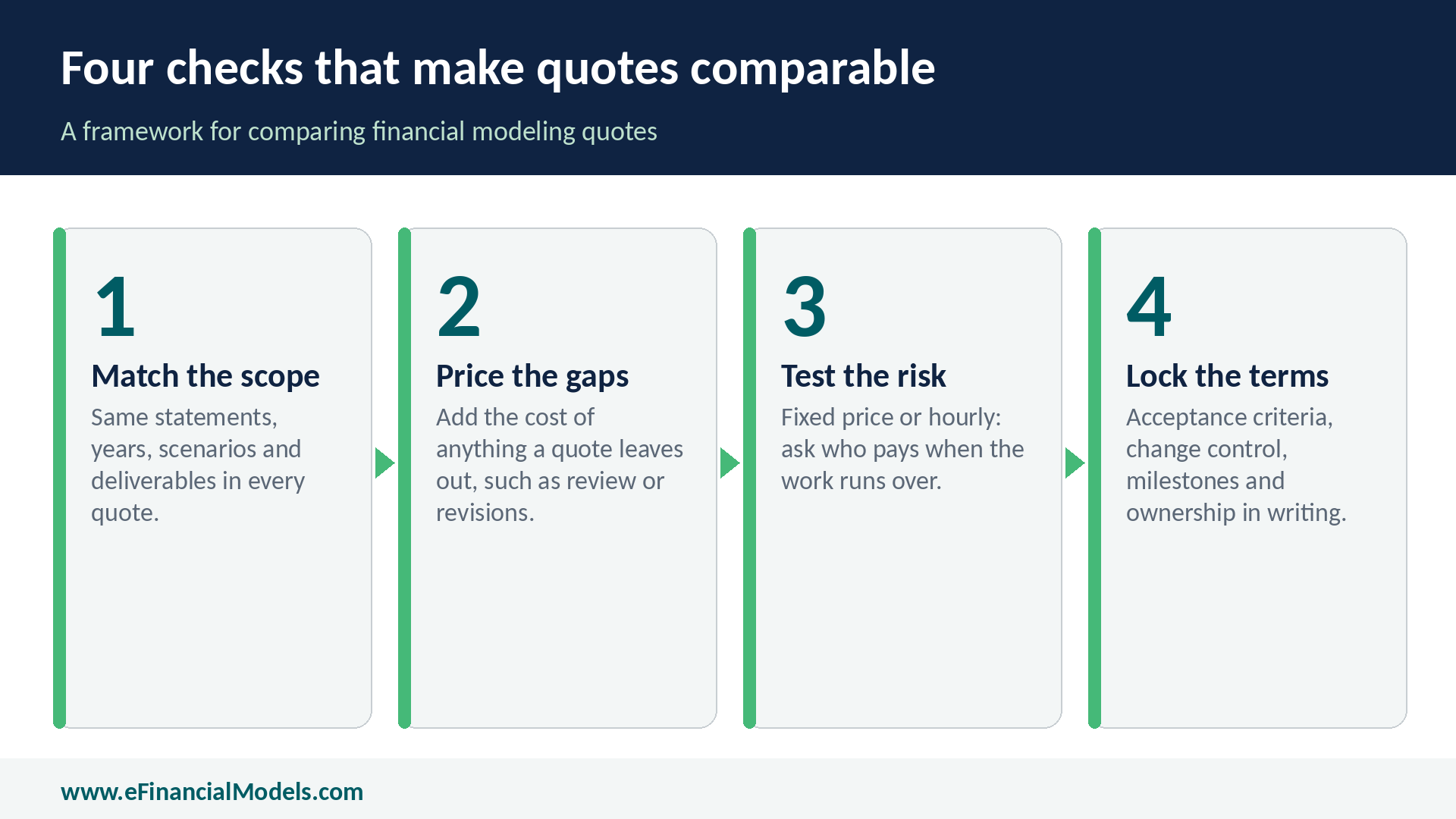
A four-check framework for rewriting any consultant quote into a form that can be compared.
How do fixed-price and hourly quotes differ in risk?
A fixed price places the cost of overruns on the consultant, while an hourly rate places it on the buyer, because the buyer pays for every hour the work takes. Applied to a model, an hourly quote needs an estimate of hours and a cap, and a fixed quote needs a written list of what the price covers. Scope changes then need a process. American Public University advises in a 2023 article that establishing a change control system is imperative so everyone involved is aware of the approved or rejected changes.
What do published prices say about a fair quote?
Published prices give a range to test a quote against, though they never replace a quote for the specific job. Upwork, a freelance marketplace, states on its own cost page that financial modelers on Upwork cost $25 to $65 per hour, a range the page labels as median hourly rates. The Custom Financial Modeling Services page on eFinancialModels shows 21 provider listings whose starting prices run from $44 to $195, excluding tax; the listings show no project scope, so each is an entry point and not a project price.
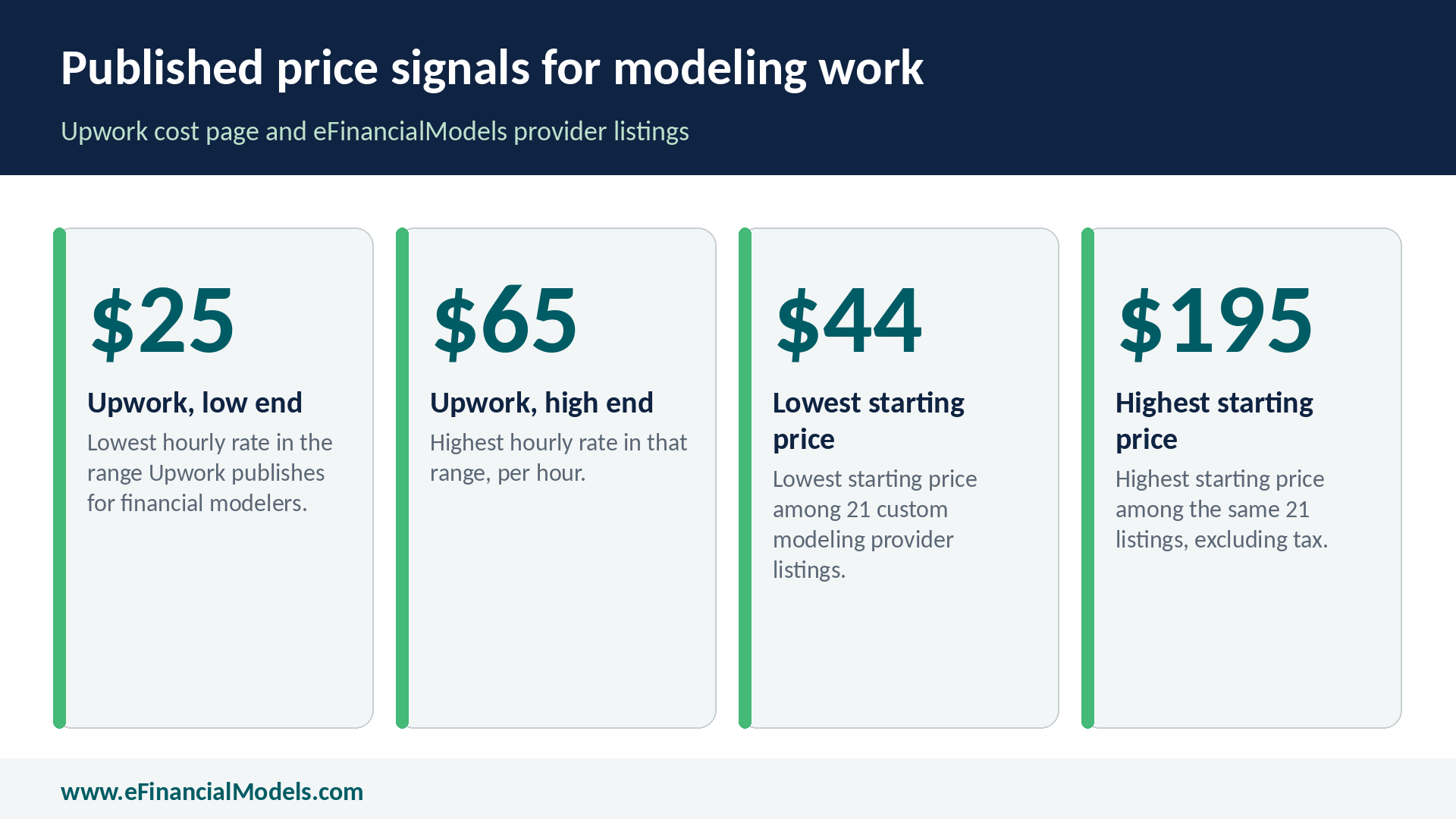
Published price signals for modeling work: an hourly range from Upwork and the spread of starting prices on eFinancialModels listings.
A “starting at” price is the entry point of a listing and not the cost of a project, so it marks a floor and not an expectation.
How should a quote describe review and error checking?
A quote should name who checks the model, how, and when, because audits find errors in most spreadsheets studied. The UK National Audit Office (NAO) wrote in 2023 that a lack of independent review increases the likelihood that a model is not fit for purpose or contains errors. A 2024 study reported by Phys.org found that 94% of spreadsheets used in business decision-making contain errors. Raymond Panko’s 2015 review of spreadsheet research reports the same share, 94% of the spreadsheets studied, and adds that commercial audits and inspections found cell error rates of 1.2%, 2.2% and 2.5%. The underlying studies are mostly older, so they support a general caution and not a precise error rate for any one consultant.
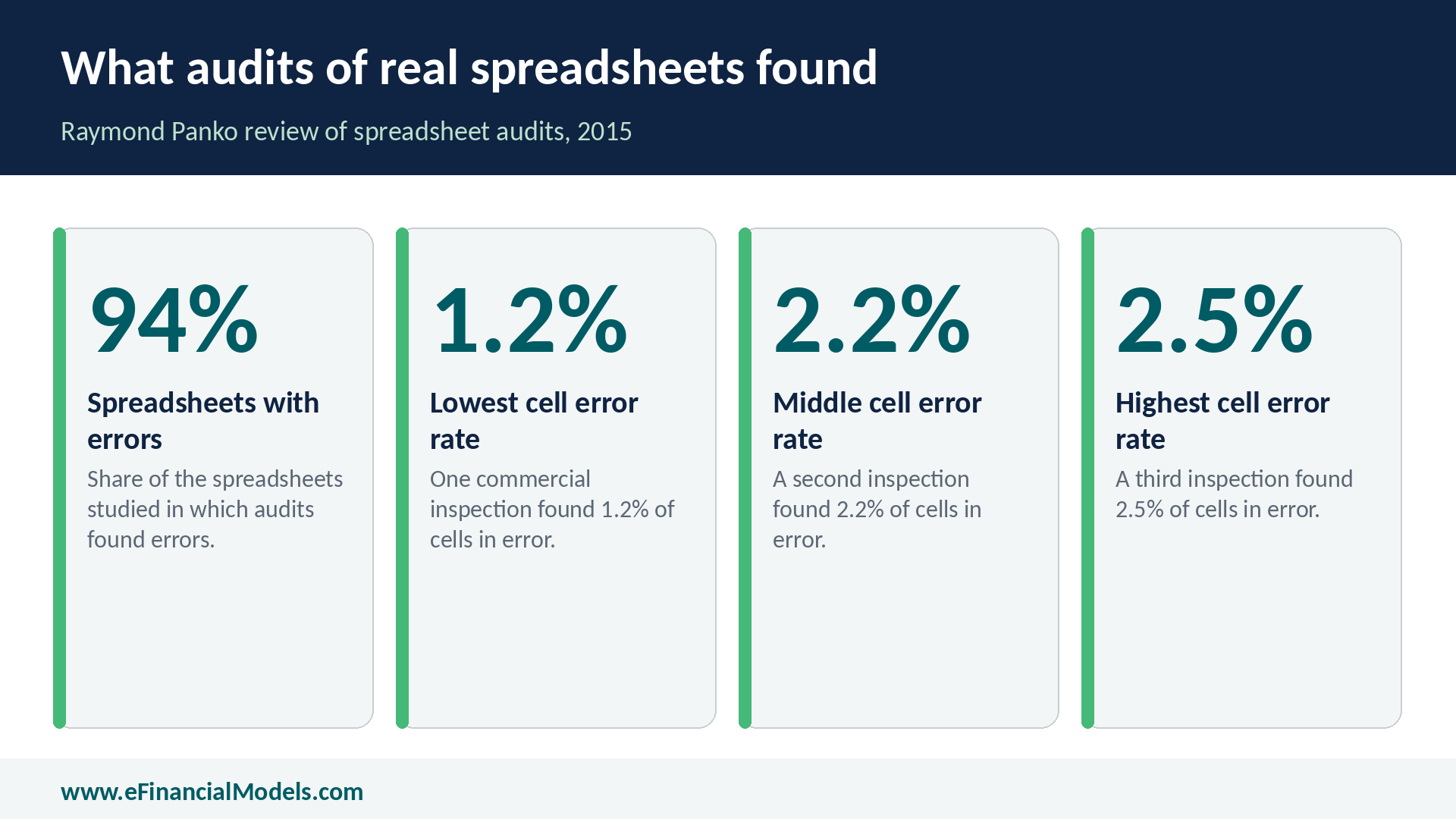
Error findings from Raymond Panko’s 2015 review of spreadsheet audits, as a share of spreadsheets and of cells.
A quote can address this in three ways. It can name a structural standard, such as the Flexible, Appropriate, Structured and Transparent (FAST) Standard, which states that a consistent approach to structuring workbooks, worksheets and formulas saves time. It can name a second person who checks the file. It can also state that formulas stay visible and cells stay unlocked. The eFinancialModels marketplace applies similar transparency tests to the templates it lists: its vendor guidelines say all submitted models are manually reviewed and approved before posting, and that all formulas and calculations need to be clearly visible.
Worked example: how do three quotes compare once the gaps are priced?
In this example, assume a founder needs a five-year three-statement model and expects an independent review and two revision rounds. Assume an hour of consultant time is worth $50, an independent review takes 8 hours and one extra revision round takes 6 hours. The same $50 rate prices every added hour in this example. These are illustrative assumptions, not market data.
Quote A is a fixed $4,000 with one revision round and no review. Quote B is hourly at $50 with an estimate of 80 hours, no review and revisions inside the hours, and no cap. Quote C is a fixed $5,200 that includes the review and two revision rounds.
| Quote | Pricing basis | Headline price | Gaps priced in | Like-for-like price | If hours run 25% over |
|---|---|---|---|---|---|
| A | Fixed | $4,000 | Review $400, extra revision $300 | $4,700 | $4,700 |
| B | Hourly, 80 hours | $4,000 | Review $400 | $4,400 | $5,400 |
| C | Fixed | $5,200 | None | $5,200 | $5,200 |
The arithmetic follows from the stated inputs. Eight review hours at $50 cost $400, and six revision hours at $50 cost $300, so Quote A rises from $4,000 to $4,700 and Quote B from $4,000 to $4,400. In the overrun case, Quote B takes 80 hours plus 20 more hours, which is 100 hours, and 100 hours at $50 cost $5,000, so adding the $400 review brings Quote B to $5,400. The overrun applies only to the consultant’s build hours, not to the priced-in gaps. The headline ranking puts A and B level and C last. The like-for-like ranking puts B first at $4,400, but only while hours hold; if they run over, B costs $5,400, which is $200 more than C. Among the two fixed quotes, A is $500 cheaper than C at $4,700 against $5,200, so C earns its premium only if the founder values one accountable party for both the build and the review.
When should a founder walk away from a quote?
A founder should walk away when a quote cannot be tested. Four signs recur. The quote has no acceptance criteria, so nobody can say when the work is done. It has no change control, so every new request becomes a fresh negotiation. It refuses visible formulas or unlocked cells, so the buyer cannot inspect the logic. Or it leaves ownership of the finished file unstated; a lawyer should settle that point, since this article is not legal advice.
Reference checks and a small paid sample, such as one sheet built from the founder’s real inputs, add evidence before a large commitment. Milestone payments tied to accepted deliverables keep the buyer’s leverage until the last one is signed off.
Conclusion
Quotes become comparable when the scope is identical, the gaps are priced, the risk is assigned and the terms are written down. Founders weighing a ready-made template against a custom quote can browse the Startup Financial Models collection from eFinancialModels, then apply the four checks to every quote received.
Frequently Asked Questions
How many quotes should a first-time founder request?
Three is a practical number: enough to show a spread, few enough to read carefully. One quote gives nothing to measure against, while ten creates a pile of mismatched documents that takes longer to normalise than to write. Send the identical brief to all three, set a reply deadline and note which consultants asked clarifying questions, because the quality of those questions often reveals how carefully the work will be done.
Is the cheapest quote always a warning sign?
Not always, but it is a reason to ask what the price leaves out. A low quote may reflect a smaller scope, a junior builder, no review or an hourly estimate that is too optimistic. Ask the consultant to list deliverables and hours line by line. If the lower price survives that itemised comparison, it may simply be the better value, and a clear answer is itself a good sign.
What should a founder ask for before paying a deposit?
Ask for a written scope, the acceptance criteria and a payment schedule linked to milestones, such as a structure sheet, a first working draft and a reviewed final file. A small first payment is a reasonable suggestion, though no standard percentage exists. Check also that the consultant will hand over the editable file with all formulas intact, and not only a locked copy or a set of screenshots.
How can a founder test a consultant before committing?
Request a short paid trial, such as one sheet built from real inputs or a model structure outline for review. Judge it against the brief: are the inputs labelled, do the totals reconcile, does the balance sheet balance and could a second person follow the formulas without a phone call? A consultant who welcomes a defined trial usually welcomes defined acceptance criteria later.