0 ITEMS

Model Assumptions Audit: The Three-Zone Rule Explained

A financial model earns trust when its assumptions sit in one Inputs zone, its formulas in one Calculations zone and its results in an Outputs zone that tests itself, because that structure lets anyone check it. An annual assumptions audit checks those three zones for seven recurring errors, so a first-time founder can show the numbers were tested before an investor asks.
Key Takeaways
- Keep assumptions, formulas and results in three separate zones, and a reviewer can trace any number back to its source far faster.
- Audit the model once a year and after every major change, because a model that nobody checks drifts away from the business.
- Seven errors recur across startup models: buried constants, duplicated assumptions, undated inputs, unit mismatches, short ranges, missing checks and unreconciled cash.
- One corrected hardcode and one corrected collection assumption cut the illustrative runway from 12.0 to 8.0 months.
- An audit lowers the risk of error but never proves a forecast right, so every audit report should state its remaining uncertainty.
The three-zone rule keeps every number traceable
The three-zone rule says a model holds inputs, calculations and outputs in separate places, and each number lives in exactly one of them. Inputs are the assumptions a person types, such as price, headcount or opening cash. Calculations are the formulas that turn those inputs into monthly figures. Outputs are the results a founder shows to others, such as cash balance, burn and runway.
The Institute of Chartered Accountants in England and Wales (ICAEW) publishes a Financial Modelling Code, and its guidance on getting financial models right advises segregating inputs, calculations and outputs wherever possible. The same guidance states that the Code acknowledges errors as both natural and unavoidable. The rule therefore does not promise a model without mistakes.
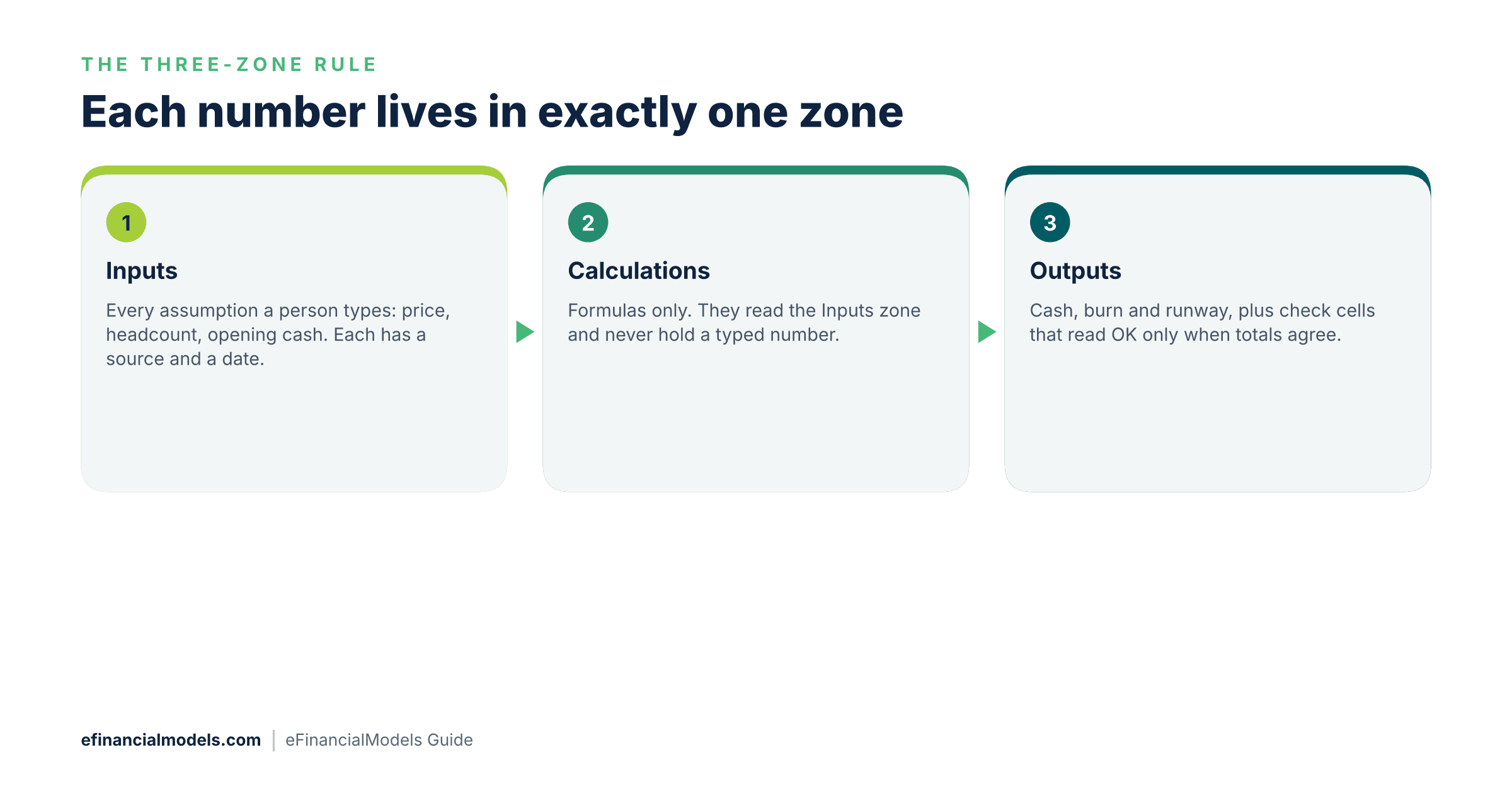
The three-zone rule: assumptions in, formulas in the middle, self-checking results out. Source: eFinancialModels Analysis
When the zones mix, an audit becomes slow. A typed number inside a formula cannot be found by scanning the Inputs zone, and a result pasted over a formula cannot be found by scanning the Calculations zone.
An annual audit replaces trust with evidence
Spreadsheets remain widely used in finance. A March 2025 survey by the software vendor Rossum, reported by TechRadar, found that 58% of 470 finance leaders in the UK, the US and Germany still rely on traditional productivity tools such as Excel.
A 2024 study in Frontiers of Computer Science, summarised by Phys.org, reports that 94% of spreadsheets used in business decision-making contain errors. The summary does not explain how the figure was derived, so it works as a warning, not a precise rate.
A first-time founder usually builds the model alone, often from one of the startup financial models available online, so nobody has ever tested it. An annual model assumptions audit is a scheduled internal review, not a statutory or external audit of financial statements, in which someone other than the builder, or the builder with a fresh checklist, tests every input, formula and output. The audit produces a short report: what was tested, what was found, what was fixed and what remains uncertain.
Banking regulators treat the same idea as standard practice. The Federal Reserve’s guidance on model risk management states that a model may have fundamental errors and produce inaccurate outputs, and that all model components, including inputs, processing, outputs and reports, should be subject to validation.
The UK government’s Analytical Quality Assurance guidance, the AQuA Book, lists a similar aim for analytical work: to minimise the risk of errors that cause operational, business or reputational damage.
Seven recurring errors to check in every zone
The seven errors below reflect the publisher’s practitioner view of what goes wrong in startup models, not a measured frequency. Each error maps to one zone, so the audit can move zone by zone.
| # | Zone | Error | Quick test |
|---|---|---|---|
| 1 | Calculations | A hardcode, meaning a typed constant inside a formula or pasted over one | Select the row and look for numbers that differ from their neighbours |
| 2 | Inputs | The same assumption typed in two places | Search for the value and count where it appears |
| 3 | Inputs | An input with no source, owner or date | Check that each input names where it came from and when |
| 4 | Calculations | A unit mismatch, such as months mixed with years or thousands mixed with units | Read the unit label next to every driver, the input that moves a result |
| 5 | Calculations | A range that stops short, so a new row is left out of a total | Add a row at the end and see whether totals move |
| 6 | Outputs | No checks, so the balance sheet or cash total can be wrong silently | Add a check cell that reads OK only when totals agree |
| 7 | Outputs | Cash that does not reconcile to the bank | Compare the modelled closing cash to the bank statement |
Errors 6 and 7 leave a model looking healthy while it is wrong.
A sound driver is a single labelled input with a unit and a source, which moves results through formulas and never through typed overrides. A founder can also compare the model’s layout with the ICAEW guidance cited above, which is a practical test of professional structure. Whether the assumptions themselves are realistic is a separate question, best put to an advisor or accountant who knows the industry.
Worked example: one audit moves runway from 12.0 to 8.0 months
The example below is illustrative. Assume a startup with opening cash of USD 240,000. Net burn is the net monthly cash outflow: all cash paid out in a month minus all cash received in that month, mostly collections from customers. This example uses simple runway, the number of months the opening cash lasts if net burn stays flat, so runway equals opening cash divided by that monthly net burn. A fuller method projects cash month by month and finds the month the balance turns negative, which matters when burn changes.
As presented. The model shows monthly cash costs of USD 50,000 and, wrongly, counts its USD 30,000 of booked monthly sales as cash received in the month, so it shows net burn of 50,000 minus 30,000, which is USD 20,000. Runway is 240,000 divided by 20,000, which is 12.0 months.
Finding 1, a hardcode. The Inputs zone shows a cost of USD 55,000 after a new hire, but one Calculations cell still holds a typed 50,000. After the fix, net burn is 55,000 minus 30,000, which is USD 25,000, and runway is 240,000 divided by 25,000, which is 9.6 months.
Finding 2, a collection assumption. Of the USD 30,000 booked as sales each month, assume USD 5,000 is never collected, for example because one customer has stopped paying. Cash collected is therefore 25,000, net burn is 55,000 minus 25,000, which is USD 30,000, and runway is 240,000 divided by 30,000, which is 8.0 months.
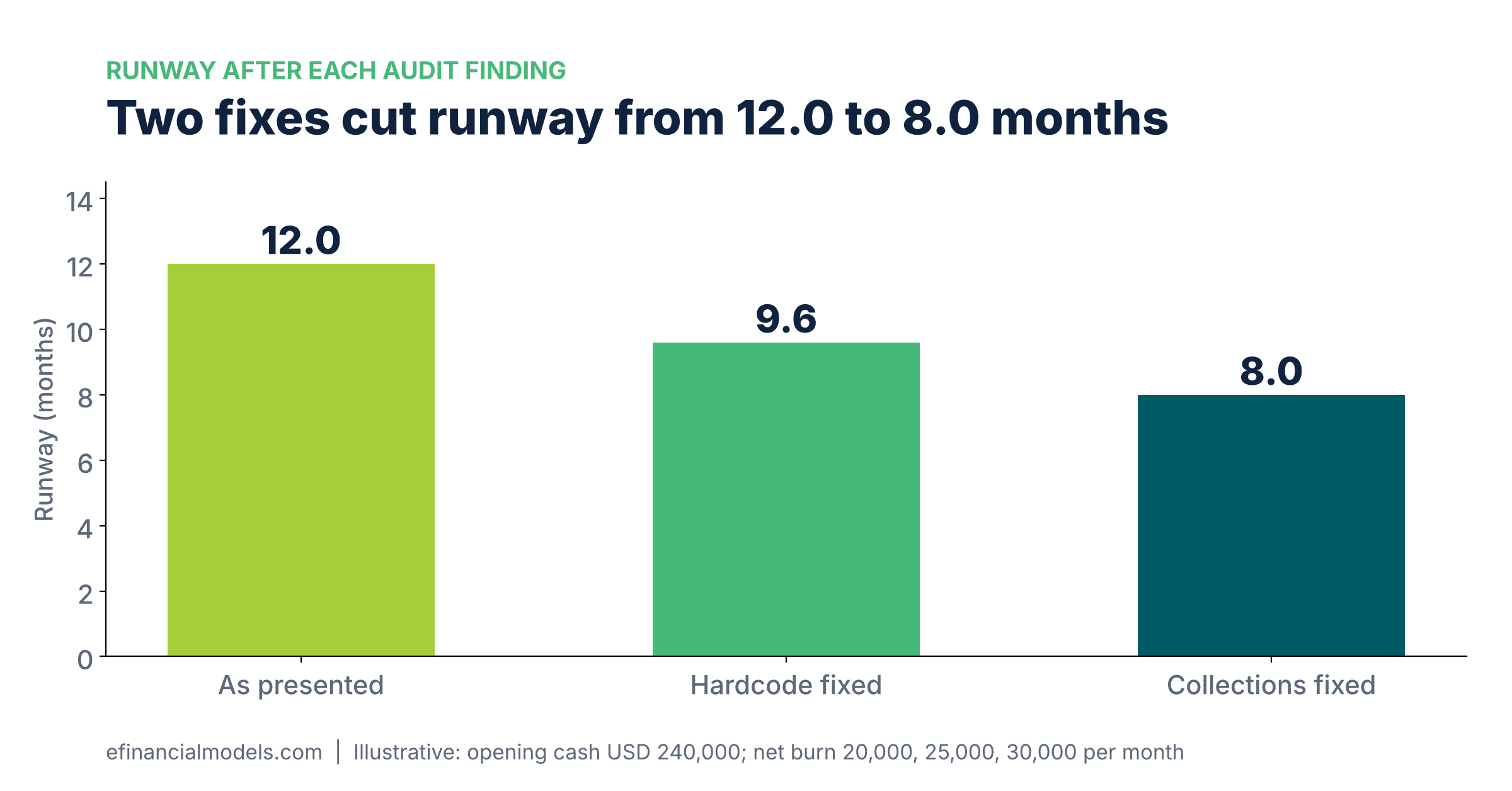
Runway in the illustrative example falls from 12.0 to 8.0 months after two audit fixes. Source: eFinancialModels Analysis
Two small fixes shortened the runway by a third.
Run the annual audit in four steps
The audit works best as a fixed routine with a named owner and a calendar date, whether the model is custom-built or one of the general Excel financial models. Four steps cover the three zones and the report.
- Freeze and copy. Save a dated copy of the model so every finding can be compared with the original.
- Test each zone. Walk through Inputs, Calculations and Outputs with the seven-error table, and log every finding with its cell address.
- Fix and re-run. Correct each finding, then confirm that every check cell reads OK and the closing cash matches the bank.
- Write the report. Record findings, fixes, the effect on key results and the uncertainty that remains.
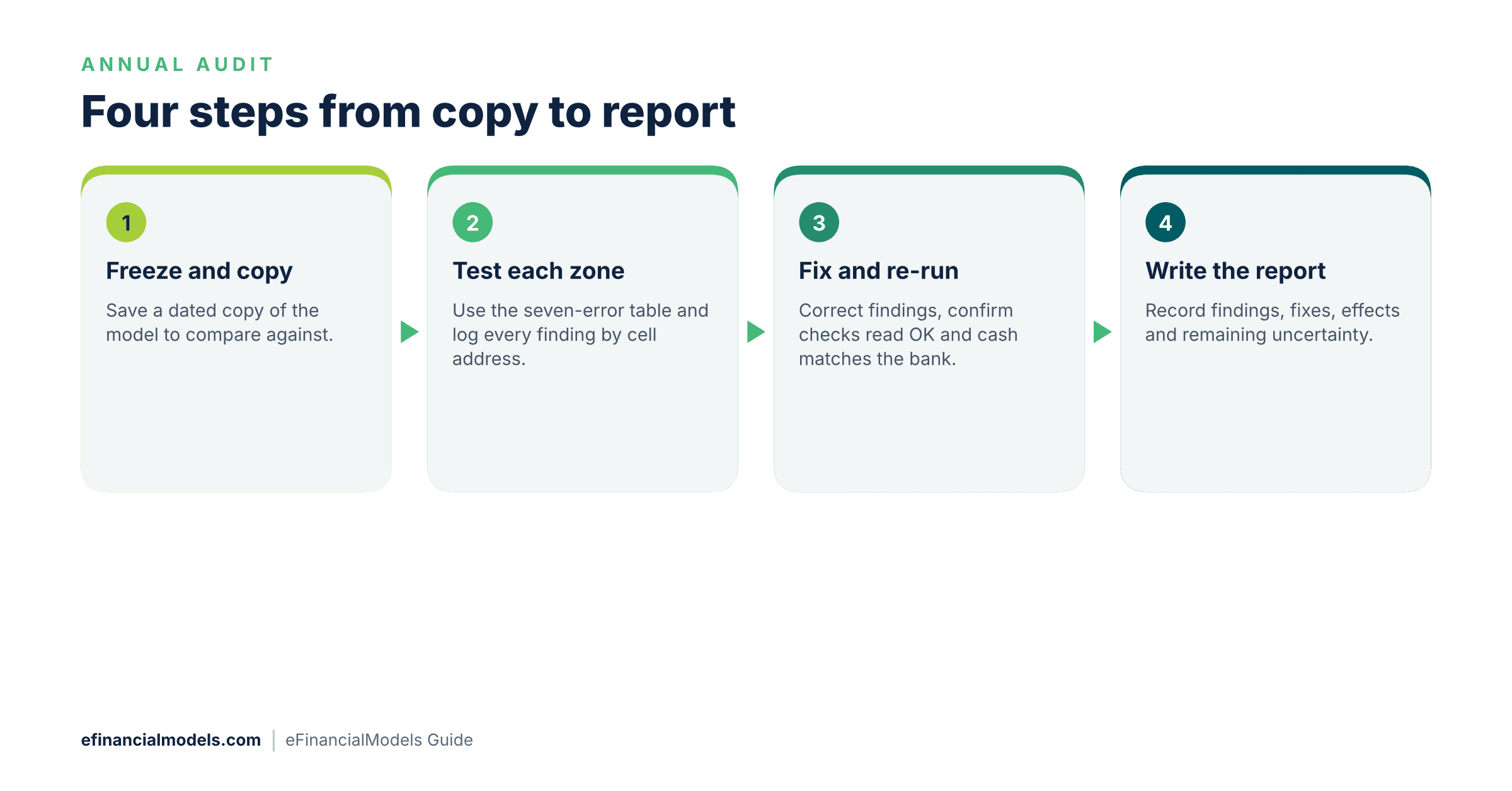
The annual audit routine from dated copy to written report. Source: eFinancialModels Analysis
An audit lowers risk but never proves a forecast
An audit tests whether the model does what its builder intended. It does not test whether the future will match the assumptions. The National Audit Office, in its summary on financial modelling in government, reports that model producers do not adequately assess or communicate the uncertainty in their models. A founder can avoid the same gap by ending every audit report with a plain list of the assumptions that matter most and the range each could plausibly take.
Frequently Asked Questions
How often should a startup run a model assumptions audit?
Run a full audit once a year, and run a shorter one after any event that changes the structure, such as a new product line, a funding round or a new hire plan. The calendar date matters less than the habit. Keep each dated copy, because a folder of past audit reports shows an investor how the model has matured over time.
Who should perform the audit if the founder built the model?
Ideally a person who did not build it, such as an advisor, an accountant or a technically minded friend. A builder reads the model through memory of what it was meant to do, so errors look correct. If no outsider is available, the builder can still audit after a break of several days, using the written checklist and testing each cell against the Inputs zone rather than against memory.
What is the difference between an audit and a sensitivity test?
An audit asks whether the mechanics are right: do the formulas read the correct inputs and do the totals agree. A sensitivity test asks how much a result moves when one input changes. Both are useful, but the order matters. Testing sensitivity on a model with a hidden hardcode produces confident answers to the wrong question, so the audit comes first.
Which errors should be fixed first?
Fix the ones that can silently change cash first: the hardcodes, the unreconciled bank balance and the missing check cells. Those errors change the runway figure a founder shares with investors, and an investor who spots one will doubt every other figure in the same file, however carefully those were built. Labelling and formatting problems matter, but they can wait until the numbers themselves are trusted.
Does a bigger model need a different process?
The process stays the same, but the time grows. A model with many sheets benefits from a written map that names which sheets belong to each zone, plus one summary sheet of check cells. Without the map, the auditor spends the first day rediscovering the structure instead of testing it, and the findings arrive late, often after the model has already been sent to an investor.
Conclusion
A trustworthy model is a model that can be traced: assumptions in one zone, formulas in another and self-checking results in a third. Founders who audit that structure every year, using the seven-error table and a short written report, can answer the investor question about accuracy with evidence. A founder who wants a ready structure for the audit can start from the eFinancialModels Free Three Statement Financial Model template.