0 ITEMS

Financial Model Cost: 2024 Pricing From $500 to $50K
A financial model can cost anywhere from $500 for a polished template to $50,000 or more for a fully custom Big 4 engagement — and the gap between those numbers is almost entirely explained by four variables: model complexity, provider tier, revision depth, and timeline.
Key Takeaways
- A basic three-statement model (income statement, balance sheet, cash flow statement integrated together) from a freelancer costs $1,500 to $5,000 in 2024.
- Big 4 firms charge $300 to $600 per hour for financial modeling work, with project minimums typically starting at $25,000.
- Boutique modeling firms deliver mid-market quality at $150 to $300 per hour, with fixed-fee projects ranging from $5,000 to $20,000.
- Offshore teams in India or Eastern Europe charge $30 to $80 per hour, cutting costs by 60% to 75% versus US-based consultants.
- Rush delivery (48-hour turnaround) typically adds a 25% to 50% premium on top of the base project fee.
- Buying a premium template ($200 to $500) and customizing it yourself can replace a $5,000 to $10,000 custom build for straightforward use cases.
- Scope creep — undefined revision rounds and vague deliverables — is the single biggest driver of cost overruns in financial modeling engagements.
What Drives Financial Model Pricing?
Financial model pricing is determined by five core cost drivers, not by the model type alone. Understanding these drivers lets you control your budget before you issue a single request for proposal.
The five drivers are: model complexity (number of tabs, scenarios, and integrated statements), data integration requirements (whether the modeler must clean and import raw data), depth of sensitivity analysis (how many variables are stress-tested), presentation deliverables (whether a pitch deck or investor memo is included), and ongoing support (revision rounds, training sessions, and audit-ready documentation).
According to the Bureau of Labor Statistics, financial analysts in the United States earned a median annual wage of $99,010 in 2023.
This translates to an effective billing rate of roughly $50 to $75 per hour at the analyst level before firm overhead and profit margin are applied. Senior consultants and directors bill at two to four times that rate, which is why provider tier matters as much as model type when you’re budgeting. Excel, the dominant tool used to build financial models, supports up to 1,048,576 rows and 16,384 columns per worksheet.
This means even the most complex multi-tab infrastructure models rarely push the software’s structural limits — complexity costs come from modeler expertise, not software constraints.

Five variables drive financial model pricing — complexity and provider tier account for the largest share of cost variance.
2024 Pricing by Model Type
Different model types carry different price tags because they require different levels of technical skill, data sourcing, and structural complexity. The table below shows 2024 fixed-fee ranges for the most common model types across three provider tiers.
| Model Type | Freelancer | Boutique Firm | Big 4 / Top-Tier |
|---|---|---|---|
| Three-Statement Model | $1,500–$5,000 | $5,000–$12,000 | $20,000–$40,000 |
| DCF Valuation | $2,000–$6,000 | $6,000–$15,000 | $25,000–$50,000 |
| LBO Model | $3,000–$8,000 | $8,000–$20,000 | $30,000–$60,000 |
| M&A / Merger Model | $4,000–$10,000 | $10,000–$25,000 | $35,000–$75,000 |
| SaaS Unit Economics | $1,500–$4,000 | $4,000–$10,000 | $15,000–$30,000 |
| Real Estate Development | $2,500–$7,000 | $7,000–$18,000 | $25,000–$50,000 |
| Project Finance / Infrastructure | $5,000–$15,000 | $15,000–$35,000 | $40,000–$100,000 |
| Startup Fundraising Model | $1,000–$4,000 | $4,000–$10,000 | $15,000–$30,000 |
A DCF model (discounted cash flow model — a valuation technique that estimates the present value of future cash flows using a discount rate) at the freelancer tier costs $2,000 to $6,000 because it requires a solid grasp of terminal value assumptions and WACC (weighted average cost of capital) calculation, but the structural complexity is lower than an LBO or M&A model. An LBO model (leveraged buyout model — used by private equity firms to evaluate acquisitions financed primarily with debt) commands a premium because it requires modeling debt tranches, interest waterfalls, and equity return calculations simultaneously.
You can explore ready-built DCF model templates on EFM as a starting point before deciding whether a custom build is justified.

LBO and M&A models command the highest premiums — Big 4 M&A model engagements can reach $75,000 in 2024.
Provider Tier Comparison: Boutique vs. Big 4 vs. Freelance
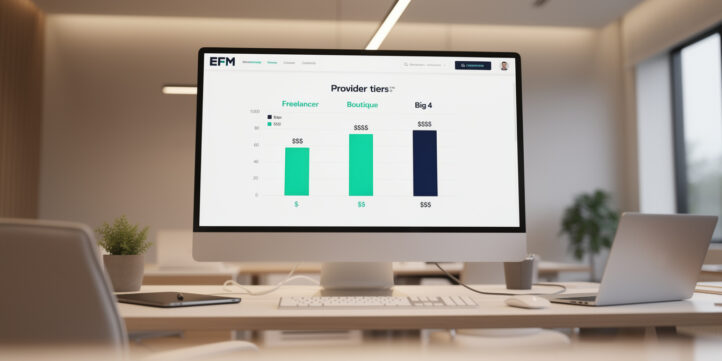
Your choice of provider is the single biggest lever on total cost. Here’s how the four main tiers compare on hourly rate, project minimum, turnaround time, and quality assurance.
| Provider Tier | Hourly Rate | Project Minimum | Typical Turnaround | QA Process |
|---|---|---|---|---|
| Offshore Team (India, Philippines, Eastern Europe) | $30–$80 | $500 | 1–3 weeks | Variable |
| Freelance Platform (Upwork, Toptal) | $75–$175 | $1,000 | 1–4 weeks | Platform rating |
| Boutique Modeling Firm | $150–$300 | $5,000 | 2–6 weeks | Internal review |
| Mid-Tier Advisory Firm | $200–$400 | $10,000 | 3–8 weeks | Senior sign-off |
| Big 4 / Bulge Bracket | $300–$600 | $25,000 | 4–12 weeks | Partner review |
Toptal, which screens the top 3% of freelance applicants according to its published vetting process, lists financial modeling specialists at $100 to $200 per hour. Upwork’s broader marketplace includes financial modelers at $40 to $150 per hour depending on experience and geography. The tradeoff is quality assurance: a freelancer has no internal reviewer, while a boutique firm typically has a senior associate check every model before delivery.
Big 4 firms (Deloitte, PwC, EY, KPMG) bring brand credibility and deep bench strength, which matters when a model will be scrutinized by institutional investors or used in litigation. Their rates of $300 to $600 per hour reflect partner-level oversight, proprietary methodology libraries, and liability coverage — not just the analyst hours.

Offshore teams charge $30–$80/hour versus Big 4 rates of $300–$600/hour — a 7x to 20x difference driven by oversight, liability, and brand.
Hourly Rates vs. Fixed-Fee Projects
Fixed-fee pricing protects your budget; hourly pricing protects the modeler. Knowing when each structure makes sense saves you money and prevents disputes.
Choose fixed-fee when the scope is well-defined: you know the model type, the number of scenarios, the data sources, and the output format. Fixed-fee projects for common model types run $3,000 to $20,000 at the boutique tier. Choose hourly when the scope is exploratory — for example, when you’re building a model for a novel business structure or need iterative feedback loops with your investment committee. Cap hourly engagements with a not-to-exceed clause to prevent runaway costs.
A Series A fundraising model — a financial model used to demonstrate growth trajectory and unit economics to early-stage investors — typically costs $4,000 to $8,000 on a fixed-fee basis from a boutique firm, or $6,000 to $12,000 on an hourly basis if the founder needs multiple strategy sessions baked in. For a $10 million acquisition model, expect $8,000 to $20,000 fixed-fee from a boutique, or $15,000 to $35,000 from a mid-tier advisory firm.
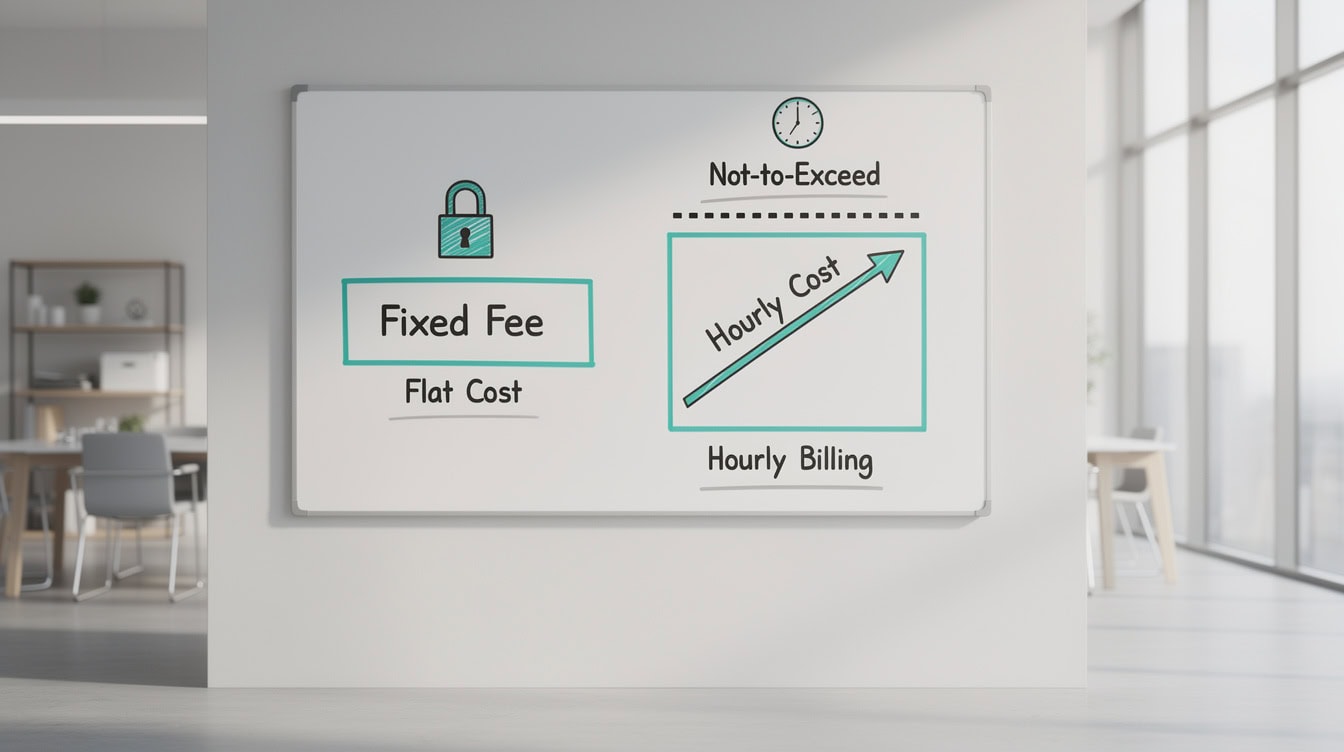
Fixed-fee protects the buyer’s budget; hourly protects the modeler — always negotiate a not-to-exceed cap on hourly engagements.
Worked Example: Budgeting a Three-Statement Model
Here’s the math for a mid-market company commissioning a three-statement integrated model (income statement, balance sheet, and cash flow statement linked together) from a boutique firm.
Assume the boutique charges $200 per hour. The project scope includes: data cleanup (8 hours), model build (20 hours), scenario analysis with 3 cases (6 hours), one revision round (4 hours), and a 30-minute training call (1 hour). Total hours: 39. Base fee: 39 x $200 = $7,800. The client requests delivery in 5 business days instead of the standard 10, triggering a 30% rush premium: $7,800 x 1.30 = $10,140. If the client also wants a one-page investor summary formatted for a pitch deck, add $1,500 to $2,500. All-in cost: $11,640 to $12,640.
The same model from a premium template — customized in-house — would cost $300 to $500 for the template plus 15 to 25 hours of internal analyst time. At a fully-loaded internal cost of $75 per hour, that’s $1,425 to $2,375 total. The template route saves $9,000 to $10,000 but requires an analyst who can adapt the model confidently. Microsoft Excel supports up to 64 levels of nested functions.
Understanding this limit helps you evaluate whether a quoted model’s formula architecture is realistic.
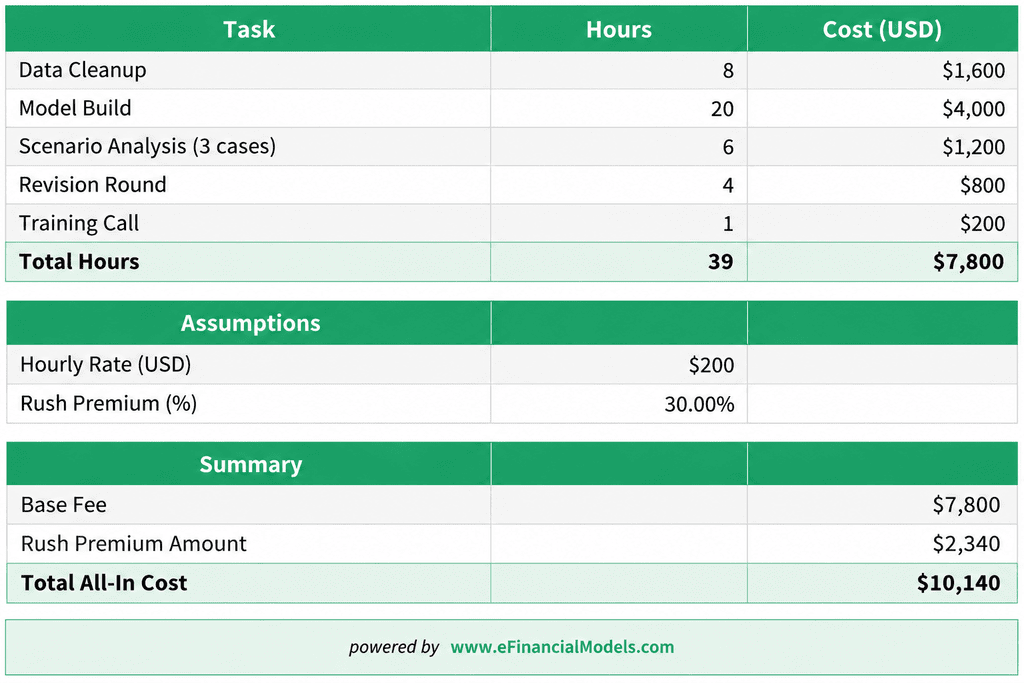
At $200/hour with a 30% rush premium, a 39-hour three-statement model engagement reaches $10,140 before pitch deck add-ons.
Hidden Costs and Scope Creep
The quoted price is rarely the final price. Four hidden cost categories consistently push financial modeling engagements over budget.
First, revision rounds: most fixed-fee quotes include one or two revision rounds. Each additional round typically costs 10% to 20% of the original project fee. A $10,000 model with three extra revision rounds can reach $13,000 to $16,000. Second, data cleanup: if you hand over raw, unstructured data, expect to pay $50 to $150 per hour for the modeler to clean it. Providing clean, structured data in a standard format (Excel or CSV) can save $500 to $2,000 on a mid-size project. Third, rush delivery: a 48-hour turnaround adds 25% to 50% to the base fee. A two-week standard timeline is the baseline most firms price against. Fourth, audit-ready formatting: if the model needs to meet investor or lender audit standards — clear assumption labels, version control, formula documentation — add $1,000 to $3,000 for a dedicated formatting and documentation pass.
Cost overruns on professional services engagements are most common when scope is defined verbally rather than in writing.
Get every deliverable, revision limit, and timeline in a signed statement of work before work begins.
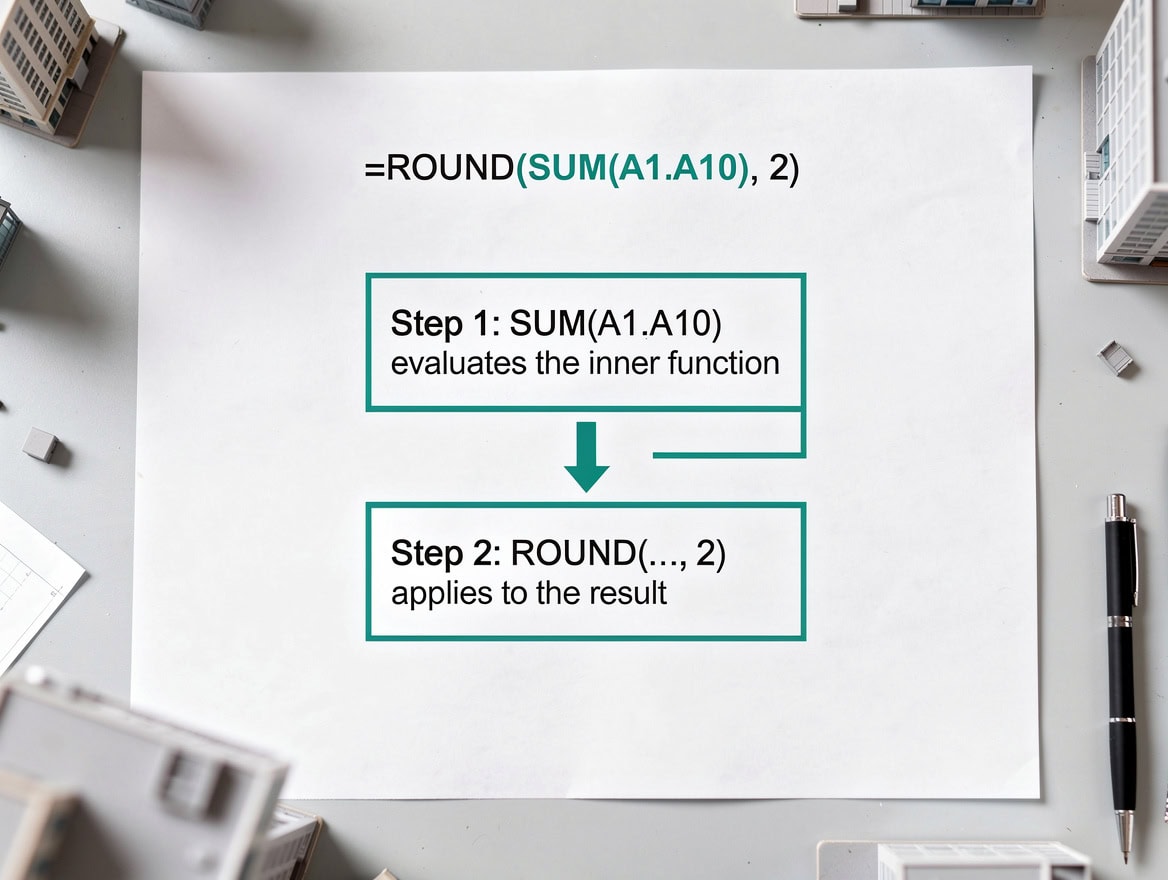
Hidden costs can add 30%–60% to a quoted financial modeling fee — revision rounds and data cleanup are the two biggest culprits.
DIY vs. Custom Build: Decision Framework
The right procurement model depends on three variables: your internal modeling capability, the model’s intended audience, and the stakes attached to the output.
Use a premium template when: the model type is standard (three-statement, DCF, SaaS metrics), your internal team has Excel proficiency, and the audience is internal or early-stage. Templates from EFM’s financial projections library cost $200 to $500 and cover the most common use cases. Use a hybrid approach (template plus boutique customization) when: the model is standard but needs company-specific logic, and the audience includes sophisticated investors. Expect $2,000 to $6,000 for customization on top of the template cost. Commission a fully custom build when: the model involves novel deal structures, regulatory complexity, or will be scrutinized by Big 4 auditors or institutional LPs. Budget $10,000 to $50,000 and treat it as a capital expenditure, not a line item.
| Use Case | Recommended Approach | Estimated Cost |
|---|---|---|
| Internal planning, early-stage startup | Premium template | $200–$500 |
| Seed or Series A fundraising | Template + freelancer | $1,500–$4,000 |
| Series B+ or PE fundraising | Boutique firm | $8,000–$20,000 |
| M&A due diligence | Mid-tier or Big 4 | $20,000–$75,000 |
| Infrastructure / project finance | Big 4 or specialist | $40,000–$100,000 |

Match procurement model to stakes: templates for internal use, boutique for investor-grade models, Big 4 for institutional scrutiny.
How to Control Costs Without Sacrificing Quality
Five tactics consistently reduce financial modeling costs by 20% to 40% without compromising output quality.
First, provide clean data upfront. Structured, labeled data in a single Excel workbook cuts modeler prep time by 30% to 50%. Second, define revision limits in writing. Two rounds is standard; negotiate this into the contract before signing. Third, use phased delivery. Break large models into phases (assumptions, income statement, balance sheet, cash flow, scenarios) and review each phase before the next begins. This catches structural errors early and avoids rebuilding entire sections. Fourth, start with a template. Even if you plan a custom build, buying a $300 to $500 template and sharing it with your modeler gives them a structural starting point, reducing build hours by 20% to 30%. EFM’s startup financial model templates are built by practitioners and used as starting points by boutique firms. Fifth, batch your revisions. Sending 10 small change requests in separate emails costs more than sending one consolidated revision list. Most firms charge a minimum time increment (0.5 hours) per communication.

These five tactics consistently reduce financial modeling costs by 20%–40% without compromising output quality.
Red Flags in Financial Modeling Pricing
Not every low bid is a bargain. Five red flags signal that a quote will either blow up in cost or deliver a model you can’t use.
Red flag 1: A fixed fee below $1,000 for a three-statement model. Building a properly integrated three-statement model takes 15 to 25 hours minimum. A $1,000 quote implies $40 to $67 per hour — offshore rates — which may be fine, but verify the modeler’s track record with similar complexity. Red flag 2: No statement of work. Any modeler who won’t put deliverables, revision rounds, and timelines in writing is setting up a scope creep dispute. Red flag 3: Hourly billing with no cap. An uncapped hourly engagement on a complex model is an open-ended liability. Always negotiate a not-to-exceed ceiling. Red flag 4: No sample models provided. A professional modeler has a portfolio. If they can’t show you anonymized examples of prior work, that’s a signal of inexperience. Red flag 5: Vague assumptions about data. If the quote doesn’t specify who provides the data and in what format, you’ll pay for data cleanup that wasn’t in the original scope.
A fixed fee below $1,000 for a three-statement model implies $40–$67/hour — verify the modeler’s track record before signing.
Frequently Asked Questions
How much does a basic financial model cost in 2024?
A basic financial model — typically a three-statement model covering income statement, balance sheet, and cash flow statement — costs $1,500 to $5,000 from a freelancer, $5,000 to $12,000 from a boutique firm, and $20,000 to $40,000 from a Big 4 firm in 2024. If your internal team has Excel proficiency, a premium template from a library like EFM costs $200 to $500 and covers the same structural ground. The right choice depends on your audience: internal planning justifies a template; institutional investor scrutiny justifies a boutique or Big 4 build.
What is the difference between a fixed-fee and hourly financial modeling engagement?
A fixed-fee engagement sets a single price for a defined scope: specific model type, number of scenarios, revision rounds, and output format. Fixed-fee protects your budget and is appropriate when scope is clear. An hourly engagement bills for actual time spent, which is better when scope is exploratory or iterative. Hourly rates for financial modeling range from $30 to $80 per hour for offshore teams, $75 to $175 for freelancers, $150 to $300 for boutique firms, and $300 to $600 for Big 4 consultants. Always negotiate a not-to-exceed cap on hourly engagements to prevent runaway costs.
How long does it take to build a financial model?
Timeline depends on complexity. A startup fundraising model takes 1 to 2 weeks from a boutique firm. A three-statement integrated model takes 2 to 4 weeks. An LBO or M&A model takes 3 to 8 weeks depending on data availability and revision cycles. Rush delivery (48-hour to 5-day turnaround) is available from most providers but adds a 25% to 50% premium on the base fee. Providing clean, structured data at the start of the engagement is the single most effective way to compress timeline without paying a rush premium.
Is it worth buying a financial model template instead of hiring a consultant?
For straightforward use cases — internal planning, early-stage fundraising, standard DCF valuation — a premium template costing $200 to $500 delivers 80% of the value of a custom build at 5% to 10% of the cost. The gap closes when your model needs company-specific logic, novel deal structures, or will face institutional scrutiny. A hybrid approach — buying a template and paying a boutique firm $2,000 to $4,000 to customize it — often delivers the best cost-quality tradeoff for Series A and Series B fundraising. EFM’s free financial model templates are a good starting point to assess what a template can cover before you decide.
What does a Big 4 firm charge for financial modeling?
Big 4 firms (Deloitte, PwC, EY, KPMG) charge $300 to $600 per hour for financial modeling work, with project minimums typically starting at $25,000. A full M&A merger model engagement can reach $35,000 to $75,000. These rates reflect partner-level oversight, proprietary methodology libraries, liability coverage, and brand credibility that matters in litigation or regulatory contexts. For most startup and mid-market use cases, a boutique firm at $150 to $300 per hour delivers comparable technical quality at 40% to 60% lower cost. Big 4 is justified when the model output will be reviewed by institutional LPs, regulators, or opposing counsel.
What are the most common hidden costs in financial modeling projects?
Four hidden costs consistently push financial modeling engagements over budget. First, extra revision rounds: each round beyond the contracted number costs 10% to 20% of the original project fee. Second, data cleanup: unstructured raw data adds $500 to $2,000 in prep time. Third, rush delivery: a 48-hour turnaround adds 25% to 50% to the base fee. Fourth, audit-ready formatting: investor-grade documentation and version control adds $1,000 to $3,000. The best defense is a detailed statement of work that specifies revision limits, data format requirements, and delivery timeline before any work begins.
How do I evaluate whether a financial modeling quote is fair?
Start by benchmarking the implied hourly rate: divide the quoted fee by the estimated hours. A three-statement model takes 15 to 25 hours; an LBO model takes 30 to 60 hours. If the implied rate is below $30 per hour for a US-based provider, the scope is likely underestimated or the modeler is inexperienced. Ask for a sample model to assess structural quality: check whether formulas are hard-coded (a red flag) or driven by a clean assumptions tab (best practice). Verify that the quote includes a statement of work with defined deliverables, revision rounds, and a timeline. Written scope definitions reduce professional services disputes by a significant margin.
Conclusion
Financial model pricing in 2024 spans a wide range — from $200 for a template to $100,000 for a complex infrastructure model — but the decision framework is straightforward once you know your model type, your audience, and your internal capability. Match the provider tier to the stakes: templates for internal planning, boutique firms for investor-grade fundraising models, Big 4 for institutional or regulatory contexts. Control costs by providing clean data, defining revision limits in writing, and starting with a template wherever possible.
I recommend browsing EFM’s library of professional financial model templates — built by practitioners, priced at $200 to $500, and used as starting points by boutique firms worldwide — before committing to a custom build. If your use case requires a fully custom model, our custom financial modeling services team can scope and price your project with no obligation.