0 ITEMS

Template vs. Custom Financial Model: Pricing Guide

Most buyers ask the wrong question: “How much does a financial model cost?” The right question is: “How much complexity do I actually need to model?”
Key Takeaways
- Pre-built financial model templates typically cost $50–$500, while custom-built models run $3,000–$25,000+ depending on scope and complexity.
- 70% of early-stage startups and small businesses get full value from a quality template without any modification.
- Custom models become necessary when you have 3 or more distinct revenue streams, complex equity structures, or investor-specific reporting requirements.
- Total cost of ownership for templates includes 5–15 hours of learning curve time; custom builds carry a 2–6 week delivery timeline and revision cycle risk.
- A hybrid path, starting with a template and upgrading to custom at a defined trigger point, cuts average modeling spend by 40% over a 24-month period.
- The “do nothing” alternative (DIY Excel from scratch) costs 40–80 hours of analyst time, which at a $75/hour opportunity cost equals $3,000–$6,000 in hidden expense.
- An 8-question self-assessment at the end of this article will route you to the right tier in under 3 minutes.
The Real Cost Question: Price vs. Value in Financial Modeling
The sticker price of a financial model is rarely its true cost. A $150 template that takes 20 hours to adapt to your business costs more in real terms than a $5,000 custom build delivered in two weeks and used immediately.
Financial modeling, at its core, is the process of building a structured representation of a business’s financial performance, usually in Excel or a similar tool, to support decisions like fundraising, budgeting, or M&A. The question of template vs. custom is really a question of fit: how closely does an off-the-shelf structure match your actual business logic?
According to the U.S. Small Business Administration, more than 33 million small businesses operate in the United States. Source The vast majority of them share common financial structures: a handful of revenue lines, standard operating costs, and straightforward cash flow patterns. For those businesses, a well-built template is not a compromise. It is the smart choice.
For the minority with genuine complexity, templates create a false economy. Forcing a multi-entity SaaS company with usage-based pricing into a generic subscription template produces outputs that mislead rather than inform.

Model value tracks complexity: templates dominate at low complexity, custom builds justify their cost as business logic becomes non-standard.
Template Model Pricing: What You Get for $50 to $500
Pre-built financial model templates are structured Excel workbooks designed for a specific industry or use case, sold as a one-time download. They include pre-wired formulas, assumption inputs, and output dashboards that a buyer populates with their own numbers. Excel supports up to 64 levels of nested functions within a single formula. Source This means well-designed templates can encode surprisingly sophisticated business logic without requiring custom development.
At EFM, financial model templates span the following price tiers:
- $50–$150: Single-purpose models covering one function, such as a startup cash flow tracker, a break-even calculator, or a basic three-statement model (income statement, balance sheet, cash flow statement linked together).
- $150–$300: Industry-specific models with scenario analysis (a feature that lets you toggle between base, upside, and downside assumptions), built-in KPI dashboards, and 3–5 year projection horizons.
- $300–$500: Advanced templates with Monte Carlo simulation (a statistical technique that runs thousands of random scenarios to estimate probability distributions of outcomes), DCF valuation (discounted cash flow, which calculates the present value of future cash flows), and multi-tab reporting packages.
The implementation timeline for a quality template runs 5–15 hours from download to a working model, assuming the buyer has basic Excel proficiency. That timeline rises to 20–40 hours if the buyer needs to restructure assumptions or add revenue lines the template did not anticipate.
Free financial model templates are also available for buyers who want to test a structure before committing to a paid version.
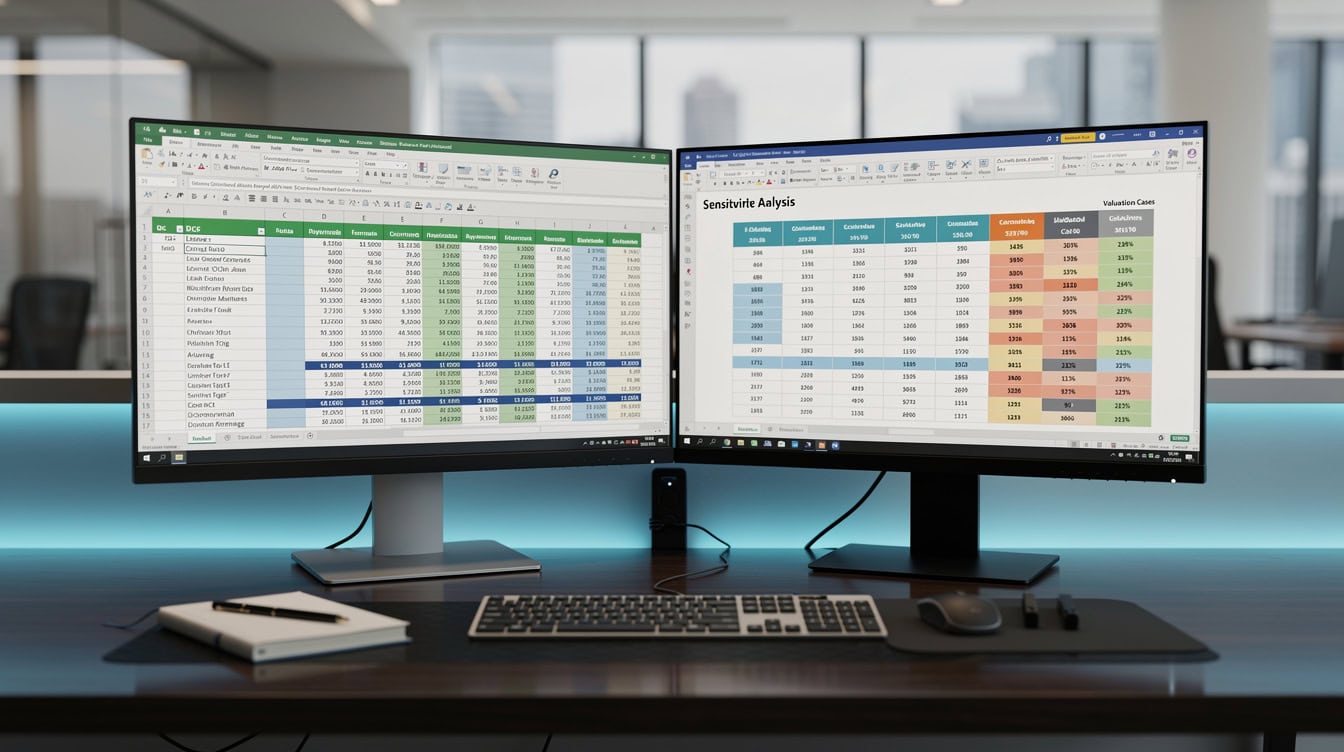
Template pricing tiers reflect feature depth: $50–$150 covers single functions, while $300–$500 templates include DCF valuation and scenario simulation.
Custom Model Investment: Typical Project Costs and Scope
A custom financial model is built from scratch (or from a proprietary framework) by a financial modeling specialist who interviews the client, maps their specific business logic, and delivers a bespoke Excel or Google Sheets workbook. Custom builds are not templates with extra tabs. They encode your actual pricing mechanics, your specific cost structure, and your investor’s exact reporting preferences.
Typical custom model project costs break down as follows:
- $3,000–$6,000: Single-entity model with up to 3 revenue streams, standard three-statement output, and one scenario toggle. Delivery: 2–3 weeks.
- $6,000–$12,000: Multi-revenue-stream model with integrated unit economics (metrics like customer acquisition cost and lifetime value that link operational drivers to financial outcomes), sensitivity tables, and investor-ready output package. Delivery: 3–5 weeks.
- $12,000–$25,000+: Multi-entity or multi-geography models, complex equity waterfall structures (which define how returns are distributed among investors at exit), LBO (leveraged buyout) analysis, or models requiring API data integration. Delivery: 5–10 weeks.
Revision cycles are the most common source of cost overrun in custom builds. A project with a poorly defined scope can generate 3–5 revision rounds, each adding 1–2 weeks and $500–$2,000 in change order costs. A single Excel workbook can contain up to 1,048,576 rows and 16,384 columns per worksheet. Source This gives custom modelers virtually unlimited structural room to encode complex multi-entity logic without hitting platform constraints.
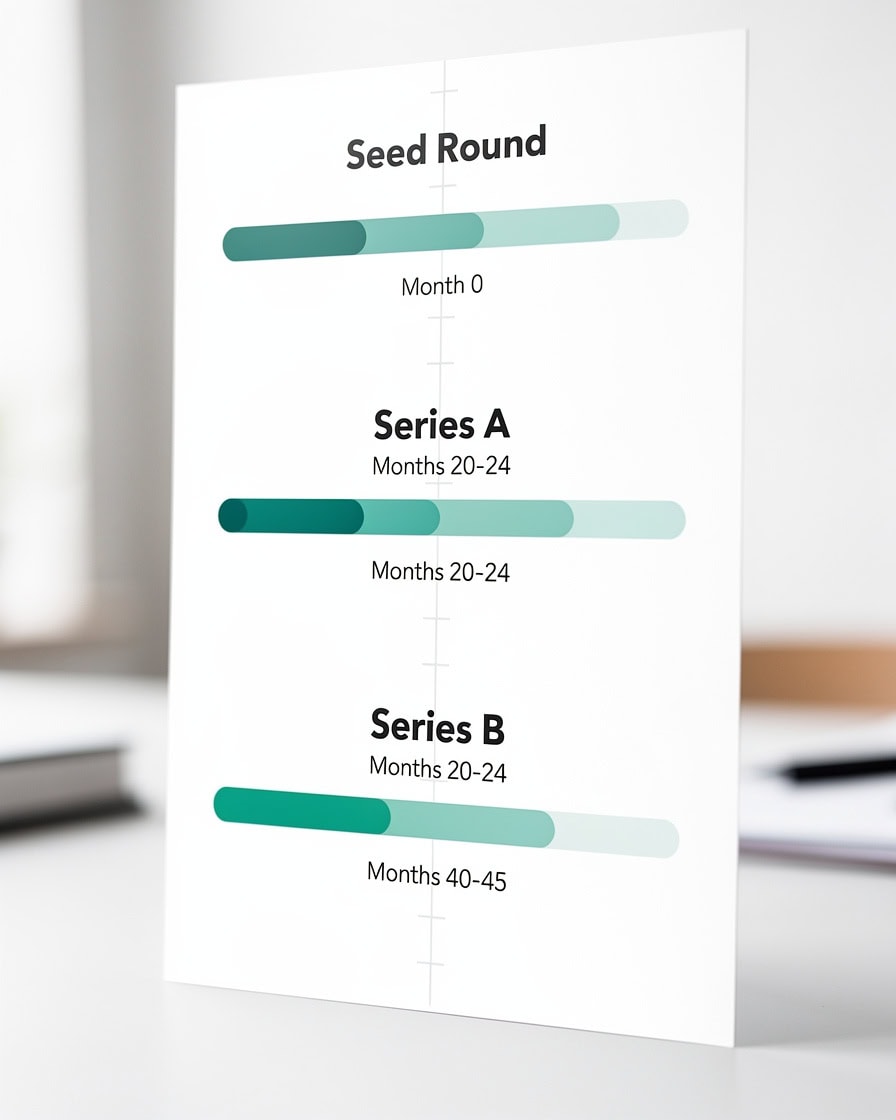
Custom model builds follow a structured 5-stage process. Revision cycles in the Review stage are the most common source of timeline and cost overruns.
Three Client Archetypes: Template, Custom, and Hybrid
Three real-world buyer profiles illustrate where each pricing tier delivers the best return.
Archetype 1: The Pre-Seed Founder (Template)
A SaaS founder raising a $500K pre-seed round needed a 3-year financial model to share with angel investors. Her business had one product, one pricing tier, and a straightforward monthly subscription model. She purchased a startup financial model template for $199, spent 8 hours customizing assumptions, and delivered a polished model to investors within one week. Total cost: $199 plus roughly $600 in time at her consulting day rate. She closed the round 6 weeks later. A custom build would have cost $5,000–$8,000 and taken 3–4 weeks, with no material improvement in investor confidence for a business at that stage.
Archetype 2: The Series B SaaS Company (Custom)
A B2B SaaS company preparing for a $15M Series B had three pricing tiers (monthly, annual, and enterprise), a usage-based overage component, a professional services revenue line, and a complex sales commission structure tied to annual contract value. The CFO attempted to adapt a $350 template and spent 30 hours before concluding the revenue logic could not be replicated without rebuilding the entire model. A custom build at $9,500 delivered a model in 4 weeks that the CFO used directly in board presentations and investor data rooms. The model’s cohort retention analysis (which tracks how groups of customers behave over time) was cited by the lead investor as a key diligence input.
Archetype 3: The Franchise Operator (Hybrid)
A multi-unit franchise operator started with a franchise model template at $249 to model units 1–3. When expanding to 8 locations across two states with different royalty structures and a shared services cost allocation, the template’s single-entity structure became a constraint. At that trigger point, the operator commissioned a custom multi-entity model at $7,200. Total spend over 18 months: $7,449, compared to an estimated $14,000–$18,000 if they had started with a custom build from day one.

Three archetypes, three outcomes: the right model tier depends on business stage and complexity, not on how sophisticated the buyer wants to appear.
The Complexity Threshold: 10 Signals You’ve Outgrown Templates
Templates become inadequate at a specific complexity threshold, not a vague one. Here are 10 concrete signals:
- You have 4 or more distinct revenue streams with different pricing mechanics.
- Your business has multiple legal entities or geographic segments that must consolidate.
- Your investors require a specific output format (e.g., a particular LP reporting template or a bank’s covenant compliance schedule).
- You need an integrated equity waterfall with preferred return hurdles, catch-up provisions, and carried interest calculations.
- Your cost structure includes variable costs that are non-linearly tied to revenue (e.g., tiered cloud hosting costs).
- You need to model an M&A transaction, including purchase price allocation and goodwill amortization.
- Your model must link to live data sources or external databases.
- You have a usage-based or consumption pricing model where revenue is calculated at the unit level.
- You need scenario analysis across more than 3 variables simultaneously (a sensitivity matrix, not just a toggle).
- Your board or investors have requested changes to a template-based model that required rebuilding more than 30% of the formulas.
If you checked 3 or more of these, a custom build will almost certainly cost less over 12 months than the accumulated time spent fighting a template.
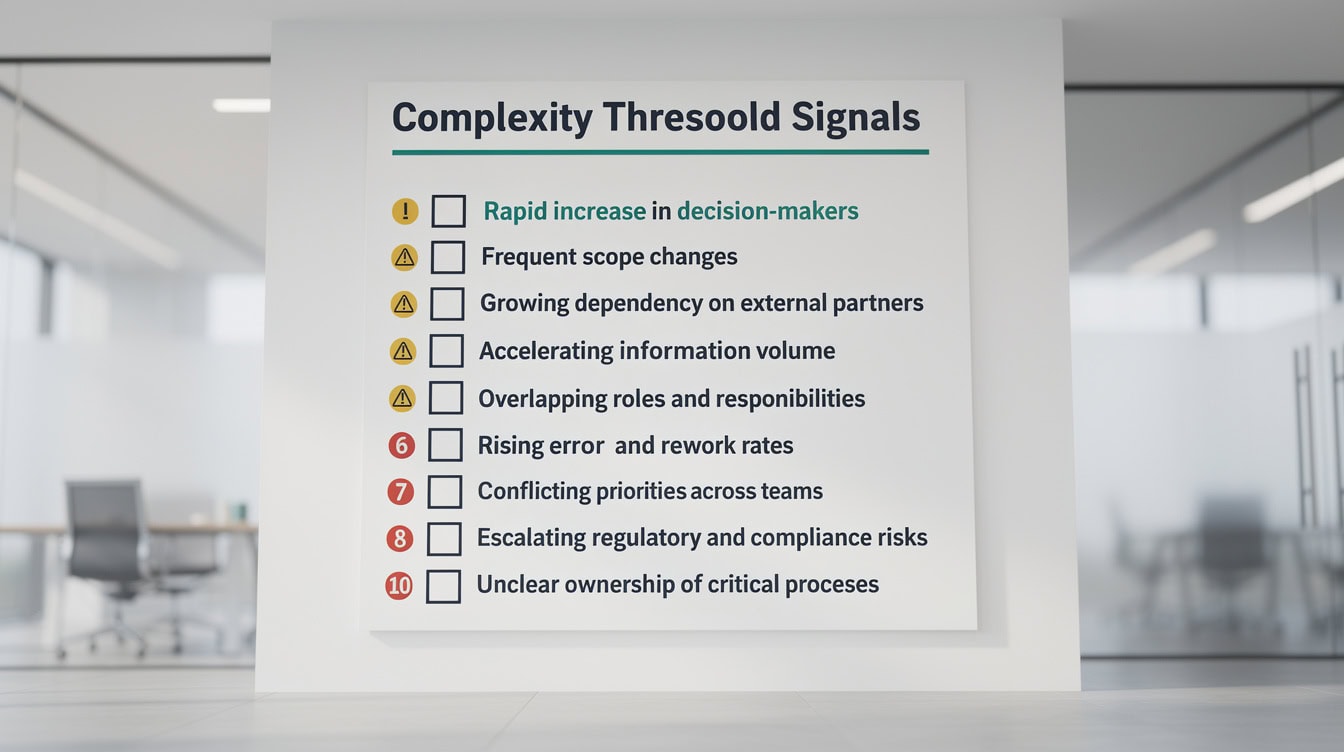
Checking 3 or more of these 10 signals means a custom build will cost less over 12 months than the accumulated time spent fighting a template.
Total Cost of Ownership: Beyond the Sticker Price
Total cost of ownership (TCO) is the full financial impact of a decision over a defined period, including purchase price, implementation time, maintenance, and opportunity costs. For financial models, TCO over 12 months tells a very different story than the purchase price alone.
Here is a worked numerical example comparing a $250 template against a $7,500 custom build for a mid-stage company:
Template TCO (12 months):
- Purchase price: $250
- Implementation time: 20 hours at $75/hour opportunity cost = $1,500
- Customization effort (adding 2 revenue lines): 15 hours = $1,125
- Monthly maintenance (updating actuals, adjusting assumptions): 2 hours/month x 12 x $75 = $1,800
- Total 12-month TCO: $4,675
Custom Build TCO (12 months):
- Build cost: $7,500
- Onboarding/handoff time: 4 hours = $300
- Monthly maintenance: 1 hour/month x 12 x $75 = $900
- Total 12-month TCO: $8,700
The custom build costs $4,025 more over 12 months in this scenario. But if the template’s outputs are less reliable, require manual workarounds, or cause a single bad decision (a missed fundraising round, an incorrect burn rate projection), the calculus reverses immediately.
The Federal Reserve’s Survey of Small Business Finances consistently shows that financial planning quality correlates with business survival rates. Source This means the cost of a wrong model is not just the model itself.
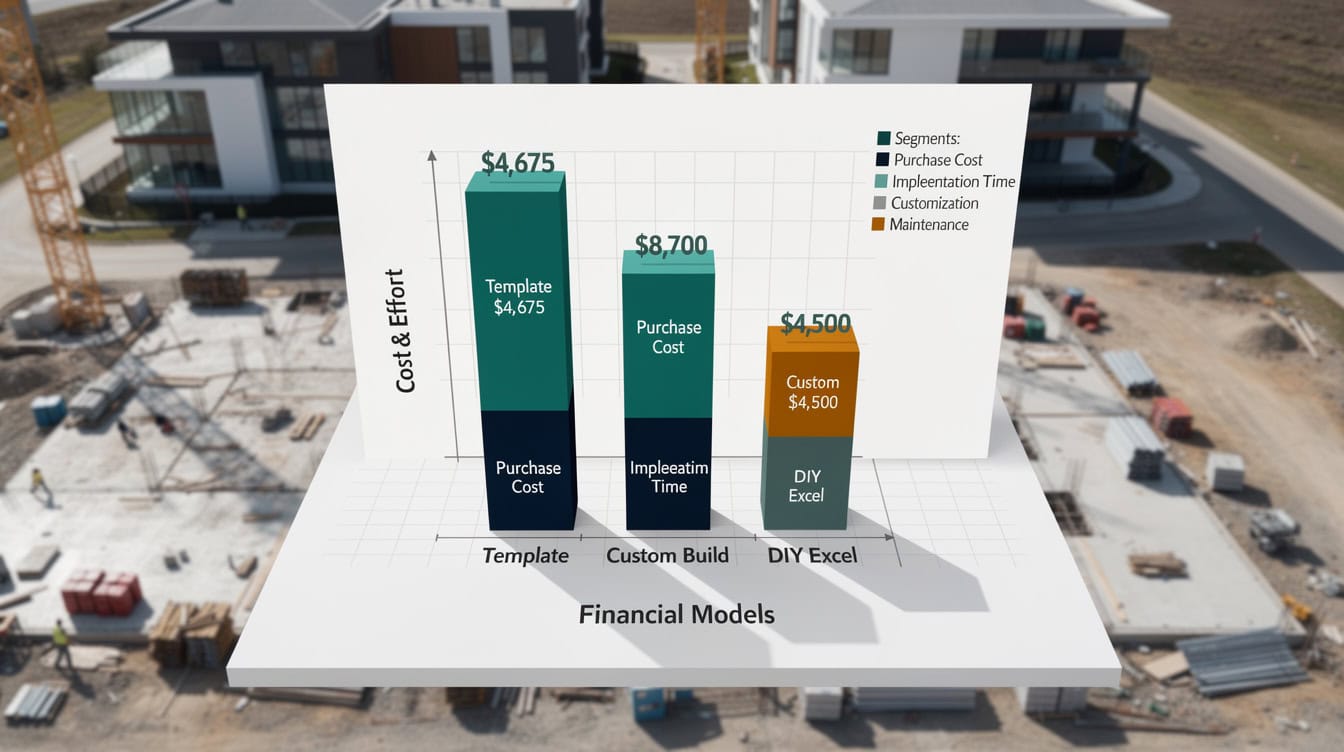
TCO over 12 months narrows the gap between templates and custom builds significantly once implementation time and maintenance are included.
The Hybrid Path: Starting Template, Scaling to Custom
The hybrid approach is the most cost-efficient path for businesses that are growing but not yet complex enough to justify a full custom build from day one. It works in three stages:
Stage 1 (Months 1–12): Purchase an industry-specific template. Use it for internal planning and early investor conversations. Budget $150–$400.
Stage 2 (Trigger point): When you hit one of the complexity thresholds listed above, or when your template requires more than 20 hours of modification in a single quarter, commission a custom build. Use your template’s assumption structure as the briefing document for the custom modeler, which cuts scoping time by 30–40%.
Stage 3 (Ongoing): Maintain the custom model with quarterly updates. If your business model changes materially (new product line, acquisition, new geography), budget for a model refresh at $1,500–$4,000 rather than a full rebuild.
Forecasting templates are specifically designed with clean assumption structures that translate well into custom build briefs, making the Stage 1 to Stage 2 transition faster.

The hybrid path cuts average modeling spend by 40% over 24 months by delaying custom build investment until complexity genuinely demands it.
Self-Assessment: Which Pricing Model Matches Your Needs?
Answer these 8 yes/no questions. Count your “yes” answers.
- Does your business have 3 or fewer distinct revenue streams? (Yes = template-friendly)
- Are you raising less than $2M in your current round? (Yes = template-friendly)
- Do you have a single legal entity with no subsidiaries? (Yes = template-friendly)
- Is your pricing model straightforward (flat fee, simple subscription, or per-unit)? (Yes = template-friendly)
- Do you have more than 3 investor or board members with specific reporting requirements? (Yes = custom signal)
- Does your model need to consolidate financials across multiple geographies or currencies? (Yes = custom signal)
- Have you already spent more than 15 hours trying to adapt a template without success? (Yes = custom signal)
- Is your deal size or company valuation above $10M, where modeling errors carry material financial risk? (Yes = custom signal)
Scoring:
- 5–8 “template-friendly” answers: A quality template is your best starting point. Budget $150–$400 and plan for 8–15 hours of setup.
- 3–4 of each: Consider the hybrid path. Start with a template and set a 6-month review trigger.
- 5–8 “custom signal” answers: Invest in a custom build. The time and decision-quality savings will outweigh the higher upfront cost within 6–12 months.

The 8-question self-assessment routes buyers to the right tier in under 3 minutes. 5+ custom signals means a custom build pays for itself within 12 months.
Comparison: Template vs. Custom vs. DIY
The table below compares all three approaches across the dimensions that matter most to buyers.
| Dimension | Template | Custom Build | DIY Excel |
|---|---|---|---|
| Upfront Cost | $50–$500 | $3,000–$25,000+ | $0 |
| Time to Usable Model | 5–15 hrs | 2–10 weeks | 40–80 hrs |
| Complexity Ceiling | Low–Medium | High | Unlimited |
| Investor Credibility | Medium | High | Low–Medium |
| Maintenance Burden | Medium | Low | High |
| Customization Limit | Moderate | None | None |
| 12-Month TCO (mid-stage) | ~$4,675 | ~$8,700 | ~$3,000–$6,000 |
DIY Excel (building a model from scratch without a template or professional help) appears cheapest at $0 upfront, but the 40–80 hours of analyst time required represents $3,000–$6,000 in opportunity cost at a $75/hour rate, and the output typically lacks the structural integrity that investors and lenders expect. Excel’s What-If Analysis tools support up to 32 changing cells in a single Scenario Manager scenario, a ceiling that DIY builders frequently hit when modeling complex sensitivity analyses without professional model architecture. According to research published by the Journal of Financial Economics, model errors in financial projections are a leading cause of valuation disputes in M&A transactions. Source
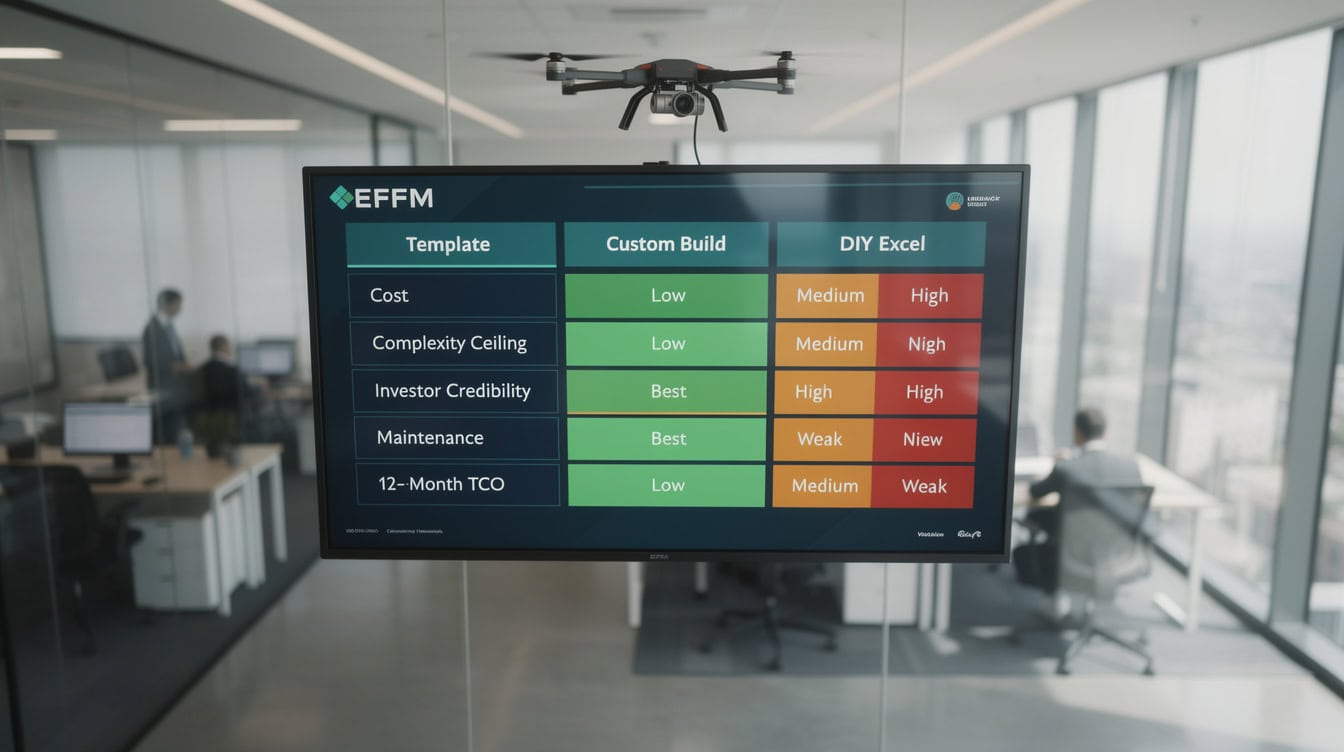
DIY Excel appears cheapest at $0 upfront but costs $3,000–$6,000 in opportunity time and typically produces outputs that lack investor-grade structural integrity.
Frequently Asked Questions
How much does it cost to have a financial model built from scratch?
A custom financial model built from scratch typically costs between $3,000 and $25,000, depending on complexity. A single-entity model with up to 3 revenue streams and standard three-statement outputs (income statement, balance sheet, cash flow) runs $3,000–$6,000 with a 2–3 week delivery timeline. Multi-entity models with equity waterfall structures, LBO analysis, or API data integration push costs to $12,000–$25,000 and require 5–10 weeks. The most common cost driver is scope creep during revision cycles: each unplanned revision round adds $500–$2,000 and 1–2 weeks. To control this, define your output requirements in writing before the project starts, including the exact tabs, scenarios, and KPIs you need.
Can I modify a purchased template to fit my business?
Yes, most Excel-based templates are fully unlocked and editable. The practical limit is not technical but structural: templates are built around a specific business logic, and if your business logic differs materially, you end up rebuilding the model’s core formulas rather than just changing assumptions. Buyers who spend more than 20 hours modifying a template in the first 90 days are almost always better served by a custom build. A useful rule of thumb: if you need to add more than 2 new revenue streams or restructure the cost allocation methodology, the template’s architecture is no longer working for you. At that point, the template’s purchase price becomes a sunk cost, and a custom build is the economically rational next step.
What is the difference between a three-statement model and a DCF model?
A three-statement model links the income statement, balance sheet, and cash flow statement so that changes in one automatically flow through to the others. It is the foundation of almost all financial modeling. A DCF (discounted cash flow) model takes the free cash flows projected in a three-statement model and discounts them back to present value using a discount rate (typically the weighted average cost of capital, or WACC) to estimate what the business is worth today. Most investor-ready models include both: the three-statement model generates the projections, and the DCF layer converts those projections into a valuation. Templates at the $150–$300 price point typically include both components. Custom builds always include both, plus sensitivity analysis showing how the valuation changes as key assumptions shift.
How long does it take to implement a financial model template?
For a buyer with solid Excel skills and a clear understanding of their business’s financials, a quality template takes 5–15 hours to implement from download to a working model. That timeline includes reading the documentation, entering historical actuals, setting projection assumptions, and reviewing outputs for reasonableness. Buyers with limited Excel experience should budget 20–30 hours and consider scheduling a 1-hour onboarding call with the template provider. The most time-consuming step is almost always gathering clean historical financial data: if your bookkeeping is current and organized, implementation is fast. If you need to reconstruct 2 years of actuals from bank statements, add 5–10 hours before you even open the template.
What hidden costs should I watch for in a custom model project?
The 4 most common hidden costs in custom model projects are: (1) Scope creep, where new requirements added after the project starts generate change orders at $150–$300 per hour; (2) Data preparation, where the client must clean and organize historical financials before the modeler can begin, often taking 10–20 hours of internal time; (3) Revision cycles, where unclear initial requirements lead to 3–5 rounds of revisions, each adding 1–2 weeks; and (4) Knowledge transfer, where the model is delivered but the internal team lacks the skills to maintain it, requiring ongoing support at $100–$200 per hour. To avoid these, insist on a detailed scope document before signing, allocate internal time for data prep, and request a 2-hour training session as part of the delivery package.
Is a free financial model template good enough for investor presentations?
Free templates can work for very early-stage conversations, particularly at the idea or pre-seed stage where investors expect rough projections. However, free templates typically lack the structural depth, scenario analysis, and output formatting that Series A and later-stage investors expect. A $150–$300 paid template from a reputable provider includes investor-ready dashboards, sensitivity tables, and clean formatting that signals financial sophistication. The credibility gap between a free template and a paid one is small compared to the gap between either and a custom build. For rounds above $2M, a custom model’s ability to encode your specific business logic and answer investor questions in real time during diligence is worth the investment.
When should I upgrade from a template to a custom model?
Upgrade when any of these 3 triggers occur: (1) You have spent more than 20 hours in a single quarter modifying or working around your template’s limitations; (2) An investor, lender, or board member has requested outputs or analyses that your template cannot produce without a structural rebuild; or (3) Your business has crossed a complexity threshold, such as adding a fourth revenue stream, acquiring another entity, or launching in a new currency. The hybrid path works best when you treat the template as a temporary tool with a defined expiration date, not a permanent solution. Setting a 12-month review date at the time of template purchase helps you make the upgrade decision proactively rather than reactively.
Conclusion
The right financial model is the one that matches your actual complexity today, not the one that sounds most impressive. For 70% of early-stage businesses, a quality template at $150–$400 delivers full value with 5–15 hours of setup. For businesses with genuine complexity, a custom build at $5,000–$15,000 pays for itself in decision quality and investor confidence within 6–12 months. The hybrid path, starting with a template and upgrading at a defined trigger, is the most capital-efficient route for growing businesses.
I recommend starting with financial model templates to find the right fit for your industry and stage. If you answer “yes” to 5 or more of the custom signals in the self-assessment above, explore custom financial modeling services for a scoped proposal. Either way, the worst option is the one most buyers default to: a DIY spreadsheet that costs 60 hours to build and still doesn’t answer the questions your investors are asking.