0 ITEMS

Family Business Valuation: 3 Methods, 1 Conflict Framework

Valuing a family business is equal parts financial analysis and conflict prevention—get the number wrong, or the process wrong, and you risk both the estate plan and the family relationship.
Key Takeaways
- Family businesses represent roughly 90% of all U.S. businesses and generate about 64% of GDP, yet most lack a documented, repeatable valuation process.
- Three core methods apply to family-owned firms: Discounted Cash Flow (DCF), Market Comparables (Multiples), and Asset-Based Valuation—each with a distinct conflict-risk profile.
- Minority interest discounts typically range from 15% to 40%, and lack-of-marketability discounts from 20% to 35%, making appraiser selection one of the highest-stakes governance decisions a family makes.
- IRS Revenue Ruling 59-60 sets the legal standard for estate and gift tax valuations of closely held businesses—ignoring it exposes families to IRS challenge and costly litigation.
- Pre-agreed valuation formulas in buy-sell agreements, combined with mandatory third-party appraisers holding ASA, ABV, or CVA credentials, reduce valuation disputes by establishing process before emotions run high.
- Independent valuation committees and binding arbitration clauses are the two most effective structural tools for preventing valuation conflicts from reaching court.
- Valuations should be updated annually for buy-sell trigger events and every 3 to 5 years for estate planning purposes, not treated as a one-time exercise.
Why Family Business Valuation Is Both a Finance and a Governance Challenge
Family business valuation fails not because the math is hard, but because the process lacks structure. A number produced without transparent methodology, independent oversight, and pre-agreed rules becomes a flashpoint for conflict the moment a founder retires, a sibling wants to exit, or an estate is settled.
Family-owned businesses account for approximately 64% of U.S. gross domestic product and employ about 62% of the workforce.
Yet surveys consistently show that fewer than one-third of family businesses have a formal, documented succession plan—and even fewer have a pre-agreed valuation methodology. That gap is where disputes are born.
The emotional stakes compound the technical ones. A founder who built a business over 40 years may anchor on a number that reflects sweat equity and legacy, not market reality. Next-generation buyers may argue for a lower value to make the buyout affordable. Outside shareholders may demand a premium. None of these positions is inherently dishonest—they reflect different interests, different time horizons, and different relationships to the business. Governance structures exist precisely to channel those differences into a defensible, fair process.

Valuation disputes arise at the intersection of financial disagreement, governance gaps, and family relationship dynamics.
Core Valuation Methods for Family-Owned Enterprises
Three methods dominate family business valuation: DCF, Market Comparables, and Asset-Based Valuation. Each produces a different number for the same business, and each carries a different risk of family conflict. Choosing the right method—or weighting a blend of methods—requires understanding both the business’s economics and the transaction context.
The IRS Revenue Ruling 59-60 (the foundational standard for estate and gift tax valuations of closely held businesses) explicitly requires appraisers to consider all relevant factors, including earnings capacity, dividend-paying capacity, goodwill, and comparable sales.
Ignoring any of these factors in a tax-context valuation invites IRS challenge.
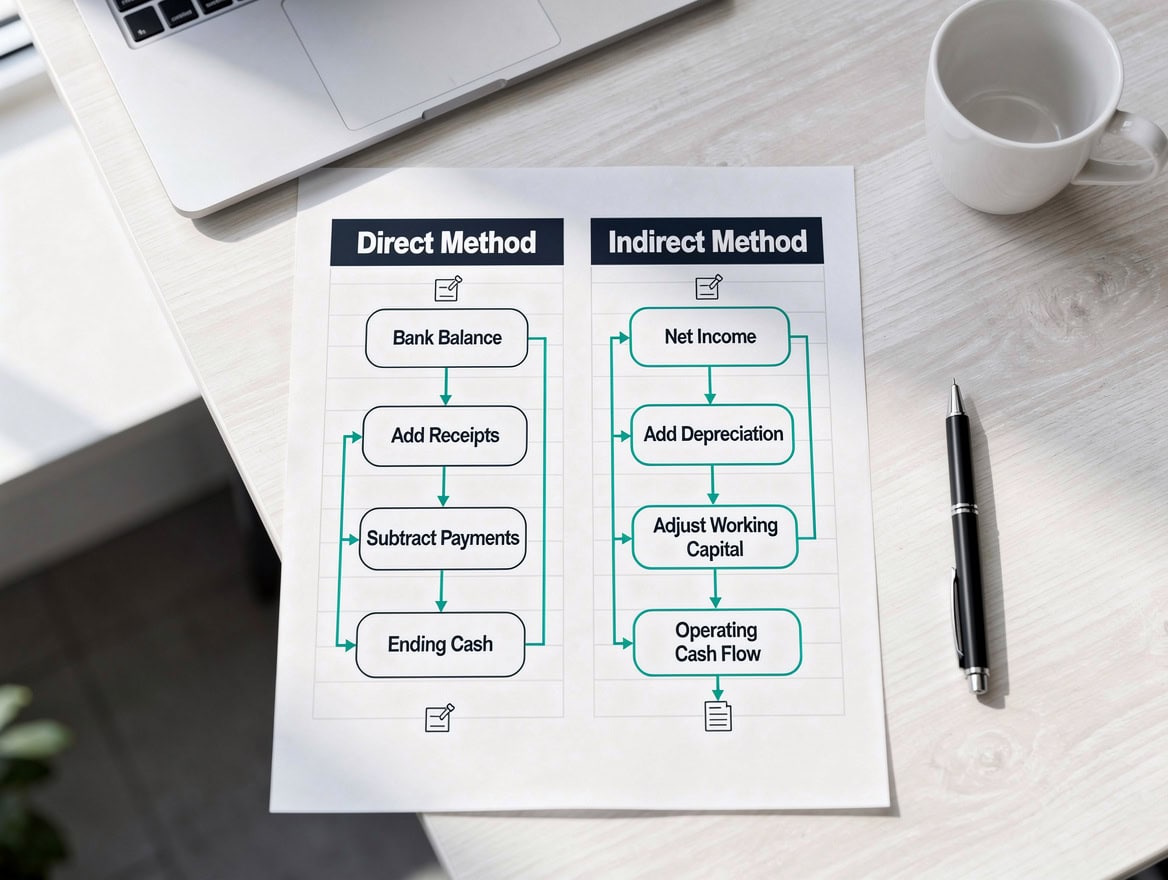
DCF, Market Comparables, and Asset-Based Valuation each produce a different number—blending all three with documented weights produces the most defensible result.
Discounted Cash Flow (DCF): Mechanics and Family Business Adjustments
DCF is the most rigorous method for a family business with stable, foreseeable cash flows. It values the business as the present value of all future free cash flows, discounted at a rate that reflects the risk of those cash flows.
Step-by-step DCF for a family business:
- Normalize earnings. Strip out owner compensation above market rate, personal expenses run through the business, and one-time items. This produces Seller’s Discretionary Earnings (SDE) or Adjusted EBITDA (earnings before interest, taxes, depreciation, and amortization).
- Forecast free cash flow. Project 5 years of revenue, operating costs, capital expenditures, and working capital changes. For founder-dependent businesses, apply a revenue haircut (typically 10% to 25%) to reflect key-person risk.
- Calculate WACC. For private companies, WACC (Weighted Average Cost of Capital, the blended required return on debt and equity) uses the Build-Up Method: start with the risk-free rate, add an equity risk premium, a size premium, and a company-specific risk premium. A typical private family business WACC ranges from 15% to 25%, far above public-company benchmarks.
- Estimate terminal value. Apply a Gordon Growth Model: Terminal Value = FCF(Year 5) × (1 + g) / (WACC – g), where g is the long-run growth rate (typically 2% to 3% for a mature family business).
- Discount and sum. Discount each year’s FCF and the terminal value back to today using WACC. Sum them to get Enterprise Value. Subtract net debt to get Equity Value.
Worked example:
Assume a family manufacturing business with normalized EBITDA of $2,000,000, capital expenditures of $300,000/year, and no working capital growth. WACC is estimated at 18%. Long-run growth rate is 2.5%.
- Year 1-5 Free Cash Flow (simplified): $1,700,000/year
- PV of 5-year FCF at 18%: $1,700,000 × (1 – (1.18)^-5) / 0.18 = $1,700,000 × 3.127 = $5,316,000
- Terminal Value at end of Year 5: $1,700,000 × 1.025 / (0.18 – 0.025) = $1,742,500 / 0.155 = $11,242,000
- PV of Terminal Value: $11,242,000 / (1.18)^5 = $11,242,000 / 2.288 = $4,913,000
- Enterprise Value: $5,316,000 + $4,913,000 = $10,229,000
- Less net debt of $1,500,000: Equity Value = $8,729,000
Apply a 25% lack-of-marketability discount (LOMD) for a minority interest transfer: $8,729,000 × 0.75 = $6,547,000 for the minority block.
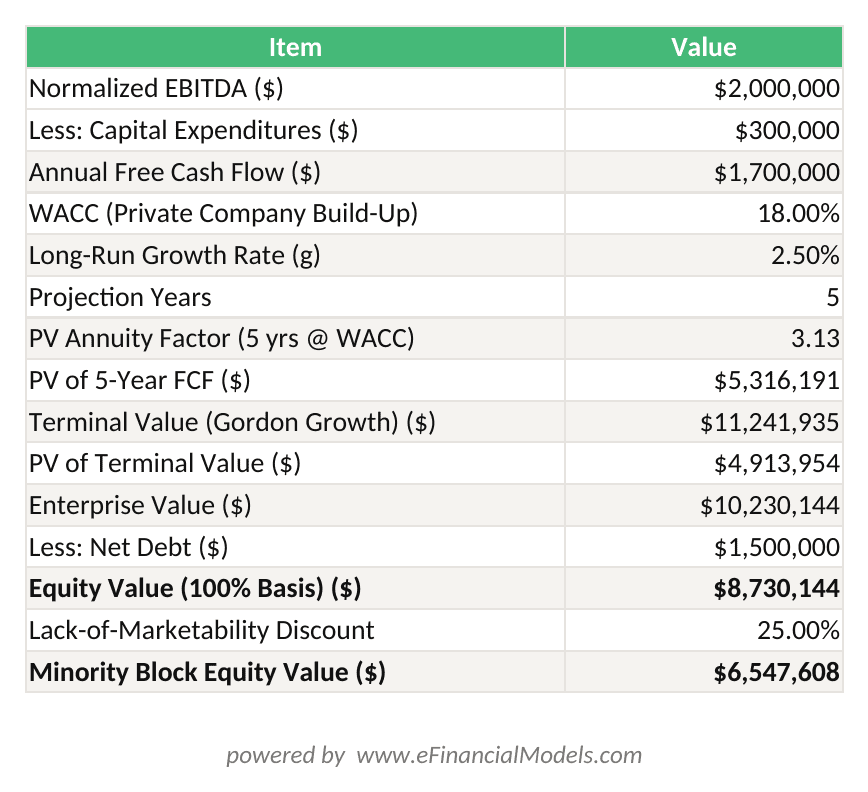
DCF Equity Value = PV of 5-Year FCF + PV of Terminal Value – Net Debt, then adjusted for applicable discounts. This example produces an equity value of $8,729,000 before discounts.
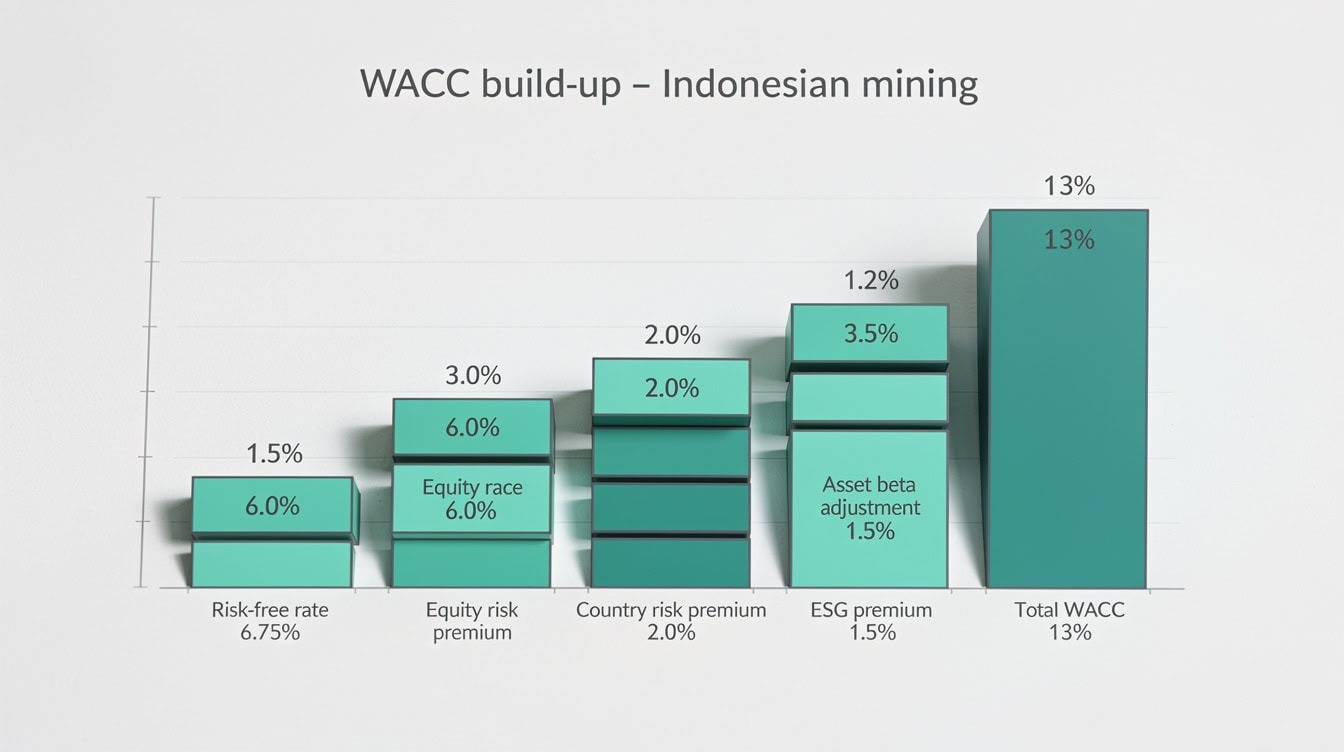
The DCF process for a family business adds two critical steps beyond standard DCF: earnings normalization and a private-company WACC build-up.
Market Comparables and Multiples: Finding Benchmarks for Private Companies
Market comparables (also called the Market Approach) value a business by applying revenue or EBITDA multiples derived from sales of similar companies. For private family businesses, relevant data comes from private transaction databases rather than public stock markets.
Private transaction databases such as DealStats (formerly BizComps) and PitchBook track actual sale prices of closely held businesses by industry and size. For example, manufacturing businesses with EBITDA under $5 million typically transact at 4x to 6x EBITDA in private markets.
Professional services firms may trade at 3x to 5x SDE. Distribution businesses often fall in the 3.5x to 5.5x EBITDA range.
The key family-business adjustment: public-company multiples must be deflated by a private-company discount (often 20% to 30%) before applying them to a closely held firm. A family business also lacks the management depth, customer diversification, and liquidity of a public peer, all of which compress multiples further.

Private-market EBITDA multiples vary significantly by sector—manufacturing trades at a premium to services due to tangible asset backing.
Asset-Based Valuation: When Book Value Isn’t Enough
The Asset-Based Approach values a business by adjusting the book value of assets and liabilities to fair market value. It’s most appropriate for holding companies, real-estate-heavy businesses, or firms with minimal earnings but significant tangible assets.
Two variants exist. The Going Concern method adjusts all assets and liabilities to fair market value while assuming the business continues operating. The Liquidation method estimates net proceeds if assets were sold and liabilities settled immediately, typically producing the lowest value of the three methods.
For a family business with significant real estate, equipment, or investment portfolios, the asset-based approach often produces a floor value. It’s rarely used alone for operating businesses because it ignores goodwill and future earnings power—two of the most valuable (and most contested) components of a family enterprise.

Asset-based valuation adjusts book values to fair market value—critical for real-estate-heavy family businesses where historical cost understates true worth.
Valuation Method vs. Conflict Risk: A Side-by-Side Comparison
Choosing a method without understanding its conflict profile is one of the most common governance mistakes family businesses make. The table below maps each method to its risk characteristics and best-use scenarios.
| Method | Subjectivity | Bias Risk | Challenge Ease | Best Use Case |
|---|---|---|---|---|
| DCF | High | High | High | Stable cash-flow businesses, succession buyouts |
| Market Comps | Medium | Medium | Medium | Operating businesses with private-market peers |
| Asset-Based | Low | Low | Low | Holding companies, real estate, liquidation |
DCF carries the highest conflict risk because every assumption—growth rate, WACC, normalization adjustments—is a judgment call that family members can dispute. Market Comps are more objective but require access to reliable private transaction data and careful peer selection. Asset-Based is the most defensible in court but often undervalues a profitable operating business, which creates its own conflict when sellers feel shortchanged.
The most defensible family business valuations use a weighted blend: for example, 50% DCF, 40% Market Comps, and 10% Asset-Based, with the weights documented and pre-agreed in the buy-sell agreement.
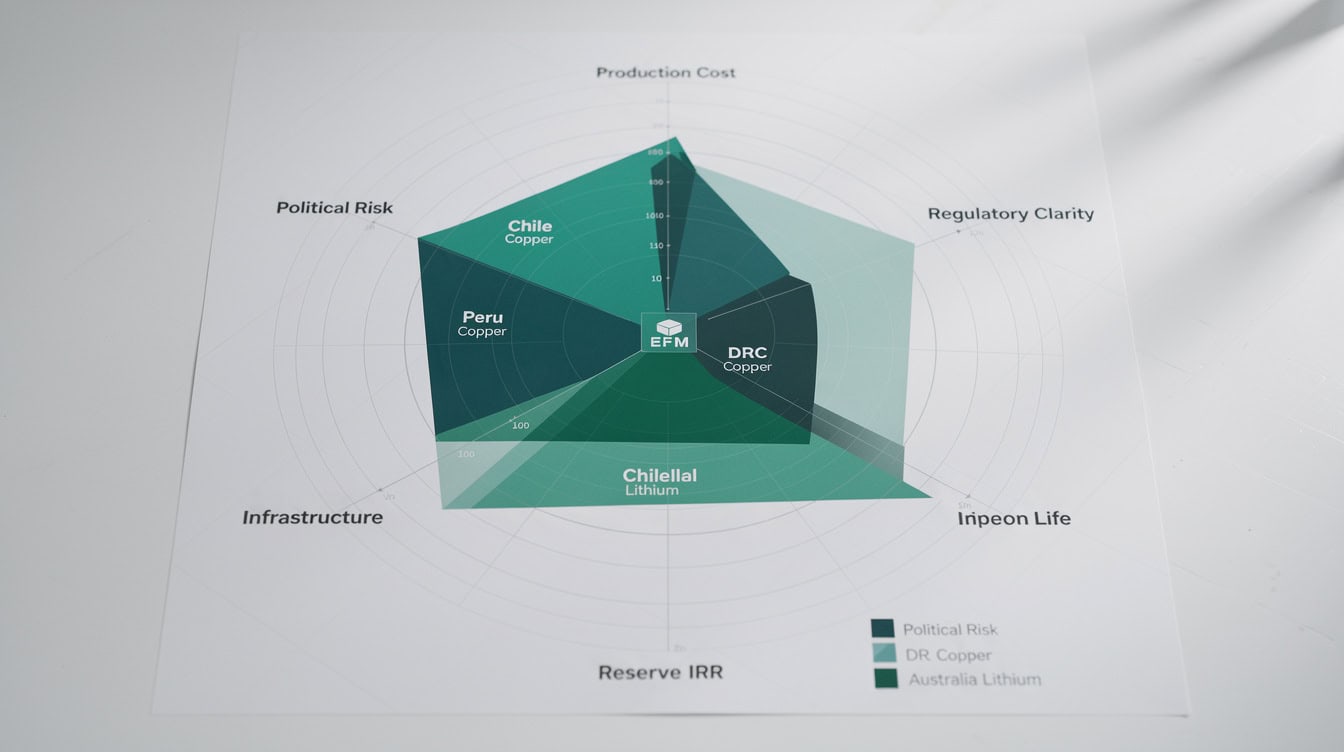
DCF scores highest on conflict risk across all dimensions—pre-agreeing its assumptions in the buy-sell agreement is the primary mitigation.
Conflict-Mitigation Frameworks: Independent Committees, Appraisers, and Pre-Agreed Formulas
The single most effective conflict-prevention tool is a pre-agreed valuation process written into the buy-sell agreement before any triggering event occurs. Once a founder announces retirement or a shareholder demands a buyout, it’s too late to negotiate methodology without conflict.
Independent valuation committees consist of 3 to 5 members with no financial interest in the outcome: typically one family representative, one outside board member, and one independent financial advisor. The committee commissions the appraisal, reviews assumptions, and approves the final report. This structure removes the perception that any one family faction controls the number.
Third-party appraisers should hold recognized credentials. The three primary designations are:
- ASA (Accredited Senior Appraiser) from the American Society of Appraisers
- ABV (Accredited in Business Valuation) from the American Institute of CPAs
- CVA (Certified Valuation Analyst) from the National Association of Certified Valuators and Analysts (NACVA)
Vetting criteria should include: at least 5 years of experience valuing businesses in the same industry, no prior relationship with any family member, and professional liability insurance. Credentialed appraisers must complete continuing education and adhere to the Uniform Standards of Professional Appraisal Practice (USPAP), which sets documentation and independence requirements.
Pre-agreed formulas in buy-sell agreements specify the exact methodology, the appraiser selection process, and the timeline. Model language might read: “The purchase price shall be determined by a qualified independent appraiser holding an ASA or ABV designation, selected by mutual agreement of the parties or, failing agreement within 30 days, appointed by the American Arbitration Association, applying the income approach weighted at 60% and the market approach weighted at 40%, with all normalization adjustments disclosed in writing.”
Minority and marketability discounts must be addressed explicitly. Minority interest discounts (reflecting lack of control) typically range from 15% to 40%, and lack-of-marketability discounts (reflecting illiquidity of closely held shares) typically range from 20% to 35%.
Source
These discounts are legitimate under IRS standards but are among the most contested elements in family disputes—pre-agreeing their application in the buy-sell agreement prevents post-hoc arguments.
For families building or reviewing their business valuation process, having a structured template as a starting point saves significant time and reduces the risk of missing key inputs.
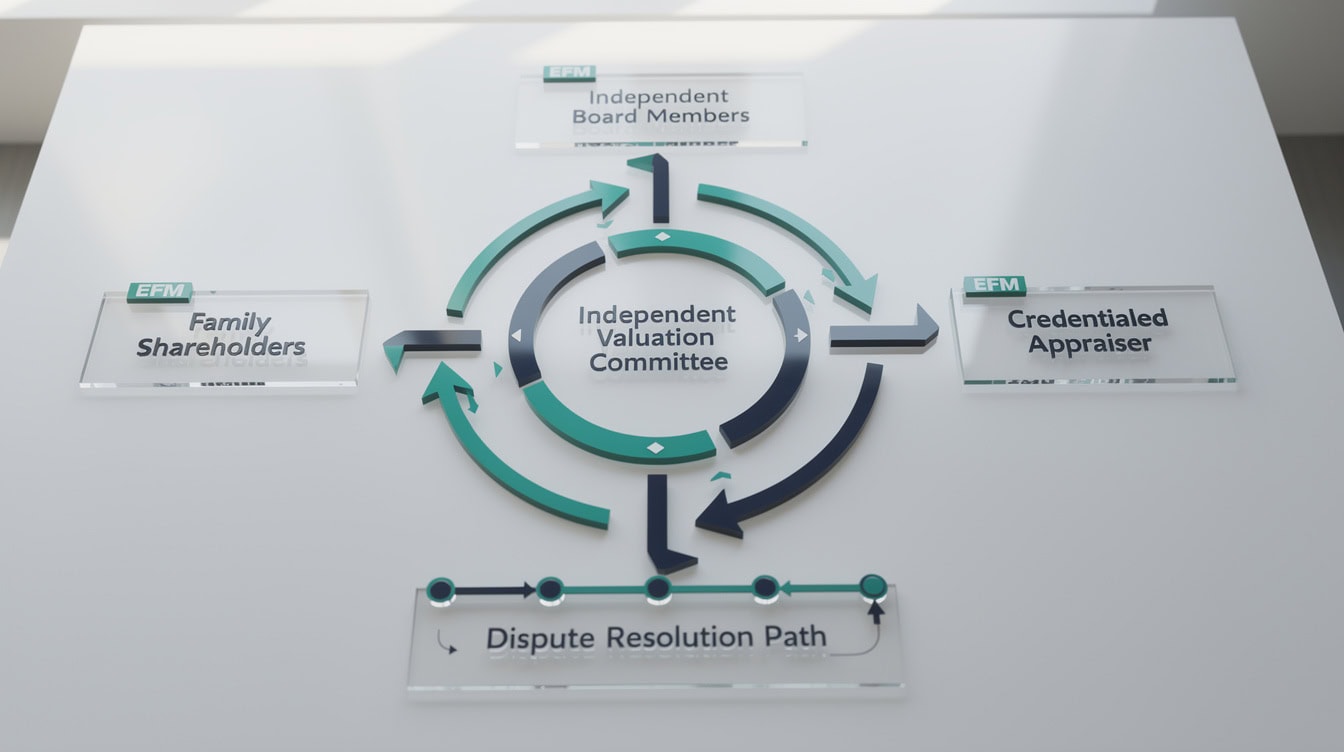
An independent valuation committee with no financial stake in the outcome is the most effective structural tool for preventing family valuation disputes.
Governance Checklist: Ensuring Integrity and Transparency
A governance checklist turns good intentions into repeatable process. Work through each item before any valuation is commissioned.
Who commissions the valuation:
- [ ] Independent valuation committee (not the buyer or seller)
- [ ] Committee charter documented in shareholder agreement
- [ ] No committee member has a financial interest in the outcome
Appraiser selection:
- [ ] Credentials verified (ASA, ABV, or CVA)
- [ ] Industry experience confirmed (minimum 5 years in sector)
- [ ] Conflict-of-interest disclosure signed
- [ ] Engagement letter specifies standard of value (fair market value for tax; fair value for litigation)
Documentation standards:
- [ ] All normalization adjustments itemized and explained
- [ ] Minority and marketability discount rates cited with supporting studies
- [ ] Comparable transaction data sourced from named database (DealStats, PitchBook)
- [ ] WACC build-up documented with each component
Dispute resolution escalation:
- [ ] 30-day negotiation period before escalation
- [ ] Mediation required before arbitration
- [ ] Binding arbitration clause names appointing authority (e.g., AAA)
- [ ] Costs allocated in advance (typically split equally)
Families managing complex ownership structures can also benefit from pre-money valuation frameworks when planning equity transfers to the next generation.
The Role of Mediators and Arbitrators in Valuation Disputes
Mediation and arbitration are not admissions of failure—they’re planned off-ramps that prevent valuation disagreements from becoming litigation. Litigation over family business valuations can cost $500,000 or more in legal fees and take 3 to 5 years to resolve.
Mediation is a non-binding process where a neutral third party facilitates negotiation. It’s most effective when family relationships are still intact and the dispute centers on assumptions rather than fundamental disagreements about value. Mediators with both financial and family systems training (often called family business mediators) are more effective than pure legal mediators in this context.
Arbitration is binding: the arbitrator’s decision replaces a court judgment. Shareholder agreements should specify: (1) the appointing authority (AAA, JAMS, or a named professional association), (2) the number of arbitrators (one for disputes under $1 million, three for larger disputes), (3) the standard of value to apply, and (4) the timeline for the award (typically 60 to 90 days after the hearing).
Model arbitration language: “Any dispute arising from the determination of the purchase price under this Agreement shall be submitted to binding arbitration administered by the American Arbitration Association under its Commercial Arbitration Rules. The arbitrator(s) shall apply the fair market value standard as defined in IRS Revenue Ruling 59-60. The arbitrator’s award shall be final and binding and may be entered as a judgment in any court of competent jurisdiction.”
Engaging a mediator early—before positions harden—is almost always cheaper and faster than arbitration. Many family business advisors recommend a mandatory 60-day mediation period before any arbitration can be initiated.

Each escalation step in a valuation dispute costs more and takes longer—pre-agreed mediation clauses keep most disputes at Step 1 or Step 2.
Case Studies: How Valuation Conflicts Arise and How Governance Resolves Them
Two anonymized scenarios illustrate how the same underlying conflict plays out differently depending on governance structure.
Scenario A: The Retiring Founder (Governance Failure)
A 72-year-old founder of a $15 million revenue distribution business wanted to sell his 60% stake to his two adult children at a price reflecting 40 years of personal sacrifice. He anchored on $8 million. His children, using a market multiples approach with a 4.5x EBITDA multiple on $1.2 million normalized EBITDA, calculated $5.4 million before discounts. No buy-sell agreement existed. The dispute went to litigation. After 18 months and $400,000 in legal fees, a court-appointed appraiser set the value at $6.1 million—close to the children’s number, but the family relationship did not survive the process.
Scenario B: The Estate Settlement (Governance Success)
A family manufacturing business had a buy-sell agreement specifying a 50/50 blend of DCF and market comps, with an independent ASA-credentialed appraiser appointed by the American Arbitration Association if the parties couldn’t agree within 30 days. When the founder died, the estate and the surviving shareholders disagreed on WACC assumptions. The AAA appointed an appraiser within 15 days. The appraiser’s report, completed in 60 days, was accepted by both sides. Total cost: $45,000. The business transferred without litigation.
The difference between these outcomes was not the complexity of the business or the size of the family—it was the presence or absence of a pre-agreed governance structure.

The difference between a $400,000 litigation and a $45,000 appraisal process is almost always the presence of a pre-agreed governance structure.
Frequently Asked Questions About Family Business Valuation
How often should a family business be valued?
Family businesses should update their valuation annually if the buy-sell agreement contains triggering events (death, disability, divorce, or voluntary exit), because a stale valuation creates immediate conflict when a trigger occurs. For estate planning purposes, most family business advisors and the American College of Trust and Estate Counsel recommend a formal revaluation every 3 to 5 years, or whenever a material change occurs in the business (a major acquisition, loss of a key customer, or significant change in profitability). Annual updates don’t require a full appraisal—a formula-based update using current EBITDA and a pre-agreed multiple can suffice for buy-sell purposes, with a full appraisal triggered only by a qualifying event.
What is the difference between fair market value and fair value in a family business context?
Fair market value (FMV) is the IRS standard for estate and gift tax purposes: the price a hypothetical willing buyer and willing seller would agree on, with neither under compulsion and both having reasonable knowledge of the facts. FMV typically includes minority and marketability discounts. Fair value is a legal standard used in shareholder oppression and dissenting shareholder cases—it often excludes those discounts, producing a higher number. The same business can have two materially different valuations depending on which standard applies. A $10 million FMV business might carry a fair value of $13 million to $14 million once discounts are removed. Families should specify the applicable standard in every valuation context: tax filings use FMV; litigation may require fair value.
How do you value sweat equity and founder goodwill in a family business?
Founder goodwill—the portion of business value attributable to the founder’s personal relationships, reputation, and skills—is one of the most contested elements in family business valuation. Appraisers distinguish between enterprise goodwill (transferable to a new owner) and personal goodwill (not transferable). Enterprise goodwill is included in business value; personal goodwill is not, because it leaves with the founder. To estimate the split, appraisers analyze customer concentration (if 60% of revenue comes from the founder’s personal relationships, a large portion is personal goodwill), management depth, and the business’s performance during periods when the founder was absent. A business with strong systems, a capable management team, and diversified customer relationships will have a higher enterprise goodwill ratio—and a higher transferable value.
Can a family business valuation for estate tax differ from its M&A transaction value?
Yes, and the gap can be substantial. Estate tax valuations use the fair market value standard with a hypothetical buyer and seller, apply minority and marketability discounts, and exclude synergies. M&A transaction values reflect what a specific strategic buyer will pay, including synergies, control premiums, and competitive bidding dynamics. A family business valued at $8 million for estate tax purposes might sell to a strategic acquirer for $12 million to $14 million. This divergence is not a problem—it’s a feature of two different standards serving two different purposes. The risk arises when families assume the estate tax value equals the transaction value and underprice a sale, or when they use a transaction value for estate tax purposes and trigger an IRS audit. Always use the correct standard for the correct purpose, and document the rationale.
What credentials should a family business appraiser hold, and how do you vet them?
The three primary credentials are the ASA (Accredited Senior Appraiser, granted by the American Society of Appraisers), the ABV (Accredited in Business Valuation, granted by the AICPA), and the CVA (Certified Valuation Analyst, granted by NACVA). All three require demonstrated experience, a qualifying examination, and adherence to USPAP (Uniform Standards of Professional Appraisal Practice). To vet a candidate: verify the credential directly with the granting organization, confirm at least 5 years of experience valuing businesses in your industry, request 3 references from prior family business engagements, confirm professional liability (E&O) insurance of at least $1 million, and require a written conflict-of-interest disclosure. Avoid appraisers who are also brokers or who earn contingency fees tied to the valuation outcome—that structure creates an inherent conflict.
How are minority interest discounts and marketability discounts determined?
Minority interest discounts (MID) reflect the reduced value of a non-controlling ownership stake—a 30% shareholder can’t force a sale, set compensation, or control distributions. MIDs typically range from 15% to 40% depending on the degree of control the minority holder lacks. Lack-of-marketability discounts (LOMD) reflect the illiquidity of closely held shares—there’s no public market to sell them quickly. LOMADs typically range from 20% to 35%. Both discounts are supported by empirical studies (restricted stock studies and pre-IPO studies) and are recognized by the IRS and courts. Appraisers cite specific studies to support their discount rates; families should require this documentation. Pre-agreeing the discount methodology in the buy-sell agreement—for example, specifying that MID shall not exceed 30% and LOMD shall not exceed 25%—removes one of the most common sources of post-hoc dispute.
What happens if family members reject the appraiser’s valuation?
If the buy-sell agreement contains a binding arbitration clause, rejection of the appraiser’s valuation triggers the arbitration process: a neutral arbitrator reviews the appraisal, hears arguments from both sides, and issues a binding award. Without such a clause, the rejecting party must file a lawsuit—an expensive, slow, and relationship-destroying path. Some agreements use a “baseball arbitration” structure: each side submits a final number, and the arbitrator must choose one of the two without modification. This structure incentivizes both sides to submit reasonable numbers, because an extreme position is likely to lose. The American Arbitration Association administers more than 500,000 cases per year, making it the most widely used appointing authority for commercial disputes in the United States.
Conclusion
Family business valuation is not a one-time event—it’s an ongoing governance discipline that protects both the financial value of the enterprise and the relationships that built it. The method you choose matters, but the process you design matters more. Pre-agreed formulas, credentialed independent appraisers, transparent documentation of assumptions, and binding dispute-resolution clauses transform valuation from a flashpoint into a routine business function. The IRS recognizes 8 specific factors that must be weighed when valuing closely held business interests under Revenue Ruling 59-60.
Addressing each one in your appraisal report is the single most reliable way to withstand IRS scrutiny.
For families managing complex ownership structures, the business valuation and valuation services resources at EFM provide ready-to-use frameworks. Families planning equity transfers to the next generation will also find the post-money valuation templates useful for modeling dilution and transfer scenarios.
I recommend downloading the EFM Family Business Valuation Toolkit—featuring a DCF template with a private-company WACC calculator, a governance checklist, sample buy-sell valuation clauses, and a mediator engagement guide—to build a defensible, conflict-resistant valuation process for your family enterprise before the next triggering event forces the conversation.