0 ITEMS

Small Business Valuation: What Is Your Business Worth?

Most small business owners overestimate or underestimate their company’s value by 30% to 50% because they use the wrong method for their industry. This guide gives you the exact formulas, 2024 industry multiples, and a step-by-step walkthrough to calculate a defensible number in under an hour.
Key Takeaways
- Most small businesses with $500K to $10M in revenue sell for 2x to 5x their Seller’s Discretionary Earnings (SDE), depending on industry and risk profile.
- 3 core valuation methods exist: Asset-Based, Market-Based (multiples), and Income-Based (DCF); the right choice depends on your business type and exit goal.
- SDE add-backs, including owner salary, personal expenses, and one-time costs, can increase your calculated value by 20% to 40% versus raw net income.
- Customer concentration above 20% in a single client typically reduces your valuation multiple by 0.5x to 1.0x, according to M&A advisors.
- Professional business appraisals cost $3,000 to $15,000 depending on business size and appraiser credential (ASA, CBA, or CVA).
- SaaS businesses command the highest multiples at 4x to 8x revenue, while retail and restaurants typically trade at 1.5x to 3x SDE.
- Tracking 5 quarterly metrics, including revenue growth rate, EBITDA margin, customer churn, owner hours, and working capital ratio, keeps your valuation current and defensible.
What Determines Small Business Value: The 5 Core Factors
Your business value is not a single number. It is a range shaped by five measurable factors that buyers and lenders weigh before making an offer.
1. Earnings Quality and Consistency
Buyers pay more for predictable cash flow. A business with 5 years of stable or growing earnings commands a higher multiple than one with volatile results, even if the average profit is identical.
2. Revenue Concentration Risk
If your top customer represents more than 20% of revenue, most buyers discount the multiple by 0.5x to 1.0x. Spread across 50 customers, that same revenue is worth significantly more.
3. Owner Dependency
A business that runs without you is worth more than one that collapses when you leave. Buyers apply a 10% to 25% discount when the owner handles key relationships, technical work, or daily operations that cannot be delegated.
4. Growth Rate
A business growing at 15% annually justifies a higher multiple than a flat or declining one. Buyers price in future earnings, so growth rate directly lifts the income-based valuation.
5. Recurring Revenue and Contracts
Subscription revenue, long-term service contracts, and retainer agreements reduce buyer risk. Businesses with more than 50% recurring revenue typically earn a 0.5x to 1.5x premium on their multiple.

Each of the 5 value drivers can shift your final multiple by 0.25x to 1.5x, making them worth quantifying before any sale conversation.
The Three Valuation Methods Every Owner Must Understand
Three methods dominate small business valuation: Asset-Based, Market-Based, and Income-Based. Each produces a different number, and the right method depends on your business type, profitability, and exit scenario.
| Method | Best For | Key Input | Typical Output |
|---|---|---|---|
| Asset-Based | Asset-heavy, low-profit | Book value of assets | Liquidation floor |
| Market-Based | Most SMBs | Industry multiples | Sale price range |
| Income-Based (DCF) | High-growth, recurring | Projected cash flows | Intrinsic value |
For most small businesses with $500K to $10M in revenue, the Market-Based method using SDE or EBITDA multiples produces the most practical and defensible valuation. Use Asset-Based as a floor and DCF as a ceiling when growth is strong.
Asset-Based Valuation: When and How to Use Book Value
Asset-Based valuation calculates what your business is worth if you sold every asset and paid every liability today. It sets the valuation floor, not the ceiling.
Formula: Business Value = Total Assets – Total Liabilities
Use this method when your business is asset-heavy (manufacturing, real estate, equipment rental), when earnings are near zero or negative, or when you are liquidating rather than selling as a going concern.
Worked Example:
A small manufacturing shop has $800,000 in equipment, $150,000 in inventory, and $50,000 in accounts receivable. Total assets equal $1,000,000. Outstanding loans and payables total $350,000. Asset-based value equals $650,000.
Note: Book value uses depreciated asset values. Fair market value appraisals of equipment often differ significantly from book value, so always get independent equipment appraisals before using this method.
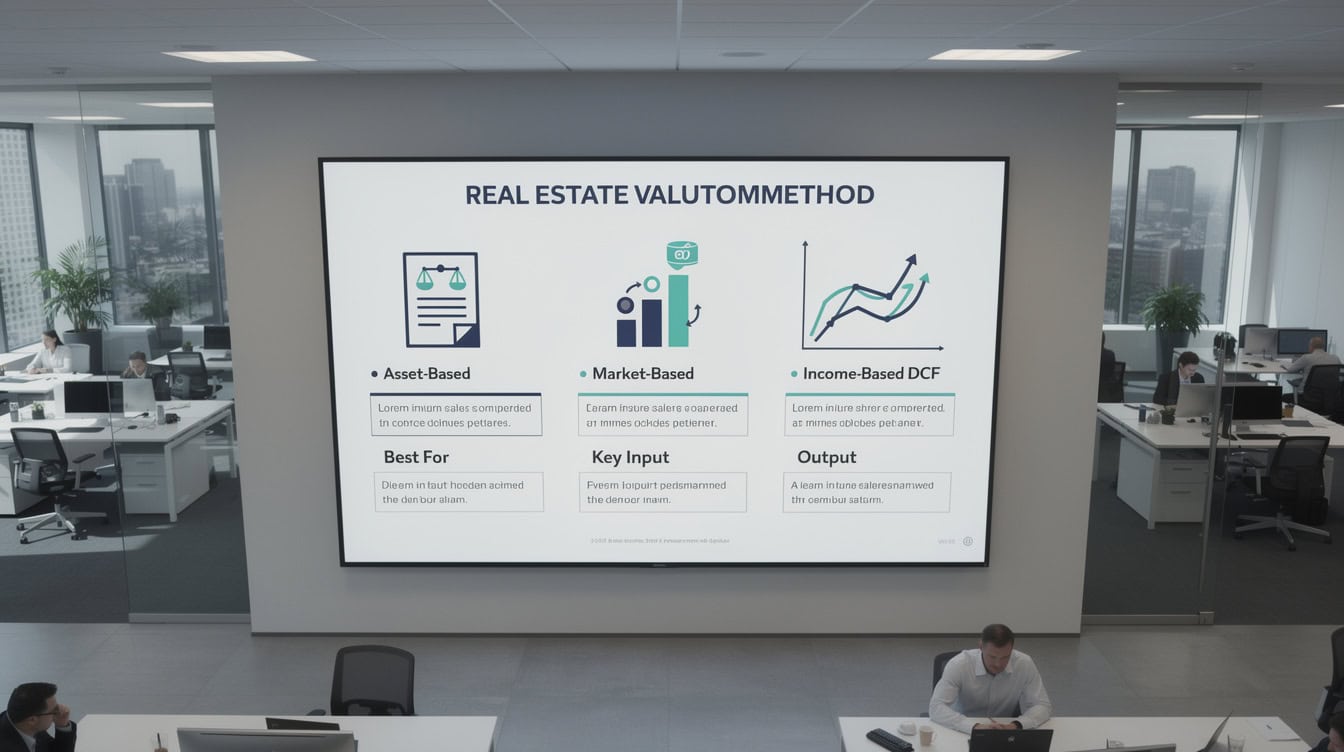
Choosing the wrong valuation method for your business type can produce a number that is 50% above or below what the market will actually pay.
Market-Based Valuation: Industry Multiples by Sector
Market-Based valuation compares your business to recent sales of similar companies using revenue or EBITDA multiples. This is the most common method used in small business M&A transactions.
According to the International Business Brokers Association, the majority of small business transactions under $5M in enterprise value close using SDE or EBITDA multiples derived from comparable sales data. BizBuySell’s research found that the median sale price of small businesses sold in the United States was approximately $330,000 (BizBuySell), reflecting how most main-street transactions fall well below the $1M threshold despite higher-profile deals attracting more attention.
2024 Industry Multiples by Sector
| Industry | SDE Multiple | EBITDA Multiple | Revenue Multiple |
|---|---|---|---|
| SaaS / Software | 3x-6x | 5x-10x | 4x-8x |
| Healthcare Practice | 3x-5x | 4x-7x | 1x-2x |
| Professional Services | 2x-4x | 3x-5x | 0.5x-1.5x |
| Manufacturing | 2x-4x | 3x-5x | 0.4x-0.8x |
| Distribution / Wholesale | 2x-3.5x | 3x-4.5x | 0.3x-0.6x |
| Home Services | 2x-3.5x | 2.5x-4x | 0.5x-1x |
| Restaurant | 1.5x-3x | 2x-4x | 0.3x-0.6x |
| Retail (brick-and-mortar) | 1.5x-2.5x | 2x-3.5x | 0.3x-0.5x |
These ranges reflect 2024 transaction data compiled by the Business Reference Guide (Business Brokerage Press) and BizBuySell’s quarterly Insight Report. Higher multiples within each range apply to businesses with strong growth, recurring revenue, and low owner dependency.
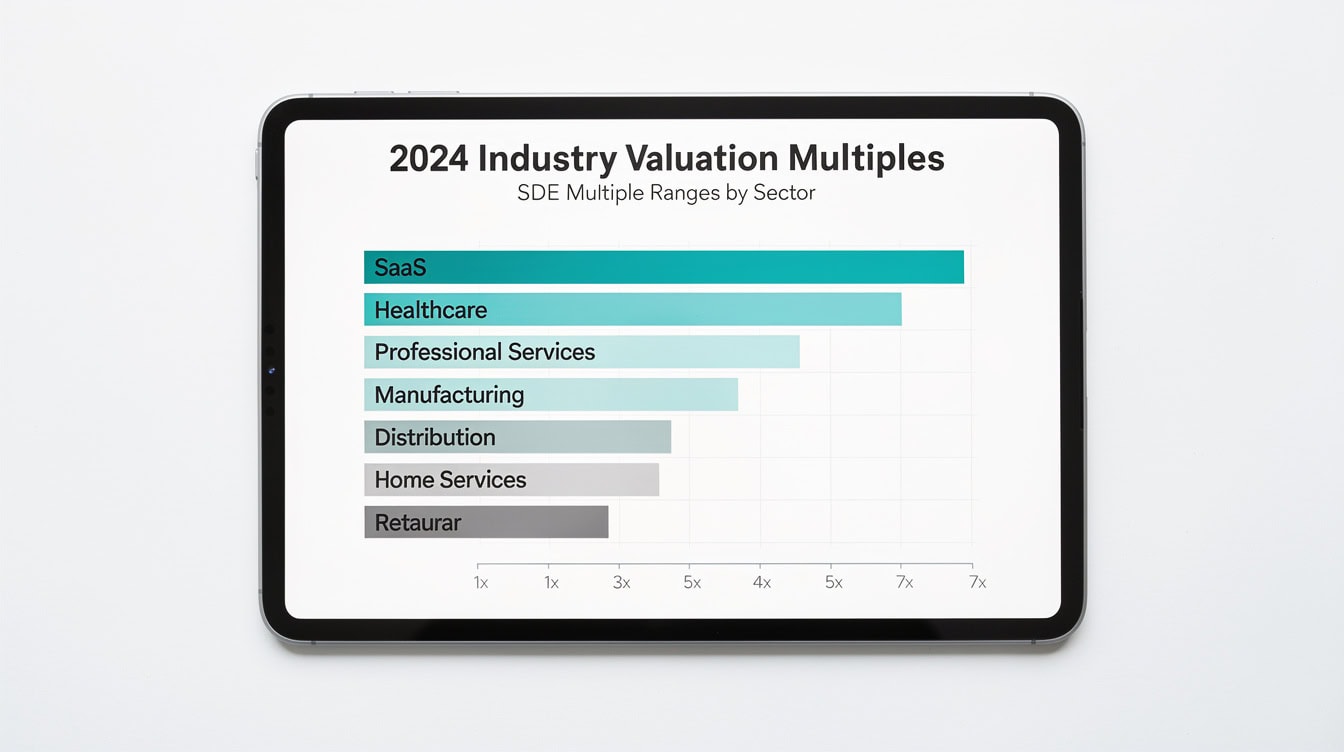
SaaS businesses command multiples 2x to 3x higher than retail, reflecting the value of recurring revenue and scalability.
Income-Based Valuation: Calculating SDE and EBITDA Step-by-Step
Income-Based valuation starts with your actual earnings and adjusts them to reflect what a new owner would truly earn. The two key metrics are SDE (Seller’s Discretionary Earnings) and EBITDA (Earnings Before Interest, Taxes, Depreciation, and Amortization).
SDE is used for businesses under $2M in earnings where the owner works in the business. EBITDA is used for larger businesses or those with professional management teams.
Step 1: Start with Net Income
Pull your most recent 12-month net income from your P&L statement. Use a 3-year weighted average if earnings fluctuate (most recent year weighted 50%, prior year 30%, two years ago 20%).
Step 2: Add Back Owner Compensation
Add back the full owner salary, benefits, and payroll taxes. A new buyer will pay themselves differently, so this normalizes the earnings.
Step 3: Add Back Non-Recurring Expenses
Add back one-time costs that will not repeat: legal settlements, equipment write-offs, pandemic-related losses, or one-time marketing campaigns.
Step 4: Add Back Personal Expenses Run Through the Business
Add back personal vehicle use, personal travel, family member salaries above market rate, and personal insurance premiums charged to the business.
Step 5: Add Back Depreciation and Amortization (for EBITDA)
Add back D&A to get to EBITDA. This removes non-cash accounting charges that do not reflect actual cash generation.
Worked SDE Example:
Here’s the math for a $2.4M revenue professional services firm:
- Net Income: $180,000
- Add: Owner Salary and Benefits: $220,000
- Add: Personal Vehicle and Travel: $18,000
- Add: One-Time Legal Settlement: $35,000
- Add: Above-Market Family Salary: $40,000
- SDE Total: $493,000
At a 3x SDE multiple (mid-range for professional services), this business is worth approximately $1,479,000. At 4x, it reaches $1,972,000. The multiple selection, not the SDE calculation, drives most of the valuation range.
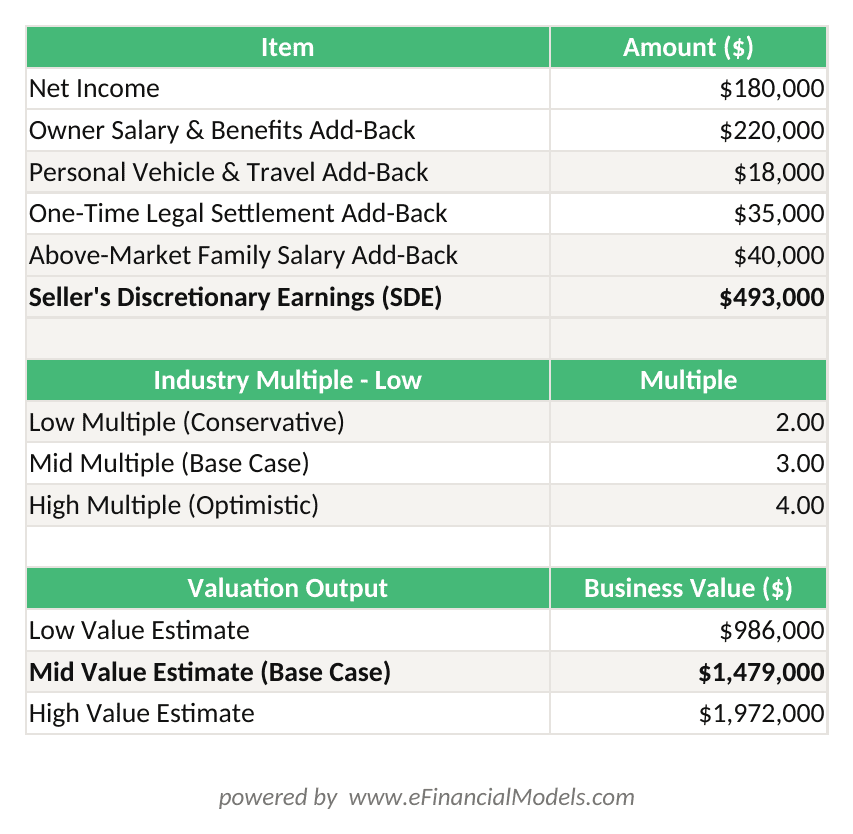
SDE = Net Income + Owner Salary + Personal Expenses + Non-Recurring Costs. At a 3x mid multiple, this firm’s value is $1,479,000.
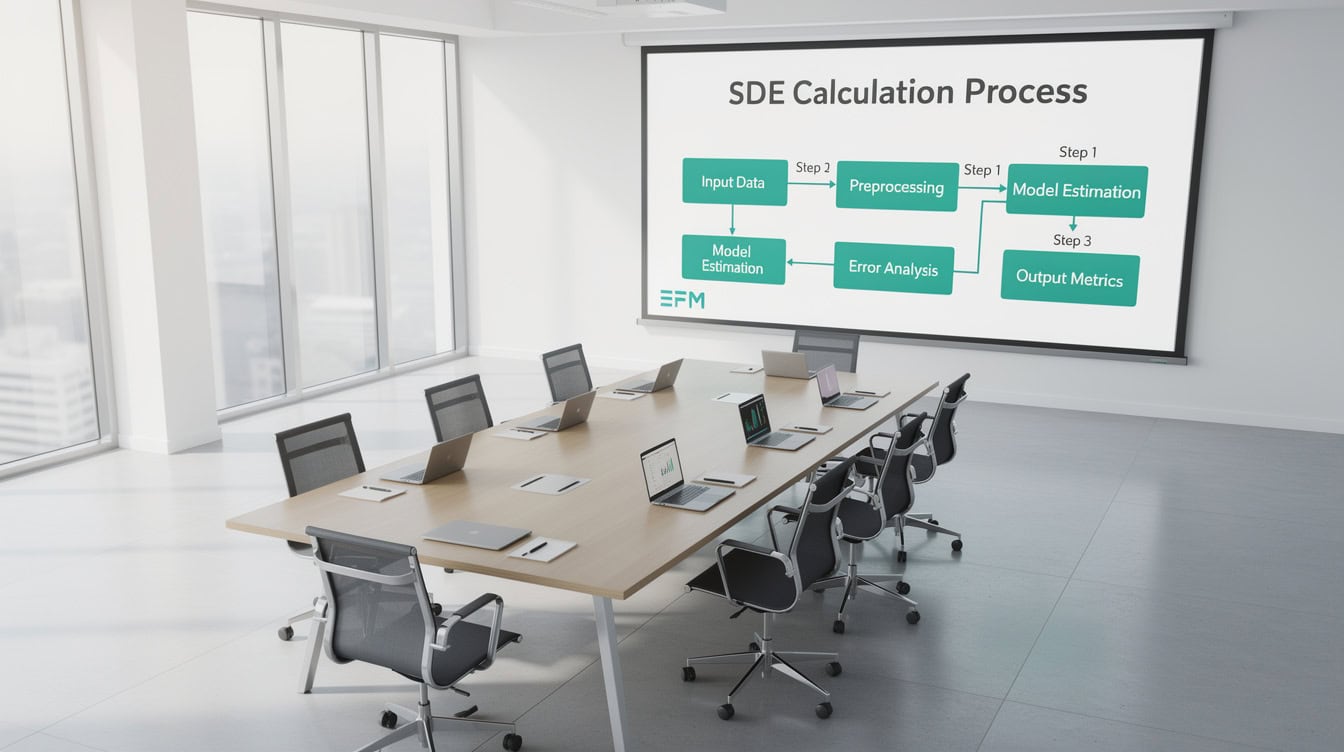
A $180,000 net income becomes $493,000 in SDE after legitimate add-backs, nearly tripling the calculated business value at a 3x multiple.
Excel Valuation Template: Cell-by-Cell Formula Guide
A structured Excel template lets you calculate all three valuation methods in one workbook and run scenario analysis in minutes. Here is the core structure for the SDE/EBITDA income approach tab.
Sheet: SDE Calculator
- B2: Net Income (enter from P&L)
- B3: Owner Salary Add-Back (enter total compensation)
- B4: Personal Expense Add-Back (enter verified amount)
- B5: Non-Recurring Expense Add-Back (enter one-time items)
- B6: SDE Formula: =SUM(B2:B5)
- B8: Low Multiple (enter sector low, e.g., 2.0)
- B9: Mid Multiple (enter sector mid, e.g., 3.0)
- B10: High Multiple (enter sector high, e.g., 4.0)
- B12: Low Value: =B6*B8
- B13: Mid Value: =B6*B9
- B14: High Value: =B6*B10
For the DCF tab, use Excel’s built-in =NPV(discount_rate, cash_flow_range) function,where the discount rate for small businesses typically ranges from 20% to 35% to reflect higher risk compared to public companies. The SBA’s financial resources provide guidance on appropriate risk adjustments for small business lending and valuation contexts.
You can download the full Small Business Valuation Excel template from EFM, which includes pre-built SDE, EBITDA, DCF, and Asset-Based tabs with industry multiple lookup tables.
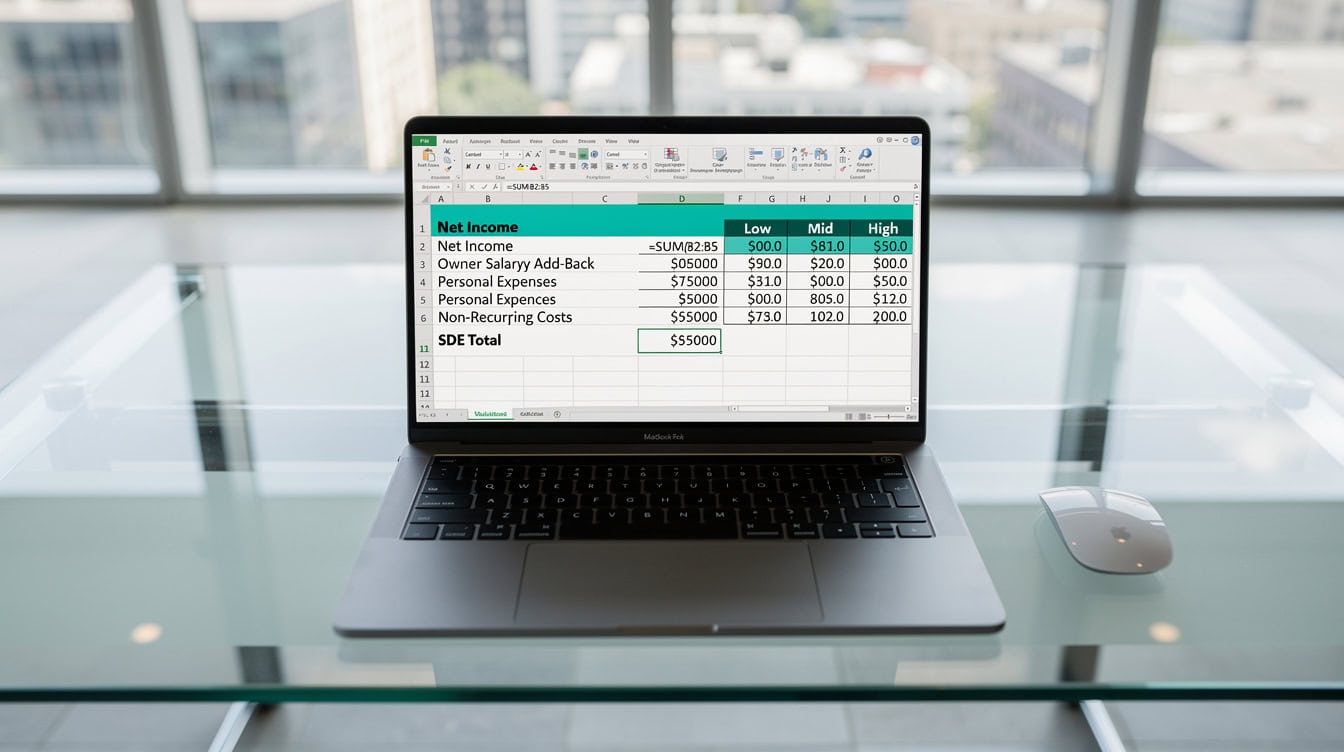
A structured Excel template with locked formulas eliminates arithmetic errors and lets you run scenario analysis in under 5 minutes.
Valuation Adjustments: How Size, Risk, and Growth Change Multiples
The base multiple from your industry table is a starting point. You adjust it up or down based on specific business characteristics.
Positive Adjustments (add to base multiple):
- Revenue growth above 15% annually: +0.5x to +1.0x
- Recurring revenue above 50%: +0.5x to +1.5x
- Proprietary technology or IP: +0.5x to +1.0x
- Tenured management team in place: +0.25x to +0.75x
- Long-term customer contracts (3+ years): +0.25x to +0.5x
Negative Adjustments (subtract from base multiple):
- Customer concentration above 20% in one client: -0.5x to -1.0x
- Owner works more than 50 hours per week in operations: -0.5x to -1.0x
- Revenue declining year-over-year: -0.5x to -1.5x
- Lease expiring within 12 months with no renewal: -0.25x to -0.5x
- Pending litigation or regulatory issues: -0.5x to -2.0x
The distinction between enterprise value and equity value matters here. Enterprise value is the total business value including debt. Equity value is what you actually receive at closing: Enterprise Value minus net debt (total debt minus cash). If your business has $200,000 in outstanding loans, subtract that from the enterprise value to get your equity check.
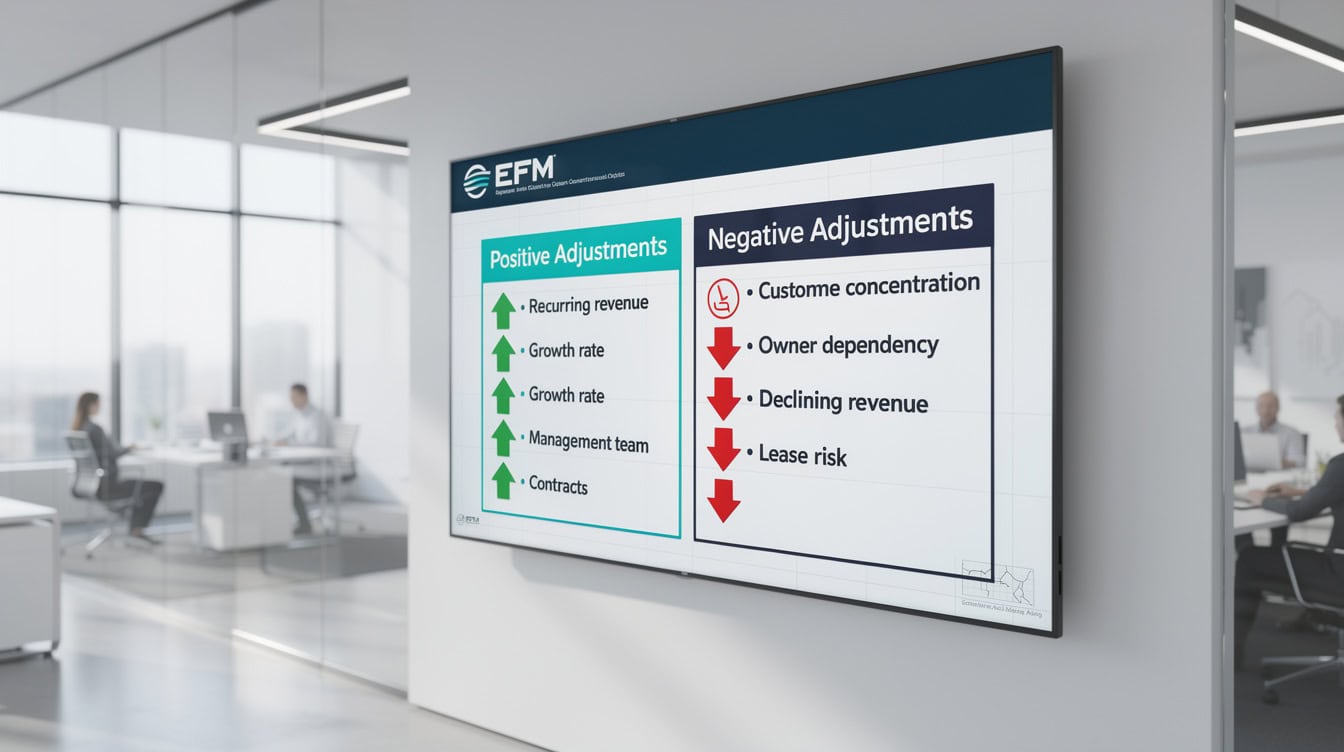
A single customer representing 40% of revenue can reduce your multiple by 1.0x, costing $300,000 or more on a $300,000 SDE business.
Common Valuation Mistakes That Cost Owners Six Figures
Five mistakes consistently cause owners to walk away from deals with less money than they deserve, or to price themselves out of a sale entirely.
Mistake 1: Using Net Income Instead of SDE
Net income after owner salary dramatically understates value. A business showing $80,000 net income with a $200,000 owner salary has $280,000 in SDE. At 3x, that difference is $600,000 in valuation.
Mistake 2: Ignoring Working Capital Requirements
Buyers expect a normalized level of working capital to transfer with the business. If you strip cash before closing, the buyer will demand a price reduction. According to transaction advisors, working capital disputes are among the top 3 post-closing adjustment issues in small business M&A deals.
Mistake 3: Using the Wrong Multiple for Your Industry
Applying a SaaS multiple to a brick-and-mortar retail business inflates value by 3x to 5x. Always use sector-specific comparables, not generic rules of thumb.
Mistake 4: Failing to Normalize for One-Time Events
A year with a large insurance payout, a PPP loan forgiveness, or a one-time contract inflates earnings. Buyers will normalize these out. Do it yourself first so you control the narrative.
Mistake 5: Confusing Enterprise Value with Equity Value
A buyer offering $1.5M enterprise value on a business with $400,000 in debt delivers $1.1M to you at closing. Always calculate your net proceeds, not the headline number.
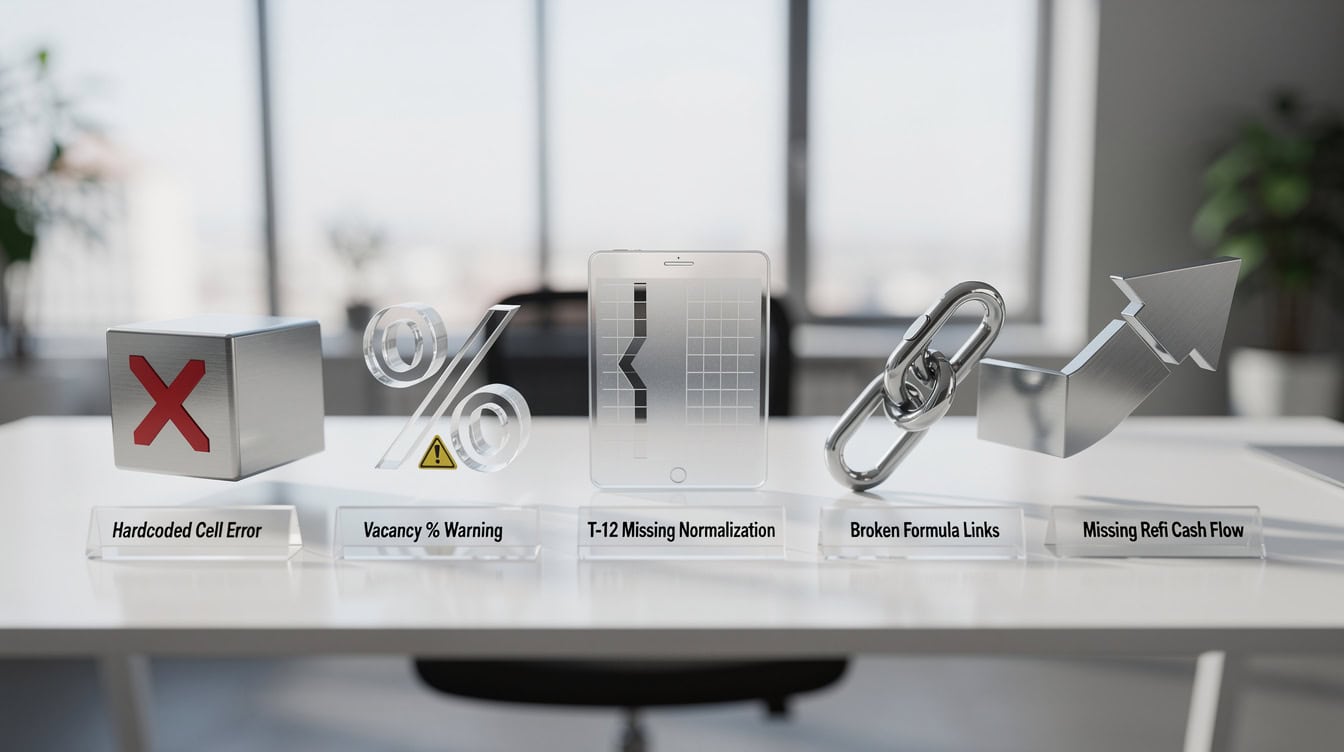
Mistake 1 alone, using net income instead of SDE, can understate your business value by $600,000 or more on a $280,000 SDE business.
DIY vs. Professional Appraisal: Cost-Benefit Analysis
A DIY valuation using the methods above is appropriate for internal planning, partnership discussions, and preliminary exit planning. A certified professional appraisal is required for SBA loans, estate planning, divorce proceedings, and formal M&A transactions.
Professional Appraiser Credentials:
- ASA (Accredited Senior Appraiser): Issued by the American Society of Appraisers, the most widely recognized credential for business valuation.
- CBA (Certified Business Appraiser): Issued by the Institute of Business Appraisers.
- CVA (Certified Valuation Analyst): Issued by the National Association of Certified Valuators and Analysts (NACVA).
Cost Ranges by Business Size:
| Business Revenue | DIY Template | Broker Opinion | Certified Appraisal |
|---|---|---|---|
| Under $500K | $0-$200 | $500-$1,500 | $3,000-$5,000 |
| $500K-$2M | $0-$200 | $1,500-$3,000 | $5,000-$8,000 |
| $2M-$10M | $0-$200 | $3,000-$5,000 | $8,000-$15,000 |
The SBA requires a business appraisal from a qualified source for loans above $250,000 where the business is the collateral, per SBA Standard Operating Procedure 50 10 7 (U.S. Small Business Administration). According to the SBA, 7(a) loans — the most common SBA loan type — have a maximum loan amount of $5,000,000 (U.S. Small Business Administration), which means many small business acquisitions financed through this program require a certified appraisal as a condition of approval. For most owners doing preliminary planning, a DIY valuation using a structured template plus a broker opinion of value covers 80% of use cases at a fraction of the cost.
Quarterly Valuation Updates: What to Track and When to Revalue
Your business value changes every quarter as earnings, market conditions, and interest rates shift. Tracking 5 metrics quarterly keeps your valuation current.
5 Metrics to Track Every Quarter:
- Trailing 12-Month SDE or EBITDA: Recalculate after each quarter closes. A 10% earnings increase at a 3x multiple adds 30% to your value.
- Revenue Growth Rate: Year-over-year and quarter-over-quarter. Growth above 15% justifies a multiple premium.
- Customer Churn Rate: Rising churn signals revenue concentration risk and compresses multiples.
- Owner Hours Per Week: Reducing owner involvement from 60 hours to 30 hours can add 0.25x to 0.5x to your multiple.
- Working Capital Ratio: Current assets divided by current liabilities. Buyers expect a ratio above 1.2x for most industries.
When to Trigger a Full Revaluation:
- Before any financing event (SBA loan, line of credit, investor conversation)
- When a competitor sells or a major industry transaction closes
- When interest rates shift by more than 100 basis points (rate increases compress multiples by reducing buyer purchasing power)
- Annually as part of exit planning, regardless of near-term sale plans
The Federal Reserve’s rate decisions directly affect small business valuations. According to the Federal Reserve Bank of St. Louis, the federal funds rate moved from near zero in early 2022 to above 5% by mid-2023 (Federal Reserve Bank of St. Louis), compressing buyer leverage and pushing SDE multiples down by an estimated 0.25x to 0.75x across most sectors during that period.

Tracking these 5 metrics quarterly means you always know your approximate value range and can time a sale or financing event strategically.
Frequently Asked Questions
What is the most common way to value a small business?
The most common method for small businesses under $5M in revenue is the SDE multiple approach. You calculate Seller’s Discretionary Earnings by adding back owner compensation, personal expenses, and non-recurring costs to net income, then multiply by an industry-specific multiple. For example, a landscaping company with $150,000 in SDE at a 2.5x multiple is worth $375,000. This method dominates because it reflects what a working owner-operator will actually earn after buying the business, making it the most relevant metric for individual buyers and SBA lenders alike. Most business brokers use this as their primary valuation tool for main-street transactions.
How do I calculate SDE if I pay myself through distributions, not salary?
If you take distributions rather than a W-2 salary, your SDE calculation starts with net income before distributions. Add back any personal expenses run through the business (vehicle, travel, insurance), any non-recurring costs, and any above-market compensation paid to family members. The formula is: SDE = Net Income + Owner Distributions (if not already deducted) + Personal Expense Add-Backs + Non-Recurring Add-Backs. For example, if net income is $120,000, you took $180,000 in distributions, and you have $25,000 in personal expenses through the business, your SDE is $325,000. Always document every add-back with receipts or payroll records, because buyers and lenders will verify each line.
What multiple should I use for my business?
Start with your industry sector from the benchmark table in this guide, then adjust based on your specific risk profile. A professional services firm with 3 years of 20% revenue growth, 60% recurring retainer revenue, and a management team in place might justify the top of the 2x to 4x SDE range, landing at 3.5x to 4x. The same firm with one dominant client representing 40% of revenue and an owner working 70 hours per week might land at 2x to 2.5x. The multiple is not arbitrary. It reflects the risk a buyer takes on, and every characteristic that reduces risk adds to the multiple. Use the adjustment table in the Valuation Adjustments section to build your case.
Does my business valuation include real estate?
Typically, no. Most small business valuations exclude owned real estate, which is treated as a separate asset. The business value reflects the operating enterprise: earnings, customer relationships, brand, and equipment. If you own the building, you can either sell it separately, include it in the deal at appraised value, or lease it back to the buyer. A sale-leaseback arrangement, where you sell the building and lease it back to the new owner, is common in transactions above $1M and can significantly increase your total proceeds. Always separate real estate value from business operating value in your valuation model to avoid confusion during negotiations.
How does an SBA loan affect my business valuation?
SBA loans require a formal business appraisal when the loan exceeds $250,000 and the business is the primary collateral, per SBA Standard Operating Procedure 50 10 7. The SBA appraisal uses fair market value standards, which may differ from what a strategic buyer would pay. SBA lenders typically apply more conservative multiples than private equity buyers because they focus on debt service coverage: the business must generate enough cash flow to cover loan payments with a cushion. A business valued at $1.5M by a broker might support only a $900,000 SBA loan if the cash flow coverage ratio falls below the lender’s 1.25x threshold. Understanding this gap helps you structure deals and set realistic price expectations.
When should I hire a professional appraiser instead of doing it myself?
Hire a certified appraiser (ASA, CBA, or CVA) when the valuation will be used in a legal or regulatory context: estate planning, divorce proceedings, partnership buyouts, SBA loan applications above $250,000, or formal M&A transactions with institutional buyers. A DIY valuation using a structured template is appropriate for internal planning, preliminary exit conversations, and annual benchmarking. The cost difference is significant: a certified appraisal runs $5,000 to $15,000 for businesses in the $1M to $10M range, while a template-based DIY approach costs under $200. For most owners doing annual planning, start with a DIY model and upgrade to a certified appraisal when a transaction becomes imminent.
How do interest rates affect my business valuation?
Higher interest rates reduce business valuations through two channels. First, they increase the discount rate used in DCF models, which reduces the present value of future cash flows. Second, they raise the cost of acquisition financing, which reduces how much a buyer can afford to pay. When the Federal Reserve raised rates from near 0% to above 5% between 2022 and 2023, SBA loan payments on a $1M acquisition increased by roughly $40,000 to $50,000 per year, directly reducing the price buyers could justify. As a seller, track the federal funds rate quarterly. A 100-basis-point rate increase typically compresses small business multiples by 0.25x to 0.5x, depending on how leveraged buyers in your sector tend to be.
Conclusion
Your business value is not a guess. It is a calculation built on normalized earnings, industry comparables, and specific risk adjustments that any buyer, lender, or appraiser will apply. Start with your SDE, apply the right sector multiple, adjust for your specific risk profile, and you have a defensible preliminary valuation in under an hour.
I recommend downloading the EFM Small Business Valuation Excel Template to run all three valuation methods in one workbook, with built-in industry multiple lookup tables, SDE and EBITDA calculators, and scenario analysis that shows your low, mid, and high value range in minutes. For broader exit planning context, the EFM Business Plans collection and Valuation Services resources provide complementary frameworks to support your full exit strategy.