0 ITEMS

Financial Modeling: Template vs Custom — 5 Questions Decide
Choosing between an off-the-shelf financial model template and a custom-built solution is one of the most consequential early decisions a finance team makes — and the wrong choice costs far more than money.
Key Takeaways
- 5 self-assessment questions (complexity, timeline, budget, expertise, stakeholder requirements) determine which approach fits your situation.
- Off-the-shelf templates deploy in 1–5 days and typically cost $50–$500, versus 4–12 weeks and $5,000–$50,000+ for a custom build.
- Pre-seed startups and teams with standard business models gain the most from quality templates; PE-backed portfolios and companies with unique revenue structures gain the most from custom builds.
- A hybrid path — start with a template, customize incrementally — works for roughly 60% of growing businesses and delays the custom investment until complexity genuinely demands it.
- Scope creep affects an estimated 52% of custom software and modeling projects according to the Project Management Institute, making scoping discipline the single biggest risk factor in custom builds.
- Switching costs are real: migrating from a poorly chosen template to a custom model mid-fundraise can delay a round by 4–8 weeks.
- The total cost of ownership for a custom model includes not just build fees but ongoing maintenance, which typically runs 15–25% of the original build cost per year.
Understanding the Spectrum: It’s Not Just Template vs. Custom
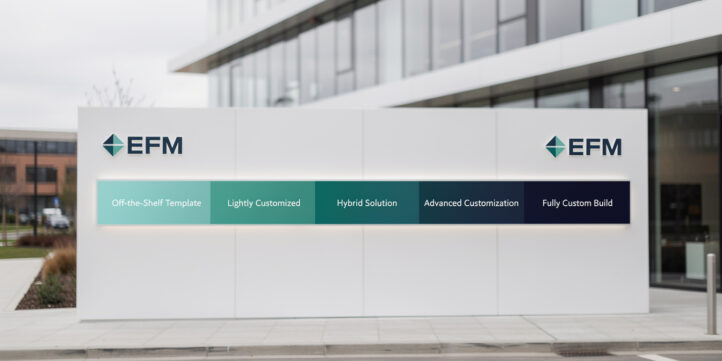
The template-versus-custom framing is a useful starting point, but the real decision space is a spectrum with at least four distinct zones. Most finance professionals think in binary terms — buy a template or hire a modeler — and miss the middle ground where the best value often lives.
Here are the four zones on that spectrum:
- Pure off-the-shelf: A pre-built model you download and populate with your numbers, with minimal structural changes.
- Lightly customized template: A quality template adapted to your specific revenue drivers, cost structure, or reporting format — typically 5–20 hours of work.
- Template-as-scaffold custom build: A professional modeler starts from a proven template architecture and rebuilds the logic around your business, cutting build time by 30–50%.
- Fully custom build: A model designed from scratch for your specific business, data sources, and stakeholder outputs.
Understanding which zone you actually need — not which zone sounds most impressive — is the core skill this guide develops.
The Self-Assessment Framework: Five Questions That Determine Your Path
Five questions reliably separate template candidates from custom-build candidates. Answer them honestly before you spend a dollar.
1. How standard is your business model?
If your revenue comes from subscriptions, e-commerce, professional services, or real estate — business models with well-established financial structures — a quality template almost certainly covers your needs. If your revenue involves multi-sided platforms, complex project finance waterfalls, or bespoke contractual structures, a template will fight you at every turn.
2. What is your real timeline?
A board meeting in three weeks means a template. A strategic planning cycle starting in four months gives you room to build custom. Be honest: most teams underestimate how long custom builds take. According to the Project Management Institute, only 29% of technology projects finish on time, and financial modeling engagements face the same dynamic.
3. What is your total budget — including internal time?
A $200 template that requires 40 hours of internal analyst time to adapt costs more than it appears. A $15,000 custom build that saves 80 hours of senior FP&A time over 12 months may be the cheaper option. Calculate fully-loaded cost, not just the vendor invoice.
4. What is your team’s modeling expertise?
Templates from reputable sources are built with best-practice structures — named ranges, error checks, scenario toggles. A team without strong Excel skills can break a template faster than they can use it. Custom builds, paradoxically, can be designed to be more user-friendly for non-modelers if the builder prioritizes that.
5. Who are your stakeholders and what do they expect?
Seed investors reviewing a pitch deck have different expectations than a PE firm conducting due diligence on a $50M acquisition. Institutional lenders running covenant compliance checks need audit-trail-ready models that a generic template rarely provides out of the box.

Evaluating a template against your specific outputs before purchase saves hours of post-purchase rework.
Off-the-Shelf Templates: Advantages, Limitations, and Ideal Use Cases
Off-the-shelf financial model templates offer the fastest path from zero to a working model, and for the right use case, they deliver 90% of the value at 5% of the cost.
Core advantages:
- Speed: A well-structured template is live in 1–5 business days. You populate inputs; the logic is already built.
- Proven architecture: Reputable templates encode best practices — integrated three-statement models (income statement, balance sheet, and cash flow statement linked together), DCF (discounted cash flow) valuation, and scenario analysis — that would take weeks to build correctly from scratch.
- Cost: Industry-specific templates from professional sources typically range from $50 to $500. Free financial model templates are also available for early-stage teams with tight budgets.
- Low commitment: If your business model pivots, you can switch templates without sunk-cost pressure.
Real limitations:
- Rigidity at scale: Templates are built for the median use case. Once your business has 4+ revenue streams, complex intercompany transactions, or non-standard cost drivers, you’ll spend more time working around the template than using it.
- Scaling ceiling: Most templates are not designed to handle 5+ years of granular monthly data without performance degradation.
- Credibility gaps with sophisticated stakeholders: A template that a PE firm recognizes as a standard download signals limited internal modeling capability, which can affect negotiating dynamics.
Ideal template users: Pre-seed and seed-stage startups, small businesses with standard models, teams building a first-pass model for internal planning, and any situation where speed matters more than bespoke precision.
Explore industry-specific financial model templates to find options matched to your sector.

Templates deliver 90% of the value at 5% of the cost — for the right use case.
Custom-Built Models: When the Investment Pays Off
Custom financial models justify their cost when the business complexity, stakeholder requirements, or strategic stakes exceed what any template can handle. The key word is “justify” — custom builds are not inherently better, they are situationally better.
Core advantages:
- Exact fit: Every assumption, driver, and output reflects your actual business. No workarounds, no unused tabs, no logic that doesn’t apply.
- Stakeholder credibility: A purpose-built model signals analytical rigor to institutional investors, lenders, and acquirers.
- Integration capability: Custom models can connect to your ERP, CRM, or data warehouse in ways templates cannot.
- Long-term maintainability: A well-documented custom model with clear architecture is easier to maintain than a heavily patched template.
Real limitations:
- Time and cost: Expect 4–12 weeks and $5,000–$50,000+ depending on complexity. Project finance models for infrastructure deals can exceed $100,000.
- Scope creep risk: The Project Management Institute reports that 52% of projects experience scope creep, and financial modeling engagements are not immune. Every “small addition” during the build extends timelines and costs.
- Key person dependency: If the modeler who built your custom model leaves or becomes unavailable, institutional knowledge walks out with them unless documentation is rigorous.
- Overkill for simple situations: A custom three-statement model for a single-product SaaS startup is like commissioning a bespoke suit for a one-day event.
For teams considering a custom path, custom financial modeling services can scope the engagement before you commit.

Custom builds justify their cost when complexity, stakeholder requirements, or strategic stakes exceed what any template can handle.
Real-World Scenarios: Matching Solutions to Situations
The right choice depends entirely on context. Here are four concrete archetypes with explicit recommendations.
Scenario 1: Pre-Seed Startup Raising a First Round
A two-person founding team needs a 3-year financial projection for a seed deck. They have $300 in budget and three weeks until their first investor meeting.
Recommendation: Off-the-shelf template. A startup financial model with integrated statements, a basic DCF, and scenario toggles covers everything a seed investor needs. Spend $100–$300 on a quality template, spend two days populating it, and spend the remaining time on your narrative.
Scenario 2: Series B SaaS Company Preparing for Due Diligence
An $8M ARR SaaS company is entering a Series B process. The lead investor’s team will stress-test cohort retention, expansion revenue, and unit economics across 36 months of monthly data.
Recommendation: Custom build or template-as-scaffold. A generic SaaS template won’t handle cohort-level analysis at this granularity. Either commission a custom build ($8,000–$20,000) or hire a modeler to rebuild a SaaS template from scratch around your actual cohort data. The investment is justified: a credible model can meaningfully affect valuation multiples.
Scenario 3: Established Company Entering a New Market
A profitable mid-market manufacturer wants to model entry into a new geographic market. The core business model is identical; only market-specific assumptions differ.
Recommendation: Lightly customized template. Start with a template that matches your existing model structure, adapt the market-entry assumptions, and add a sensitivity table for the key unknowns (market penetration rate, local cost structure). Total effort: 10–20 hours.
Scenario 4: PE-Backed Company Standardizing Portfolio Reporting
A private equity firm needs all 12 portfolio companies to report on a standardized monthly basis with consistent KPI definitions and roll-up capability.
Recommendation: Custom build with template distribution. Build one master model architecture custom, then distribute it as a locked template to portfolio companies. This is the highest-value use case for custom work: the build cost is amortized across 12 companies and multiple years.
The Hybrid Path: Starting Simple and Scaling Smart
The hybrid approach — start with a quality template, customize incrementally, and graduate to a custom build only when complexity demands it — is the right path for roughly 60% of growing businesses. It preserves capital in early stages and delays the custom investment until the ROI is clear.
Specific triggers for graduating from template to custom:
- Your template requires more than 20 hours of workarounds per quarter to produce accurate outputs.
- A key stakeholder (investor, lender, acquirer) has flagged model limitations as a concern.
- Your business now has 3+ distinct revenue streams with different drivers and margin profiles.
- You’re preparing for a transaction (fundraise, M&A, refinancing) where model credibility directly affects outcome.
- Your team spends more time maintaining the model than using it for decisions.
If none of these triggers apply, stay with the template. Premature complexity is as costly as insufficient rigor.
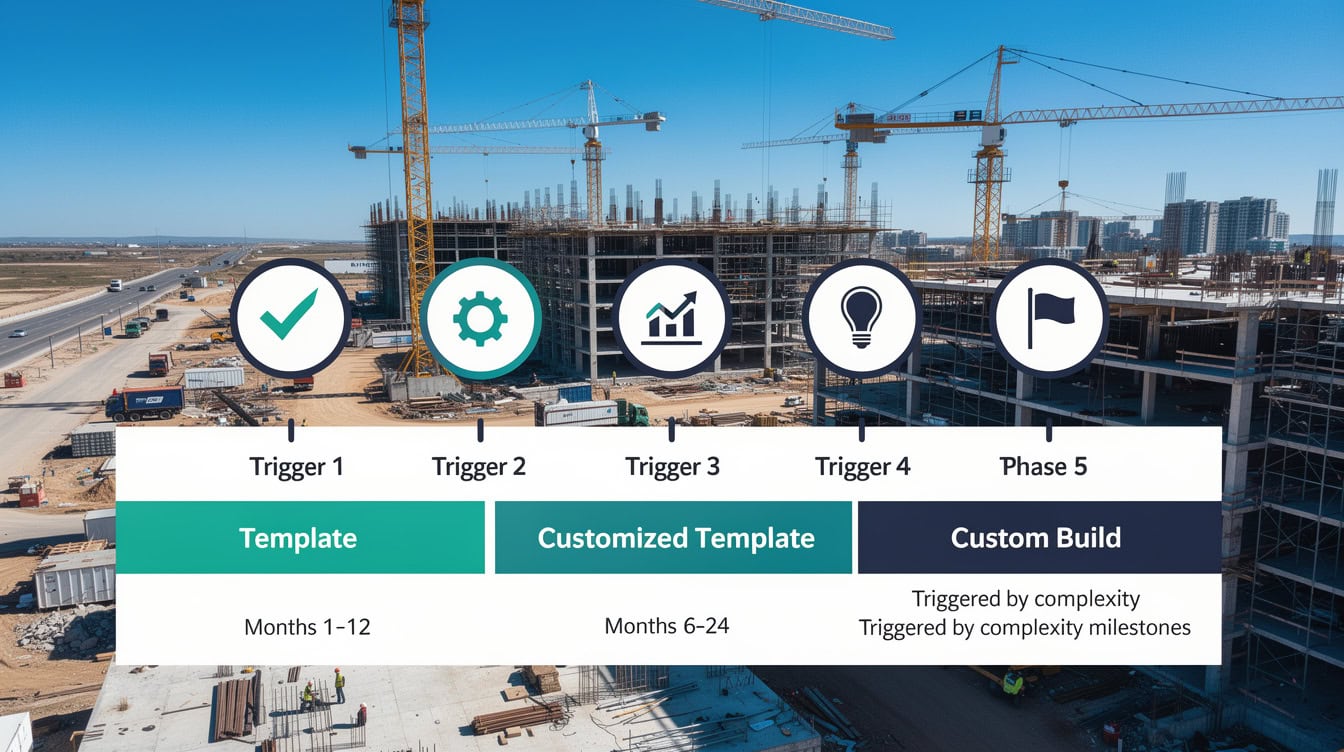
The hybrid path delays the custom investment until complexity genuinely demands it — preserving capital in early stages.
Cost Analysis Beyond the Price Tag
The true cost of a financial modeling solution includes four components that most teams undercount.
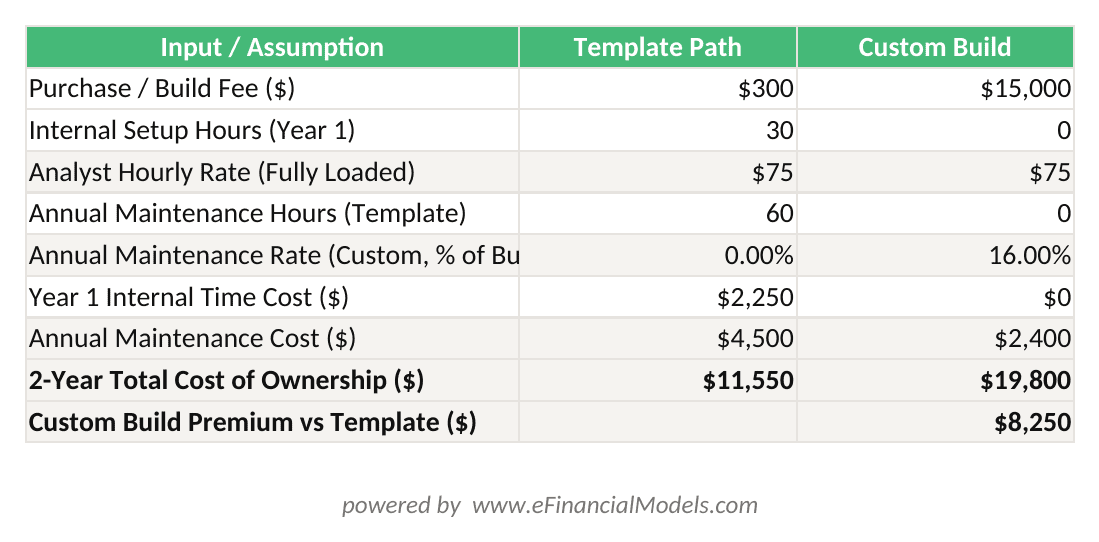
Template Path 2-Year TCO = Purchase Cost + (Internal Hours × Hourly Rate) + Annual Maintenance × 2. Custom Build 2-Year TCO = Build Fee + (Build Fee × Maintenance Rate × 2).
Here’s how the math works for a typical growth-stage company choosing between a $300 template and a $15,000 custom build:
- Template path: $300 purchase + 30 hours of analyst time at $75/hour fully loaded = $2,550 in Year 1. Maintenance in Year 2: 15 hours/quarter = $4,500/year. Two-year total: $7,050.
- Custom build path: $15,000 build + 8 hours/quarter maintenance at $75/hour = $2,400/year. Two-year total: $19,800.
- Break-even point: The custom build breaks even on time savings only if it saves the analyst more than 170 hours over two years — roughly 85 hours per year. For a complex model used weekly, that’s plausible. For a model used quarterly, it’s not.
The total cost of ownership for a custom model typically includes ongoing maintenance running 15–25% of the original build cost per year, according to standard software maintenance benchmarks from the Software Engineering Institute at Carnegie Mellon University. A $20,000 custom model therefore costs $3,000–$5,000 per year to maintain properly.
Risk Management: What Can Go Wrong
Both approaches carry specific failure modes. Knowing them in advance lets you mitigate rather than react.
| Risk | Template | Custom Build |
|---|---|---|
| Scope creep | Low | High (52% of projects) |
| Rigidity at scale | High | Low |
| Key person dependency | Low | High |
| Stakeholder credibility gap | Medium | Low |
| Build timeline overrun | Low | Medium-High |
| Maintenance cost surprise | Low | Medium |
| Wrong model for business | Medium | Low |
Template-specific risks and fixes:
- Outgrowing the model: Fix by setting a complexity review at 12 months. If you’ve added more than 3 structural workarounds, start scoping a custom build.
- Misapplying a template to the wrong business model: Fix by validating the template’s core assumptions against your actual revenue and cost drivers before purchase, not after.
- Over-reliance on template defaults: Fix by auditing every hardcoded assumption in the template on day one. Default tax rates, depreciation schedules, and working capital assumptions are often wrong for your specific situation.
Custom build-specific risks and fixes:
- Scope creep: Fix with a written scope document that defines deliverables, revision rounds, and a change-order process before work begins.
- Key person dependency: Fix by requiring the builder to deliver full documentation, a model audit trail, and a handover session as contractual deliverables.
- Technical debt (the accumulation of shortcuts and undocumented logic that makes a model harder to maintain over time): Fix by specifying coding standards — named ranges, consistent formula structure, no hardcoded values in formula cells — in the contract.

Template and custom build risks cluster in different quadrants — knowing which risks you’re taking helps you mitigate them proactively.
Making Your Decision: A Practical Action Plan
The right financial modeling solution is the one that fits your current stage, not your aspirational stage. Here’s a concrete action plan.
If you’re leaning toward a template:
- Define your three most critical model outputs (e.g., 36-month cash flow, unit economics dashboard, investor-ready P&L).
- Evaluate 3–5 templates against those outputs specifically. Don’t buy based on feature lists.
- Check whether the template uses best-practice structure: no hardcoded values in formula cells, clear input/output separation, error checks built in.
- Run your actual numbers through the template for one revenue stream before purchasing. Most reputable providers offer previews.
If you’re leaning toward a custom build:
- Write a one-page model brief: what decisions will this model support, who are the users, what are the key outputs, and what data sources will feed it.
- Get three quotes. Expect significant variation — a $5,000 quote and a $25,000 quote for the same brief usually reflect different scope assumptions, not just different rates.
- Ask every vendor: “What does your documentation deliverable look like?” and “How do you handle scope changes?” Vague answers are red flags.
- Build in a 20% timeline buffer. If the vendor says six weeks, plan for seven.
For financial planning needs that fall between these extremes, explore general Excel financial models that offer professional structure with room for customization.

The right financial modeling solution is the one that fits your current stage — not your aspirational stage.
Frequently Asked Questions
How long does it actually take to set up a financial model template?
A quality off-the-shelf template takes 1–5 business days to set up for most standard business models. The first day covers downloading, reviewing the structure, and understanding the input logic. Days two and three cover populating your historical data and adjusting key assumptions. Days four and five cover sense-checking outputs, running scenarios, and formatting for presentation. Complex templates with multiple revenue streams or integrated valuation modules may take 5–10 days for a thorough setup. The biggest time sink is almost always data gathering, not the template itself — if your historical financials are clean and accessible, setup is faster.
What does a custom financial model actually cost?
Custom financial model costs vary widely by complexity. A basic three-statement model (income statement, balance sheet, cash flow statement) with a simple DCF typically runs $3,000–$8,000 from a freelance modeler or boutique firm. A SaaS model with cohort analysis, unit economics, and scenario planning runs $8,000–$20,000. A project finance model for infrastructure or real estate development — with debt waterfall, construction draws, and IRR sensitivity — can run $20,000–$80,000 or more. PE firms and investment banks often pay $50,000–$150,000 for transaction-grade models. These ranges reflect 2024 market rates from financial modeling consultancies and freelance platforms.
Can I customize a template myself, or do I need a professional?
You can customize a template yourself if you have solid Excel skills — specifically, comfort with named ranges, INDEX/MATCH formulas, and the ability to trace formula precedents and dependents. Named ranges are labels assigned to specific cells or ranges (for example, naming cell B5 “Revenue_Growth_Rate”) that make formulas readable and reduce errors. Most structural customizations — adding a revenue line, adjusting a depreciation schedule, inserting a new scenario column — are within reach for an analyst with two or more years of Excel modeling experience. Structural changes like adding a new financial statement, rebuilding the debt schedule, or integrating a valuation module typically require professional help to avoid breaking the model’s internal consistency.
What are the red flags that a template is low quality?
Four red flags identify a low-quality template immediately. First, hardcoded values inside formula cells — for example, a formula like =B50.21 where 0.21 is a tax rate baked into the formula rather than referenced from an input cell. This makes the model fragile and hard to audit. Second, no error checks: a well-built template includes cells that flag when the balance sheet doesn’t balance or cash flow doesn’t reconcile. Third, no input/output separation: inputs and outputs should live in clearly labeled sections, not scattered across the model. Fourth, circular references that aren’t intentional: these cause Excel to iterate calculations and can produce unstable results. Always check for these before purchasing.
When should a startup switch from a template to a custom model?
A startup should switch from a template to a custom model when at least two of these five conditions are true: the business has three or more distinct revenue streams with different margin profiles; the model requires more than 15 hours per quarter of structural workarounds to produce accurate outputs; a key investor or lender has flagged model limitations as a concern; the company is preparing for a transaction (Series B or later, M&A, or debt financing) where model credibility directly affects terms; or the team has grown to include a dedicated FP&A function that will maintain the model daily. For most startups, this transition happens between Series A and Series B, typically when ARR exceeds $3M–$5M and investor scrutiny intensifies.
What questions should I ask a financial modeler before hiring them for a custom build?
Ask six questions before hiring any financial modeler for a custom build. First: “Can you show me three models you’ve built for businesses similar to mine?” Second: “What does your documentation deliverable look like — will I be able to maintain this model without you?” Third: “How do you handle scope changes — is there a change-order process?” Fourth: “What modeling standards do you follow — do you use named ranges, avoid hardcoded values in formulas, and include error checks?” Fifth: “What is your revision policy — how many rounds of revisions are included?” Sixth: “What happens if the model needs changes six months after delivery?” A modeler who answers these questions specifically and confidently is worth paying more for.
Is there a middle ground between buying a template and commissioning a full custom build?
Yes, and it’s often the best value option. The middle ground is hiring a financial modeler to take a high-quality template as a starting point and rebuild the logic around your specific business — sometimes called a “template-as-scaffold” approach. This typically costs $2,000–$6,000 and takes 2–3 weeks, compared to $8,000–$20,000 and 6–10 weeks for a fully custom build. The modeler preserves the proven architecture (integrated statements, scenario toggles, formatting) while replacing the generic assumptions with your actual revenue drivers, cost structure, and reporting requirements. This approach works best when a strong template exists for your industry — SaaS, real estate, e-commerce — and your customization needs are structural rather than architectural.
Conclusion
The template-versus-custom decision is not a question of quality — it’s a question of fit. A $200 template that matches your business model and gets you to your board meeting on time is a better decision than a $20,000 custom build that arrives after the fundraise closes. Equally, a template that requires 40 hours of workarounds per quarter is not saving you money — it’s deferring a necessary investment.
Use the five self-assessment questions as your starting point. Be honest about your timeline, your team’s expertise, and your stakeholders’ expectations. If you’re in the 60% of situations where a quality template covers your needs, don’t let complexity anxiety push you toward an unnecessary custom build. If you’re in the 40% where custom work is genuinely warranted, don’t let budget pressure push you toward a template that will fail you at a critical moment.
I recommend starting with EFM’s curated library of financial model templates — filter by industry and stage, review the structure before you buy, and use the hybrid path to grow into greater complexity only when your business demands it. If you’ve already identified that a custom build is the right call, explore custom financial modeling services to scope your engagement with professionals who build models for a living.