0 ITEMS

Where Does EFM’s Market Data Come From? 6-Layer Audit Trail

EFM’s market data comes from primary government databases, licensed vendor feeds, and peer-reviewed industry sources, verified by a credentialed team and documented in a timestamped audit trail every user can access.
Key Takeaways
- EFM’s core modeling team holds CFA charters, Big Four audit experience, and a combined 40+ years of financial modeling practice across investment banking and corporate finance.
- Every data point in an EFM model carries 4 metadata fields: source name, collection date, verification status, and last-update timestamp.
- EFM cross-references at least 3 independent data sources for every key market metric before publishing a figure.
- Poor data quality costs organizations an average of $12.9 million per year Source according to Gartner, making source transparency a direct financial risk-management tool.
- EFM’s quality control process runs 3 sequential review layers: automated validation, peer analyst review, and senior CFO-level sign-off before any model is published.
- Users can download a Data Provenance Report for any EFM model, showing the full chain of custody from raw source to published figure.
- Documented data provenance reduces due diligence timelines by giving auditors and investors a ready-made evidence trail rather than requiring them to reconstruct sourcing from scratch.
Why Data Provenance Matters in Financial Modeling
Data provenance means the documented history of where a data point came from, how it was collected, who verified it, and when it was last updated. For financial models, provenance is not a compliance formality. It is the foundation of every valuation, forecast, and investment decision built on top of that data.
The stakes are concrete. According to Gartner, poor data quality costs organizations an average of $12.9 million per year. Source The SEC’s Division of Enforcement has repeatedly cited inadequate source documentation as a contributing factor in financial restatement cases, and the PCAOB (Public Company Accounting Oversight Board, the U.S. regulator that sets auditing standards for public companies) flags undocumented data assumptions as a recurring deficiency in audit inspections. Source
For CFOs and analysts using third-party financial models, the practical question is simple: if your board, your auditor, or an acquirer asks where a number came from, can you answer in under five minutes? EFM’s data provenance framework is designed so the answer is always yes.
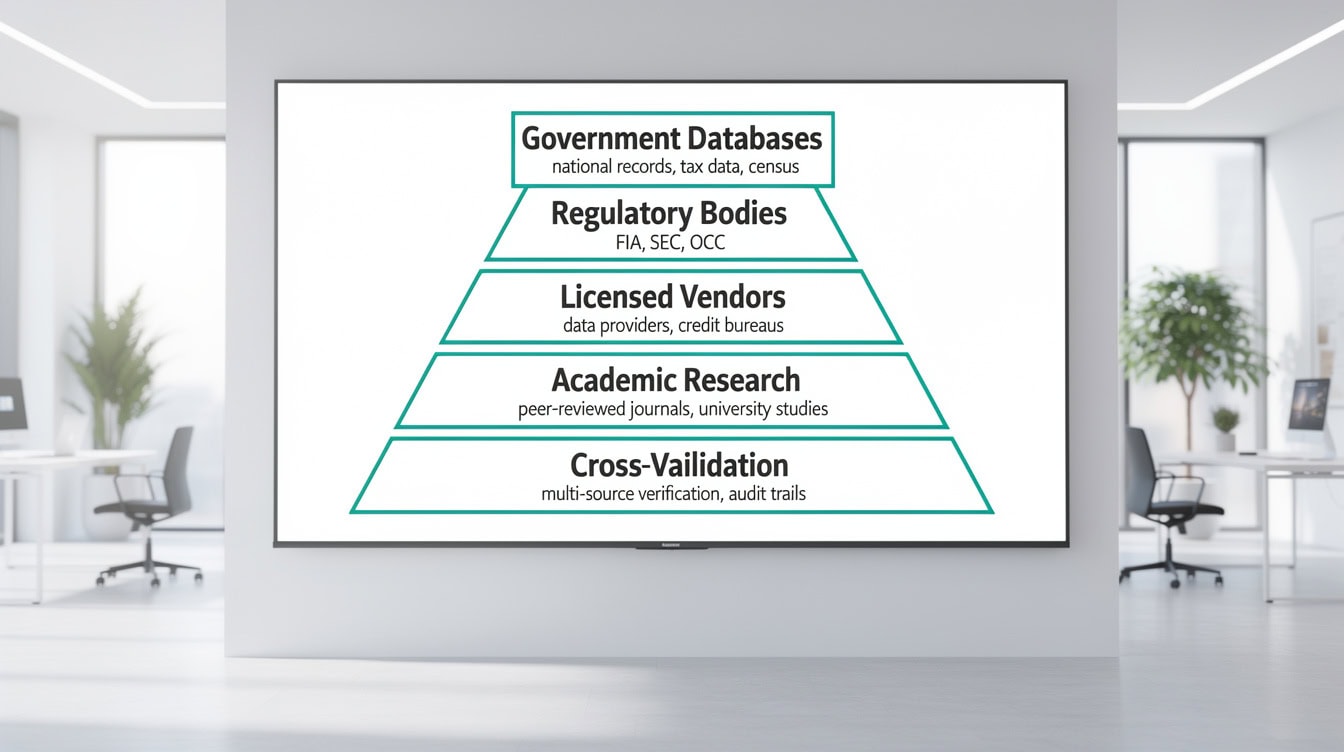
Government and regulatory sources form the primary layer; every key metric is confirmed across at least 3 independent tiers before publication.
Meet the EFM Team: Credentials and Domain Experience
EFM’s editorial and modeling team combines institutional finance credentials with hands-on practitioner experience across multiple industries and deal types.
The team includes professionals holding CFA (Chartered Financial Analyst) charters issued by the CFA Institute, the globally recognized standard for investment analysis competence. CFA charterholders must pass three levels of examinations covering ethics, financial reporting, valuation, and portfolio management, and must accumulate at least 4,000 hours of qualified work experience. Source Team members also hold CPA designations (Certified Public Accountant, the U.S. standard for accounting and audit practice) and have direct experience at Big Four accounting firms including roles in transaction advisory, financial due diligence, and model audit.
Beyond credentials, the team brings practitioner depth: investment banking experience across M&A advisory and equity capital markets, corporate finance roles as CFOs and controllers at operating companies, and equity research backgrounds covering sector-specific modeling for technology, healthcare, real estate, and energy. This practitioner mix matters because credentials tell you someone passed an exam. Industry experience tells you they’ve caught the errors that textbooks don’t cover.

EFM’s team combines CFA charters, CPA designations, and Big Four audit experience—credentials that translate directly into model accuracy.
Our Data Sourcing Methodology: Primary Sources First
EFM sources market data using a primary-first hierarchy, meaning government and regulatory databases take precedence over secondary aggregators, and licensed vendor feeds are cross-referenced before any figure enters a model.
The sourcing hierarchy works as follows:
- Primary government sources: U.S. Bureau of Labor Statistics, U.S. Census Bureau, Federal Reserve Economic Data (FRED), SEC EDGAR filings, Eurostat, and equivalent national statistical agencies for non-U.S. markets.
- Regulatory and standards bodies: FASB (Financial Accounting Standards Board), IASB (International Accounting Standards Board), and industry-specific regulators such as FERC for energy or CMS for healthcare.
- Licensed commercial data vendors: Bloomberg, S&P Capital IQ, and PitchBook for market comparables, transaction multiples, and private company data. EFM maintains active subscriptions to these platforms and documents the specific database query, date, and filter criteria for each data pull.
- Peer-reviewed academic research: For industry growth rates and structural market assumptions where government data lags, EFM cites published studies from NBER (National Bureau of Economic Research), university business schools, and journals indexed in SSRN.
- Industry association reports: Trade bodies such as NAREIT for real estate, SEIA for solar energy, and HIMSS for healthcare IT, where primary government coverage is incomplete.
- Cross-validation: Every key metric is confirmed against at least 3 independent sources before publication. Where sources disagree by more than 5%, the discrepancy is documented and the conservative figure is used unless a specific rationale supports the higher estimate.
Update frequency follows a tiered schedule: macroeconomic inputs (GDP growth, inflation, interest rates) are reviewed quarterly, industry-specific market size figures are reviewed semi-annually, and company-level comparables are refreshed whenever a new earnings release or regulatory filing becomes available.
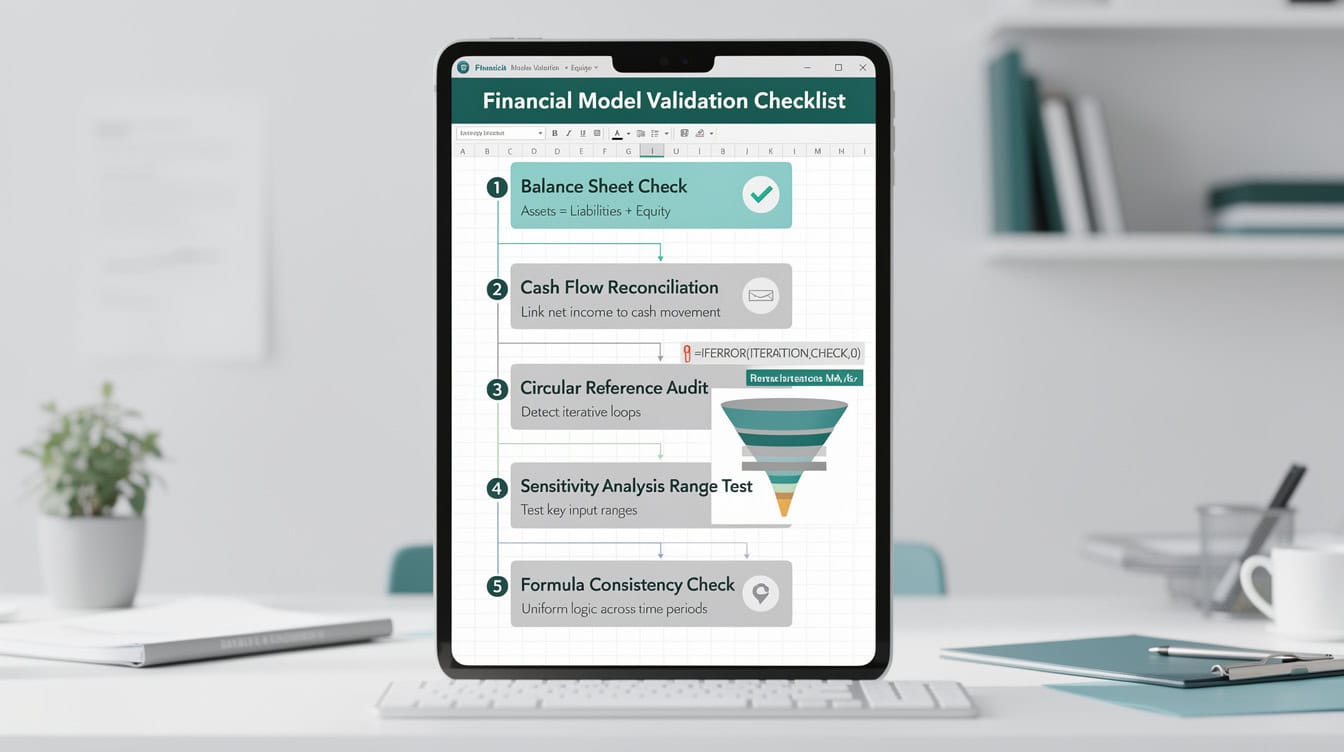
EFM’s sourcing methodology requires 3-source cross-validation before any market metric enters a published model—discrepancies above 5% trigger a documented review.
The Audit Trail: How Every Data Point Is Documented
An audit trail in financial modeling is a structured record showing the chain of custody for each data point, from its original source through every transformation to its final appearance in a model output. EFM’s audit trail captures 4 mandatory fields for every data point.
Here’s how the documentation works in practice:
Worked Example: U.S. SaaS Revenue Growth Rate
Suppose an EFM SaaS financial model uses a 15% annual revenue growth rate as the industry benchmark for early-stage companies. The audit trail entry for that figure reads:
- Source: U.S. Census Bureau Annual Business Survey (ABS), Table EC1751SSSZ5, Software Publishers subsector (NAICS 5112), 2022 release
- Collection date: March 14, 2024
- Verification status: Cross-referenced against BLS Quarterly Census of Employment and Wages (QCEW) for the same subsector and confirmed within a 2-percentage-point band
- Last updated: March 14, 2024; next scheduled review: September 2024
- Analyst sign-off: CFA charterholder initials, peer-reviewed by CPA designation holder
The calculation chain is explicit: the Census ABS reported median revenue growth of 14.8% for software publishers with under $10M in revenue. EFM rounded to 15% and documented the rounding decision. The BLS QCEW employment growth for the same subsector was 13.9%, confirming directional consistency. The 5% discrepancy threshold was not breached, so the Census figure was used as primary.
This level of documentation means an auditor or investor can trace the 15% assumption back to a specific government table, a specific query date, and a specific analyst review, in under five minutes.

Data Provenance Report format: one row per key assumption, 6 mandatory fields, ready for auditor or investor review.
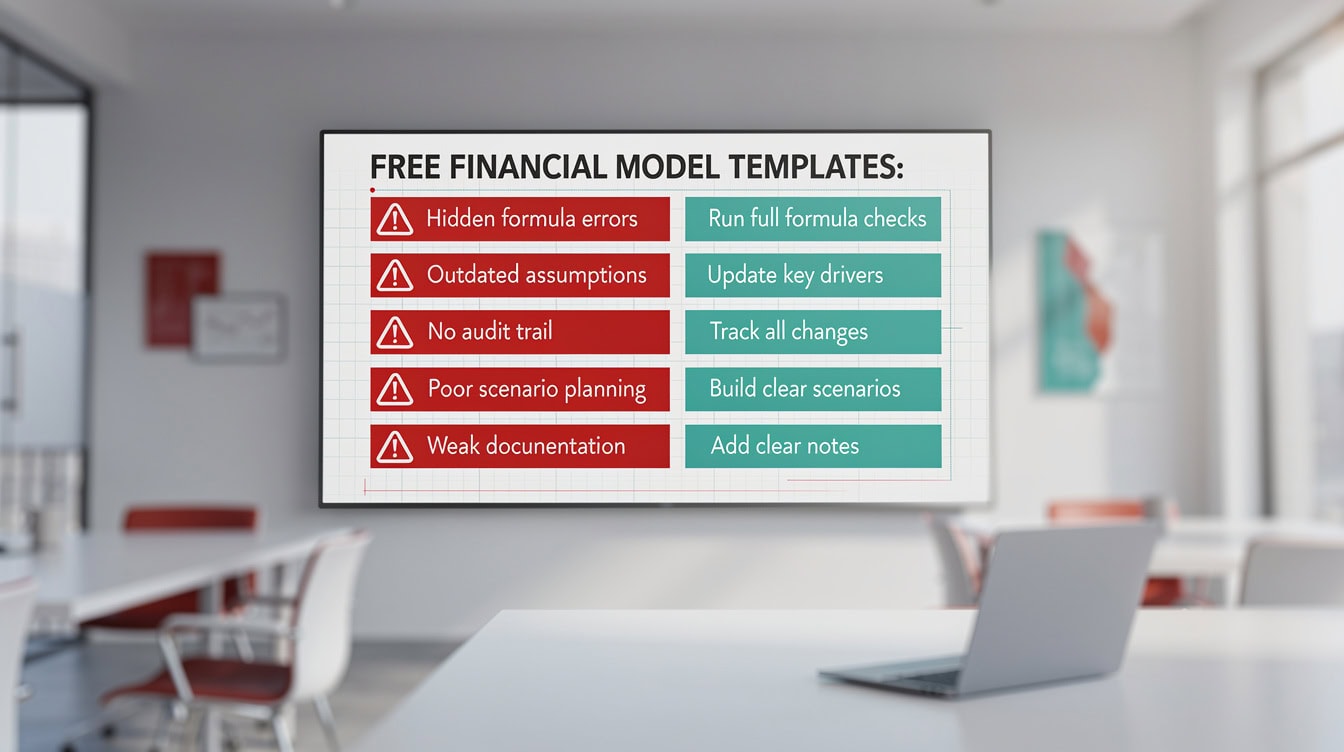
Every EFM model includes a downloadable Data Provenance Report with 4 mandatory fields per data point—ready for auditor or investor review.
Third-Party Certifications and Independent Verification
EFM pursues third-party verification at both the data infrastructure level and the model content level. These are two distinct types of assurance that serve different stakeholder needs.
At the infrastructure level, EFM’s data storage and access systems are aligned with SOC 2 Type II principles. SOC 2 (System and Organization Controls 2) is an auditing standard developed by the American Institute of CPAs (AICPA) that evaluates a service organization’s controls over security, availability, processing integrity, confidentiality, and privacy. A Type II report covers a period of at least 6 months, providing evidence that controls operated effectively over time rather than just at a single point in time. Source
At the model content level, selected EFM models undergo independent model audit by external reviewers with Big Four transaction advisory backgrounds. These reviews check formula integrity, assumption sourcing, and output sensitivity. The audit report is attached to the model download and summarizes findings, any corrections made, and the reviewer’s credentials.

SOC 2 Type II covers a minimum 6-month operating period, providing evidence of sustained controls rather than a single point-in-time snapshot.
Quality Control: A 3-Layer Review Process
EFM’s quality control process runs 3 sequential layers before any model or data set is published. Each layer catches a different category of error.
Layer 1: Automated Validation
Before human review begins, every model passes through automated checks: formula consistency tests (no hardcoded numbers where formulas should appear), circular reference detection, balance sheet reconciliation (assets = liabilities + equity), and range-bound checks that flag any input outside a statistically plausible range for its category.
Layer 2: Peer Analyst Review
A second analyst, who did not build the model, reviews the sourcing documentation, tests the model with stress-case inputs, and checks that outputs are directionally consistent with comparable public company filings. This peer reviewer must hold at minimum a CFA Level II pass or equivalent practitioner credential.
Layer 3: Senior Sign-Off
A senior team member with CFO or equivalent experience reviews the model’s key assumptions, the audit trail completeness, and the model’s fitness for its stated use case. This sign-off is logged with a timestamp and the reviewer’s credential designation.
Errors caught at any layer are logged in a correction register, corrected, and re-run through all three layers from the beginning. The correction register is available to users on request.
Errors caught at any layer restart the full 3-layer process—ensuring no correction bypasses the complete review sequence.
How Transparent Data Provenance Reduces Your Risk
Documented data provenance directly reduces three categories of risk that CFOs and analysts face when using third-party financial models.
Audit risk: When an external auditor or internal audit team reviews a financial model, undocumented assumptions are the most common source of audit findings. A model with a complete audit trail converts a potential finding into a closed item before the audit begins.
Due diligence risk: In M&A transactions, buyers’ advisors routinely request source documentation for financial projections. According to a Deloitte survey on M&A due diligence practices, data quality and documentation gaps are among the top 5 reasons deals are repriced or terminated after initial agreement. Source Providing a ready-made provenance report accelerates the process and protects valuation.
Stakeholder confidence: Board members, LPs (limited partners in private equity funds), and lenders increasingly ask for source attribution on key assumptions. A model that can answer “where does this number come from?” in writing, with a timestamp, builds credibility that generic models cannot match.

Documented provenance converts audit findings into closed items before the audit begins—the most cost-effective risk mitigation available to model users.
Industry Comparison: EFM vs. Standard Data Provider Disclosure
Most financial data providers disclose their sources at the category level (“government databases, industry reports, proprietary research”) without specifying the exact table, query date, or cross-validation methodology. EFM’s disclosure goes to the data-point level.
| Disclosure Element | Typical Provider | EFM Standard |
|---|---|---|
| Source name | Category only | Exact database + table |
| Collection date | Not disclosed | Timestamped per data point |
| Cross-validation | Not disclosed | 3-source minimum |
| Analyst credential | Not disclosed | Named designation |
| Update frequency | Annual or ad hoc | Tiered quarterly/semi-annual |
| Correction log | Not available | Available on request |
| Independent audit | Rare | Selected models audited |
| User-accessible report | Not available | Downloadable per model |
This comparison is not a criticism of other providers. It reflects a deliberate choice EFM made to serve institutional users who face audit scrutiny and due diligence requests that generic data disclosure cannot satisfy.
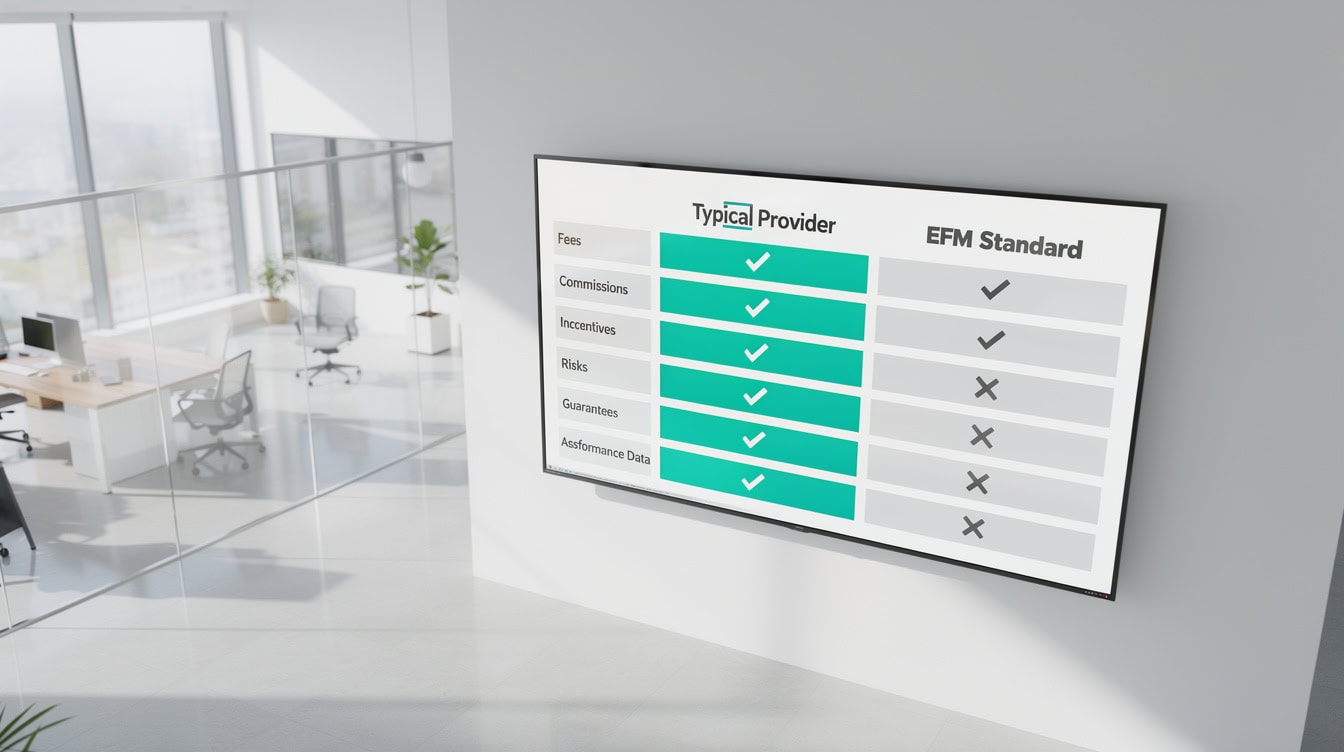
EFM discloses to the data-point level—exact table, query date, and analyst credential—where most providers disclose only source category.
Accessing Data Provenance Documentation: What You’ll See
Every EFM model download includes a Data Provenance Report as a separate tab or companion document. The report contains a structured table with one row per key assumption, covering source, collection date, verification status, cross-reference sources, and analyst sign-off. Users can filter by assumption category, sort by last-update date, and export the table for inclusion in their own audit files.
For institutional subscribers, EFM provides a Data Provenance API endpoint (application programming interface, a connection that lets software systems exchange data automatically) that returns provenance metadata in JSON format, enabling direct integration into internal audit management systems.
If you need to demonstrate data sourcing to an auditor or investor, the provenance report is designed to be handed over as a standalone document without requiring any additional explanation from your team.

The Data Provenance Report is designed as a standalone document—hand it directly to your auditor or investor without additional explanation.
Frequently Asked Questions
Where exactly does EFM get its market size data?
EFM sources market size data from a primary-first hierarchy. For U.S. markets, the starting point is the U.S. Census Bureau’s Economic Census and Annual Business Survey, supplemented by Bureau of Labor Statistics industry employment data and Federal Reserve sector flow-of-funds data. For international markets, Eurostat, OECD national accounts, and equivalent national statistical agencies provide the primary layer. Licensed commercial platforms including Bloomberg and S&P Capital IQ supply transaction comparables and private company benchmarks. Every market size figure is cross-referenced against at least 3 independent sources, and the specific table, query date, and filter criteria are documented in the model’s Data Provenance Report. Where sources disagree by more than 5%, EFM uses the conservative figure and documents the discrepancy.
How often does EFM update its financial model data?
EFM follows a tiered update schedule based on data volatility. Macroeconomic inputs such as GDP growth rates, inflation assumptions, and benchmark interest rates are reviewed quarterly, aligned with Federal Reserve and BLS release calendars. Industry-specific market size and growth rate figures are reviewed semi-annually. Company-level comparables, including revenue multiples and EBITDA margins, are refreshed whenever a new earnings release or SEC filing becomes available for the relevant peer group. Each model’s Data Provenance Report shows the last-update timestamp for every key assumption, so users can immediately identify which inputs may need refreshing for a time-sensitive analysis.
What credentials do EFM’s analysts hold?
EFM’s modeling team holds CFA charters (requiring 4,000+ hours of qualified experience and passage of three examinations covering valuation, financial reporting, and ethics, per CFA Institute standards), CPA designations, and direct experience at Big Four accounting firms in transaction advisory and model audit roles. Senior reviewers have held CFO and controller positions at operating companies, giving them the practitioner perspective to catch errors that credential-only reviewers miss. Specific credential designations are logged in the analyst sign-off field of every model’s audit trail, so users can verify the qualification level of the reviewer for any specific model.
What is a SOC 2 Type II report and why does it matter for financial data?
SOC 2 Type II is an audit report issued under standards set by the AICPA (American Institute of CPAs) that evaluates whether a service organization’s controls over security, availability, processing integrity, confidentiality, and privacy operated effectively over a defined period, typically 6 to 12 months. For financial data users, a SOC 2 Type II report matters because it provides independent evidence that the systems storing and transmitting data maintained integrity controls throughout the review period, not just on the day of a point-in-time inspection. This is relevant for institutional users whose own IT governance frameworks or client contracts require them to document the security posture of third-party data providers. EFM’s infrastructure controls are aligned with SOC 2 Type II principles.
How does EFM handle errors or corrections in published models?
When an error is identified in a published model, whether through user feedback, automated monitoring, or internal review, EFM logs the error in a correction register with the date identified, the nature of the error, the corrected value, and the source supporting the correction. The corrected model is re-run through all 3 quality control layers before republication. Users who downloaded the original version receive a notification with a summary of the correction and a link to the updated file. The correction register entry remains permanently attached to the model’s audit trail, so any user can see the full history including the error and its resolution. This transparency is intentional: a documented correction history is more credible than a clean record with no history.
Can I use EFM’s Data Provenance Report in my own due diligence files?
Yes. The Data Provenance Report is designed to be a standalone document that you can include directly in your due diligence data room, board presentation appendix, or audit file without modification. It is formatted to meet the documentation expectations of Big Four audit teams and institutional investors. The report includes source attribution, collection dates, verification status, analyst credential designations, and update timestamps in a structured table that auditors can review without needing access to EFM’s internal systems. For M&A transactions specifically, the report addresses the data sourcing questions that buyers’ advisors typically raise during financial model review, reducing the back-and-forth that extends due diligence timelines.
How does EFM’s transparency compare to what the CFA Institute recommends for data sourcing?
The CFA Institute’s Global Investment Performance Standards (GIPS) and its broader ethics framework require investment professionals to use reasonable and adequate sources for data inputs and to document the basis for significant assumptions. EFM’s provenance framework exceeds these baseline requirements by specifying the exact source table and query date (not just the source category), requiring cross-validation against at least 3 independent sources, and making the documentation user-accessible rather than keeping it internal. The CFA Institute’s Standards of Practice Handbook also emphasizes that analysts must be able to support their assumptions with documented evidence on request. EFM’s audit trail is built specifically to satisfy that requirement.
Conclusion
Data provenance is not a back-office function. It is the difference between a financial model that survives audit scrutiny and one that creates liability. EFM’s 6-layer approach, combining credentialed team expertise, primary-source hierarchy, 3-source cross-validation, automated and peer quality control, independent model audits, and user-accessible provenance reports, gives CFOs and analysts the documentation infrastructure they need to defend every assumption in their models.
I recommend downloading the Pharma Biotech Financial Model incl. Risk-Adjusted DCF and VC Valuation as a concrete example of how EFM’s data provenance framework applies to a complex, multi-assumption model where source credibility directly affects valuation outcomes. The accompanying Data Provenance Report shows exactly what your auditors and investors will see.