0 ITEMS

UAE Off-Plan Luxury Homes: 64% Brand Premium Explained
Dubai’s branded residential sector commands a 64% price premium over comparable non-branded stock — more than double the global norm of 25–35% — and understanding why that premium exists, where it is vulnerable, and how to model it is the central challenge for anyone underwriting UAE real estate through 2031.
Key Takeaways
- Dubai recorded more than 270,000 real-estate transactions worth roughly AED 917 billion in 2025, with off-plan accounting for approximately 60–65% of sales value.
- Branded residences in Dubai carry a 64% price premium over non-branded equivalents; Abu Dhabi’s premium reaches 87%, far above the 25–35% global average.
- Dubai’s 2027 handover pipeline peaks at roughly 70,500 units — about 98% above the five-year average — but 86% of that supply is mass-market apartments, not prime or branded stock.
- The base-case scenario (50% probability) projects a prime price CAGR of approximately 4.5% from 2026 to 2031, with branded residences rising to roughly 12% of new prime supply.
- Gross rental yields of 6.5–8% make the UAE one of the highest-yielding gateway residential markets globally, with prime and branded stock offering the most durable yield profile.
- The Golden Visa — available on off-plan purchases above AED 2 million after the February 2026 rule change — directly supports demand at the luxury threshold.
- The single most expensive analytical mistake is conflating the mass-market supply glut with the prime and branded scarcity story: they are different markets with different risk profiles.
Why the UAE Off-Plan Market Is Structurally Different
The UAE residential market is not simply a hot property market — it is structurally engineered to favor off-plan sales, and that structure shapes every financial model built on it. Off-plan (meaning the sale of a residential unit before construction is complete, registered via Dubai’s Oqood system) represented roughly 60–65% of Dubai residential sales value and about 71% of Abu Dhabi residential deals in 2025, according to analysis by eFinancialModels Research based on Dubai Land Department (DLD) and Abu Dhabi Real Estate Center (ADREC) data.
Three forces make off-plan dominant. First, developer payment plans — typically a 10–20% deposit followed by construction-linked installments and, increasingly, post-handover plans stretching years beyond completion — let buyers control a full asset with modest upfront capital. Second, the Oqood registration system and RERA-approved escrow accounts (funds held by a regulator-approved third party and released only against verified construction progress) protect buyer capital in a way that few emerging markets can match. Third, the Golden Visa links a property purchase directly to ten-year UAE residency: an off-plan purchase above AED 2 million qualifies, and the February 2026 circular removed the earlier requirement to pre-pay a large share before applying, broadening the eligible buyer pool considerably.
For financial modelers, this means the market must be underwritten on a phased-cash-flow basis: deposit, construction-linked installments, handover, and post-handover tail — never on a simple spot-price-times-units basis.
The Branded Residential Premium: What Drives It and How to Model It
Branded residences are units sold under a third-party brand license — from hospitality groups such as Address, Vida, and the Dorchester Collection, fashion houses such as Armani, Bulgari, and Versace, or automotive marques such as Bugatti and Mercedes-Benz — or under a developer’s own premium line. The premium buyers pay for that brand is extraordinary by global standards.
Dubai is the undisputed global capital of branded residences, with roughly 48,500 completed units across approximately 132–140 projects, according to CBRE’s UAE Branded Residences Report 2025. Its pipeline is set to grow about 80% to around 250 projects by 2030. Buyers in Dubai pay approximately 64% more per square foot for branded stock than for comparable non-branded units in the same location; in Abu Dhabi, that premium reaches approximately 87%, versus a global norm of 25–35% (CBRE UAE Branded Residences Report 2025).
The premium reflects four compounding factors: brand cachet and the marketing power of a globally recognized name; hotel-grade amenities and service that justify higher rents; professional rental management that makes the asset genuinely turnkey for international buyers; and the resale liquidity that a recognized brand confers in a market where buyers often exit before or shortly after handover.
For modelers, the discipline is to underwrite the branded premium as a function of brand strength, location scarcity, service quality, and exit liquidity — not as a flat uplift applied uniformly. A branded scheme in a weak location with a poorly matched brand will not sustain an 87% premium; a well-located, well-branded, well-managed asset can.

Supply-Side Analysis: The 2027 Peak and Why Segment Separation Matters
Supply is the swing factor that separates winners from losers over the 2026–2031 forecast period. Dubai’s handover pipeline peaks in 2027 at roughly 70,500 units — approximately 98% above the five-year average of around 35,500 units — based on JLL, Knight Frank, and DLD pipeline data analyzed by eFinancialModels Research.
That headline number is alarming, but the segment breakdown is what matters. Approximately 86% of the pipeline consists of apartments, concentrated in five mass-market districts: JVC and JVT, Dubai South, MBR City, Business Bay, and Dubailand Residence Complex. These are communities where price and rent adjustments of 5–15% are plausible if absorption (the pace at which available units are sold) lags supply.
Prime and branded supply faces a completely different dynamic. Waterfront and island land in Palm Jumeirah, Downtown Dubai, Saadiyat Island, and Yas Island is finite, so the top of the market faces far less absorption pressure. Dubai’s branded pipeline, even at 250 projects by 2030, represents only about 8% of total new residential supply — keeping branded product structurally scarce relative to demand. Abu Dhabi is earlier in its branded cycle but accelerating, with branded homes projected to account for up to 18% of the emirate’s residential deliveries by 2029.
Conflating the mass-market glut with the prime and branded scarcity story is the most common and most expensive analytical error in UAE real estate underwriting.
Dubai Supply Pipeline at a Glance
| Year | Forecast Handovers | vs 5-Yr Avg | Apt Share | Prime/Branded Pressure |
|---|---|---|---|---|
| 2025 | ~52,000 units | +46% | ~86% | Low |
| 2026 | ~55,000–68,000 | +55–90% | ~86% | Low |
| 2027 | ~70,500 | +98% | ~86% | Low–Moderate |
| 2028 | ~55,000 | +55% | ~86% | Low |
Source: eFinancialModels Research based on JLL, Knight Frank, and DLD pipeline data. 2026–2028 are forecasts.
Pricing Dynamics: From Euphoric Boom to Sustainable Expansion
Pricing has normalized from an exceptional peak to a pace that is healthier for long-horizon investors. Dubai prime values rose roughly 18–20% per year in 2023–2024 before cooling to high-single digits in 2025; across ten prime neighborhoods, prices averaged about AED 3,767 per square foot, up approximately 8.4% year on year by Q3 2025, according to Knight Frank’s Dubai Residential Market Review.
Knight Frank forecasts a measured 3–5% rise for prime in 2026. The base case in the UAE Real Estate Off-Plan Luxury and Branded Residential Market Study 2026–2031 extends a mid-single-digit prime trajectory through 2031, with Abu Dhabi prime growing at a broadly similar pace from a lower base.

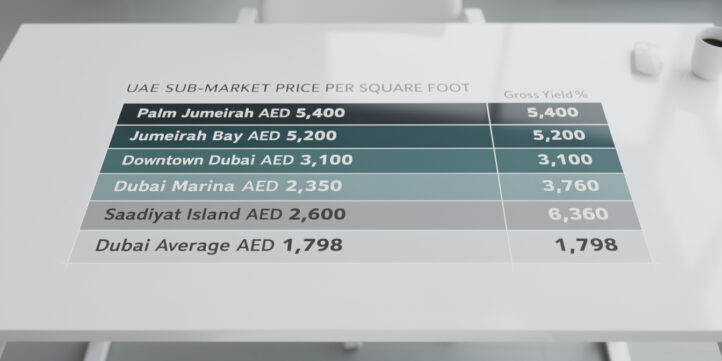
Price dispersion across sub-markets is wide and is the foundation of any credible model. Palm Jumeirah apartments reach about AED 5,400 per square foot and villas around AED 5,000, while Downtown Dubai sits near AED 3,100 and Dubai Marina around AED 2,350 — all far above the Dubai apartment average of roughly AED 1,798. In Abu Dhabi, Saadiyat Island anchors the prime tier near AED 2,600 per square foot (Knight Frank and Savills, 2025). A flat blended price assumption misstates returns badly; sub-market- and product-specific pricing is essential.
Sub-Market Pricing and Yield Comparison
| Sub-Market | Price (AED/sqft) | Gross Yield | Segment |
|---|---|---|---|
| Palm Jumeirah (apt) | ~5,400 | ~5–6% | Prime/Branded |
| Jumeirah Bay / District One | ~5,200 | ~4.5–6% | Ultra-Prime |
| Downtown Dubai | ~3,100 | ~5–6% | Prime |
| Dubai Marina | ~2,350 | ~6–7% | Prime/Mid |
| Saadiyat Island (Abu Dhabi) | ~2,600 | ~5.5–6.5% | Prime |
| Dubai Apartment Average | ~1,798 | ~6.5–7.5% | Mid-Market |
Source: eFinancialModels Research based on Knight Frank, Savills, Property Finder, and Global Property Guide (2025). Yields are indicative.
Worked Example: Modeling an Off-Plan Branded Residence IRR
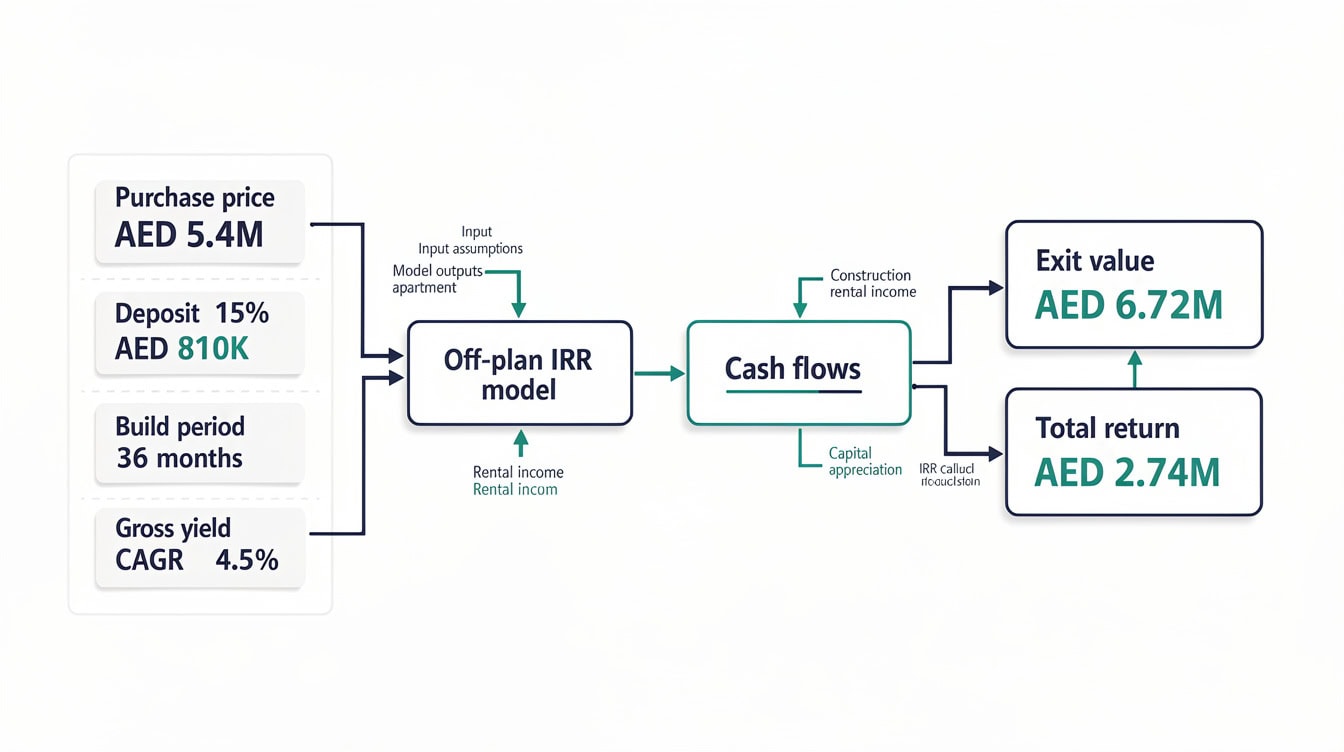
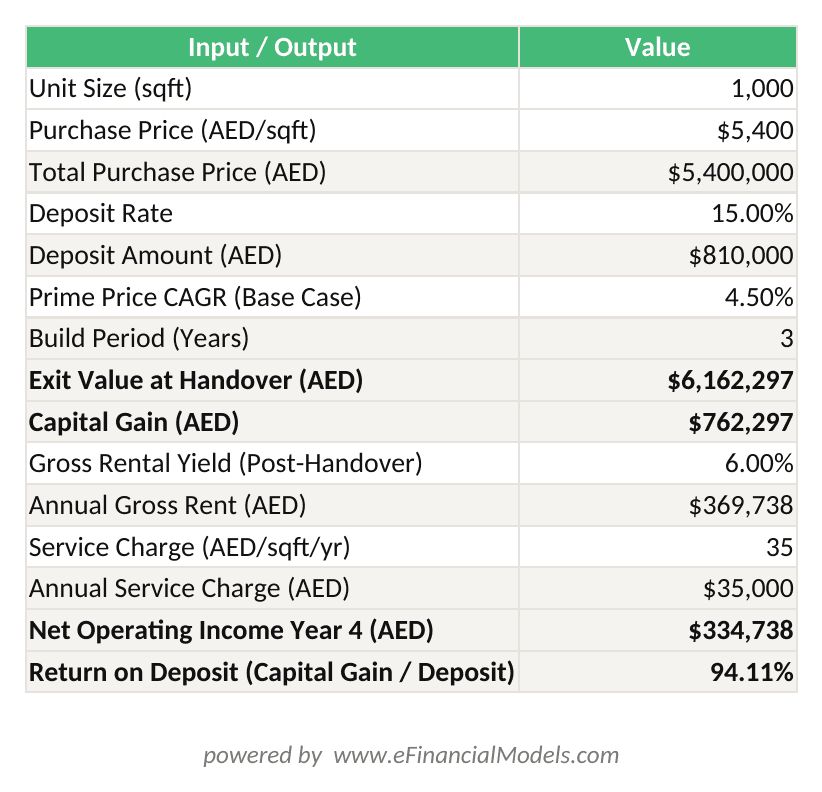
The economics of an off-plan purchase are dominated by the payment plan, not just the price. Here’s the math for a base-case branded apartment on Palm Jumeirah.
Inputs:
- Unit size: 1,000 sq ft
- Price: AED 5,400/sqft = AED 5,400,000 total
- Deposit (15%): AED 810,000 at signing
- Construction installments (55%): AED 2,970,000 paid over 36 months
- Handover payment (30%): AED 1,620,000 at month 36
- Gross rental yield: 6% per annum on AED 5,400,000 = AED 324,000/year
- Service charges (branded): AED 40,000/year (netted against gross rent)
- Net operating income (NOI): AED 284,000/year
- Base-case price appreciation (CAGR 4.5%): exit value at year 5 post-handover = AED 5,400,000 × (1.045)^5 = approximately AED 6,720,000
Equity deployed at signing: AED 810,000
Total equity deployed by handover: AED 5,400,000
Capital gain at exit (year 5 post-handover): AED 6,720,000 − AED 5,400,000 = AED 1,320,000
Cumulative NOI (5 years): AED 284,000 × 5 = AED 1,420,000
Total return: AED 1,320,000 + AED 1,420,000 = AED 2,740,000 on AED 5,400,000 invested
The key insight: because the buyer deployed only AED 810,000 at signing and the asset appreciated during the 36-month build period, the equity IRR on the initial deposit is substantially higher than the unlevered return suggests. Thin deposits magnify both gains and losses — which is why modeling the full payment-plan schedule, not just the exit price, is non-negotiable.
Three Scenarios to 2031: Bear, Base, and Bull
The forecast period could unfold along three broad paths. The central uncertainty is how the 2027 supply peak interacts with demand: whether absorption keeps pace, whether global liquidity and millionaire in-migration hold, and whether the branded premium proves durable.
| KPI (2026–2031) | Bear (25%) | Base (50%) | Bull (25%) |
|---|---|---|---|
| Prime Price CAGR | ~-1% | ~4.5% | ~8% |
| Mass-Market Adjustment | -10 to -15% | Flat to modest | Positive |
| Branded Share of New Prime Supply (2031) | ~8% | ~12% | ~16% |
| Off-Plan Transaction Volume | Falling | Stable/growing | Strong growth |
| Branded Premium | Holds (scarcity) | ~60–65% Dubai | Widens |
| Gross Prime Yield | Compresses | ~6–8% stable | Stable, growth-led |
Source: eFinancialModels Research. Probabilities reflect analyst judgment grounded in study evidence.
In the bear case, the 2027 handover wave overwhelms absorption in the mass market just as global liquidity tightens. Mass-market apartment prices and rents correct 10–15% in saturated districts, and off-plan buyers on thin deposits face negative equity. Branded and ultra-prime stock proves more resilient given scarcity, but transaction volumes fall.
In the base case — the most probable path at 50% — the supply surge is absorbed unevenly. Mass-market communities see flat-to-modest adjustments, while prime and branded sub-markets continue to grow at a mid-single-digit pace. The Golden Visa and tax advantages sustain foreign demand, and the cash-heavy buyer base (approximately 87% of Abu Dhabi deals are cash, per ADREC) limits rate sensitivity.
In the bull case, demand outruns even the 2027 supply. Sustained millionaire in-migration and the UAE’s safe-haven status drive prime growth of about 8% CAGR, with branded residences reaching roughly 16% of new prime supply as more global brands enter.
Common Modeling Mistakes and How to Fix Them
Financial models built on UAE off-plan and branded residential data fail in predictable ways. Here are the five most common mistakes and their fixes.
1. Using a flat blended price assumption. Price per square foot varies from AED 1,798 (Dubai apartment average) to AED 5,400 (Palm Jumeirah). Applying a single blended figure misstates returns by hundreds of basis points. Fix: use sub-market- and product-specific price inputs for every asset in the model.
2. Applying a uniform branded premium. The 64% Dubai premium and 87% Abu Dhabi premium are market averages, not guarantees for every branded scheme. A poorly located branded project with a weak brand match will not sustain that uplift. Fix: underwrite the premium as a function of brand strength, location scarcity, service quality, and exit liquidity.
3. Modeling off-plan as spot price times units. Off-plan IRR is driven as much by payment-plan leverage as by price growth. Fix: model the full cash-flow schedule — deposit, construction-linked installments aligned to escrow drawdown (triggered at 20% construction progress per RERA rules), handover payment, and any post-handover tail.
4. Conflating mass-market and prime supply risk. The 2027 handover peak of 70,500 units is concentrated in five mass-market districts. Prime and branded supply remains scarce. Fix: stress the mass-market supply peak separately; hold prime and branded scarcity assumptions.
5. Ignoring service-charge inflation in branded schemes. Branded and amenity-rich schemes carry elevated service charges that erode net yields. Fix: model service charges explicitly in net operating income (NOI) rather than using gross yield as a proxy for cash return.
Regulatory and Policy Context: A Tailwind, Not a Constraint
The UAE’s regulatory framework is unusually supportive for off-plan and branded residential investment. Dubai Law No. 8 of 2007 established the escrow account regime for off-plan development, and Dubai Law No. 13 of 2008 created the Oqood interim register that protects buyer rights before title deed issuance. Abu Dhabi tightened its framework further with Law No. 2 of 2025, amending Real Estate Law No. 3 of 2015 to strengthen off-plan buyer protections.
The Golden Visa is the demand-side policy lever that most directly affects the luxury off-plan market. A purchase above AED 2 million — including off-plan — qualifies for a ten-year UAE residency visa. The February 2026 circular removed the earlier requirement to pre-pay a large share of the purchase price before applying, which had previously excluded buyers on back-weighted payment plans. This change directly expands the eligible buyer pool at the AED 2 million-plus threshold where branded and prime product concentrates.
Cash dominance — approximately 87% of Abu Dhabi deals are cash transactions, per ADREC — makes the UAE cycle more demand- and supply-driven than credit-driven, reducing the market’s sensitivity to global interest rate movements. The UAE also levies 0 corporate and personal income tax on residential property gains (UAE Ministry of Finance), a structural advantage that meaningfully enhances after-tax returns for international investors compared with competing gateway markets such as London or Singapore, where capital gains and stamp duties can consume 20–40% of nominal gains.
For investors building real estate financial models for UAE assets, the regulatory environment is a genuine tailwind that reduces the political and legal risk premium typically applied to emerging-market property.
Competitive Landscape: Who Dominates and Why It Matters
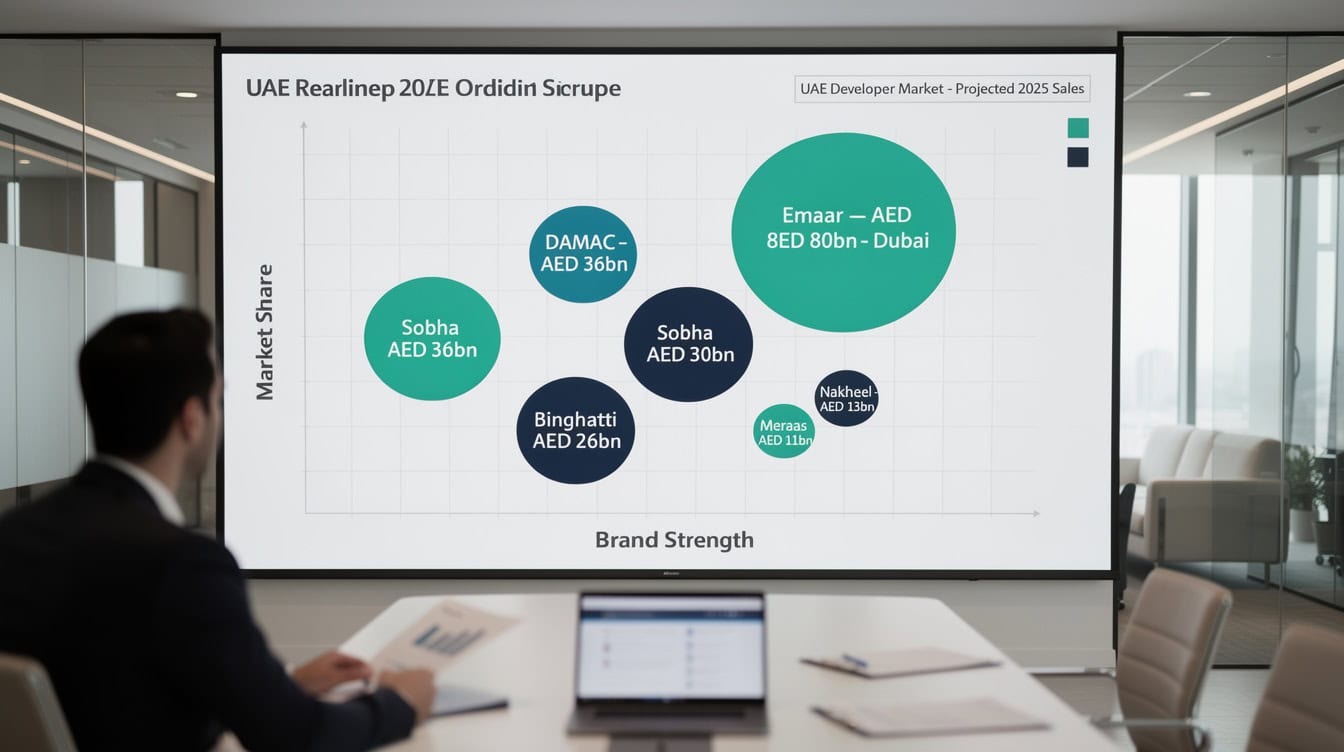
The UAE off-plan and branded market is concentrated among a small number of dominant developers, and understanding their positioning matters for absorption and pricing assumptions. Emaar Properties leads Dubai with approximately AED 80 billion in 2025 sales, anchored by its Address Hotels + Resorts branded residential line. DAMAC Properties follows at approximately AED 36 billion, with luxury launches under the Versace, de Grisogono, and Cavalli brands. Sobha Realty (approximately AED 30 billion) and Binghatti (approximately AED 26 billion, with Mercedes-Benz and Bugatti branded towers) round out the leading private cohort. In Abu Dhabi, Aldar Properties dominates with approximately AED 31 billion in sales, roughly 40% of the emirate’s residential value, per ADREC and company disclosures.
On the branded operator side, Address Hotels + Resorts leads Dubai with about 15 branded developments, followed by Vida with around 9 and the Dorchester Collection with about 8. Globally, Marriott and Accor account for roughly 79% of branded residential schemes, and both are expanding aggressively in the UAE (CBRE UAE Branded Residences Report 2025). Dubai’s branded residential pipeline is set to nearly double to around 250 projects by 2030 (Knight Frank), underscoring the scale of operator commitment to the market.
For modelers building commercial real estate financial models, developer track record is a critical input: escrow protects buyer funds, but it does not protect against handover delays, which are the most common source of off-plan IRR erosion.
Frequently Asked Questions
What is the branded residential premium in Dubai and how is it calculated?
The branded premium is the percentage uplift in price per square foot that a branded residence commands over a comparable non-branded unit in the same location and sub-market. In Dubai, that premium averages approximately 64%; in Abu Dhabi, it reaches approximately 87%, according to CBRE’s UAE Branded Residences Report 2025. The global norm is 25–35%. To calculate it for a specific asset, divide the branded price per square foot by the non-branded comparable price per square foot, subtract 1, and express as a percentage. For example, if a branded Palm Jumeirah apartment sells at AED 5,400/sqft and a comparable non-branded unit sells at AED 3,293/sqft, the premium is (5,400 / 3,293) − 1 = approximately 64%. The premium must be underwritten to brand strength, location scarcity, service quality, and exit liquidity — not applied as a flat uplift across all branded schemes.
How does the 2027 supply glut affect prime and branded property values?
The 2027 handover peak of approximately 70,500 units in Dubai sits roughly 98% above the five-year average, but approximately 86% of that pipeline consists of apartments in five mass-market districts: JVC, Dubai South, MBR City, Business Bay, and Dubailand Residence Complex. Prime and branded supply is constrained by finite waterfront and island land, so Palm Jumeirah, Downtown Dubai, Saadiyat, and Yas face far less absorption pressure. The base-case scenario projects price and rent adjustments of 5–15% in saturated mass-market communities, while prime and branded sub-markets continue to grow at a mid-single-digit CAGR of approximately 4.5% through 2031. The critical discipline is to model these segments separately, not as a single blended market.
What is the Golden Visa and how does it affect off-plan demand?
The UAE Golden Visa is a ten-year residency visa available to property buyers who purchase a unit valued at AED 2 million or more, including off-plan purchases. The February 2026 circular removed the earlier requirement to pre-pay a large portion of the purchase price before applying, which had previously excluded buyers on back-weighted or post-handover payment plans. This change directly expands the eligible buyer pool at the AED 2 million-plus threshold — precisely where branded and prime off-plan product concentrates. For financial modelers, the Golden Visa functions as a structural demand support at the luxury threshold: it converts a property purchase into a residency pathway, which is a compelling proposition for the international high-net-worth buyers who drive branded residential demand.
What gross rental yields can investors expect from UAE prime and branded residential?
Gross rental yields in the UAE run approximately 6.5–8% across the residential market, making it one of the highest-yielding gateway residential markets globally, according to Global Property Guide and Knight Frank data for 2025. Prime and branded stock yields approximately 5–7% gross, which is lower than the mass-market average but more durable because branded assets attract higher-quality tenants, benefit from professional rental management, and face less rent compression from new supply. The key modeling discipline is to net service charges — which are elevated in branded and amenity-rich schemes — against gross rent to arrive at net operating income (NOI). A branded Palm Jumeirah apartment yielding 6% gross might net 5.2–5.5% after service charges of AED 35,000–50,000 per year on a AED 5–6 million unit.
How should I structure the payment-plan cash flows in an off-plan financial model?
An off-plan financial model must treat the payment plan as the primary driver of equity IRR, not just the exit price. The standard structure is: a deposit of 10–20% at signing; construction-linked installments (typically 40–60% of the purchase price) paid in tranches aligned to verified construction milestones, with escrow drawdown triggered at 20% construction progress per RERA rules; a handover payment of 20–30%; and, increasingly, a post-handover tail stretching 12–36 months beyond completion. Build period to handover is typically 30–42 months, and modelers should stress for a 6–12 month delay. The thin deposit and back-weighted plan create embedded leverage: the buyer controls the full asset value while deploying only a fraction of capital during the appreciation period, magnifying equity returns when prices rise — and losses if they fall or if handover slips. Never model off-plan as spot price times units.
Which UAE sub-markets carry the highest supply risk through 2027?
The five highest-risk sub-markets for mass-market supply absorption are JVC and JVT, Dubai South, MBR City, Business Bay, and Dubailand Residence Complex. Together, these districts account for nearly 45% of under-construction stock in Dubai, and they are predominantly apartment communities where price and rent adjustments of 5–15% are plausible if absorption lags the handover wave. By contrast, Palm Jumeirah, Downtown Dubai, Dubai Marina, Saadiyat Island, and Yas Island face low-to-moderate absorption pressure because prime and branded supply in these locations is constrained by finite waterfront and island land. For investors and developers, the base-case recommendation is to concentrate exposure in supply-constrained prime and branded locations and to stress the 2027 peak explicitly in mass-market underwriting.
What tools and templates are available for modeling UAE off-plan and branded residential?
Building a credible UAE off-plan model requires a phased cash-flow template that handles deposit, construction-linked installments, escrow drawdown timing, handover, post-handover tail, NOI (net operating income, meaning gross rent minus service charges and management fees), and levered IRR. The UAE Real Estate Off-Plan Luxury and Branded Residential Market Study 2026–2031 provides the sector-level assumption set — price per square foot by sub-market, branded premium, yield, absorption pace, and three scenarios to 2031 — that feeds into a property-level model. For the financial model itself, EFM’s real estate financial model templates provide the DCF, payment-plan schedule, and levered return framework needed to translate sector data into project-level investment decisions.
Conclusion: Separate the Segments, Then Model the Premium
The UAE off-plan and branded residential market through 2031 is two markets in one: a mass-market apartment sector facing a genuine supply test in 2027, and a prime and branded sector protected by finite land, strong brand-led demand, and a regulatory framework that is actively supportive. The 64% branded premium in Dubai and 87% in Abu Dhabi are real, but they must be earned and defended in the underwriting — through brand selection, location scarcity, service quality, and exit liquidity — not assumed as a flat uplift.
The base case projects a prime price CAGR of approximately 4.5% through 2031, gross yields of 6–8% in prime and branded stock, and branded residences rising to roughly 12% of new prime supply. The bear case — a 25% probability — sees mass-market corrections of 10–15% and prime growth turning marginally negative. The bull case — also 25% — sees prime growing at 8% CAGR as millionaire in-migration accelerates.
I recommend starting with the UAE Real Estate Off-Plan Luxury and Branded Residential Market Study 2026–2031 to anchor your assumption set, then pairing it with EFM’s pre-sold apartments real estate model template to build the phased cash-flow, payment-plan, and levered IRR analysis that this market demands.