0 ITEMS

Template vs Custom Financial Models: 8 Factors to Decide

Choosing between a template and a custom financial model is one of the highest-leverage decisions a CFO or founder makes before a fundraise, acquisition, or board presentation.
Key Takeaways
- Templates cost $50–$2,000 upfront and deploy in hours; custom models run $5,000–$50,000+ and take 4–12 weeks to build.
- 8 quantitative factors, including revenue size, transaction complexity, and investor sophistication, determine the right path more reliably than gut feel.
- Hidden customization costs can push a $500 template to $8,000+ in total spend when consultant modification fees and rework cycles are included.
- Templates hit architectural limits at roughly 3–5 scenario cases, multi-currency consolidation, and complex waterfall distributions.
- Sector matters: SaaS and early-stage startups typically start with templates; real estate development and M&A transactions above $10M almost always require custom builds.
- A hybrid strategy, starting with a template then migrating to custom, cuts total cost by 30–50% compared to building custom from day one.
- Institutional investors and audit committees increasingly scrutinize model provenance; a poorly adapted template can introduce credibility risk on deals above $5M.
The Real Cost Equation: Beyond Sticker Price
The sticker price of a financial model template tells you almost nothing about total cost of ownership. A $500 SaaS template can balloon to $6,000–$8,000 once you factor in consultant modification fees ($150–$300/hour), version control cleanup, and the 20–40 hours a finance analyst spends adapting assumptions to your business model.
Custom models carry a higher upfront number, typically $5,000–$15,000 for a three-statement integrated model (income statement, balance sheet, and cash flow statement linked together) and $20,000–$50,000+ for complex transaction or operational models. But they arrive purpose-built, which eliminates most rework cycles.
Here’s the math on a mid-market SaaS company preparing a Series B raise:
- Template path: $800 template + 30 analyst hours at $75/hour internal cost + $3,500 consultant modification = $6,550 total
- Custom path: $12,000 custom build + $1,200 annual maintenance = $13,200 year-one total
The gap narrows fast when the template requires a second modification cycle, which happens in roughly 60% of cases where the business model has more than 3 revenue streams, according to the Association for Financial Professionals.
Technical debt (the accumulated cost of shortcuts and workarounds embedded in a model) is the most underestimated hidden cost. A template modified by three different analysts over 18 months often contains circular references, hardcoded assumptions, and broken audit trails that require a full rebuild before any serious investor review.
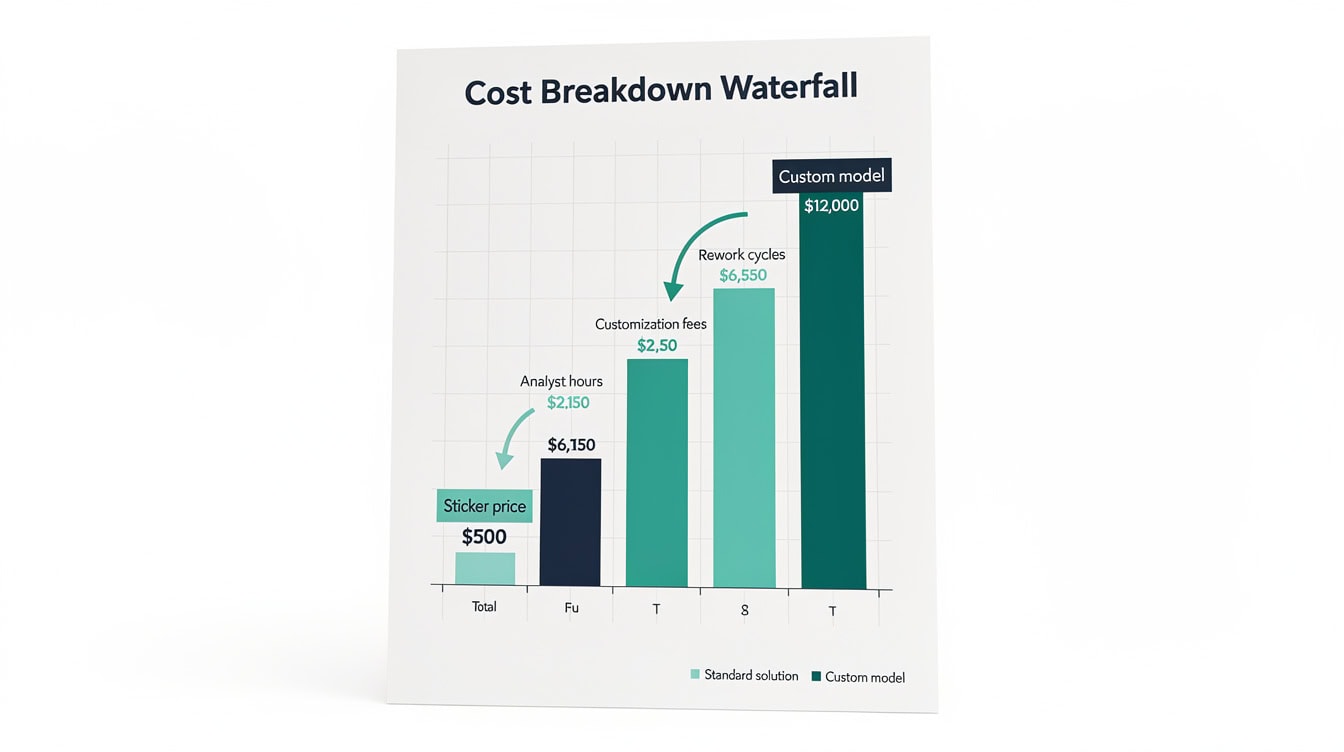
Hidden customization costs routinely push a $500 template to $6,000–$8,000 in total spend.
Decision Framework: 8 Factors That Determine Your Optimal Path
The right choice between template and custom depends on eight measurable factors, not subjective preference. Score each factor below and use the result to guide your decision.
| Factor | Template Threshold | Custom Threshold |
|---|---|---|
| Annual Revenue | Under $5M | Over $10M |
| Transaction Size | Under $2M | Over $5M |
| Revenue Streams | 1–2 | 3+ |
| Scenario Cases Needed | 3 or fewer | 4+ |
| Currencies | Single | Multi-currency |
| Investor Type | Angel / seed | Institutional / PE |
| Timeline to Deadline | Under 1 week | 4+ weeks available |
| Regulatory Complexity | Standard GAAP | IFRS, multi-entity, or regulated industry |
If 5 or more of your answers fall in the custom column, a bespoke build almost always delivers better ROI. If 6 or more fall in the template column, start with a proven template and invest the savings in better assumptions and market research.
Financial model errors affect an estimated 88% of large spreadsheets, according to the Association for Financial Professionals, making model architecture, not just assumptions, a material risk factor on any deal above $1M.

Score 5 or more factors in the custom column and a bespoke build almost always delivers better ROI.
Template Models: When Speed and Standardization Win
Templates win when speed, cost, and standardization matter more than bespoke precision. A well-designed industry template from a reputable provider encodes best practices that would take an in-house analyst weeks to research and structure from scratch.
The strongest use cases for templates include:
- Early-stage fundraising: Seed and pre-Series A investors evaluate dozens of decks per week. A clean, standard three-statement model with a 5-year projection signals competence without requiring custom architecture. Explore startup financial models built for exactly this stage.
- Internal budgeting and planning: Annual budget cycles with stable business models don’t justify custom builds. Templates with locked structure and unlocked assumptions serve 80% of planning needs.
- Proof-of-concept analysis: Before committing to a market entry or product launch, a template lets you stress-test assumptions in hours, not weeks.
- Subsidiary or divisional reporting: When a corporate parent maintains a custom consolidated model, individual business units can use standardized templates that feed into the parent structure.
Templates from established providers typically range from $50 for basic projection tools to $2,000 for sector-specific models with integrated dashboards, according to the U.S. Small Business Administration. Small businesses with revenues under $5M rarely need modeling infrastructure beyond what a quality template provides.

Templates deploy in hours to days, making them the only viable option when fundraising deadlines are weeks away.
Custom Models: When Complexity Demands Bespoke Architecture
Custom financial models become necessary when your business structure, transaction complexity, or stakeholder requirements exceed what any template can accommodate without a near-complete rebuild. At that point, you’re paying template prices for custom work, which is the worst of both worlds.
Specific triggers that justify custom builds:
- Multi-entity consolidation with intercompany eliminations across 3+ legal entities
- Complex waterfall distributions in real estate or private equity structures
- ERP integration requirements where the model must pull live data from SAP, Oracle, or NetSuite
- Regulatory capital modeling for banks, insurance companies, or regulated utilities
- M&A transaction models with purchase price allocation, goodwill amortization, and synergy tracking
- Revenue recognition complexity under ASC 606 or IFRS 15 with multiple performance obligations
Custom model development follows a structured process: requirements scoping (3–5 days), architecture design (1–2 weeks), build and testing (2–6 weeks), and client review cycles (1–2 weeks). Total elapsed time runs 4–12 weeks depending on complexity.
The Federal Reserve defines model risk as the potential for adverse consequences from decisions based on incorrect or misused models, a standard that institutional lenders apply directly to borrower-submitted financial models.

Custom models handle multi-entity consolidation, waterfall distributions, and ERP integration that templates cannot accommodate.
Sector-Specific Guidance: Which Industries Favor Which Approach
Your industry dictates model requirements more than company size alone. Here’s how the decision breaks down across five major sectors.
| Sector | Recommended Start | Upgrade Trigger | Key Complexity Driver |
|---|---|---|---|
| SaaS / Recurring Revenue | Template | Series B+ or ARR > $5M | Cohort churn, expansion MRR |
| Real Estate Development | Custom | Any project > $2M | Draw schedules, waterfall, debt tranches |
| Manufacturing | Template to Custom | 3+ product lines or ERP needed | COGS allocation, inventory modeling |
| Professional Services | Template | Multi-office or PE-backed | Utilization rates, partner comp |
| Retail / E-commerce | Template | Omnichannel or 50+ SKUs | Inventory turns, margin by channel |
SaaS: Monthly recurring revenue (MRR) models with standard cohort analysis (grouping customers by acquisition period to track retention) work well in templates up to roughly $5M ARR. Beyond that, investor-grade models require custom cohort waterfall logic and unit economics dashboards that templates rarely include out of the box.
Real estate development: Almost every project above $2M justifies a custom model. Construction draw schedules, interest reserves, preferred equity waterfalls, and IRR hurdle calculations interact in ways that generic templates handle poorly. A single modeling error on a $20M development deal can misstate the investor IRR by 200–400 basis points.
Manufacturing: Template models handle single-product or simple multi-product businesses well. Once you add work-in-progress inventory, standard costing variances, or multi-plant allocation, you need custom architecture.
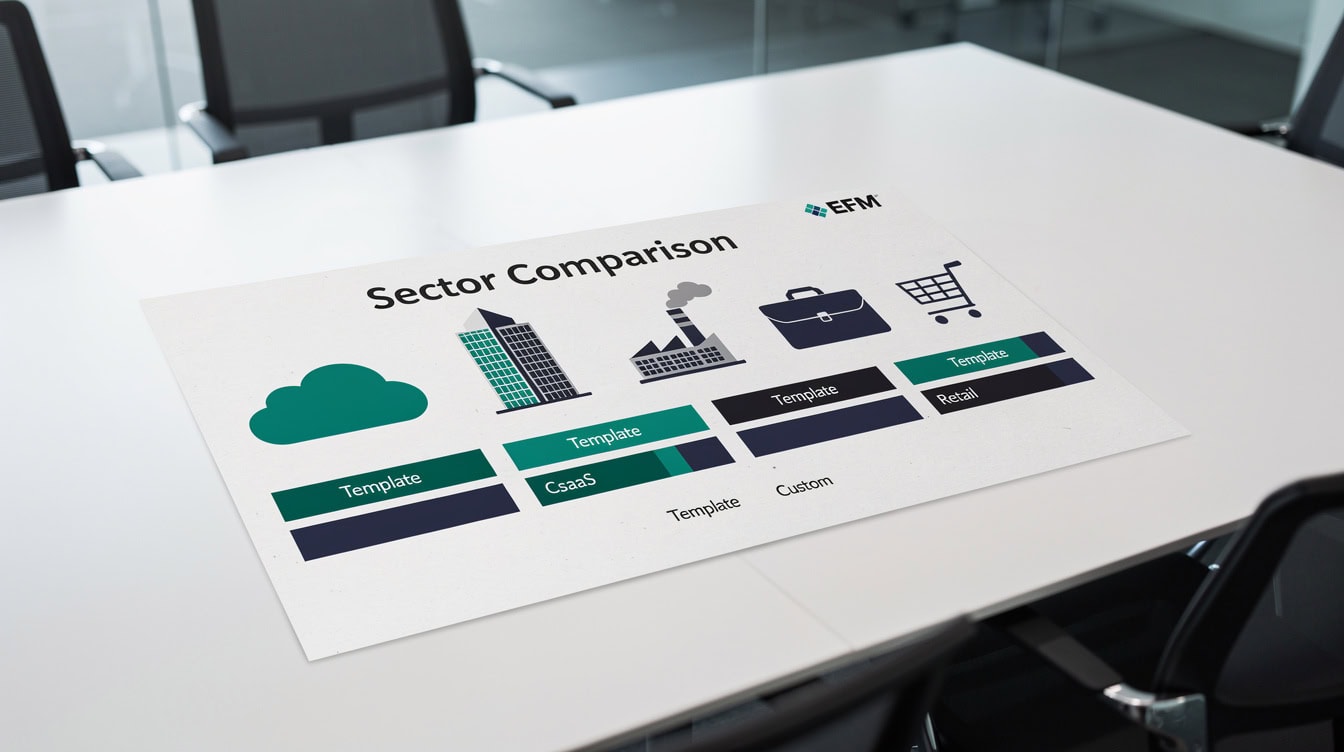
Real estate development and M&A transactions above $10M almost always require custom builds regardless of company size.
The Hybrid Strategy: Combining Template Efficiency with Custom Precision
The hybrid approach, starting with a template and migrating to custom at a defined inflection point, cuts total modeling cost by 30–50% compared to building custom from day one. It also reduces time-to-first-model from weeks to days, which matters enormously when a fundraising deadline is 3 weeks out.
A practical hybrid roadmap looks like this:
- Months 0–6: Deploy a sector-specific template for internal planning and early investor conversations. Budget $500–$2,000.
- Months 6–18: Identify the 3–5 customizations that matter most (usually revenue recognition logic, scenario structure, and KPI dashboard). Commission targeted modifications. Budget $3,000–$6,000.
- Month 18+: If the business crosses $10M revenue, closes a Series B, or enters M&A discussions, commission a full custom rebuild using the template’s assumption base as the starting point. Budget $10,000–$20,000.
This phased approach also solves the skill gap problem: whoever maintains the model needs to understand its architecture. A template gives your team 12–18 months to build that understanding before the model becomes too complex to manage without specialist support.
For companies running multiple divisions, a common hybrid structure uses three-statement models at the subsidiary level feeding into a custom consolidated parent model.
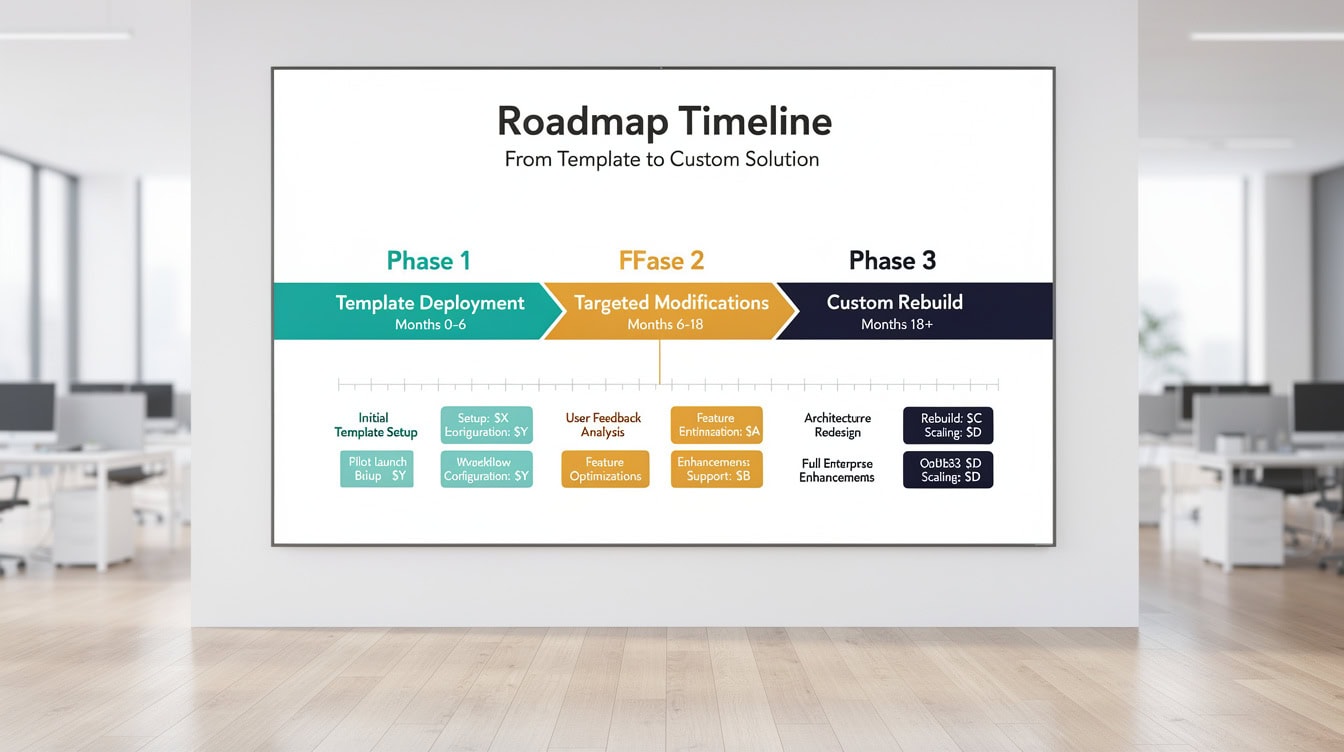
The hybrid roadmap cuts total modeling cost by 30–50% compared to building custom from day one.
Stakeholder Perception: How Your Model Choice Affects Credibility
Institutional investors, M&A advisors, and audit committees don’t just evaluate your numbers. They evaluate your model’s architecture, auditability, and provenance. A poorly adapted template signals that your finance function may not be ready for the scrutiny that comes with a significant transaction.
Specific credibility risks from templates on high-stakes deals:
- Hardcoded assumptions that can’t be traced to a source or changed without breaking formulas
- Inconsistent formatting that suggests multiple hands modified the model without version control
- Missing audit trail for key assumptions, which institutional due diligence teams flag immediately
- Generic line items that don’t match your actual business (e.g., a SaaS company showing “product sales” instead of MRR/ARR)
On deals above $5M, most institutional investors expect a model that was either built by a recognized advisory firm or can be demonstrated to have been purpose-built for the specific transaction. Financial model quality is a standard diligence checkpoint in Series A and later rounds, according to the National Venture Capital Association.
Below $2M, template-based models are broadly accepted provided assumptions are well-documented and the structure is clean.

On deals above $5M, institutional investors evaluate model provenance and audit trail quality as standard diligence checkpoints.
Common Pitfalls and How to Avoid Them
Both paths carry specific failure modes. Knowing them in advance prevents the most expensive mistakes.
Pitfall 1: Underestimating template customization time. Most finance teams assume 4–8 hours to adapt a template. The actual average runs 20–40 hours for a business with more than 2 revenue streams. Fix: scope the customization before purchasing the template by mapping your revenue model to the template’s structure.
Pitfall 2: Over-engineering a custom model. Custom builds sometimes grow to 15+ tabs with 50+ input variables that no one uses after the initial build. Fix: define the 10 decisions the model must support before the build starts, and refuse scope additions that don’t serve those decisions.
Pitfall 3: No maintenance plan. A model built in Q1 with January assumptions is materially wrong by Q3 without updates. Fix: budget 10–15% of build cost annually for assumption refreshes and structural updates, whether template or custom.
Pitfall 4: Single-analyst dependency. If only one person understands the model, you have a key-person risk embedded in your finance function. Fix: require documentation as a deliverable on any custom build, and train at least two team members on template models.
Pitfall 5: Choosing based on price alone. A $500 template that requires $8,000 in modifications is more expensive than a $10,000 custom build. Fix: calculate total cost of ownership using the framework in Section 1 before committing.

The most expensive pitfall: choosing based on sticker price alone without calculating total cost of ownership.
Worked Example: Total Cost of Ownership Comparison
A manufacturing company with $8M revenue, 4 product lines, and a $15M bank refinancing in progress needs a financial model within 6 weeks. Here’s how the two paths compare.
Template path:
- Purchase manufacturing template: $1,200
- Internal analyst time to adapt (35 hours at $80/hour): $2,800
- External consultant to add multi-product COGS allocation (12 hours at $200/hour): $2,400
- Second review cycle after bank feedback (8 hours internal + 4 hours consultant): $1,440
- Total: $7,840 over 5 weeks
Custom path:
- Scoping and requirements: included
- Custom build with multi-product COGS, 5-scenario sensitivity, and bank-ready output: $14,000
- Client review cycles: included
- Annual maintenance agreement: $1,800/year
- Total year-one: $15,800 over 6 weeks
The custom path costs $7,960 more in year one. But the template path consumed 43 internal analyst hours (roughly 5.4 working days) that could have been spent on the refinancing itself. If the analyst’s fully loaded cost is $120/hour, the opportunity cost adds another $5,160, closing the gap to $2,800. For a $15M refinancing, that difference is immaterial.
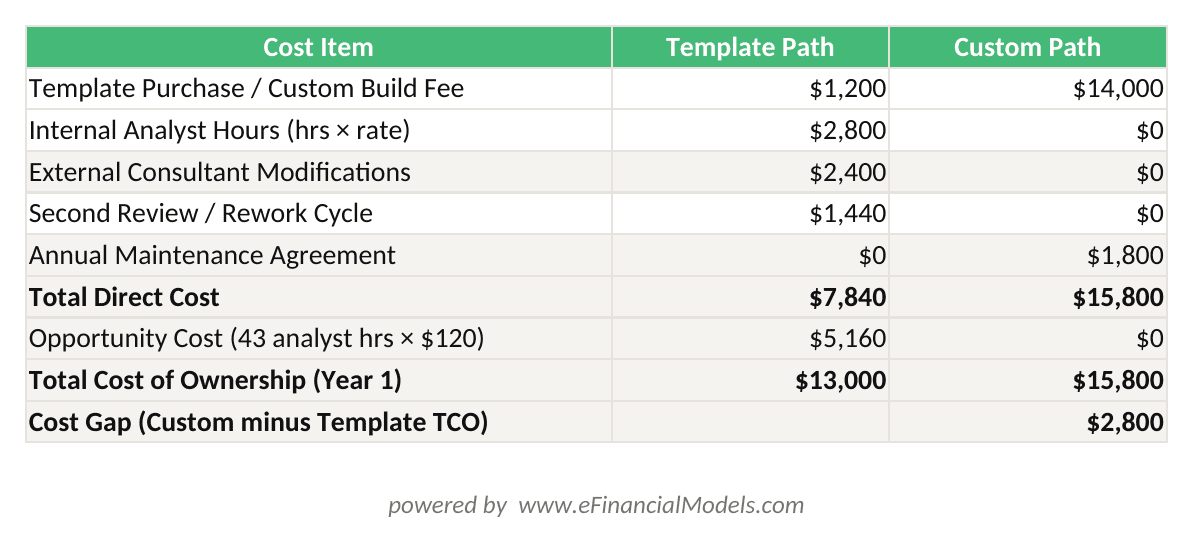
Template path total: $7,840 vs Custom path total: $15,800 — gap closes to $2,800 after opportunity cost adjustment.
For a $15M bank refinancing, the $7,960 cost gap between template and custom paths narrows to $2,800 once opportunity cost is included.
Frequently Asked Questions
How much does a financial model template cost compared to a custom build?
Financial model templates from reputable providers typically range from $50 for basic projection tools to $2,000 for sector-specific models with integrated dashboards and scenario analysis. Custom financial models start at $5,000 for a simple three-statement model (income statement, balance sheet, and cash flow statement linked together) and run to $50,000 or more for complex transaction models involving multi-entity consolidation, waterfall distributions, or ERP integration. The critical number to calculate is total cost of ownership: a $500 template that requires 30 hours of analyst time and $3,500 in consultant modifications costs $6,550 in total, which overlaps significantly with the lower end of custom model pricing.
When does a startup need a custom financial model instead of a template?
Most startups should use a quality template through seed and pre-Series A stages, when the primary goal is demonstrating a coherent business model rather than modeling operational complexity. The upgrade trigger is typically one of three events: raising a Series B or later round where institutional investors conduct detailed model diligence, crossing $5M ARR with multiple customer cohorts requiring custom churn and expansion modeling, or entering M&A discussions where a buyer’s financial team will stress-test every assumption. Before those triggers, the $10,000–$20,000 saved on a custom build is better deployed on product or sales.
Can I use a template for a real estate development deal?
For simple single-asset acquisitions under $2M, a well-structured real estate template handles the core analysis: purchase price, financing assumptions, NOI projection, and basic IRR calculation. For development deals, ground-up construction, or any project with preferred equity, mezzanine debt, or complex waterfall distributions, templates almost always require modifications so extensive that you’re effectively building a custom model anyway. A $20M development deal with a 3-tranche capital stack and a 2-year construction period needs custom draw schedule logic, interest reserve modeling, and waterfall calculations that no off-the-shelf template handles cleanly. The cost of a modeling error on a deal that size, measured in misstated investor IRR, far exceeds the cost of a custom build.
How long does it take to implement a financial model template versus build a custom model?
Template implementation runs 4–40 hours depending on how closely the template matches your business model. A SaaS company using a SaaS-specific template with standard MRR, churn, and CAC inputs might be operational in 4–8 hours. A manufacturing company adapting a generic template to accommodate 4 product lines and multi-plant allocation might spend 30–40 hours. Custom model builds follow a structured process: 3–5 days for requirements scoping, 1–2 weeks for architecture design, 2–6 weeks for build and testing, and 1–2 weeks for client review cycles. Total elapsed time runs 4–12 weeks. If your fundraising deadline is 3 weeks out, a template is your only viable option regardless of complexity preferences.
What do institutional investors think about template-based financial models?
Institutional investors, particularly private equity firms and growth equity funds, evaluate model architecture as part of standard due diligence. They look for clean audit trails, traceable assumptions, consistent formatting, and logic that matches the specific business model. A template that has been adapted by multiple analysts without version control often fails these checks, not because it’s a template, but because the adaptation process introduced errors and inconsistencies. On deals above $5M, most institutional investors expect either a purpose-built model or one that has been reviewed and validated by a recognized advisory firm. Below $2M, clean template-based models are broadly accepted. Financial model quality is a standard Series A diligence checkpoint, according to the National Venture Capital Association.
What is the hybrid approach to financial modeling and when does it make sense?
The hybrid approach starts with a template for speed and cost efficiency, then migrates to a custom build at a defined business inflection point. It makes sense for companies that need a model within days (for an immediate fundraise or board meeting) but know they’ll need more sophisticated architecture within 12–18 months. A typical hybrid roadmap deploys a $500–$2,000 sector template in month one, commissions $3,000–$6,000 in targeted modifications by month 12, and funds a full $10,000–$20,000 custom rebuild when the business crosses $10M revenue or enters a significant transaction. This phased approach cuts total modeling cost by 30–50% compared to building custom from day one, while giving the finance team time to build the internal expertise needed to maintain a more complex model.
How do I know when my template has hit its architectural limits?
Templates hit their architectural limits when you start working around the model rather than with it. Specific warning signs include: adding more than 5 scenario tabs because the built-in scenario structure can’t handle your cases; copying and pasting formulas across columns to handle a new revenue stream the template didn’t anticipate; maintaining a separate spreadsheet to reconcile numbers the template can’t consolidate; and spending more than 2 hours per month fixing broken formula references. Multi-currency consolidation, complex equity waterfall calculations, and ERP data integration are the three most common capabilities that push companies past template limits. When you hit 3 or more of these warning signs simultaneously, the cost of continuing to patch the template typically exceeds the cost of a custom rebuild within 6 months.
Conclusion
The template-versus-custom decision reduces to one core question: does your business model’s complexity, your stakeholder’s sophistication, and your transaction’s size justify the additional investment in bespoke architecture? For most companies under $5M revenue with straightforward business models and early-stage investors, a quality template delivers 90% of the value at 10% of the cost. For companies above $10M, running complex transactions, or facing institutional investor scrutiny, custom models pay for themselves in credibility, accuracy, and time saved on rework.
I recommend starting with financial model templates to assess whether a template meets your needs, and if your scoring on the 8-factor decision matrix points toward custom, contacting a custom financial modeling services team for a 15-minute needs assessment that will tell you exactly what architecture your situation requires.