0 ITEMS

Best Financial Model Templates by Use Case for SME Owners

The best financial model template is the one built for the decision at hand: a startup template for cash runway, a subscription template for recurring revenue, a buyout template for acquisitions, and a valuation template for pricing a business. eFinancialModels, the Excel financial model marketplace at efinancialmodels.com, lists templates for all four, and a growth-stage owner can choose between them by naming the question the model must answer.
Key Takeaways
- Startup templates show how many months of cash remain, so they come first before a raise or hiring plan.
- Subscription templates track recurring revenue, retention and customer payback, and suit only businesses that bill repeatedly.
- Buyout templates test whether an acquisition can be financed with mostly borrowed money and still meet a target return.
- Valuation templates estimate what a business is worth today and show how much value sits beyond the forecast period.
- A template that shows its version and last update is safer than a static file, because discount rates change.
The Best Financial Model Templates Cover Four Decisions
Four template families cover most growth-stage choices: startup budgets, software-as-a-service (SaaS) forecasts, leveraged buyout (LBO) models and discounted cash flow (DCF) valuations. A small and medium-sized enterprise (SME) owner who names the decision first can pick the template second, and the table below maps each decision to its template.
| Use case | Question answered | Main output | Best fit |
|---|---|---|---|
| Startup | How long does the cash last? | Runway in months | Companies that spend more than they earn and plan a raise |
| SaaS | Does recurring revenue compound? | Retention and payback | Subscription and software businesses |
| LBO | What can a buyer pay and still earn a return? | Sources and uses, returns | Acquirers, search funds and sponsors |
| DCF | What is the business worth? | Enterprise value | Sales, fundraising and strategy reviews |
Startup Templates Answer How Long the Cash Lasts
A startup template first answers how many months of cash remain at the current spending rate. The U.S. Small Business Administration advises a business plan to include a five-year financial outlook, with the first year projected quarterly or even monthly, which is the structure a good startup template provides by default.
Runway and Burn: A Worked Example
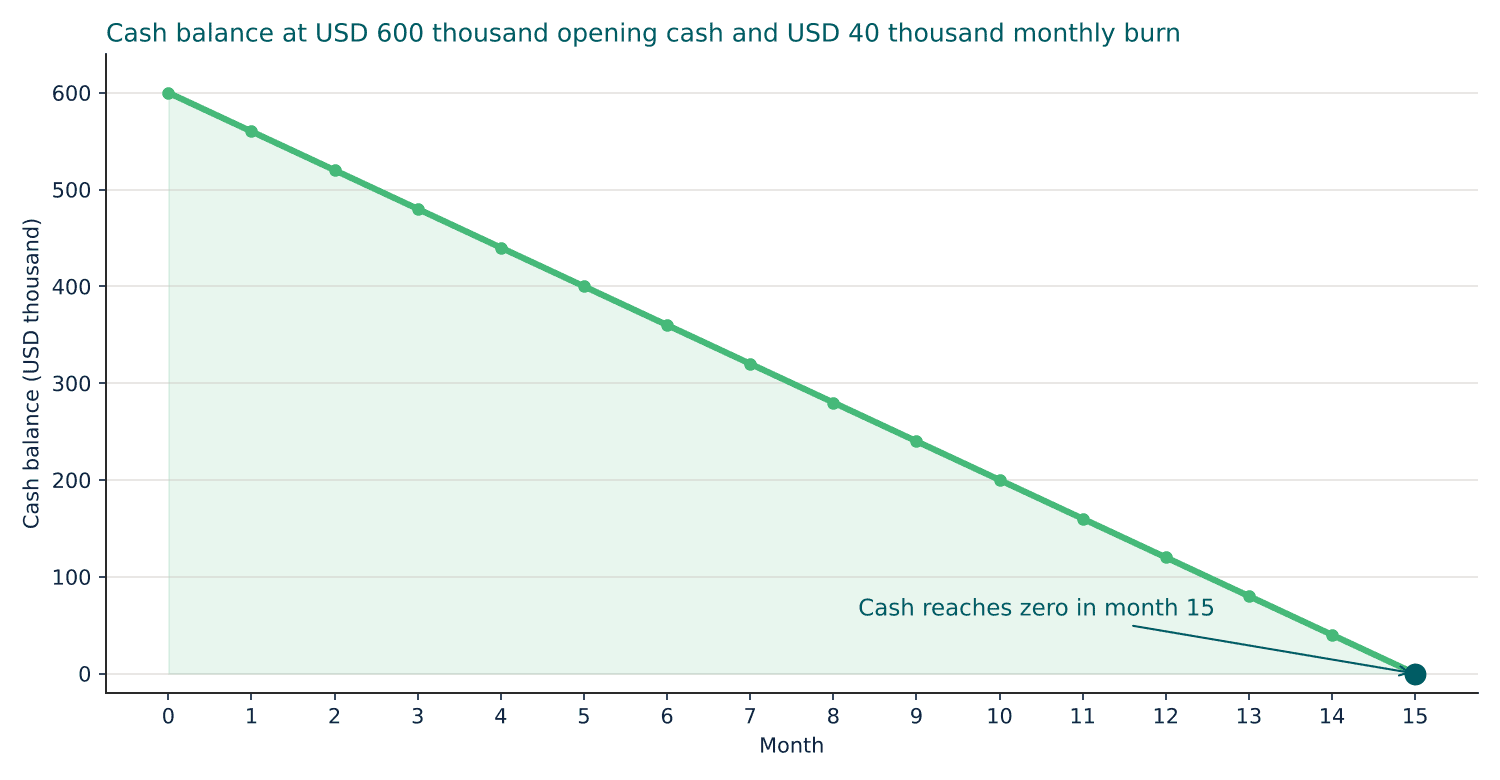
Burn is the net cash a company spends each month, and runway is the cash balance divided by that monthly burn. Assume a company holds USD 600,000 in cash and burns USD 40,000 a month. The runway is 600,000 divided by 40,000, which gives 15 months.
What a Startup Template Must Include
A usable startup template links the income statement, cash flow statement and balance sheet, with a hiring plan feeding payroll. A template without a cash flow statement is a budget and not a forecast.
The U.S. Bureau of Labor Statistics reported in 2024 that 34.7 percent of private-sector business establishments born in March 2013 were still operating in March 2023.
Recommended template
Free Three Statement Financial ModelWhy it fits: It links a five-year income statement, balance sheet and cash flow with scenario tests on growth and margins, the cash flow view a plain budget lacks.
View template →SaaS Templates Answer Whether Recurring Revenue Compounds
A SaaS template tracks annual recurring revenue (ARR), retention and acquisition cost, because subscription businesses grow or stall on those three numbers.
Retention and Payback Metrics
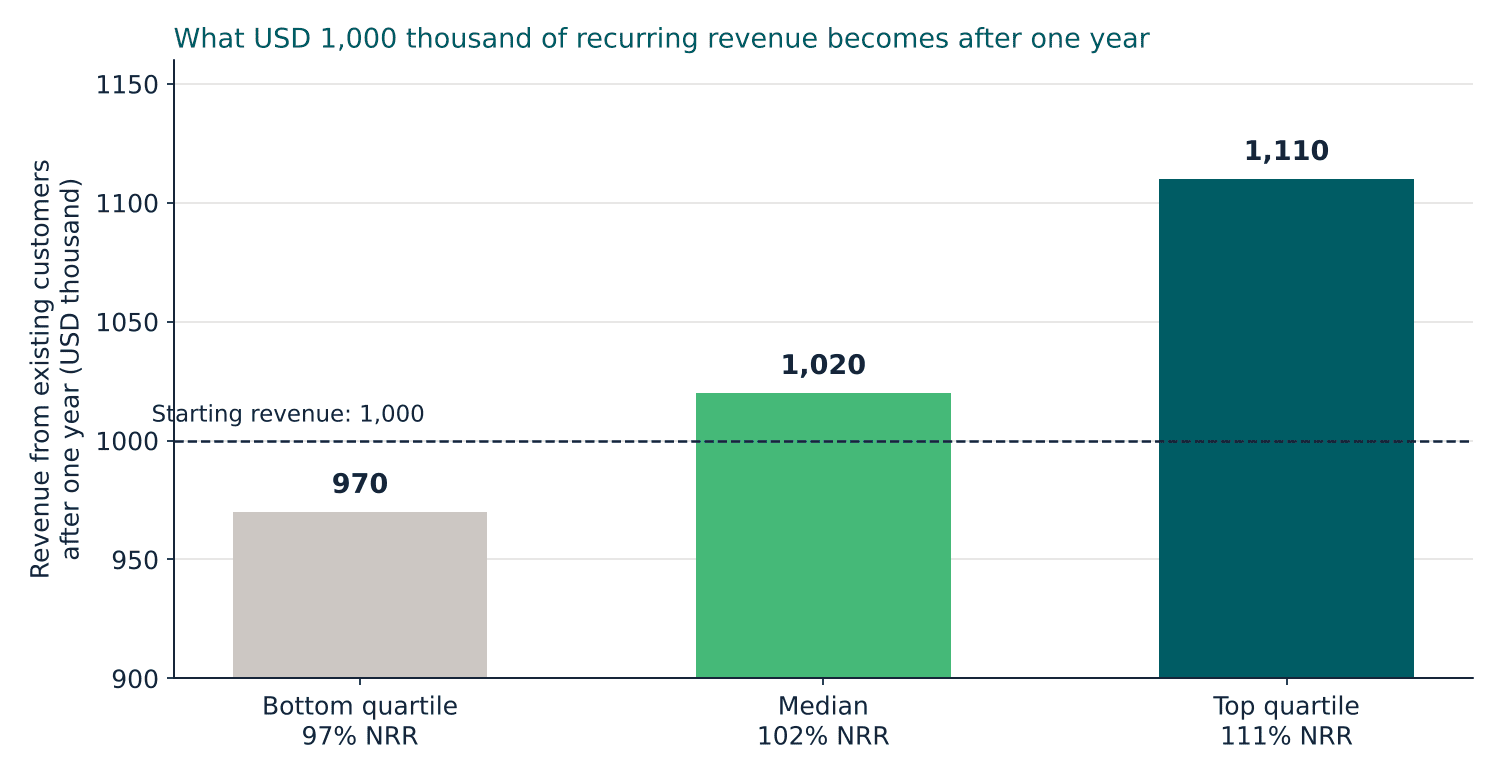
Net revenue retention (NRR) measures the revenue kept from existing customers after a year, including upsells. SaaS Capital’s September 2025 research found a median NRR of 102 percent for private business-to-business companies with an annual contract value of USD 25,000 to USD 50,000, with a top quartile of 111 percent and a bottom quartile of 97 percent.
Assume a business starts a year with USD 1,000 thousand of recurring revenue from existing customers. A 97 percent NRR leaves USD 970 thousand a year later, the 102 percent median leaves USD 1,020 thousand, and 111 percent leaves USD 1,110 thousand.
Andreessen Horowitz defines customer acquisition cost (CAC) as the full cost of acquiring a user, and lifetime value (LTV) as the present value of a customer’s future net profit.
When a SaaS Template Is the Wrong Choice
A SaaS template assumes revenue that repeats without a new sale each period. A consultancy or a retailer with one-off orders gains little from cohort and churn sheets, so a startup or budget template fits better.
Recommended template
SaaS Business Financial ModelWhy it fits: It forecasts sign-ups, four pricing tiers, recurring revenue, churn, customer acquisition cost and lifetime value, the retention and payback metrics discussed above.
View template →LBO Templates Answer What a Buyer Can Afford to Pay
An LBO template tests whether an acquisition can be funded mostly with borrowed money and still deliver the return an investor requires. EQT (a global private equity firm) describes the debt in such deals as typically ranging from 60 to 80 percent of the total transaction price.
Sources and Uses
A sources and uses table lists where the money comes from, such as senior debt, seller notes and equity, and where it goes, such as the purchase price and fees.
Returns: IRR and MOIC
The internal rate of return (IRR) is the annual compound rate of return earned on an investment over its holding period. The multiple on invested capital (MOIC) is the total cash returned divided by the cash invested. An LBO template calculates both from a debt schedule, so a buyer sees how a lower purchase price or faster debt repayment lifts returns.
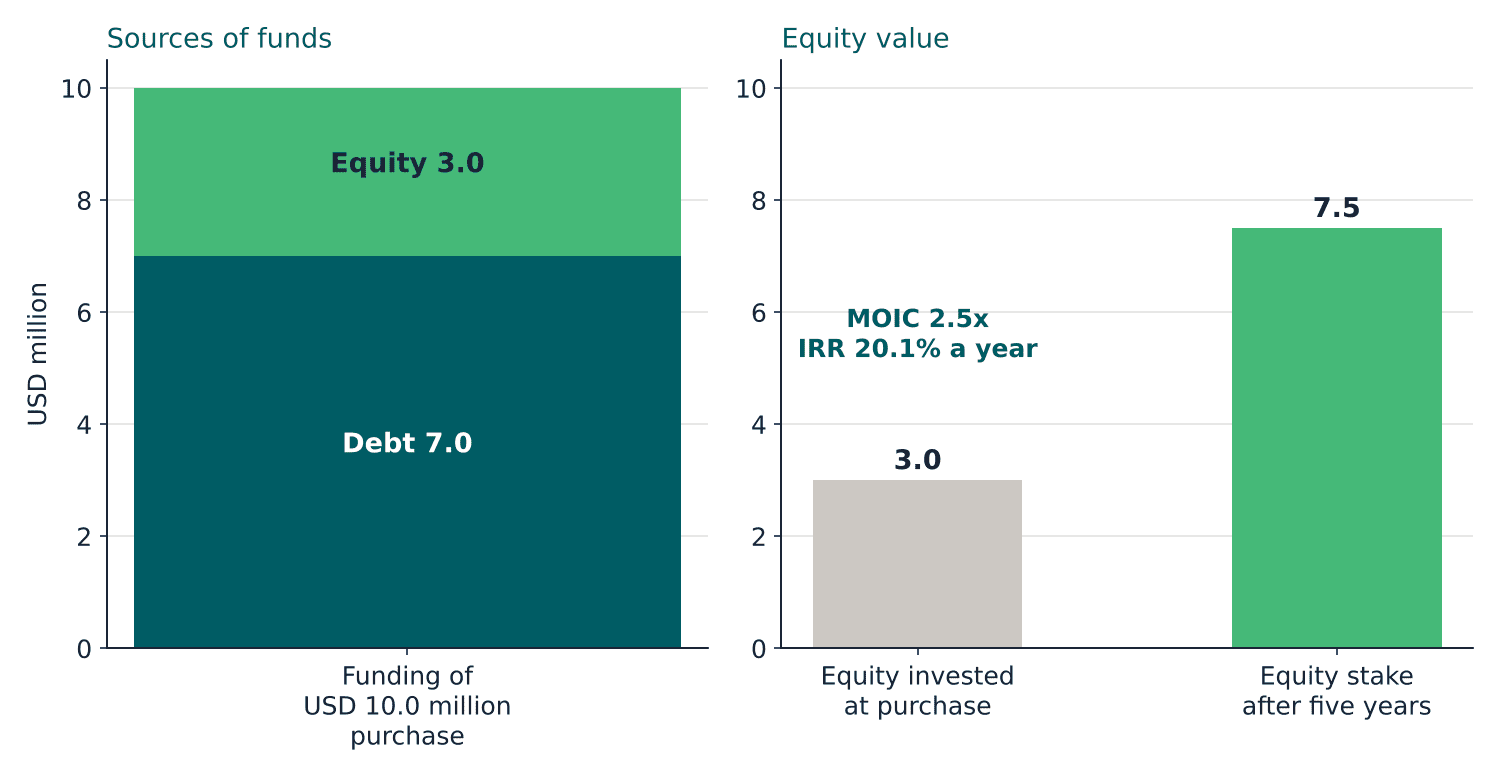
Assume a buyer pays USD 10.0 million, funded by USD 7.0 million of debt and USD 3.0 million of equity, and sells the business five years later so that the equity stake is worth USD 7.5 million. The MOIC is 7.5 divided by 3.0, or 2.5x, and the IRR is 20.1 percent a year.
Recommended template
Private Equity – Leveraged Buyout ModelWhy it fits: It includes a sources and uses table, a debt financing schedule and investor IRR and cash-on-cash multiple outputs, matching the buyout example above.
View template →DCF Templates Answer What a Business Is Worth
A DCF template values a business as the present value of its expected future cash flows. Aswath Damodaran of New York University’s Stern School states that in this method the value of an asset is the present value of the expected cash flows on the asset.
How a DCF Template Works
Free cash flow is the cash a business generates after operating costs and investment, available to lenders and owners. The discount rate converts future cash into today’s value and is usually the weighted average cost of capital (WACC), which blends lender and owner required returns by their share of financing. Terminal value is the value of all cash flows after the explicit forecast, and Damodaran’s lecture notes describe a stable growth model in which cash flows grow at a fixed rate forever.
Worked Example: Five-Year Forecast at a 12 Percent Discount Rate
Assume free cash flows of USD 100, 120, 140, 160 and 180 thousand over five years, a discount rate of 12 percent and a terminal growth rate of 3 percent. The five discounted cash flows total USD 488.4 thousand. The terminal value equals 180 multiplied by 1.03 and divided by 0.09, or USD 2,060.0 thousand, which discounts to USD 1,168.9 thousand today. The enterprise value, meaning the value of the operating business before net debt, is therefore USD 1,657.3 thousand.
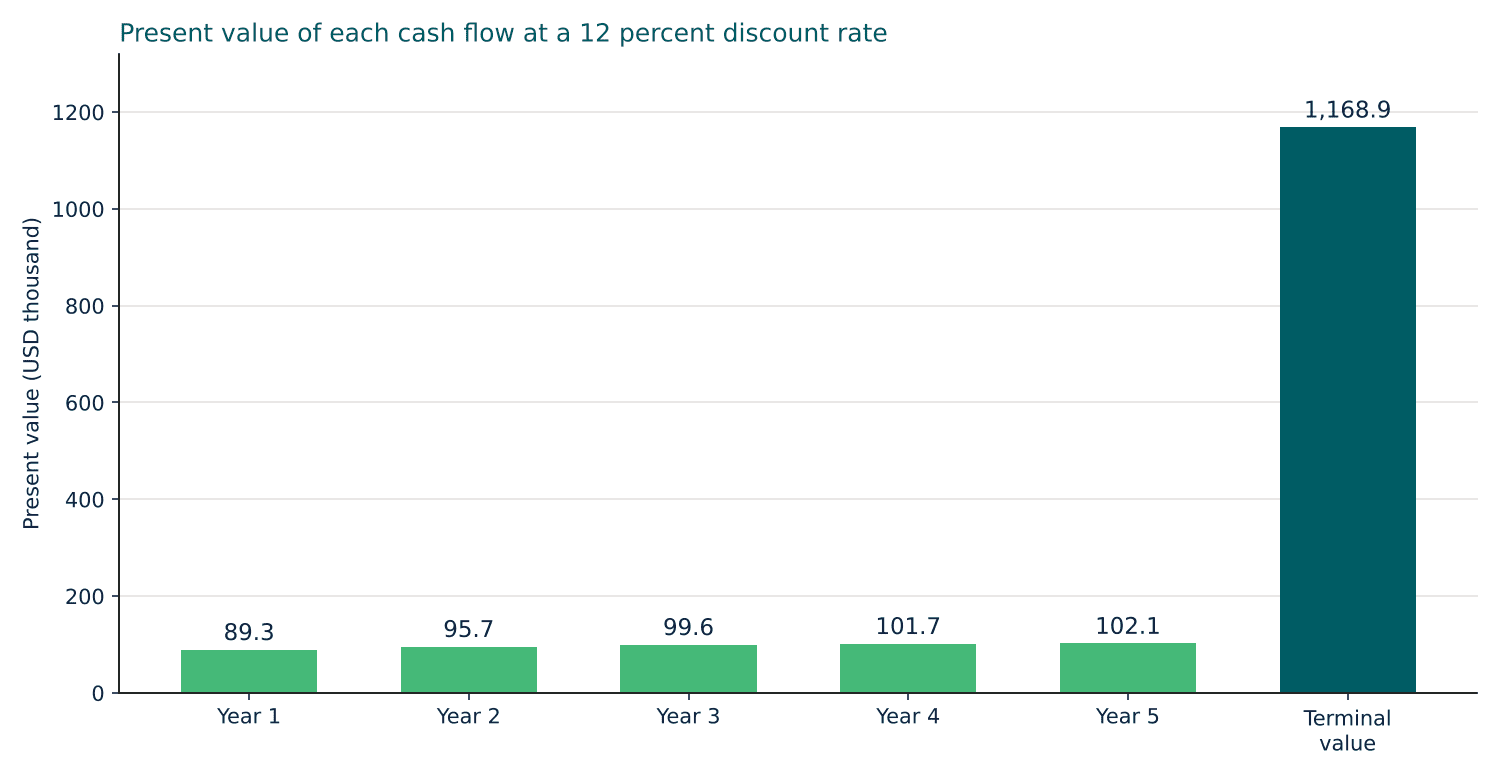
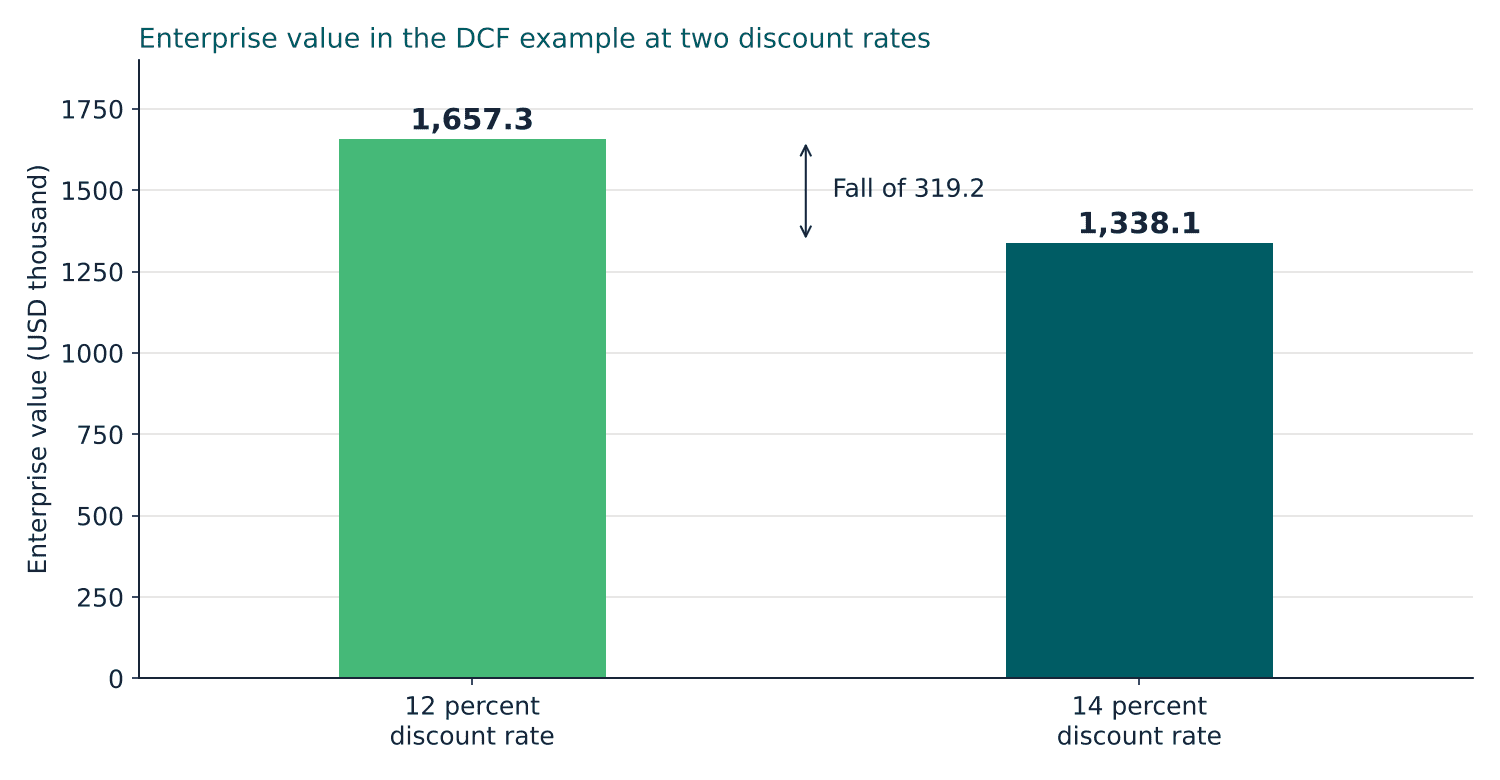
The terminal value supplies 70.5 percent of this result, so a sensitivity analysis, which varies one assumption at a time, is essential. Raising the discount rate to 14 percent cuts the enterprise value to USD 1,338.1 thousand, a fall of USD 319.2 thousand.
Recommended template
Advanced Discounted Cash Flow (DCF) Valuation Model TemplateWhy it fits: It pairs a weighted average cost of capital calculator with ten terminal value methods and sensitivity analysis on revenue growth, discount rate and terminal value inputs.
View template →Update Frequency Separates Living Templates from Static Files
A template stays reliable only while its inputs are current, so version history and update dates are selection criteria. eFinancialModels lists templates from independent modeling authors, shows a version number on each product page, and lets buyers sort category pages by last updated and publication date. Cyrill Haenni founded eFinancialModels.
Discount rates show why. The equity risk premium is the extra return investors demand for holding stocks instead of the risk-free rate, the return on a government bond assumed free of default. Damodaran’s January 2026 data update estimated the implied equity risk premium in the United States at 4.23 percent as of January 2026, so templates built on older figures carry older answers. Buyers should therefore confirm a stated version, a recent update date, visible formulas and check cells that flag errors.
Frequently Asked Questions
What are the best financial model templates?
No single template wins in every case. The strongest choice matches the decision: a startup template for runway planning, a SaaS template for subscription metrics, an LBO template when borrowing funds an acquisition, and a DCF template when the goal is a valuation. Templates with visible formulas, check cells and a recent update date beat polished files that hide their logic.
Which financial model template should a small business start with?
A small business should start with the template that answers its most urgent cash question. Most owners begin with a three-statement budget linking income, cash flow and the balance sheet, because every later model reuses those numbers. A valuation or acquisition model can follow once that foundation runs reliably, for example ahead of a sale, a loan application or an investor meeting.
How often should a financial model template be updated?
Inputs that move with markets, such as discount rates, tax rates and benchmarks, deserve a review at least once a year and before any major decision. A model’s structure changes more slowly, but an author who publishes new versions signals that errors get fixed. A template with no version history offers no evidence that anyone maintains it, which is a risk for the buyer.
Is a free financial model template good enough?
A free template can be enough for learning, a first draft or testing a layout. Paid templates usually add deeper scenarios and support. The deciding test is transparency: if the formulas are visible and the checks pass, the price matters less. A lender or investor will ask where every number comes from, and a template that cannot answer that question fails regardless of cost.
Conclusion: Match the Template to the Decision
The best financial model templates are the ones that fit the decision, stay current and show their formulas. Growth-stage owners ready to put a value on their company can open the DCF Model collection at efinancialmodels.com, where each listing shows its version and update status, and then move to the Startup Financial Models collection if runway is the more urgent question.