0 ITEMS

How to Hire a Financial Modeling Consultant: Step-by-Step

Yes, a founder can hire someone to build a financial model, and the safest way is to define the decision first, vet the modeling standard, run a paid pilot and take ownership of the file at handover. This guide gives six steps, a comparison of Upwork with eFinancialModels custom modeling services, and an illustrative cost example.
Key Takeaways
- Hire a modeler when investors, lenders or a large spending decision will rely on the numbers; a simple spreadsheet is enough for early exploration.
- Define the decision, the outputs and the scenarios before contacting anyone, because a clear brief reduces rework and quote revisions.
- Vet the model, not the profile: check for separated inputs, live formulas, check cells and documentation in a sample file.
- A short paid pilot task shows a modeler’s real standard before the full engagement and the full budget are committed.
- Put scope, milestones, revisions, file ownership and a handover session in writing, then test the finished model with extreme inputs.
A founder can hire a modeler in six steps
Six gates take a founder from a clear brief to a model the founder owns.
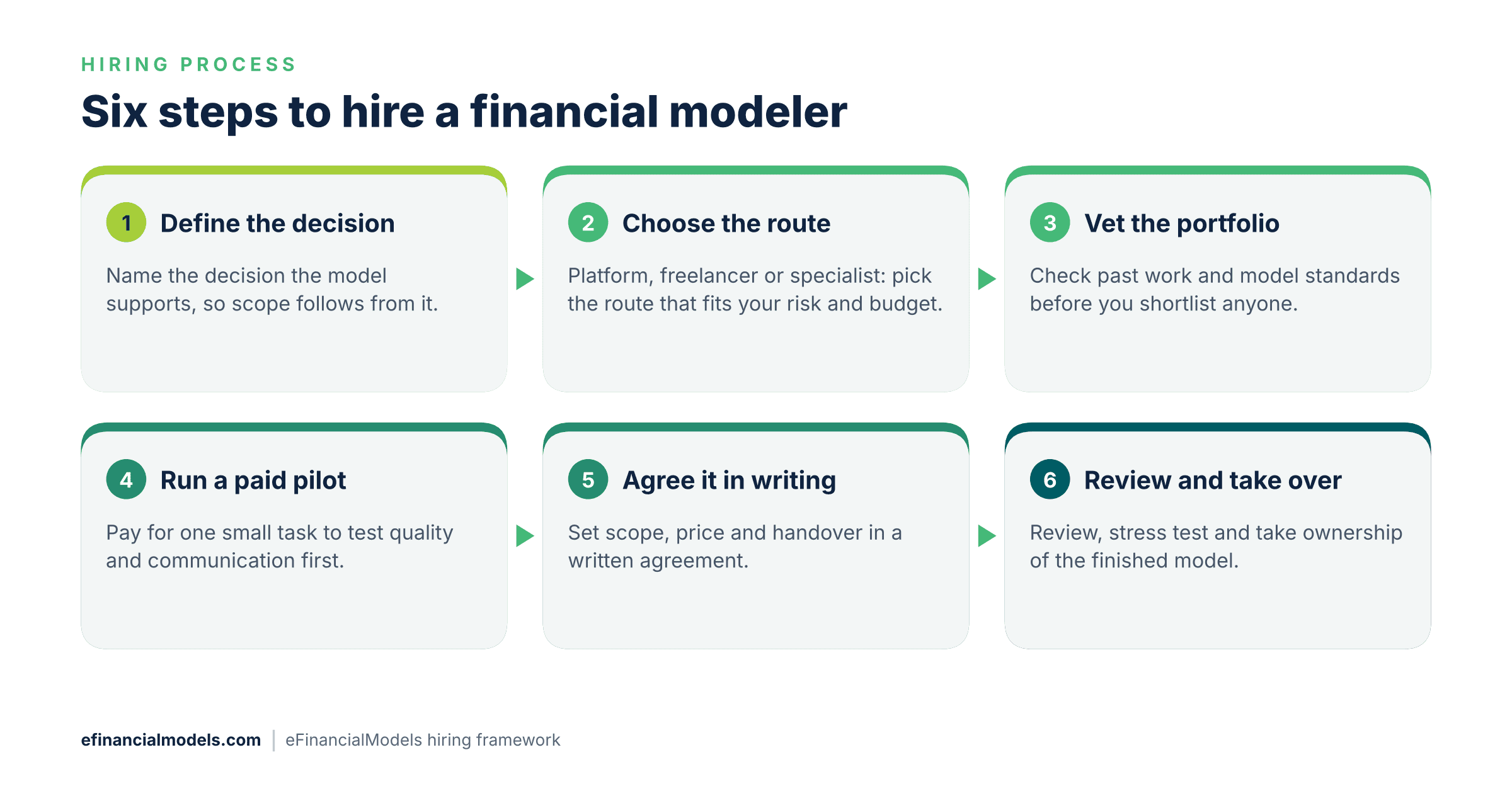
The six steps of the hiring framework, from defining the decision to taking ownership of the model.
- Define the decision the model supports.
- Choose the route: platform freelancer, marketplace service or specialist consultant.
- Vet the portfolio and the modeling standard.
- Run a paid pilot task.
- Agree scope, price and handover in writing.
- Review, stress test and take ownership.
Hire a modeler when others will rely on the numbers
Hiring makes sense when investors, lenders or a board will rely on the model, when the business has several revenue streams, debt or equity rounds, or when the founder’s time is better spent selling. A single spreadsheet with key assumptions, burn (monthly cash spent), runway (months of cash left) and a few scenarios can be enough for an early-stage company, as long as the logic is clear and evolves according to an Andreessen Horowitz (a16z) speedrun investing partner. Building it alone, known as do-it-yourself (DIY), is the right call at that stage.
Errors are a risk whoever builds the model. Research reviewing field audits of operational spreadsheets from 1995 to 2001 found errors in 94% of the spreadsheets studied, so an independent review has real value for hired and home-built models alike. In the Federal Reserve’s 2025 Small Business Credit Survey, 56% of small employer firms cited paying operating expenses and 51% cited uneven cash flows as challenges, and a model that tests cash timing helps with both. A modeler builds projections; tax, audit and valuation opinions belong to an accountant or adviser.
Step 1: Define the decision the model must support
A model answers a question, so the brief should start with that question. Write one page that states the decision (for example, how much to raise and when), the time horizon, the revenue drivers, the outputs wanted and the scenarios to compare. A three-statement model links the income statement, balance sheet and cash flow statement so that one change flows through all three. Founders can see typical structures first in the eFinancialModels startup financial models collection.
Step 2: Choose a platform freelancer, a marketplace service or a specialist consultant
The route sets how much vetting falls on the founder. On Upwork, a general freelance platform, the founder posts a job and screens applicants. Hourly rates vary with experience and scope, so the founder should compare quotes for the same brief. Platform fees apply on top of the rate, so the founder should ask whether a quoted rate includes them.
On eFinancialModels, the custom financial modeling services collection lists scoped packages from individual modelers. In November 2026 the 21 listings had starting prices from $44 to $195 before tax, and the page tells buyers to contact the modeler about availability and to supply their requirements and files when ordering. These are entry-package prices, so the founder should confirm what each package includes and request a quote for a full model.
A specialist consultant, the third route, is usually a boutique firm or an experienced independent who scopes the work first and quotes a fixed price. Referrals and sample work replace platform ratings, so the vetting in Step 3 matters most here.
| Question | Upwork freelancer | eFinancialModels custom modeling service |
|---|---|---|
| How the founder finds a modeler | Posts a job or browses profiles across all skills | Browses listings that are all modeling offers |
| Vetting the platform provides | Performance badges; interview-based prescreening for Expert-Vetted only | Listing details; the founder still checks samples |
Neither route removes the need for Steps 3 to 6. Upwork’s Top Rated badge is a performance label rather than a skills test, and only Expert-Vetted freelancers are prescreened through interviews and skill assessments.
Step 3: Vet the portfolio and the modeling standard
Ask every candidate for a sample model, anonymised if needed, and open it. A good file separates inputs, calculations and outputs, so a reviewer can see what was assumed, how it was processed and what came out. Check for live formulas rather than typed-in numbers, a balance check cell and a documentation sheet. Audits reported in 1995 and 1998 found cell error rates of 1.2%, 2.2% and 2.5% in operational spreadsheets, so a modeler who describes a testing routine is worth more than one who promises perfection.
Step 4: Run a paid pilot task
Pay the two or three best candidates for a small task, such as a revenue build for one product line. A pilot of a few hours costs little compared with a failed engagement.
Step 5: Agree scope, price and handover in writing
The agreement should list deliverables (an Excel file with live formulas, a documentation sheet, a walkthrough call), milestones, the number of revision rounds, a support window after delivery, and who owns the intellectual property (IP) in the finished model. A non-disclosure agreement (NDA) protects the company’s plans. On Upwork fixed-price contracts, milestone funds sit in a secure account and are released automatically if the client does not respond, so the founder should review each milestone promptly.
Step 6: Review, stress test and take ownership
Before the last payment, test the model rather than admire it. Enter extreme inputs (zero sales, double the costs), confirm that the balance check stays at zero, trace one headline number back to its inputs, and compare outputs with a quick manual calculation. Then book a walkthrough so the founder can change assumptions alone.
Worked example: what each route costs a founder
This illustrative scenario assumes the same deliverable, a full startup three-statement model, which is needed later than the simple spreadsheet described earlier, and values founder time at USD 80 per hour. It excludes platform fees, sales tax and the paid pilot. The eFinancialModels marketplace route is not costed because its listings publish only entry-package starting prices.
Total cost for each route = modeler fee + (founder hours × USD 80).
| Route | Modeler fee | Founder hours | Founder time | Total cost |
|---|---|---|---|---|
| DIY by the founder | USD 0 | 70 | USD 5,600 | USD 5,600 |
| Platform freelancer | USD 1,500 (30 hours × USD 50) | 10 | USD 800 | USD 2,300 |
| Specialist consultant | USD 4,000 (fixed) | 6 | USD 480 | USD 4,480 |
A paid pilot of 4 hours at USD 50 per hour costs USD 200 per candidate, so piloting two candidates adds USD 400 and piloting three adds USD 600 to a hired route.
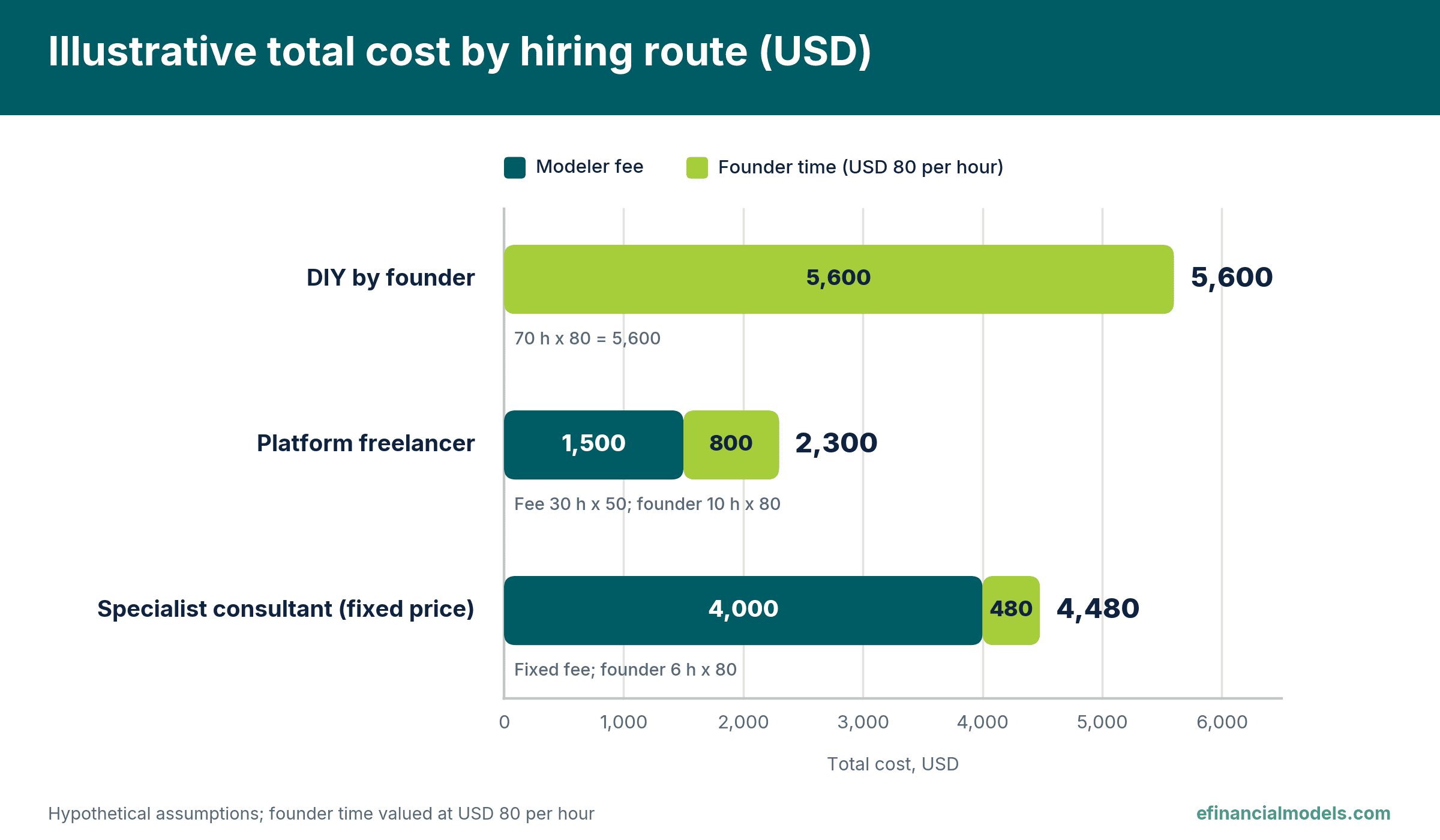
Illustrative total cost by hiring route, split into modeler fee and founder time, using the hypothetical assumptions above.
The cheapest line is not automatically the best, because the example ignores rework. All assumptions are hypothetical and should be replaced with the founder’s own rates and hours.
What clients say about eFinancialModels
The quotes below come from published reviews of models and support, not from a verified custom build.
“It’s exceptionally well-structured, easy to populate, and built with precision. The clarity it brought to forecasting and investor communications was invaluable.”
Faiza Syed, founder, 8 August 2025, eFinancialModels reviews page
“The personal service and knowledge on how to solve a complex problem easy.”
Andrew Parker, 27 June 2023, Trustpilot
Trustpilot also hosts public reviews of eFinancialModels, including critical ones about paid support, so buyers should read both.
Frequently Asked Questions
Can a founder hire someone to build a financial model without a finance background?
Yes. A good modeler asks business questions, not accounting questions, so the founder needs to explain the product, the customers, the pricing and the plan for hiring and spending. The modeler should then explain every output in plain language during the handover call, and the founder should keep asking until each headline number traces back to an input that makes sense.
How long does a custom model take to build?
Scope sets the duration more than the modeler does. A model with one revenue line and monthly statements can take days, while multiple products, debt schedules and equity rounds stretch the work to weeks. Agree dated milestones, ask for an early draft, and treat a modeler who asks no questions as a warning sign. Slow founder feedback is also a common cause of delay.
Should the model be built in Excel or Google Sheets?
Choose the tool that the people who will use the model already know, and confirm it before the contract. Excel files travel easily between modeler, accountant and investors, while Google Sheets suits teams that edit together in real time. Whatever the tool, insist on live formulas, protected formula cells, a clear input sheet and a version history, so the file survives staff changes.
What should happen if the delivered model contains an error?
Treat errors as a normal part of review. The contract should state how many correction rounds are included and how long the support window lasts. Send each issue with the cell reference and the expected result. If the problem is structural, such as a balance sheet that does not balance, withhold the final milestone until the modeler has resolved it and explained the cause.
Is a template better than hiring a consultant?
A template is the better first step when the business is simple, the budget is tight or the founder wants to learn how models work. Hiring wins when the structure is unusual, the audience is demanding or time is short. Many founders combine the two: they start from a template, then pay a modeler to adapt it and train the team.
Conclusion
A founder who defines the decision, vets a sample model, runs a paid pilot and signs a clear handover agreement can hire a financial modeler with confidence. Founders ready to commission a model can request one through the eFinancialModels Expert Financial Modeling Services listing, which offers a two-hour review of an existing model with a discussion call, a half-day or full-day template adjustment, and custom development scoped from the client’s specification. Applying the six steps above before ordering keeps the scope, price and handover clear.