0 ITEMS

5 Vetting Criteria for Excel Modeling Consultants (Scorecard)

A first-time founder can vet an Excel modeling consultant by scoring five criteria: Excel proficiency, industry experience, model type specialization, model integrity and documentation, and engagement terms. A weighted scorecard turns those answers into one comparable number per candidate, which a typical marketplace profile does not provide.
Key Takeaways
- Score every candidate on the same five criteria before choosing a shortlist, so price and personality do not decide it.
- Prove Excel proficiency with a timed build, because a short skills exam tests features, not a full integrated model.
- Match industry and model type: a fundraising forecast, a budget and a valuation need different structures and different experience.
- Ask which modeling standard the consultant follows and what handover pack comes with the file, since a 2024 review found most business spreadsheets contain errors.
- Use the weighted scorecard below to compare two or three candidates on identical evidence, then decide on the gaps that matter most.
Why does vetting matter more than the day rate?
Vetting matters because a major risk in any spreadsheet model, hired or not, is an undetected error rather than a high price. A 2024 literature review led by Prof. Pak-Lok Poon, reported by Phys.org, found that 94% of spreadsheets used in business decision-making contain errors. A founder who picks the cheapest quote may buy a file nobody has tested.
The five criteria below check that errors get caught, in a first call, a sample request and a reference check.
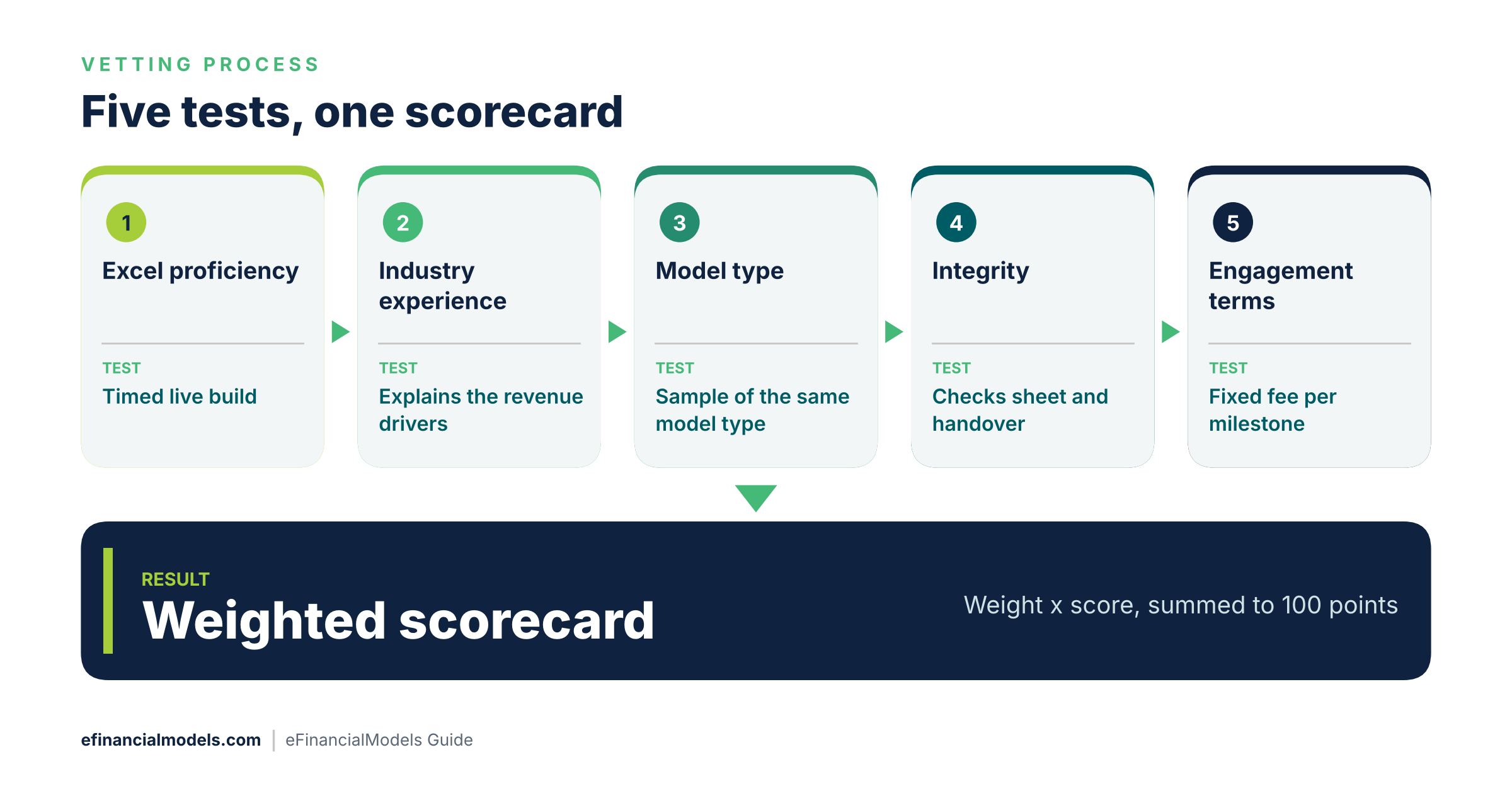
The five vetting criteria in order, with the single test a founder applies to each, summarised from the sections below.
Criterion 1: Can the consultant prove Excel proficiency?
Yes, if the consultant builds something live or shares an unlocked sample, because a skills tag on a profile proves nothing. Public credentials show how different the tests can be. Microsoft’s Excel Associate certification exam allows 50 minutes to complete an assessment of skills such as managing worksheets, formulas and charts. The Financial Modeling Institute (FMI) Advanced Financial Modeler (AFM) credential is more demanding. The UK society of Chartered Financial Analyst (CFA) charterholders, CFA UK, reported on 24 June 2024 that the AFM requires candidates to design and build a three-statement financial model of a company in an online exam, meaning an income statement, balance sheet and cash flow statement that feed each other.
Ask each candidate for three things:
- A 60 to 90 minute screen-share build of a small revenue forecast, with no hardcoded numbers inside formulas.
- A scenario switch that changes the whole model from one input cell.
- A sensitivity analysis, which shows how the outputs move when one input changes, with the reason for each range.
Criterion 2: Does the consultant know your industry’s economics?
Industry experience means the consultant understands what drives revenue and cash in a business like the founder’s, not that the consultant has worked at a famous company. A subscription business turns on churn and renewals, a retailer on stock levels and margins, a services firm on utilization and milestones. A cross-industry founder should ask the candidate to explain, in plain words, how the revenue line of the founder’s own business should be built.
Ask for two past models in a similar business, with client details removed. A consultant who cannot name the main drivers behind the revenue line has probably not built this type of model.
Criterion 3: Does the consultant specialize in your model type?
Model type specialization means the consultant has built the specific kind of model the founder needs, because a fundraising forecast, an operating budget and a valuation serve different readers. The table matches each need to the evidence a founder should request.
| Founder need | Model type | Evidence to request |
|---|---|---|
| Raise seed or Series A capital | Startup forecast with scenarios | Sample with hiring plan, cash runway (months of cash left) and cap table (ownership by shareholder) |
| Control spending month to month | Budget and variance model | Sample with actuals import and variance report |
| Price a deal or an offer | Valuation model | Sample with stated assumptions and a reconciliation to inputs |
| Show lenders repayment ability | Loan and cash flow model | Sample with debt schedule and covenant checks (tests of the loan conditions) |
Founders who want to see what these structures look like can browse the startup financial model collection and use it as a reference when briefing a candidate.
Criterion 4: Does the consultant build for integrity and documentation?
Integrity means the file can be reviewed, tested and handed over, with documentation, without the builder in the room. The Institute of Chartered Accountants in England and Wales (ICAEW) publishes a Financial Modelling Code whose 08/24 edition includes error-reduction guidance to review and test models. A candidate does not have to follow that code, but must name a standard and show how it is applied.
Require five items in the written scope:
- A checks sheet in which every balance and total reconciles, with one master check cell.
- An assumptions log naming the source and date of every input.
- A version record, so changes after delivery can be traced.
- A recorded handover session in which the founder changes an input and reads the result.
- An unlocked source file with no hidden sheets or passwords, so any other modeler can open and change it.
Criterion 5: Are the engagement terms and references clear?
Clear terms mean a fixed scope, named deliverables, staged payments and references from clients who resembled the founder. The U.S. Bureau of Labor Statistics (BLS) notes that self-employed management analysts are typically paid by the hour or the project. Hourly billing leaves the cost open-ended, so fixed fees per milestone are safer. For context, the BLS reported a median annual wage of $102,740 for US financial and investment analysts in May 2025. That is an employee wage, not a freelance rate, so it shows only the scale of pay in the profession and should not be read as a price benchmark.
Call two references and ask what went wrong, not only what went well.
Where should a founder look, and what do generalist platforms miss?
A founder can source candidates from four places: referrals from investors, accountants or other founders; the member directories of professional bodies; generalist freelance platforms; and specialist directories that describe providers by service. Referrals and directories give names quickly, so the scorecard decides who makes the shortlist.
Generalist platforms deserve extra care. Their profiles typically sort freelancers by rating and hourly rate, so a founder should check four things a profile may not show. First, whether an “Excel” skill tag has been tested. Second, which model type the freelancer builds. Third, which modeling standard the freelancer follows. Fourth, whether two candidates can be compared on the same evidence. The criteria above close the first three gaps in a first call, and the scorecard closes the fourth.
Founders can review the Business Consulting Services category on eFinancialModels to see providers described by service.
Worked example: scoring two candidates
In this example, a founder gives each criterion a weight, with the five weights adding up to 100, and scores each candidate from 0 to 5, where 0 means no evidence, 3 means adequate evidence and 5 means strong evidence backed by a sample. The heaviest weights belong on the criteria that carry the founder’s biggest risk. Weighted points for a criterion equal the weight times the score, divided by 5. The weighted total is the sum of the five weighted points, so the maximum is 100. The numbers are illustrative.
| Criterion | Weight | Candidate A score | Candidate A points | Candidate B score | Candidate B points |
|---|---|---|---|---|---|
| Excel proficiency | 25 | 4 | 20 | 5 | 25 |
| Industry experience | 20 | 3 | 12 | 2 | 8 |
| Model type specialization | 25 | 5 | 25 | 3 | 15 |
| Integrity and documentation | 20 | 4 | 16 | 5 | 20 |
| Engagement terms | 10 | 3 | 6 | 4 | 8 |
| Weighted total (out of 100) | 100 | 79 | 76 |
Candidate A earns 20 + 12 + 25 + 16 + 6 = 79 points, and Candidate B earns 25 + 8 + 15 + 20 + 8 = 76 points. The 3-point gap is small, so the founder should look at where each candidate is weak. Candidate B scores higher on Excel proficiency and integrity but only 2 on industry experience, which matters if the revenue logic is unusual.
To reuse the scorecard, copy the table into a blank spreadsheet, replace the scores and adjust the weights to the founder’s own risks. If the table starts in cell A1, the spreadsheet formula =SUMPRODUCT(B2:B6, C2:C6)/5 reproduces Candidate A’s total.
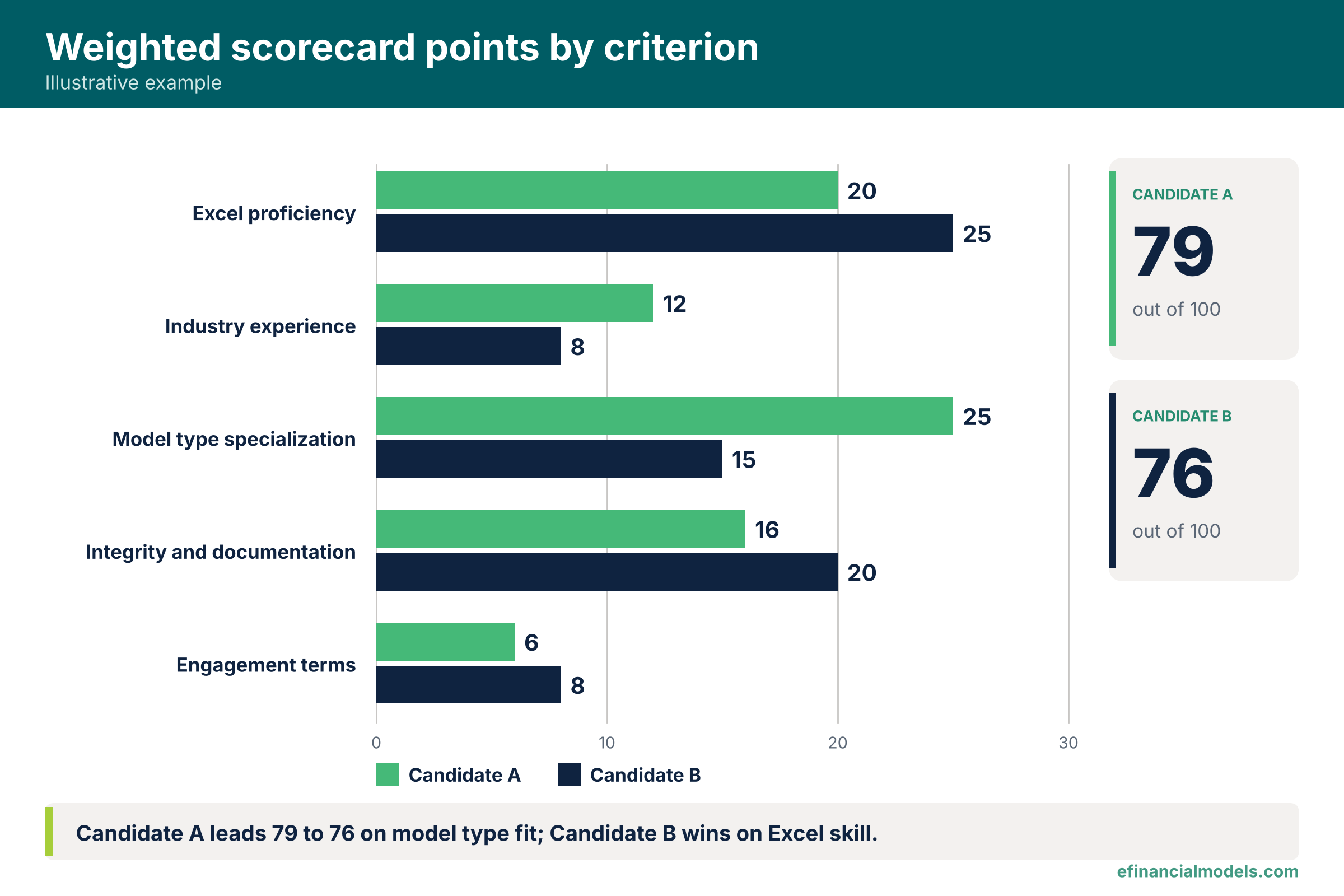
Weighted points per criterion for the two illustrative candidates in the worked example, using the weights and scores in the table above.
Conclusion
A founder who applies one set of weights to every candidate replaces a gut-feel hire with a comparison that can be explained to a co-founder or an investor. Founders who want a concrete option to score against other quotes can review the eFinancialModels Expert Financial Modeling Services product and rate it with the scorecard above.
Frequently Asked Questions
How much should a financial modeling consultant charge?
Prices depend on scope, model type and the consultant’s track record, so a single figure would mislead. Ask for a written quote tied to named deliverables and compare at least three of them. If a quote is far below the others, find out what is missing, for example the testing and handover items listed under Criterion 4. Prefer a fixed fee per milestone over open hours, and agree in advance what counts as a revision.
How long does it take to build a startup financial model?
A simple forecast with one revenue line can take a few days, while an investor model with scenarios, a hiring plan and a funding schedule usually takes several weeks. The main delay is usually waiting for the founder’s inputs. A consultant who gives a timeline before seeing your data is guessing, so expect the schedule to be confirmed after a scoping call.
Should a founder hire a freelancer or a modeling firm?
A freelancer suits a single, well-defined model and offers direct contact with the builder. A firm suits repeated work, where a second person can review the file, and cover for holidays or illness. Whichever route is chosen, the scorecard stays the same. Ask the firm who will actually build the model and request that person’s sample, because the sales contact and the builder are often different people.
What should a founder prepare before the first call?
Gather the last two years of financial statements if the business has them, a list of products with prices, the main cost lines, and the purpose of the model, such as an investor pitch, a loan application or internal planning. Add the deadline and the audience. A consultant can then quote against real material and tell the founder in the first call which assumptions are still missing.
Who owns the model when the project ends?
Ownership should be written into the contract. The founder should receive the unlocked source file, with no hidden sheets, no passwords and no dependence on the consultant’s own tools. Clarify whether the consultant may reuse the structure for other clients, and whether the contract covers support for questions after delivery. Without these lines, a founder can end up holding a file that nobody else is able to change.