0 ITEMS

Is eFinancialModels Legitimate? Security FAQ for Founders

Yes on both counts: eFinancialModels is run by a Zurich company that publishes its address and policies, and it takes card payments through Stripe and PayPal instead of handling cards itself. The one condition is that every sale is final, so a first-time founder should confirm fit before paying.
Key Takeaways
- Legitimate: a Zurich company, Privilege Partners, operates the site, and a register listing shows an active company at the address the Terms of Use publish.
- Established: not confirmed by the site, which states no founding date or catalogue size; a buyer must check the company register and independent reviews.
- Payment is secure: Stripe and PayPal process the cards, and the privacy policy says eFinancialModels does not collect or store card information.
- Certifications such as PCI Service Provider Level 1 belong to Stripe, because eFinancialModels names none of its own.
- Every download is a final sale with no refunds, so recourse runs through PayPal or the card issuer.
Is eFinancialModels a legitimate company?
Yes, on the public evidence. The site’s privacy policy states that Privilege Partners LLC, a limited liability company (LLC), owns and operates eFinancialModels.com, and the Terms of Use give the same operator a street address in Zurich, Switzerland. A third-party register mirror, onlineinfo.ch, lists a company called Privilege Partners at that address as active, with a registered purpose of business consulting and the promotion of trade. A buyer can repeat that check by searching the company name in the Swiss commercial register. The mirror says it is not an official source, so a binding extract must come from the cantonal commercial register.
The site also works as a marketplace: its refund policy states that payments are “directly credited to the authors of the model templates”, and it publishes a support contact route.
Is it an established business?
Not confirmed by the site. The pages reviewed state no founding year, customer count or catalogue size, so age is not established by the site itself. A buyer who needs proof of age must ask the register for the incorporation date, and should search for independent customer reviews of eFinancialModels before paying.
Is payment secure?
Yes, because card details never sit on the seller’s servers. The privacy policy states that “Credit Card information is not collected nor stored on eFinancialModels’ servers”, and the how-to-purchase guide names the gateways as Stripe and PayPal.
Stripe publishes the standards behind that arrangement on its security page. Stripe states that a Payment Card Industry (PCI) certified auditor evaluated the company and “certified us to PCI Service Provider Level 1”. Stripe’s PCI compliance guide adds that all businesses accepting credit card payments must comply with the Payment Card Industry Data Security Standard (PCI DSS), and that using a processor helps a business by “avoiding the need to directly handle sensitive credit card data”.
Those certifications belong to Stripe, not to eFinancialModels, and the sources reviewed here do not cover PayPal’s own certifications. The company’s own pages name no security certification, so its role in payment is to hand the buyer to outside processors, one of which has published its certifications.
Card fraud is measurable, and the regulators publish the numbers. A joint report from the European Central Bank (ECB) and the European Banking Authority (EBA), published on 15 December 2025, found that in 2024 the payment fraud rate in the European Economic Area (EEA) was stable at around 0.002% of the total value of transactions. In the same report, the ECB and EBA data states, the total value of fraud rose to €4.2 billion from €3.5 billion in 2023, and losses on card payments with EU and EEA-issued cards were €1.329 billion, a year-on-year increase of 29%. These figures describe the EEA, not Switzerland or the whole world, but they show why a buyer should prefer a seller that hands card data to a certified processor.
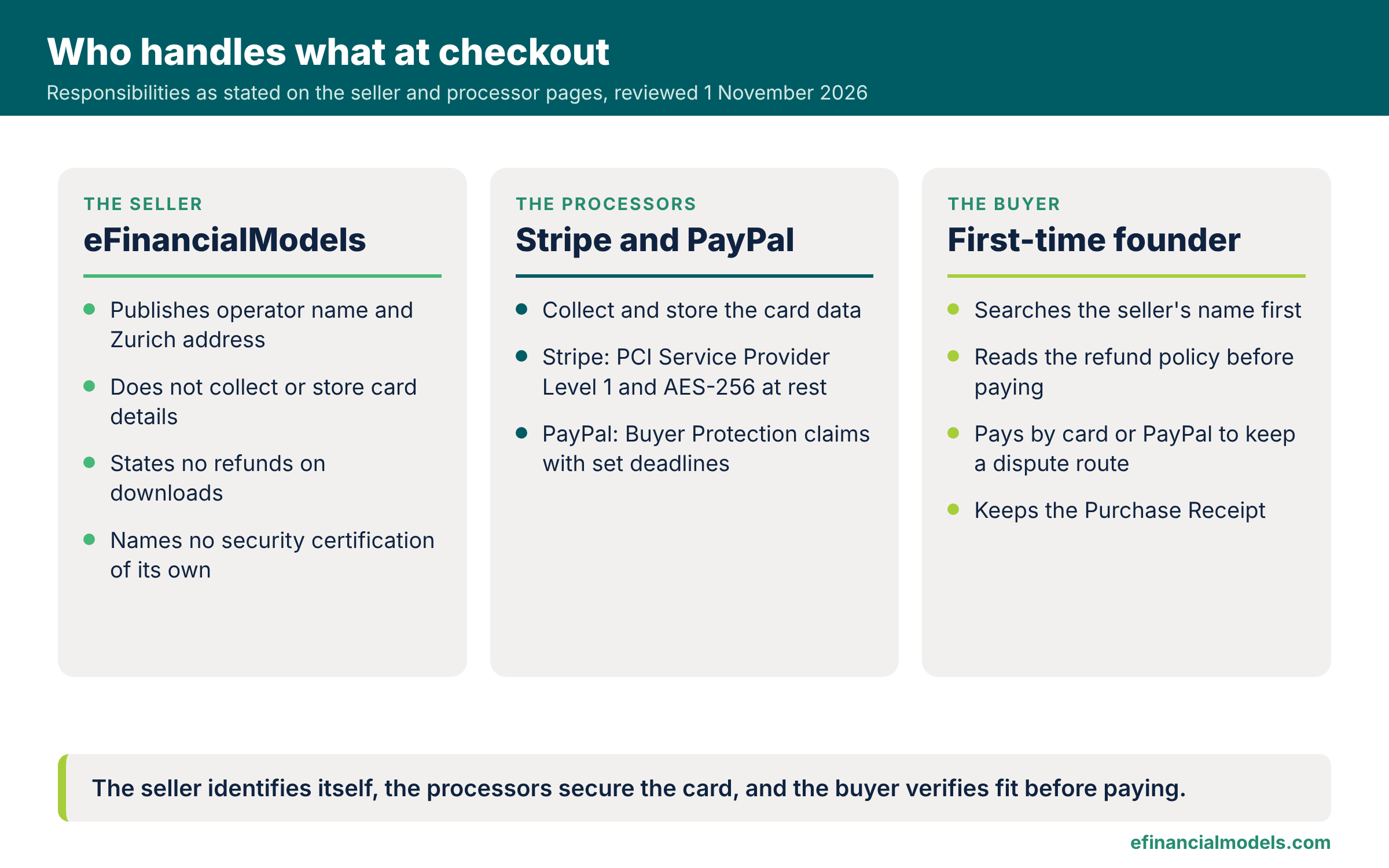
Division of responsibilities at checkout, drawn from the eFinancialModels, Stripe and PayPal pages reviewed on 1 November 2026.
What recourse does a buyer have after paying?
Recourse does not come through a refund. The refund policy states “Unfortunately, we do not offer any refunds” and describes the products as digital goods sold “as is” that cannot be taken back once downloaded.
Recourse therefore sits with the payment method. PayPal’s Buyer Protection program “may result in coverage for the full purchase price of the item plus the original shipping costs you paid”, when an item never arrives or differs significantly from its description. The page sets one limit for an item not received: 180 days from the payment date. For an item that is significantly not as described, it sets a single rule: 30 days from delivery, capped at 180 days from payment, whichever is sooner. PayPal decides eligibility under its own terms, and the quoted terms come from PayPal’s US page, so buyers elsewhere should check their own country’s PayPal page and read the conditions before relying on cover for a digital download.
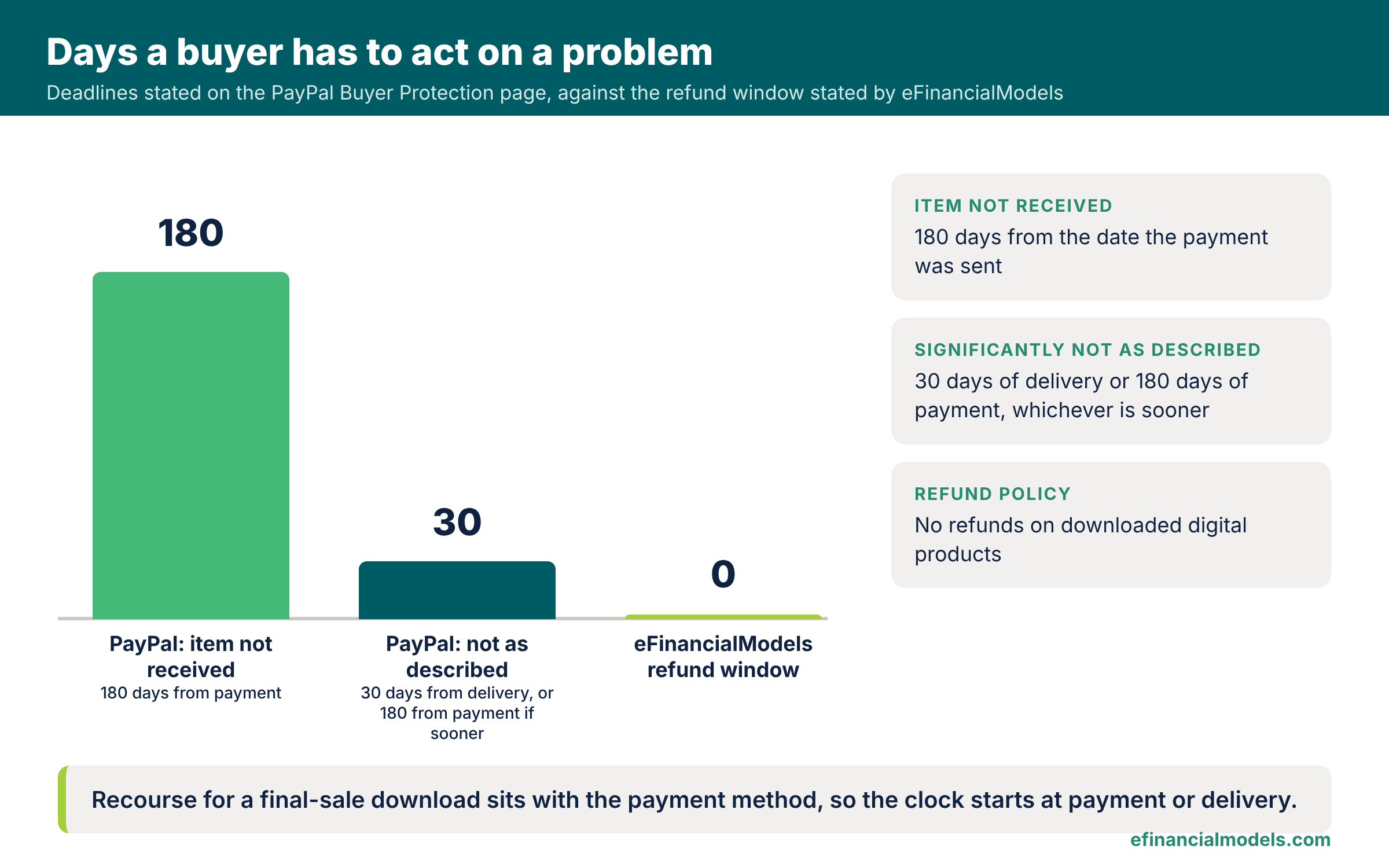
PayPal deadlines count from payment or delivery as labelled on each bar, with the no-refund policy of eFinancialModels shown beside them.
Both PayPal claims and card-issuer disputes depend on acting quickly, which is why the checklist below starts before the purchase.
How can a buyer compare any vendor or free download site?
The six rows below work for any vendor or free download site. The middle column records what eFinancialModels states publicly, and the right column turns each row into a question for any other source, since this article assesses only eFinancialModels.
| Check | What eFinancialModels states | Question for any other vendor or free site |
|---|---|---|
| Operator identity | Privilege Partners LLC, with a Zurich address in the Terms of Use and a matching register listing | Is a company name and address published, and does a register confirm it? |
| Card handling | Card data not collected or stored on its servers; Stripe and PayPal process payments | Who processes payment, and does the seller ever store card details? |
| Own certifications | None named on the pages reviewed | Does the seller claim any, and can a buyer verify them? |
| Refunds | None; products sold as is | Is a written refund policy available, and what does it exclude? |
| Licence | Personal, non-commercial use; single-user and multi-user options; no resale | Who may use the file, and may it be shared? |
| Data protection | Policy names European and Swiss data laws and says personal information is not sold | Does a privacy policy name the laws it follows? |
What should a first-time founder check before paying?
Six steps cover the points above, and each takes a few minutes.
- Search the operator’s name and confirm the address in the Terms of Use and the contact route in the privacy policy.
- Read the refund policy before checkout, and treat a no-refund policy as a final sale.
- Compare the template description with the business: industry, spreadsheet software and the level of detail, starting with the General Excel Financial Models category when no industry fits.
- Pay by a method with a published dispute process, such as PayPal or a card whose issuer sets one out, so a route exists if the file never arrives.
- Confirm that the browser shows Hypertext Transfer Protocol Secure (HTTPS), the encrypted version of the web protocol, on the checkout page.
- Keep the Purchase Receipt, which holds the download links.
Conclusion
eFinancialModels is a legitimate, register-listed marketplace operated from a published Zurich address, with outsourced card handling, a clear no-refund rule and no certifications of its own, so the documented facts describe a traceable seller whose sales are final. A first-time founder who has run the checks above can start with the SaaS Business Financial Model, a financial model template for Software as a Service (SaaS) startups that prepares the three financial statements, and read its description against the checklist before paying.
Frequently Asked Questions
What happens when a buyer picks the wrong template?
The policy treats a mistaken purchase of the wrong intended template as a “wrong purchase”, and it does not refund the first payment. Support can try to help request a discount on the correct template instead. The practical lesson is to match the listing to the business before checkout: confirm the industry, the forecast horizon and whether the layout suits an investor or a lender. A buyer unsure about fit can email support before paying, since afterwards the sale is final.
Who may use a purchased model inside a company?
The Terms of Use grant “a lifelong, royalty free, strictly personal and non-commercial usage right” within a closed user group. Because the wording is personal and non-commercial, a founder who plans to use a model inside a new business should confirm the permitted use with support in writing before relying on it for fundraising. The licences page separates a single-user licence, held by one person, from a multi-user licence for a team, and it states that redistribution or reselling is not allowed. Team limits sit in the licence terms, so a team buyer should ask support to confirm the applicable limit in writing before paying.
Does eFinancialModels sell personal data?
The privacy policy says the company does not share, sell or disclose information collected through the website to a third party, except in the cases the policy lists. It names the General Data Protection Regulation (GDPR) and the Swiss Federal Act on Data Protection (FADP) as laws it follows. The policy says personal data is retained only as long as necessary, and that backups are kept for system integrity but not actively modified upon deletion requests, so some data can remain in backups after a deletion request.
Is a credit card or PayPal the safer way to pay?
Neither is risk free, and both rest on rules set by the provider, not by the seller. PayPal runs a claim process with its own published deadlines, while a card issuer sets its own dispute rules and time limits, which differ by issuer and are not covered here. As general guidance, a buyer should check the issuer’s published terms, save the receipt, note the payment date and contact the seller first, because PayPal lists that step among its eligibility conditions.
What does a buyer receive after paying, and how can it be kept safe?
After checkout the buyer receives a Purchase Receipt containing the download links for the chosen templates. The purchased files can also be downloaded again through the platform account, so a lost email does not mean a lost model. Because refunds are not available, it helps to save a copy of each file in the buyer’s own storage straight away, and to keep the receipt as evidence of the purchase date if a dispute with the payment provider ever becomes necessary.