
0 ITEMS

Precedent Transaction Valuation
Precedent Transaction Valuation is a powerful financial analysis technique that uses historical M&A (mergers and acquisitions) data to determine the value of a company. By examining past transactions within the same industry, this approach provides insights into the valuation multiples and trends that investors have applied, offering a reliable benchmark for current deals. This valuation multiples approach helps to assess market sentiment, understand the premium paid for control, and set realistic price expectations. These templates streamline the process by allowing users to input transaction data, including deal size, valuation multiples, and financial metrics, to generate insightful comparisons and valuations.
Financial model templates are essential tools for Precedent Transaction Valuation. They provide a structured approach to assessing the value of companies based on past acquisitions. By leveraging historical transaction data, these models help identify market trends and benchmark valuations and make informed investment decisions. They ensure users have a robust framework to evaluate potential acquisition targets and negotiate favorable deals.
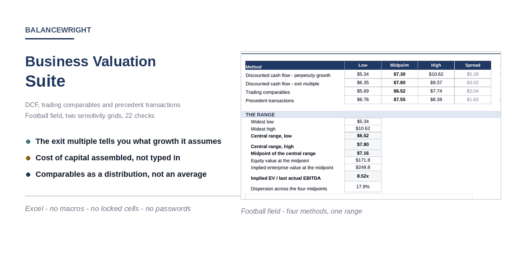

Value a company three ways and reconcile them on a…


Partner with IT Cloud Companies today – and unlock the…

Introducing the **New Equity Raise Template (Debt-to-Equity Rollover Included)**—an essential…


Apple Inc. Financial Model is a robust, all-encompassing financial model…
Understanding the Basics of Precedent Transaction Valuation

Do you want a crystal ball that reveals the market's true valuation magic by examining past sales of similar companies? That's Precedent Transaction Valuation! It's the treasure map that not only guides investors but also empowers them to navigate through the complex terrain of mergers and acquisitions. It ensures they strike gold with their decisions, giving them a strategic advantage in the market.
Precedent Transaction Valuation, also known as Comparable Transactions Analysis, is a financial method that accurately assesses a company's value by comparing it to similar businesses that have recently been sold or acquired. This valuation technique is grounded in the principle that a company's value can be inferred by analyzing the prices paid for similar companies under similar circumstances.
Investment bankers and financial analysts frequently use this valuation multiples approach during mergers and acquisitions (M&A) to determine fair market value and to negotiate purchase prices. By examining past transactions, professionals gain insights into market trends, sector-specific valuations, and the premium buyers are willing to pay for certain companies.
Key Components of Precedent Transaction Valuation
Precedent Transaction Valuation, a market-based method, is used to determine the value of a company by analyzing the prices paid for similar companies in past transactions. This valuation multiples approach involves identifying comparable transactions and examining the valuation multiples, such as EV/EBITDA, EV/Revenue, and P/E ratios, applied in those deals. By studying these multiples, one can derive a range of values that reflect how the market has historically valued similar companies under comparable circumstances. This method assumes that the valuation multiples from these precedent transactions are relevant and applicable to the valued company, providing a market-based benchmark for its worth.
Precedent transaction analysis typically yields a higher price because it reflects the premium buyers are willing to pay to acquire a company, considering the strategic benefits, synergies, and control premiums often involved in acquisitions. These premiums are above the standalone market value of the company, accounting for the potential future gains that the acquirer anticipates. The method is more accurate because it is based on actual market transactions, capturing real-world prices for comparable companies in similar industries and conditions. Using these real transaction data points, precedent transaction analysis incorporates the most recent market sentiments and conditions, making it a reliable and practical approach to valuation.
Among the key components of a precedent transaction valuation are:
Acquisition Details
The valuation multiples approach includes details of the acquisition. These details provide the context and framework of the transaction, allowing for accurate comparisons and assessments. They help understand the strategic importance and the financial commitment involved in the deal.
- The transaction date is crucial because market conditions can significantly affect its valuation. Knowing the date helps compare similar transactions within the same economic period.
- The percentage of stakes acquired indicates whether the transaction involved a controlling interest or a minority stake, impacting the valuation multiples applied.
- The type of sale (e.g., merger, acquisition, leveraged buyout) affects the deal structure and valuation.
- The transaction value is the total amount paid for the acquisition. It is a baseline for calculating and comparing valuation multiples with other transactions.
Details of the Acquirer, including Company Name & Country
Identifying the acquiring company and its location provides insights into the acquirer's market presence, regulatory environment, and strategic goals. Understanding the acquirer helps evaluate the transaction's strategic rationale and any potential synergies that might justify the valuation. The acquirer's country can influence valuation due to different accounting standards and market conditions.Details of the Acquired Company
Identifying the acquired company and its location helps understand its market and regulatory environment. Knowing whether the type of company is public, private, or a subsidiary affects the availability of financial data and valuation approaches. The size of the company (measured by revenue, number of employees, etc.) influences the valuation, as larger companies often have different risk profiles and growth potentials compared to smaller ones. The product/service mix details the diversity and nature of the company's offerings, impacting its market positioning and revenue stability.Financial Metrics
The following financial metrics provide a comprehensive view of the target company's financial health and market position. Accurate financial metrics are essential for performing valuation analyses and ensuring that comparisons with other transactions are meaningful and reliable.- Equity value is the value of the company's shares, which is essential for determining the cost of acquiring the company.
- Enterprise value, which includes the company's debt, is a comprehensive measure of its total value. This metric provides a more accurate picture of a company's worth, as it takes into account not just its equity but also its debt obligations.
- Revenue is the total income generated from sales, which is important for evaluating a company's market share and growth potential.
- Earnings before interest, taxes, depreciation, and amortization (EBITDA) are critical measures of operational profitability.
- EBITDA margin indicates a company's operational efficiency and profitability relative to its revenue. It measures how much profit a company makes before accounting for interest, taxes, depreciation, and amortization expenses.

The foundation of Precedent Transaction Valuation lies in its key components. These form the backbone of valuation using multiples. However, it's worth noting that employing the Precedent Transaction Valuation method requires careful consideration of the available data. The transactions selected for the analysis must be similar to the company being valued, and market fluctuations and shifts in industry trends must be factored into the final valuation determination.
Diving Deep Into Precedent Transactions as a Valuation Multiples Approach
Precedent Transactions is a valuation multiples approach grounded in the principle that a company's value can be inferred by analyzing the valuations of similar companies acquired or sold under comparable circumstances. It uses the multiples derived from similar companies' purchase prices to estimate the target company's value. These multiples are then applied to the target company's financial metrics to assess its value.Performing peer group multiple calculations offers an overview of a company's valuation metrics. This process involves gathering multiples into a dataset and determining the relevant multiples, whether the median or a range from minimum to maximum. For example, if similar companies were acquired at an EV/EBITDA multiple of 8x, this multiple could be applied to the target company's EBITDA to estimate its enterprise value. The essential valuation multiples in a precedent transaction analysis include:
- The Enterprise Value to EBITDA (EV/EBITDA) multiple is a key component of this valuation approach. It measures a company's value (including debt and equity) relative to its earnings before interest, taxes, depreciation, and amortization (EBITDA). This multiple is crucial as it helps us understand how much investors are willing to pay for each unit of EBITDA, thereby facilitating comparisons across similar transactions.
- The EV/Revenue multiple is a financial metric that plays a significant role in benchmarking against peers. It compares a company's enterprise value (EV) to its total revenue, thereby measuring how much investors are willing to pay for each dollar of its sales. This comparison helps identify whether a company is valued higher or lower than its peers, potentially indicating overvaluation, undervaluation, or alignment with industry norms.
- The Price-to-earnings (P/E) ratio is a valuation metric that compares a company's current share price to its earnings per share (EPS), indicating how much investors are willing to pay for each dollar of its earnings. The multiple is essential in precedent transaction valuation because it helps to determine a fair valuation for the target company based on market trends and investor sentiment.

You are invited to view an example of Precedent Transaction Analysis for the Distillery Industry.
The Pros of Precedent Transaction Valuation Using Multiples
Precedent transaction valuation using multiples offers a practical and market-based approach to determining a business's value. It has the following advantages:- Guide in assessing what a buyer may pay for a bus Precedent transaction valuation using multiples helps determine what a buyer may pay for a business by providing a benchmark based on historical data. By examining previous transactions of similar companies, one can estimate a reasonable price range for the industry in question.
- Multiples reflect real-life deal payments. Multiples derived from precedent transactions are a practical and grounded valuation method. They reflect real-life deal payments based on actual deals in the market, making them more reliable than theoretical valuations.
- Valuable for M&A negotiations. Precedent transaction valuation using multiples is a helpful tool for M&A negotiations. It provides concrete data that can support price discussions, creating a common ground for negotiations when buyers and sellers can access data from similar transactions. This transparency can facilitate smoother negotiations and lead to more mutually agreeable terms.

The Cons of Precedent Transaction Valuation Using Multiples
While precedent transaction valuation using multiples can provide a valuable benchmark for assessing value, it's important to be aware of its drawbacks.- Limited availability of information. One major drawback of precedent transaction valuation is the limited availability of information. Unlike publicly traded companies, private transactions often lack transparency, which must disclose detailed financial data. The lack of comprehensive information can lead to inaccurate valuation, as analysts might have to rely on incomplete or second-hand data, making it challenging to derive accurate multiples.
- Multiples obtained may vary widely. Another disadvantage is that the multiples obtained from precedent transactions can vary significantly. These variations can be attributed to differences in the timing of the transactions, economic conditions, and the specific circumstances of each deal. For example, market conditions during a booming economy can lead to higher multiples than during a recession. Additionally, the strategic importance of the acquisition to the buyer or the unique synergies anticipated can lead to premium pricing in specific deals.
- Precedent transactions are rarely perfectly comparable. Precedent transactions are rarely perfectly comparable, which poses another significant challenge. Each transaction is unique, influenced by specific factors such as the industries involved, the size of the companies, the geographical markets, and the strategic goals of the buyers and sellers. These differences can significantly impact the valuation multiples, making applying them directly to another company problematic. Analysts must carefully adjust for these differences, but even with adjustments, there is always an inherent level of imprecision when using precedent transactions for valuation purposes.

Let Precedent Transaction Valuation Elevate Your Business
Precedent Transaction Valuation offers a practical and real-world approach to assessing business value. It permits companies to align their valuation with similar, successful transactions, giving businesses a realistic estimate of their worth. This method leverages actual market data, making it a reliable indicator of current trends and industry standards. Additionally, it provides a benchmark for negotiations, ensuring that businesses have a solid foundation when discussing deals and acquisitions.Financial modeling supports precedent transaction valuation by providing a structured and quantitative framework for analyzing past transactions. Analysts can extract key metrics and financial ratios from similar transactions through detailed financial models, enabling them to make informed comparisons and adjustments. These models help normalize data for differences in size, industry, and market conditions, ensuring a more accurate and relevant valuation.
Furthermore, financial modeling allows for scenario analysis, sensitivity testing, and incorporating various assumptions, enhancing the valuation's robustness and reliability. Ultimately, financial modeling ensures that the precedent transaction valuation is grounded in real-world data and adaptable to the business's unique circumstances.
You might also like: