
0 ITEMS

What Is a Good Airbnb Income?

Airbnb hosting offers the potential for steady income by renting out spare space to travelers.
- Earnings vary widely depending on location, property type, and booking frequency, with some hosts earning over $3,000 monthly.
- Success depends on smart pricing, quick responses, and positive reviews to maintain high occupancy.
- In 2024, Airbnb generated over $11 billion in revenue, with millions of active listings worldwide.
- Compared to hotels, Airbnb properties often provide more personal amenities, local experiences, and cost savings for guests.
- Calculating Airbnb income involves estimating bookings, setting realistic nightly rates, subtracting expenses, and using financial models to forecast profits.
This guide covers how to optimize your Airbnb setup and maximize earning potential effectively.
What Does Airbnb Mean?
Airbnb began in 2008 when two friends, Brian Chesky and Joe Gebbia, rented air mattresses in their San Francisco apartment to earn extra money. They quickly saw the potential of connecting travelers with hosts offering spare space. With Nathan Blecharczyk joining as a third co-founder, they built a website called “AirBed & Breakfast.” The idea took off. Over time, Airbnb grew from a small startup into a global platform with millions of listings in over 190 countries, changing how people travel and find places to stay.
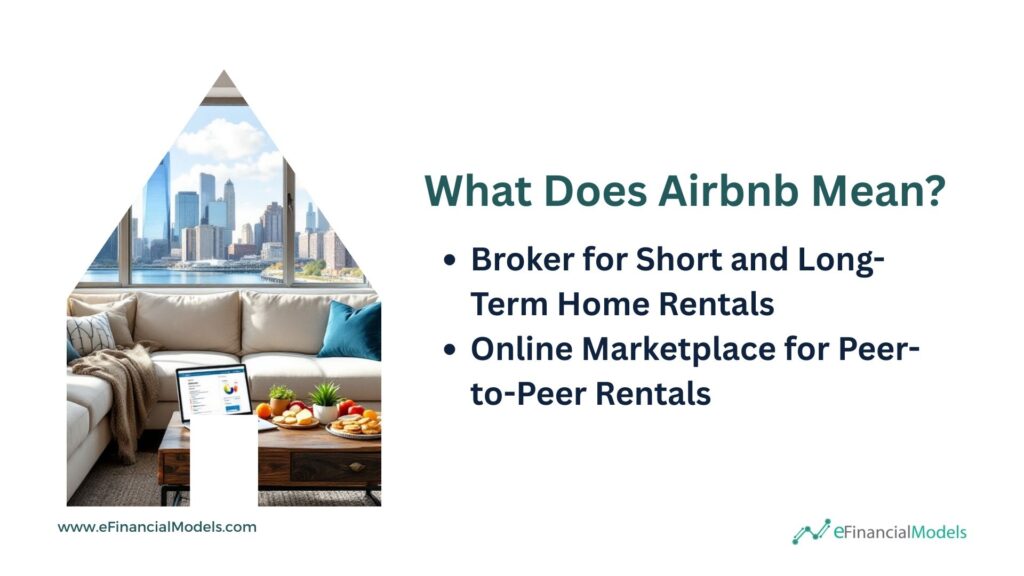
Airbnb acts as a broker for short and long-term home rentals. The platform connects hosts who list their spaces with guests looking for a place to stay. It offers flexible booking options and a wide range of homes worldwide. Today, it is a popular online marketplace where people rent out homes, rooms, or apartments for short stays. It connects travelers with hosts worldwide, offering a cheaper and more personal alternative to hotels.
Why Is It Called an Airbnb?
Airbnb gets its name from “Air Bed and Breakfast.” In 2008, the founders offered air mattresses in their apartments to guests needing a place to stay. They combined the idea of an “airbed” with the warmth of a “bed and breakfast.” The name was too long, so they shortened it to Airbnb.
The name was shortened to Airbnb in August 2008, just before the company officially launched its website as Airbnb.com. The founders simplified the name to make it more brandable, modern, and easier for users to remember and type. The rebranding aligned with their shift from air mattresses to a broader range of short-term rentals. It’s simple, catchy, and easy to remember—perfect for a growing brand. The name stuck, and today, Airbnb is known worldwide.
What Is the Average Airbnb Income?
The average Airbnb income varies widely. It depends on your location, the type of property you offer, how often it’s booked, and how much effort you put in. A small city apartment might earn an average Airbnb income of $1,000 monthly, while a well-run vacation home in a tourist hotspot can bring in several thousand. Your hustle—cleaning, managing listings, responding fast—can make all the difference.
In 2024, Airbnb earned $11.1 billion in revenue, up 12.1% from the year before. Despite this growth, net income fell to $2.6 billion. The platform had 491 million bookings and a gross booking volume of $81.8 billion. While Airbnb hasn’t updated its user count since 2020, it’s estimated at 275 million. There are now 8.1 million active listings hosted by five million people worldwide.
How Is Airbnb Different From a Hotel?
A hotel is a business that rents rooms to travelers, offering services like housekeeping, front desk support, and often meals. It’s been the go-to option for lodging for centuries, with set standards and prices. But this predictable setup sparked a shift—people started looking for more unique, flexible, and personal places to stay. That’s where Airbnb comes in. Born from the idea of renting out extra space, Airbnb reimagined travel by letting everyday people host guests in their homes. This fresh approach quickly became a global movement, offering an alternative to the traditional hotel stay.
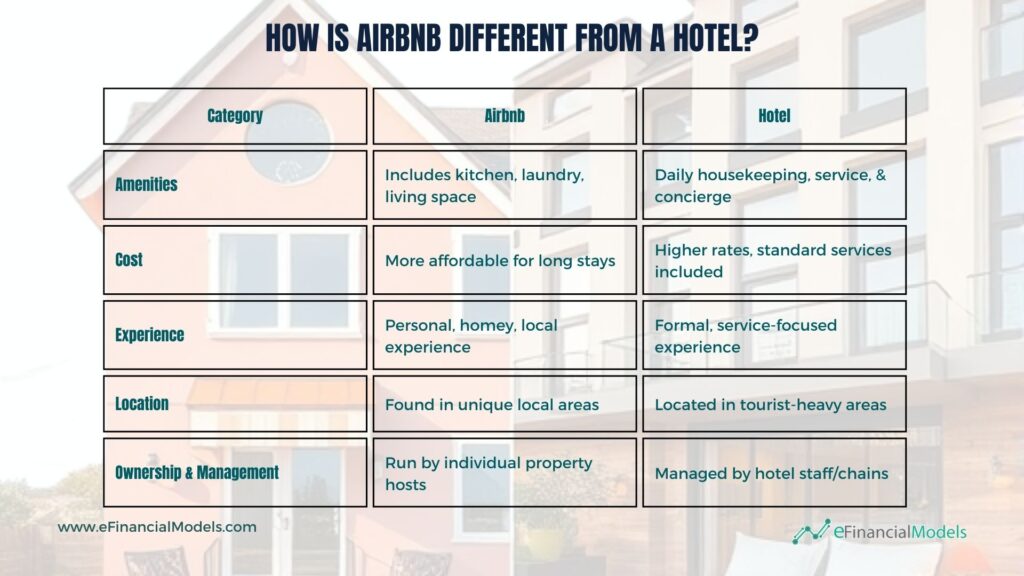
- Amenities: Airbnb properties often include home-style features like a full kitchen, laundry area, and living space. These extras give guests more flexibility to cook, do laundry, and relax at home. In contrast, hotels offer daily housekeeping, concierge service, and room service but generally lack personal-use amenities like a full kitchen.
- Cost: Airbnb tends to be more budget-friendly, especially for longer stays. The per-night cost is usually lower, and guests can save more by cooking meals or doing laundry onsite. Hotels, however, come with higher rates, including standard services, such as fresh linens, toiletries, and daily cleaning.
- Experience: Staying at an Airbnb gives a cozy, personal feel with a touch of local charm. Guests often interact directly with hosts and get a more authentic experience. Hotels focus on a formal, service-driven experience with standardized rooms and services designed for comfort and predictability.
- Location: Airbnbs are often found in unique neighborhoods that offer a taste of local life. These properties can be tucked away in residential zones or lesser-known parts of a city. Hotels are typically placed in commercial or tourist-heavy areas, making them easy to find but less immersive.
- Ownership & Management: Airbnbs are owned and managed by individual hosts, each bringing their style and rules to the table. This decentralized model allows for various property types and service levels. Hotels are run by professional staff and often belong to larger chains, ensuring consistent standards but less personal touch.
No Downloads found
How to Calculate Airbnb Income?
How much money can you make on Airbnb? Here are five simple steps on how to to calculate Airbnb income:
- Estimate Monthly Bookings: Count how many nights your place gets booked each month.
- Set Your Nightly Rate: Choose a realistic price per night based on your location and property type.
- Add Up Monthly Revenue: Multiply booked nights by your nightly rate to get gross income.
- Subtract All Expenses: Deduct costs like cleaning, maintenance, supplies, utilities, rent or mortgage, and platform fees.
- Calculate Net Profit: What’s left after expenses is your real Airbnb income—your monthly profit.
There are a few other ways on how to calculate airbnb income. You can start with the nightly rate you plan to charge and multiply it by the monthly booked nights. You can also estimate income using the average occupancy rate in your area and seasonal pricing trends. Try Airbnb’s income calculator tools or compare similar listings nearby for a faster method. Don’t forget to subtract costs like cleaning, service fees, and taxes to get your real profit. Each method helps you understand your potential earnings from a different angle.
How to calculate Airbnb income? An Excel financial model is the best way to calculate Airbnb’s income. It’s fast, clear, and easy to update. Just input your nightly rate, number of bookings, and expenses. The model does the math for you. It shows profits and trends and helps you plan smarter. Unlike guesswork, Excel keeps things organized and accurate. It’s the best tool to track income and spot ways to earn more.
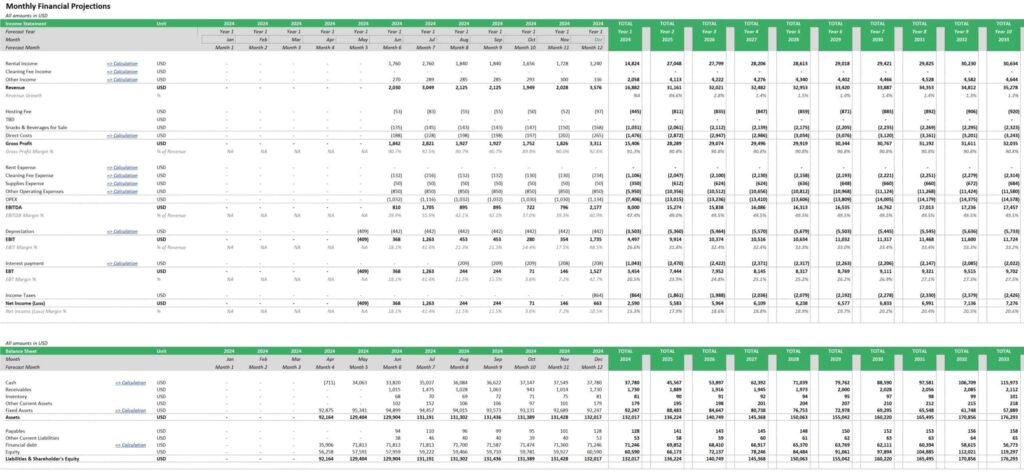
The above financial projection is from our Single Airbnb Rental Unit Financial Model. It calculates income mainly through Rental Income, which starts at $1,760 in May and rises to $3,240 in December 2024, totaling $14,824 for the year. It also includes cleaning fee income, which peaks at $285 in June and July, contributing $2,058 annually, and other income, which totals $2,000. These three streams total a 2024 revenue of $18,882, which grows yearly to $35,278 by 2033. The file breaks this down monthly and shows how revenue less direct costs like hosting fees, snacks, and cleaning expenses lead to Gross Profit (e.g., $1,942 in May) and, finally, Net Income, which ends at $2,590 in 2024 and grows to $7,266 by 2033.
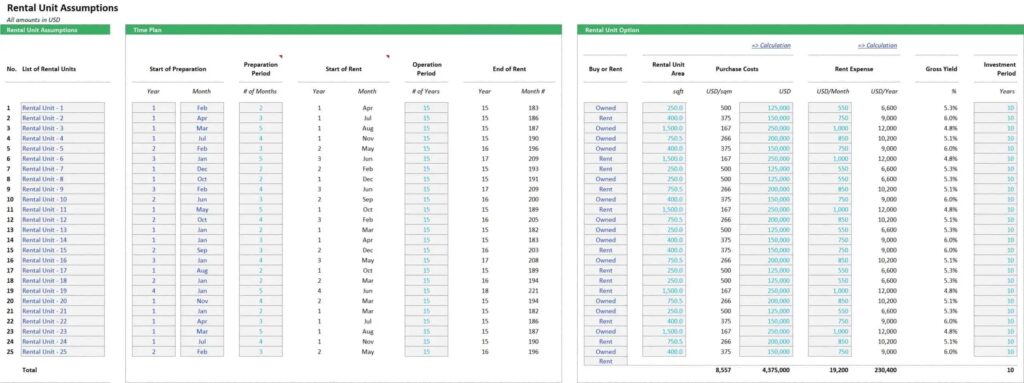
Our Airbnb Rental Units Business Plan calculates the Airbnb income by listing 25 rental units, each with details like area, rent type, and start date. Units generate income as owned properties with purchase costs (e.g., $125,000 for a 250 sqft unit) or rented properties with monthly rent (e.g., $750/month for a 400 sqft unit). Income starts once units begin operation—such as Rental Unit 1 starting in April Year 1—and continues for 15 years. The file uses Gross Yield (ranging from 4.8% to 6.0%) to estimate returns on investment. The total purchase cost is $4,375,000, while annual rent expenses total $230,400, helping determine each unit’s profitability.
Conclusion: Is Airbnb a Good Source of Income?
A good Airbnb income refers to net earnings from short-term rental operations that consistently exceed operating costs, generate an attractive return on capital, and reflect strong occupancy and nightly rate performance. A good Airbnb income means earning more than your costs while keeping bookings steady. In smaller cities, hosts make around $1,000 a month. In busy tourist areas, income can climb to $3,000 or more. The difference comes down to effort—clean listings, fast replies, and strong reviews boost bookings. Location helps, but how well you run things matters just as much.
Yes, Airbnb can be a good source of income if you manage it well. It offers flexible earnings that often beat traditional rent, especially in high-demand areas. You can earn steady cash flow and strong returns with the right property, smart pricing, and solid guest reviews. Unlike long-term rentals, Airbnb lets you adjust rates, block dates, and take advantage of peak seasons. But it also takes work—cleaning, managing guests, and handling upkeep. If you stay active and organized, Airbnb can become a profitable and rewarding income stream.
No Downloads found
You might also like:
- 10 Main Elements of a Business Plan
- 10 Tips to Develop a First Class Business Valuation Report
- Creating a Business Plan for your Food Truck Business
- Cash Flow Analysis in Excel
- Real Estate Financial Modeling in Excel
- Pro-Forma
- Understanding What is Yield to Maturity and Why It Matters
- Financial Planning for Small Business Owners – Taking an SBA Loan
- 10 Ideas to Increase Average Revenue Per User
- Finding a Valuation Model for Your Business
- How to use data validation for creating drop-down lists in Excel
- 10-Step Financial Planning Checklist for Smart Executives
- Total Rent Estimate Method
- Financial Statements – Definition, Uses, Contents and Templates
- Investment Multiple
- Residential Properties
- Do You Need an Investment Proposal Template in Excel?
- How to Optimize the Average Selling Price: Strategies for Higher Profits
- 5 Smart Ways To Manage Personal Finances In A Pandemic
- Airbnb