
0 ITEMS

How To Calculate Profit Margins?
Table of Content
- Introduction: Why Profit Margins Matter More Than Revenue
- Gross Profit Margin: Measuring Product-Level Profitability
- Operating Profit Margin: Measuring Business Efficiency
- Net Profit Margin: What You Actually Take Home
- When To Use Each Metric?
- Conclusion: Profit Margin As A Management Tool
- Frequently Asked Questions (FAQ)

Introduction: Why Profit Margins Matter More Than Revenue
In the pursuit of growth, it is easy to become addicted to “top line” numbers. We celebrate hitting seven figures in sales or doubling year-over-year revenue as if those milestones are the finish line. However, revenue is often a noisy, distracting metric. In the world of high-performance business, the only number that truly dictates your future is your Profit Margin.
The most common trap entrepreneurs fall into is the belief that high sales automatically equal a successful company. In reality, revenue is simply the volume of money passing through your hands. Your net profit margin is how much of that money you actually earn. If your expenses scale faster than your sales, you can find yourself growing into a crisis, managing a larger, more stressful organization that leaves you with less take-home pay than when you were still a small enterprise.
Why Profit Margins Is The Ultimate Strategic Compass
Learning how to calculate profit margins provides a high-resolution view of your business’s structural financial health. A strong margin acts as a report card for three critical pillars of any successful enterprise:
- Pricing Power & Market Positioning: A healthy margin is proof of your “economic moat.” It shows that customers value your brand or expertise enough to pay a premium. If your margins are razor-thin, you aren’t a market leader; you are likely a commodity competing on price, a “race to the bottom” that leaves you vulnerable to any competitor willing to undercut you by a few cents.
- Cost Control & Operational Efficiency: Margins reveal how well you manage your resources. A high-margin business is proof of a disciplined organization that converts time, labor, and materials into value without excessive waste. It means you are getting maximum “output” for every dollar of “input.”
- Determines Business Longevity: Strong margins or having a high “Margin of Safety”, provide the breathing room necessary to survive the unexpected. Whether it’s an economic dip, a sudden increase in supply costs, or a slow sales month, businesses with high margins have a buffer. A company operating on a 2% margin is always one minor setback away from a total collapse. Ultimately, these margins dictate the business’s long-term longevity, transforming a fragile operation into a durable asset capable of sustained growth through any market cycle.
What You Will Master In This Article
To truly take control of your business’s financial health, you must understand that profitability happens in layers. This article will guide and show you exactly where your money is going and where your biggest growth opportunities are hiding:
- How to Calculate the Three Key Margins: We will break down the gross profit margin formula, operating margin, and net profit margins. You’ll learn how to move beyond basic math to understand what these numbers are telling you about your product and your overhead.
- When to Use Each Metric: Not every margin is relevant at every moment. You’ll learn which number to check when you’re setting prices versus when you’re evaluating your team’s efficiency.
- Strategic Levers for Improvement: Numbers are only useful if you know how to move them. We will discuss practical, real-world strategies to widen your margins, ranging from supplier negotiations to automation, allowing you to stop just “moving money” and start building lasting wealth.
By the end of this guide, you will have a clear roadmap for transforming your business from a high-volume revenue machine into a high-efficiency profit business.

Gross Profit Margin: Measuring Product-Level Profitability
The first and most fundamental level of profitability is the Gross Profit Margin formula. While many owners focus on the total cash in the bank, this metric looks specifically at your “unit economics.” It answers the essential question, “Are you actually making money on the individual products or services you sell before you account for the costs of running the business?”
What Is Gross Profit?
Gross profit is the raw dollar amount remaining after subtracting the direct costs associated with creating your product or delivering your service. These direct costs are known as COGS (Cost of Goods Sold).
To ensure your calculation is comprehensive, COGS should include:
- Raw Materials: The physical components of your product.
- Direct Labor: The wages of the people physically making the product or providing the service.
- Manufacturing Supplies: Consumables used during production.
- Packaging and Direct Shipping: The costs required to get the specific item ready for the customer.
The Gross Profit Formula:
Gross Profit = Revenue – Cost of Goods Sold
How To Calculate Profit Margins At The Product Level
While gross profit gives you a dollar amount, it doesn’t tell you the whole story of your efficiency. To understand the health of your pricing, you must convert that dollar amount into a percentage of your total sales.
The Gross Profit Margin Formula:
Gross Margin = (Gross Profit / Revenue) x 100
Step-by-Step Practical Example:
Let’s apply this to a real-world scenario. Imagine you run an e-commerce shop selling premium coffee makers:
- Total Revenue: $10,000 (Your total sales for the month)
- COGS: $6,500 (The cost to buy the units from the supplier + packaging)
- Gross Profit: $3,500 ($10,000 – $6,500)
- Gross Margin: 35% ($3,500 ÷ $10,000)
This 35% is your “working room.” Every other expense in your business, from your rent to your own salary, must be paid out of that 35%.
Why Gross Margin Is The Foundation Of Strategy
A thin gross margin indicates an unsustainable value proposition where the business fails to retain enough capital from each transaction to fund its own operations. This percentage serves as the primary constraint on your commercial strategy, dictating the feasibility of three critical business levers:
- Marketing Spend Limits: Your gross margin defines the maximum “Allowable Acquisition Cost”. If your margin is 35%, spending 40% of revenue on customer acquisition creates an immediate deficit on every sale. Recognizing this threshold prevents you from scaling losses under the guise of growth.
- Discount Sustainability: High margins provide the “Pricing Power” necessary for aggressive promotions. A business with a 50% margin can execute a 20% Flash Sale, while remaining profitable. Conversely, that same discount would push a 15% margin operation into immediate debt, making increased volume a financial liability.
- Supply Chain Optimization: A compressed gross margin is a leading indicator of supply chain inefficiency. It signals the immediate need to audit input costs, whether through renegotiating bulk rates, optimizing packaging, or streamlining logistics, to restore the unit economics required for long-term health.
Gross Margin Benchmarks (By Business Type)
A healthy gross margin is relative and looks different for every industry. Comparing your numbers to a business from a different industry could lead to strategic misalignment and flawed financial expectations. For instance, here are the different expectations of each industry:
- SaaS & Digital Products (Higher Margins): Digital goods command the highest margins to offset significant fixed costs in research, development, and engineering. These high margins are a structural necessity rather than luxury that must be maintained to recoup the heavy upfront investment required to build and maintain the product.
- Manufacturing (Medium Margins): Manufacturing companies typically operate within medium to lower margins due to the costs of raw materials, specialized labor, and other direct costs associated with creating the product. Unlike high-margin digital goods, manufacturing margins are inherently compressed by the tangible inputs required for every unit, meaning success is more about capacity utilization and economies of scale. A significant gross margin is expected to provide the necessary capital to reinvest in automation and absorb fluctuations in global supply chains. Falling below these percentages often signals a ‘commodity trap’, where a business is forced to compete solely on price, leaving zero financial buffer for innovation, equipment depreciation, or market volatility.
- Drop shipping (Low Margins): Drop shipping represents a “low margin, high volume” strategy where profitability is dictated by the supplier’s willingness to assume the risks of inventory and fulfillment. Margins are inherently thin, as the supplier captures the responsibility of production and handling logistics. In this model, success is entirely dependent on high-velocity sales and efficient marketing, as there is minimal room to absorb customer acquisition costs (CAC). Falling below these percentages creates a break-even trap, where a slight increase in advertising spend or a small percentage of product returns can render the entire operation unprofitable. To be sustainable, this model requires a relentless focus on niche selection and conversion rate optimization to ensure that thin per-unit profits eventually scale significant returns through transaction volume.

Operating Profit Margin: Measuring Business Efficiency
While Gross Margin confirms viability, the Operating Profit Margin determines if the company itself is structurally sound and profitable. This metric accounts for the cost of doing business, the Operational Expenses (OPEX) required to maintain human resources, infrastructure, and market presence.
What is Operating Profit?
Operating profit represents the residual earnings after deducting Operating Expenses (OPEX) from your Gross Profit. Unlike the Cost of Goods Sold (COGS), which sales with every unit, OPEX often consists of fixed or semi-variable costs, such as rent, software subscriptions, and administrative payroll, that are necessary to keep the business operational regardless of sales volume.
The Operating Profit Formula:
Operating Profit = Gross Profit – Operating Expenses
Calculating Your Operating Margin (%)
This percentage serves as the ultimate test of organizational leanness, showing exactly how much of every dollar remains to cover taxes, and debt interest, after the bills are paid.
The Operating Profit Margin Formula:
Operating Margin = (Operating Profit/Revenue) x 100
Step-by-Step Example (Continuing from our Coffee Shop):
Let’s see what happens to that $3,500 Gross Profit after we pay the monthly bills:
- Gross Profit: $3,500
- Operating Expenses: $2,800 (Rent, marketing, and software)
- Operating Profit: $700 ($3,500 – $2,800)
- Operating Margin: 7% ($700 ÷ $10,000)
Despite a healthy 35% gross profit margin, the business is only retaining 7% because its overhead is disproportionately high. This suggests that while the product is strong, the structural engine running the business is inefficient. Scaling this business without first optimizing OPEX would likely lead to the top-line trap where increased sales simply fuel a larger, more expensive infrastructure without increasing owner wealth.
What Operating Margin Reveals
The Operating Margin is often the most critical metric for a business owner because it serves as the efficiency gauge for your organizational structure. It provides an unfiltered look at three specific areas of your business:
- Cost Structure Efficiency: A healthy business should see economies of scale, however, if your revenue is rising while your operational margin is shrinking, it indicates that your fixed expenses, like administrative bloat or inefficient systems, are outstripping your growth.
- Structural Scalability: Your operating margin determines how much friction exists in your growth model. High-margin businesses are considered lightweight and easy to scale as they don’t require a linear increase in headcount, office space, or infrastructure for every new customer acquired.
- ROI of Growth: This is the primary indicator of whether your expansion efforts are profitable. If you increase ad spend by $1,000 but only generate an additional $500 in operating profit, your margin will dip, signaling that you are over-leveraging marketing to mask an inefficient sales funnel or a weak retention strategy, essentially buying “hollow growth” that doesn’t reach the bottom line.

Net Profit Margin: What You Actually Take Home
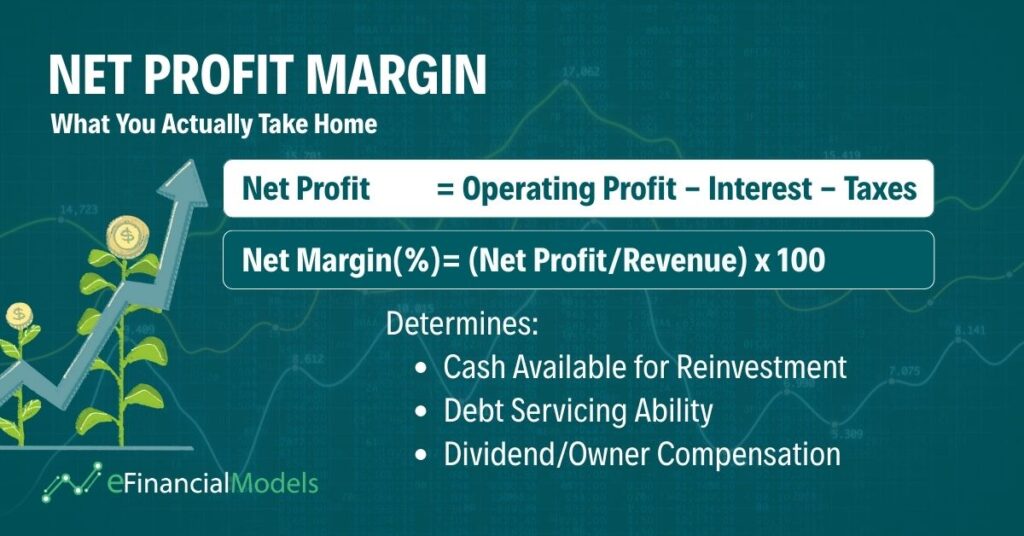
The Net Profit Margin is the destination of every dollar your business earns. It serves as the definitive truth teller because it accounts for every cent that leaves the entity. While previous margins measure product viability (Gross Margin), and operational efficiency (Operating Margin), the Net Profit Margin reveals the actual profitability of the business after all external and internal obligations are met. It is the clearest indicator of whether a business is generating wealth or losing its revenues through costs and expenses.
What Is Net Profit?
Net profit is the residual income remaining after every expense has been satisfied. Beyond your daily operating costs, this figure incorporates below the line expenses that are often outside your immediate operational control, specifically interest on debt, and corporate taxes.
The Net Profit Formula:
Net Profit = Operating Profit – Interest – Taxes
Calculating Your Net Profit Margin (%)
This percentage represents the portion of total revenue that translates into retained earnings or owner distributions. It is the metric for assessing business resilience and investment return.
The Net Profit Margin Formula:
Net Margin = (Net Profit/Revenue) x 100
Step-by-Step Example (The Final Result):
Let’s finish the journey of our $10,000 in revenue:
- Operating Profit: $700
- Taxes & Interest: $200 (The government’s share and loan interest)
- Net Profit: $500 ($700 – $200)
- Net Profit Margin: 5% ($500 ÷ $10,000)
In this scenario, despite the activity required to generate $10,000 in sales, the owner retains only $5 for every $100 spent by the customer. A 5% Net Profit Margin provides very little “Margin of Safety.” If supply costs rise or a marketing campaign underperforms by just a few percentage points, this business risks falling into a net loss. This highlights why high-volume growth is dangerous without first optimizing the “Net” at the bottom.
Why Net Profit Margin Matters Most
Investors and high-level operators prioritize the Net Margin above all other figures because it represents the actual Economic Power of the entity. While other margins measure efficiency, Net Profit Margin dictates your capacity for three fundamental business actions:
- Capital for Strategic Reinvestment: This is your “Innovation Fund.” Net Profit provides the liquidity necessary to acquire modern equipment, fund R&D for new product lines, or secure top-tier executive talent. Without a healthy net margin, a business is perpetually stuck in maintenance mode, unable to fund the next moves that would lead to its next stage of growth.
- Debt Serviceability & Solvency: A thin net margin significantly increases financial leverage risk, if the margin is too narrow, a minor dip in revenue could leave you unable to meet your debt obligations, leading to credit downgrades or insolvency. High-margin businesses have a higher chance of acquiring additional loans as they demonstrate a clear ability to carry and repay capital.
Owner Distributions & Wealth Accumulation: Ultimately, the Net Profit Margin is the source of your personal compensation. Whether you choose to take a dividend, a partner draw, or reinvest for a future high-value exit, that wealth is derived strictly from the net profit. A business with high revenue but low net profit margin is often nothing more than a high-stress operation for the owner, rather than a productive asset that builds lasting wealth.
When To Use Each Metric?
To lead a high-efficiency profit engine, a business owner must treat these three margins as a diagnostic sequence. Each provides a different “lens” through which to view your business health, and focusing on one while ignoring the others can lead to distorted strategic decisions.
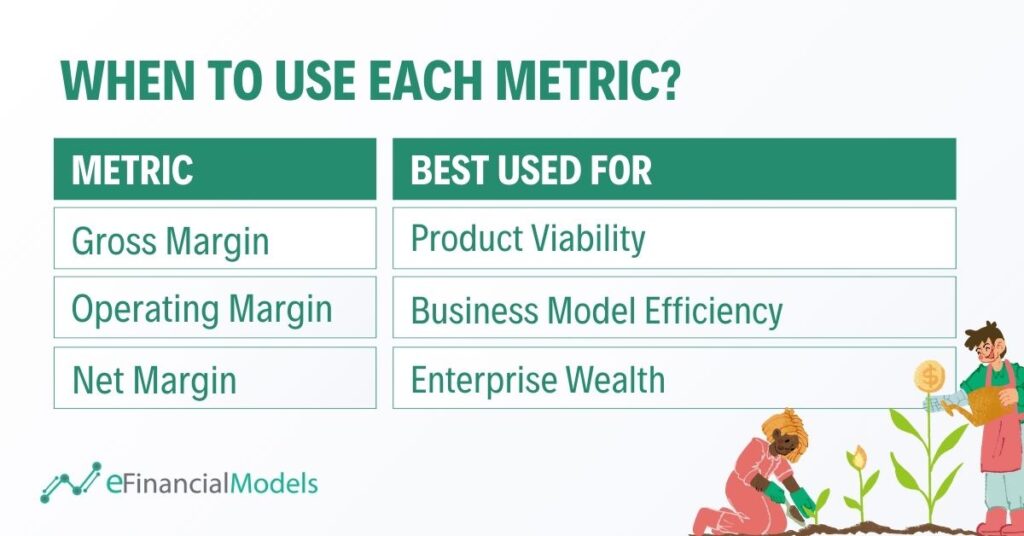
- Gross Profit Margin: The gross profit margin formula focuses solely on product viability, determining whether the business product or service alone creates revenue. Evaluating unit economics, managing inventory costs, and auditing supplier relationships. It answers the fundamental question: “Is this core product or service worth selling?”
- Operating Profit Margin: This determines the business model efficiency, it monitors the “engine” of the business. Business owners can use this to determine if organizational overhead, marketing spend, and payroll are appropriately scaled relative to the revenue. It reveals if the business is “top-heavy.”
- Net Profit Margin: Finally, this margin exhibits enterprise wealth, it is the definitive truth teller for financial health. This “take-home” figure is used for tax planning, owner compensation, investments, and evaluating the long-term ROI of the business.
Ultimately, these three margins function as a single, integrated roadmap for sustainable wealth creation. A robust Gross Margin confirms that your product has value in the marketplace, but it is the Operating Margin that proves your business model can scale without collapsing under its own weight, and the Net Margin that finally translates all that effort into retained earnings and reinvestment capital. Ignoring the transition between these numbers is how owners fall into the “top-line trap”, generating millions in revenue while remaining functionally undercapitalized. By monitoring all three in sequence, entrepreneurs can shift from a reactive state of moving money around to a proactive state of strategic leadership, ensuring that every sale not only pays for itself but also fuels a leaner engine and long-term financial security.
What Is A “Good” Profit Margin?
Determining what constitutes a “good” profit margin is a nuanced exercise because there is no universal benchmark that applies to every enterprise. A healthy margin is not a fixed number, but rather a dynamic target defined by the following strategic and structural factors:
- Why There Is No Universal Answer: Benchmarks are highly dependent on the ecosystem in which your business operates. Your Industry dictates the baseline, as a software firm faces vastly different economic realities than a grocery store. Capital Intensity also plays a role; businesses that require heavy investment in machinery or inventory require higher margins to recoup those costs than asset-light businesses. Furthermore, your Risk Profile and the level of Competition in your niche will dictate whether you can command premium pricing or must fight for every percentage point to stay relevant.
- Typical Ranges & Business Models: Profitability is generally a balance between volume and margin. Low-margin, high-volume businesses (like retail stores or drop shipping) rely on massive transaction numbers to accumulate profit. Conversely, high-margin, low-volume businesses (like luxury goods or specialized consulting) focus on high per-unit profitability, to offset the significant costs of customer acquisition and research.
- The Margin vs. Growth Trade-Off: There is often a strategic tension between maintaining high margins and pursuing expansion. Lower margins are acceptable when they are part of a deliberate expansion strategy, reinvesting profit into marketing or R&D to capture market share. However, thin margins become dangerous when they are unintentional, without high sales velocity to compensate, a low margin leaves the business with zero “margin of safety” to absorb sudden increases in operational costs or shifts in the economic state.
How To Improve Profit Margins?
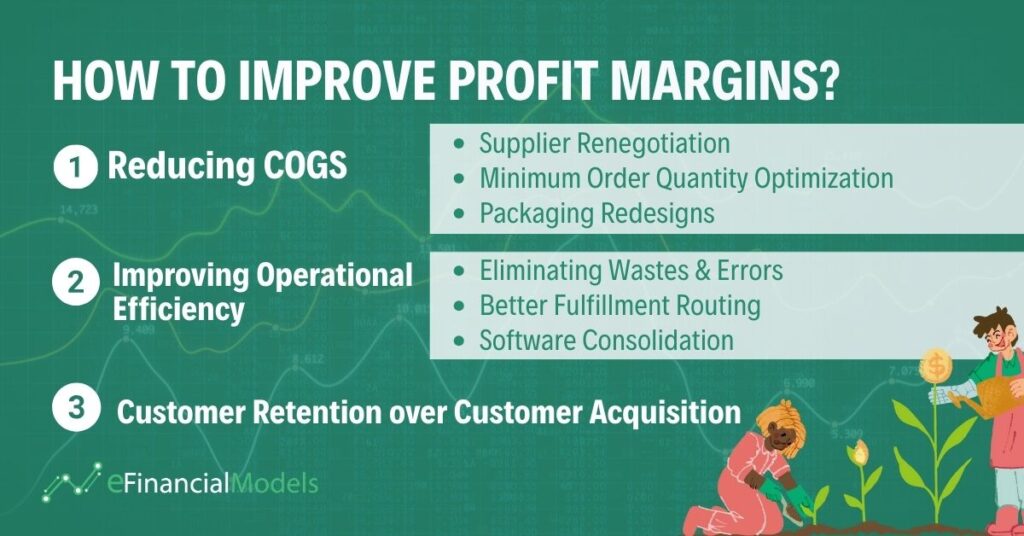
If market competition prevents you from raising prices, you must pull internal levers to protect your bottom line. Improving margins is a three-dimensional process that targets your product costs, your operational engine, and your customer relationships.
- Reducing Cost of Goods Sold (COGS): To improve gross margins, lowering direct costs of production through supplier renegotiation is the first step, leveraging payment history or long-term commitment to secure better rates. You can also engage in “Minimum Order Quantities” (MOQ) optimization, where increasing order size can lower the per-unit cost through bulk discounts. Also, packaging redesigns can yield massive savings, by reducing the weight or dimensions of containers, this effort can significantly slash shipping and storage fees.
- Improving Operational Efficiency: To boost Operating Margin, eliminating wastes and errors in daily workflows is one significant factor. This can be resolved through automation, using technology to handle repetitive tasks that currently drain human resources and time. Implementing better fulfillment routing can shave dollars off every order by optimizing the path from warehouse to doorstep. Additionally, performing a software consolidation audit allows the management to identify the stack bloat, the redundant subscriptions, and underutilized platforms that quietly bleeds the monthly budget.
- Customer Retention over Customer Acquisition: The most effective way to protect margins is to shift the focus from constant “buying” to “keeping.” The impact on marketing spend is significant, it is more cost-effective to sell to an existing customer than to acquire a new one. By prioritizing retention, it reduces the pressure on advertising budget, which lowers CAC and raises Operating Margin. Over time, this improves the Lifetime Value (LTV) of each customer, ensuring that the initial cost of acquisition is spread across multiple transactions, making every dollar of revenue more profitable.
Profit Margin In Predicting The Future
Beyond immediate gains, the strategic value of profit margins lies in their ability to predict the future and define a business’s market value. Consistently expanding margins signal a business that is successfully gaining competitive leverage, whether through brand power, economies of scale, or technological superiority. By analyzing margin trends, leadership can forecast how the business will perform under various economic conditions, for instance, a healthy margin buffer indicates a high “margin of safety” that can absorb future inflationary spikes or aggressive price wars. Ultimately, forward-looking margin analysis allows an owner to transition from reactive management to proactive engineering, identifying potential “profit leaks” before they manifest and ensuring that the business remains resilient, investable, and prepared for long-term expansion.
Conclusion: Profit Margin As A Management Tool
Effective financial management requires moving beyond top-line revenue to understand the three distinct layers of profitability. Real control begins with knowing how to calculate profit margins to identify the objective facts behind the business’s sales data. By consistently applying the (1) Gross Profit Margin, (2) Operating Margin, and (3) Net Profit Margin, management can move past the distraction of total volume to reveal the actual structural health of the enterprise. This process transforms your financial statements into a precise diagnostic tool, identifying exactly where product costs are excessive, where overhead is inefficient, and how much actual wealth the business generates for every dollar of revenue.
Once the calculations are established, entrepreneurs must understand when to use each metric as a strategic lens. Strategic leadership treats these margins as a sequential audit: Gross Margin validates your pricing power and unit economics, Operating Margin assesses your organizational efficiency and management of overhead, and Net Margin serves as the definitive measure of reinvestment capacity and owner distributions. Monitoring these in sync prevents the common error of scaling a business that is fundamentally inefficient. This layered oversight creates a necessary “Margin of Safety,” ensuring the business remains resilient during market fluctuations and attractive to potential investors or acquirers.
The final stage of financial mastery is knowing how to improve these margins through internal levers, particularly when market conditions prevent price increases. By focusing on reducing COGS through supplier negotiation, improving operational efficiency through automation, and prioritizing customer retention over expensive new acquisition, you can expand your margins from within. Because profit improvements scale non-linearly, even a modest 2% shift in efficiency can lead to a significant increase in net profit. By shifting your focus toward a precision-engineered margin strategy, you ensure that every sale contributes to long-term financial stability and enterprise value.



Frequently Asked Questions (FAQ)
As business owners shift focus from revenue to true profitability, several core questions consistently emerge. The following answers highlight the most critical concepts needed to use profit margins as effective management tools.
- Why can a business grow revenue but still struggle financially?
Because expenses often scale with growth. Higher sales usually require more staff, marketing, systems, and working capital. If these costs rise faster than revenue, operating and net margins shrink even as total sales increase. This creates the “top-line trap,” where the business becomes larger but not more profitable, increasing complexity and risk without improving owner income.
- Which profit margin should I prioritize first?
Start with Gross Profit Margin. If unit economics are weak, no amount of cost-cutting or efficiency at the operating level can fix the business at scale. Once gross margins are healthy, focus on Operating Margin to ensure overhead and marketing are proportionate to revenue. Net Margin then reflects the final outcome of these structural decisions.
- Can a business have strong gross margins but weak net margins?
Yes, and it is very common. This usually indicates excessive operating expenses, inefficient marketing, or high financing costs. In these cases, the product is profitable, but the business model is not optimized. Improving systems, automation, and cost structure is often more effective than trying to increase sales volume.
- Is improving margins more effective than increasing sales?
Often, yes. Small margin improvements apply across all revenue and can significantly increase net profit without adding operational complexity. For example, improving net margin from 5% to 7% increases profit by 40% on the same revenue base. Margin optimization is frequently the fastest and lowest-risk way to strengthen financial performance.
- How do profit margins affect long-term business value?
Margins determine how much capital the business generates for reinvestment, risk protection, and growth. Higher and more stable margins signal pricing power and operational efficiency, which increases investor confidence and valuation multiples. Strong margins also provide a “margin of safety” that allows the business to survive downturns and capitalize on future opportunities.

Tags: Gross Profit Margin, Net Profit Margin, Operating Profit Margin, Profit Margins