
0 ITEMS

6 Steps To Calculate MRR

Imagine you are an owner of a SaaS business, offering cloud-based software applications to customers on a monthly subscription. As your customer base expands, keeping track of your expected revenue stream becomes increasingly challenging. This is why it’s crucial to have a clear understanding of your financial health. One of the key metrics in this process is determining your Monthly Recurring Revenue (MRR) as it provides a predictable and stable view of your business’ monthly and yearly income.
Key Takeaways:
- MRR gives you a clear view of predictable revenue – It’s the foundation for stable income forecasting and is essential for understanding your SaaS business’s financial health.
- Start with the baseline, then build from there – Establish your Start MRR first, then track new subscriptions, losses, reactivations, upgrades, and pricing changes to get the full picture.
- New, Lost, Reactivation, and Expansion MRR are all pieces of the puzzle – Each reflects different customer behaviors and helps you understand what drives revenue shifts.
- Tracking price changes is as important as tracking customer numbers – Even small pricing tweaks can significantly impact MRR. Always factor these into your analysis.
- MRR drives smarter decisions and investor confidence – Use MRR data to manage cash flow, plan growth, and show consistent performance to stakeholders.
- Financial modeling helps as things get complex – As your SaaS structure evolves, leverage models to keep MRR calculations accurate and scalable.
Why Should You Calculate MRR?
Calculating MRR is essential to accurately plan revenues, maximize business growth through data-driven insights, and raise confidence among investors by demonstrating predictable, recurring income as well as profitability trends. We’ll now delve into each of these areas showing the practical benefits of MRR for your business strategy and financial decisions:

- Plan Your Revenues – It is essential for subscription-based businesses to plan their revenues to better manage cash flow and make informed decisions. This process begins by first tracking your MRR, then forecasting future earnings. Utilize this forecasted data to manage cash flow effectively (e.g., determining revenue to manage costs and expenses, resulting in the desired profit). Subsequently, allocate resources strategically (e.g., invest more in marketing if it increases MRR). This predictable revenue stream enables operational efficiency and ensures profitability.
- Maximize Growth – To maximize growth, actively track your MRR to see your monthly performance clearly. This helps you spot and act on growth chances quickly. For example, if you see a spike in new subscriptions after a promotion, invest more there. Also, use MRR to adjust for seasonal changes, if you know July is slow, plan accordingly. Make pricing and product decisions based on MRR trends. If a higher-priced tier has low churn, consider its value proposition. Regularly check MRR for customer retention trends like cancellations, and address satisfaction issues proactively. By doing this, you’ll understand what fuels your growth and where to improve for even better revenue.
- Raise Confidence Among Investors – To boost investor confidence, first calculate your MRR accurately to show a clear picture of your recurring income. Then, use MRR to assess profitability by comparing it to your operational costs and expenses. When presenting to investors, highlight your stable and predictable MRR trends, as this is a key indicator of business valuation and reduces their perceived risk. For example, show a graph of consistent MRR growth over the past year. By clearly demonstrating a strong MRR, you enable investors to make informed financial decisions and increase their confidence in your business’s potential.
To learn more about the significance of Monthly Recurring Revenue (MRR) and the key performance indicators (KPIs) that impact your business, check out our article on “What Is Monthly Recurring Revenue?”. Now that we understand the importance of calculating monthly recurring revenue (MRR), we’ll walk through the six key steps to accurately calculate MRR and apply it to your business.

How To Calculate MRR?
In calculating MRR, all key performance indicators, such as new and lost MRR, reactivation, expansion, and price changes, are assessed and summed to determine the year-end MRR. Let’s begin by defining the calculation horizon, which refers to the time period during which we measure and analyze revenue. The Monthly Recurring Revenue (MRR) is usually calculated monthly, and then extended to a yearly horizon to observe MRR trends over time. Now, let’s move on to the MRR calculation.
Step 1: Define The Baseline (Start MRR)
This represents as the starting point for calculating MRR at the beginning of a period. It reflects the revenues generated from active customers before accounting for new, lost, and upgrades/downgrades. It also answers the question “How much MRR do we currently have?”. To calculate the start MRR, the number of active customers is multiplied to their respective prices.
Formula: MRR = Σ (Active Customers × Subscription Price)
Example: 500 active customers × $50/month = $25,000 Baseline MRR

Table 1. Define the Baseline (Start MRR)
Step 2: Estimate New MRR
To determine the number of new MRR, we track the number of new subscribers during the period or forecast estimated new customers based on historical trends. It is important to identify the subscription plan, whether normal or premium, and multiply it according to its respective subscription price. Finally, sum the revenue from all the new subscribers across different plan to arrive with the total New MRR.
Formula: MRR = Σ (New Customers × Subscription Price)
Example: 100 new customers × $50/month = $5,000 New MRR

Table 2. Estimate New MRR
Step 3: Estimate Lost MRR
Results from lost revenue due to subscription cancellations or expirations are calculated by determining actual lost subscribers or analyzing through seasonal churn trends and multiplying it by their respective subscription price before cancellation or expiration.
Formula: MRR = Σ (Lost Customers × Subscription Price)
Example: 50 lost customers × $50/month = $2,500 Lost MRR

Table 3. Estimate Lost MRR
Step 4: Estimate Reactivation MRR
This refers to revenue regained from previously lost subscribers, who re-subscribed after cancellation or expiration of subscription. It is important to estimate reactivations as it properly reflects the increase in MRR as well as the business’ re-engagement efforts and product/service improvements. It can also be forecasted based on historical reactivation patterns.
Formula: MRR = Σ (Reactivation Customers × Subscription Price)
Example: 25 reactivation customers × $50/month = $1,250 Reactivation MRR

Table 4. Estimate Reactivation MRR
Step 5: Calculate Expansion MRR
This refers to the recurring revenue from existing customers who decides to upgrade/downgrade their subscription plans. This is often calculated using a cohort table to analyze customer behavior over time. For example, if 10% (45 normal subscribers) in January decided to switch to premium plan, then the difference between revenue gained from premium subscription is compared to revenue lost in normal subscription.
Formula: Revenue Gained in Premium Plan – Revenue Lost in Normal Plan
Example:
⇨ 45 premium subscriptions from normal x $80 premium price = 3,600 Gained Premium
⇨ 45 normal subscriptions to premium x $50 normal price = 2,250 Lost Normal
⇨ 3,600 – 2,250 = 1,350 Expansion MRR

Table 5. Calculate Expansion MRR
Step 6: MRR Due To Price Changes
Price changes of subscription plans significantly affects the MRR as the change can either increase or further decrease MRR. This is calculated by determining the difference between the old price and new price, and multiplying it by the number of customers.
Formula: MRR Due to Price Change = Number of Affected Customers x Price Change per Customer
Example:
Price Change per Customer = new normal price – old normal price
Price Change per Customer = $60 – $50
MRR due to price increase = 653 normal customers x $10/month price change per customer = $6,530

Table 6. MRR due to Price Changes
Finally, sum up all components of the MRR. It is also important to reconcile if the number of subscribers per month and its respective revenue accurately reflects the total MRR computed. Below is an example of how the MRR changes, from the start to the end of the year.
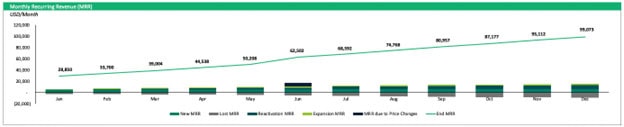
Chart 1. MRR January-December
Final Thoughts
In conclusion, calculating Monthly Recurring Revenue (MRR) is essential for any SaaS business, providing a clear and predictable view of both monthly and yearly income. By understanding and calculating MRR through the six key steps defining the baseline, estimating new and lost MRR, calculating reactivation and expansion MRR, and accounting for price changes, you can better manage cash flow, make strategic decisions, and plan for sustainable growth. MRR is not only a financial metric but also a critical tool for financial planning, boosting investor confidence, and optimizing growth strategies driving business success. By regularly tracking and analyzing MRR, businesses can gain deeper insights into customer behavior, retention, and areas for improvement, ultimately fostering long-term profitability and stability.
Calculating MRR in a simple business structure is relatively straightforward. However, as businesses grow and become more complex, such as offering different subscription plans, dealing with fluctuating customer numbers, and handling various changes in customer behavior, it can get tricky to keep everything in check. That’s where financial modeling comes in. It helps simplify the process by giving businesses a clearer way to track and analyze their revenue. With the right models in place, businesses can make smarter, data-driven decisions and stay on top of their financial health as they grow.
FAQ
1. Why should I calculate MRR?
MRR (Monthly Recurring Revenue) is crucial for understanding the predictable revenue stream of your SaaS business. Calculating MRR helps with financial planning, growth tracking, and investor confidence. It provides a clear view of future income, helps manage cash flow, and supports informed decision-making for long-term business success.
2. How do I calculate the baseline (start MRR)?
To calculate the baseline MRR, multiply the number of active customers by their respective subscription prices. This gives you the starting point before considering new, lost, or upgraded/downgraded subscriptions.
Formula: MRR = Σ (Active Customers × Subscription Price)
3. What are New, Lost, and Reactivation MRR?
New MRR: The revenue from new customers acquired during the period.
Lost MRR: The revenue lost from customers who cancel their subscriptions.
Reactivation MRR: The revenue regained from customers who re-subscribed after previously canceling. Each of these can be calculated by multiplying the number of customers in each category by their subscription price.
4. What is Expansion MRR and how do I calculate it?
Expansion MRR refers to the revenue gained from existing customers who upgrade their subscription plans. To calculate it, compare the additional revenue from upgrades against the revenue lost from downgrades.
Formula: Revenue Gained in Upgraded Plan – Revenue Lost in Downgraded Plan
5. How do price changes affect MRR?
Price changes directly impact MRR by either increasing or decreasing the amount of revenue generated per customer. To calculate the effect, determine the difference between the old and new prices and multiply it by the number of affected customers.
Formula: MRR Due to Price Change = Number of Affected Customers × Price Change per Customer
You might also like:
- How to Calculate SaaS Monthly Recurring Revenue?
- How to Calculate Annual Recurring (ARR) Revenue for Sustainable Growth
- 10 Ideas to Increase Average Revenue Per User
- Measuring Monthly Recurring Revenue For SaaS Business
- Monthly Recurring Revenue (MRR)
- Average Revenue per User (ARPU)
- Financial Modeling for Startups and Small Businesses
- Financial Modeling using Excel
- SaaS
- Online Businesses
- 10 Tips to Develop a First Class Business Valuation Report
- Why Financial Forecasting Models Are Vital for Your Business
- Understanding the Debt Service Coverage Ratio: An Essential Metric for Financial Analysis
- Top 5 Risks of Wind Energy Parks
- 10-year Financial Projections
- How to Prepare a Financial Plan for a Chicken Egg Farm?
- Understanding Insurance Policies: A Beginner’s Guide
- Financial Ratios Analysis and Its Importance
- Free Budget Planner Template in Excel for Services Businesses
