0 ITEMS

Best Airbnb Income and Expense Spreadsheet for Taxes

The best spreadsheet template for Airbnb income and expenses tracking for taxes is one that maps every transaction to a line on IRS Schedule E (the form for reporting rental income and expenses), flags each expense as direct or indirect, splits shared costs between rental and personal days, calculates depreciation on the building, and reconciles gross 1099-K totals to net payouts. Most host spreadsheets skip most of those five tax jobs, so this guide from eFinancialModels, home of the Airbnb financial model templates category, shows what a tax-ready tracker contains through a two-property worked example.
Key Takeaways
- A tax-ready Airbnb spreadsheet needs Schedule E line mapping, a direct or indirect flag, a days-based allocation factor, a depreciation line, and a 1099-K reconciliation tab.
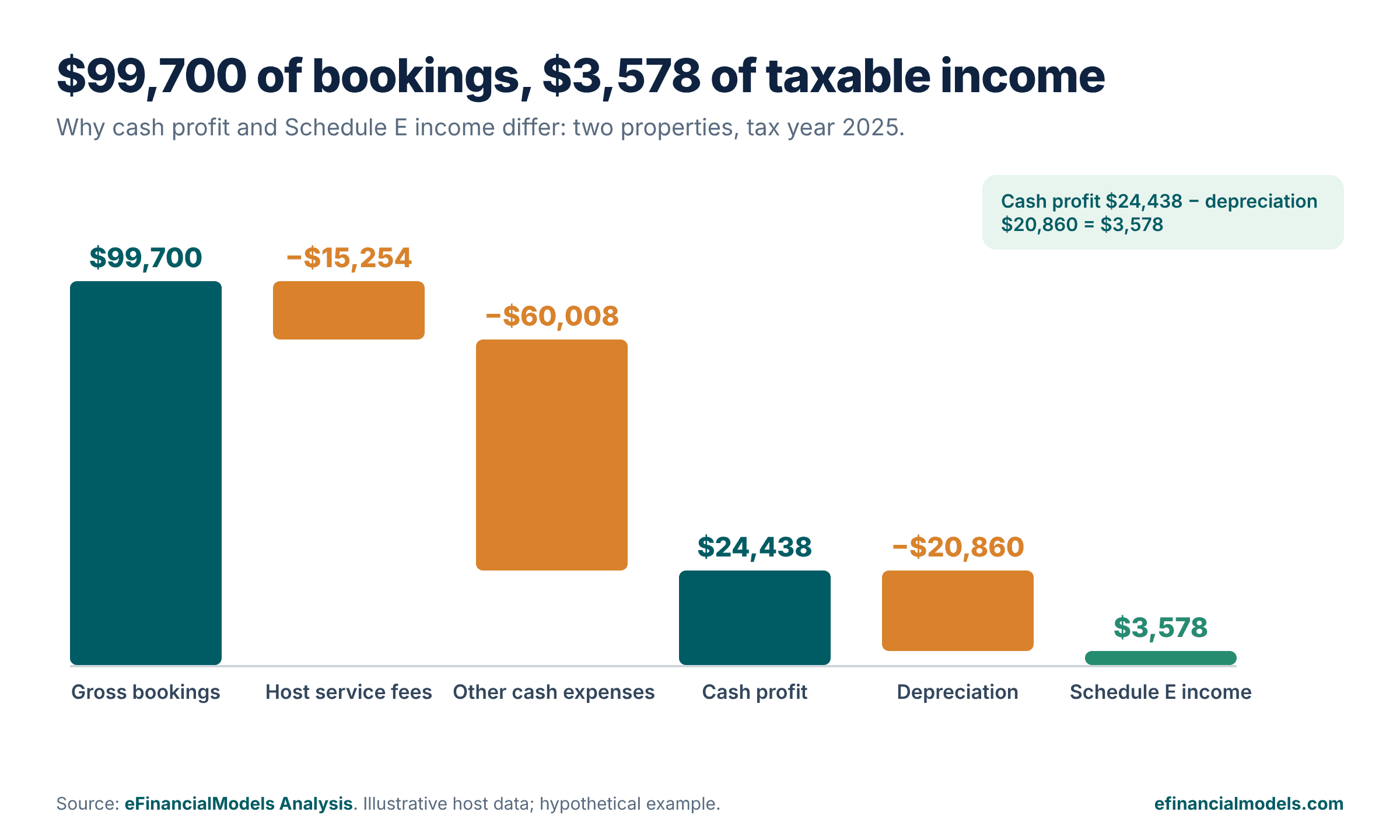
- In a hypothetical worked example, two properties produced $99,700 of gross bookings and $24,438 of cash profit but only $3,578 of taxable Schedule E income.
- Twenty personal-use days on one property cut its allowable deductions by $3,015 even though the property was not treated as a residence.
- Recording gross bookings on line 3 and the host service fee on line 8 is what makes a spreadsheet agree with the 1099-K.
- Hosts who provide significant services such as daily maid service report on Schedule C, which added $506 of self-employment tax in the example.
Five Jobs a Tax-Ready Airbnb Spreadsheet Must Do
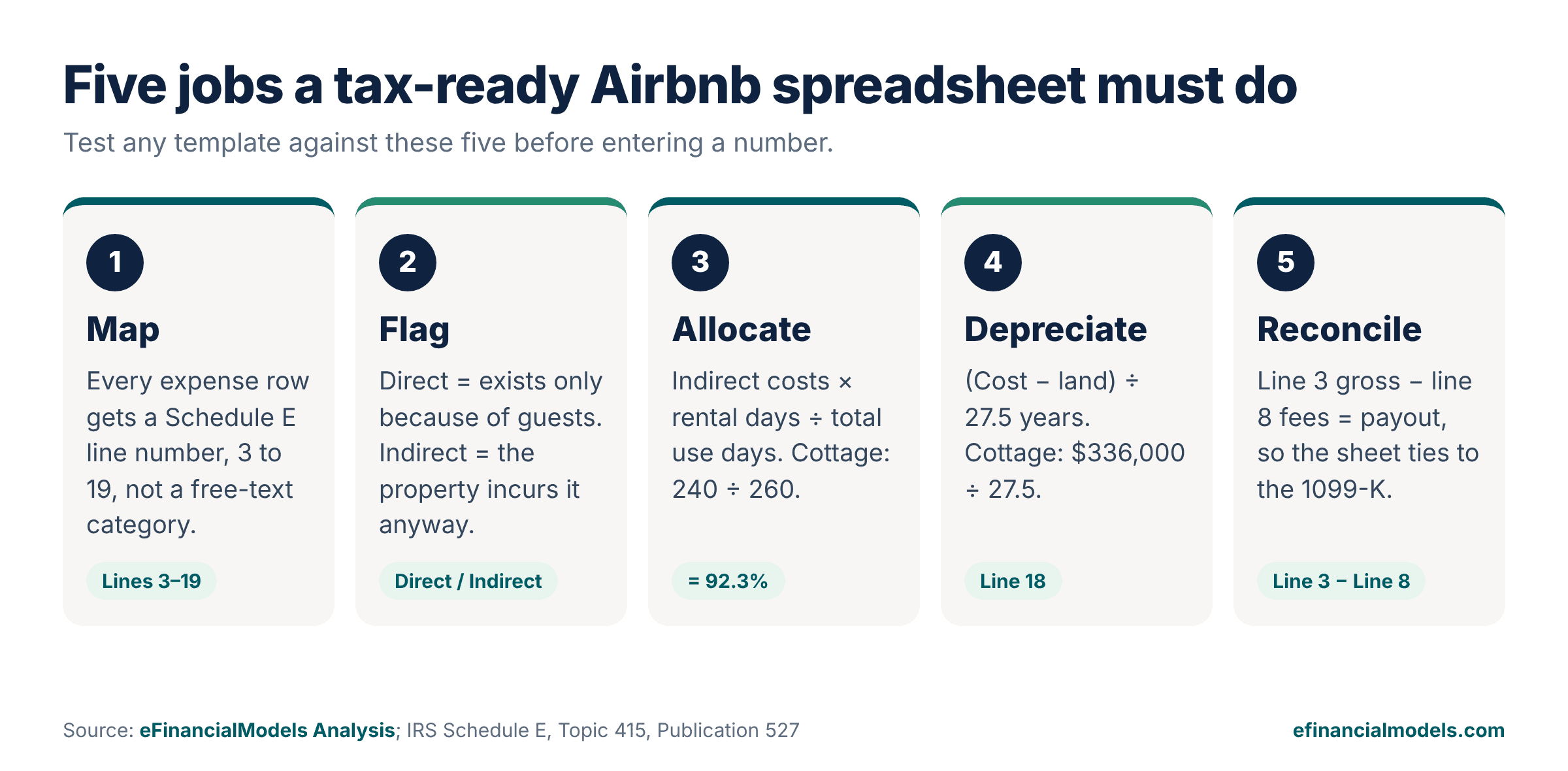
A tax-ready Airbnb spreadsheet reproduces Schedule E so filing becomes a copy exercise. The 2025 Schedule E rental section runs from line 5 (Advertising) to line 19 (Other), with line 18 for depreciation.
Map every row to a Schedule E line number
Every expense row needs a numeric Schedule E line, not a free-text category. The worked example uses a “Schedule E line” column with values from 3 to 19 and a summary tab that adds them with SUMIFS by property and line, so one list feeds two Schedule E columns. Mileage belongs on line 6. In December 2023 the IRS set the standard mileage rate for business use for tax year 2024 at 67 cents per mile (IRS Notice 2024-08, issued December 2023), and in December 2024 it set the tax year 2025 rate at 70 cents per mile (IRS Notice 2025-5, issued December 2024), so each trip to the property is its own row at the rate for its year.
Flag each expense as direct or indirect
An expense is direct when it exists only because of guests (cleaning turnovers, the host service fee) and indirect when the property incurs it anyway (mortgage interest, insurance, property tax, utilities, depreciation). The distinction matters because, in the words of IRS Topic 415, “if you use the dwelling unit for both rental and personal purposes, you generally must divide your total expenses between the rental use and the personal use based on the number of days used for each purpose.” Direct guest costs are fully rental; indirect costs are multiplied by an allocation factor of fair rental days (days rented at a market rate) over total use days, which for the cottage’s 240 rental and 20 personal days is 240 / 260 = 92.3 percent. IRS Topic 415 also defines a residence as a unit whose personal days exceed the greater of 14 days or 10 percent of rental days, which for 240 rental days is 24 days; the cottage’s 20 personal days did not exceed 24, so it was not a residence, yet the days-based split still applied.
Depreciate the building and tie out the 1099-K
Depreciation, the annual deduction that spreads the building’s cost over its tax life, is usually the largest line on Schedule E and the one most host templates omit. Residential rental property is recovered over 27.5 years and, under the heading “What Rental Property Can’t Be Depreciated?”, IRS Publication 527 (for 2025 returns) lists land first, so the template needs a land-share input, a formula for the portion of the property cost that can be depreciated, known as the depreciable basis and calculated as property cost minus land value, and an annual depreciation line that flows to line 18. The 1099-K, the form a payment platform files to report gross amounts paid to a host, must also tie out, and the IRS notes that a host may receive the form even when payments fall below the reporting threshold (IRS, Understanding your Form 1099-K). Recording gross bookings on line 3 and the host service fee on line 8 (Commissions) makes line 3 equal the form, with the bank seeing line 3 minus line 8.
How Template Types Compare on the Tax Criteria
Most options fall into four groups, rated below on six tax criteria as eFinancialModels observed them in the templates and tools reviewed.
| Option type | Schedule E line mapping | Multi-property | Personal-use allocation | Depreciation | 1099-K reconciliation | Schedule C vs E check |
|---|---|---|---|---|---|---|
| Free host spreadsheets (blogs, community downloads) | Sometimes | Sometimes | Rarely | Rarely | No | No |
| Paid marketplace templates (Excel or Google Sheets) | Rarely | Usually | Rarely | Rarely | No | No |
| Landlord bookkeeping apps | Usually | Yes | Rarely stated | Rarely stated | Partial | No |
| General accounting software | Only with a custom chart of accounts | Yes | Manual | Manual journal entry | Manual | No |
Forecasting models on the eFinancialModels Rental Income tag page go one step further by projecting what a tracker records.
Worked Example: Two Properties, One Schedule E Each
The worked example is hypothetical, built by eFinancialModels for this article with illustrative figures rather than data from a real host, and it tracks a seasonal lakeside cottage and a steady downtown condo through tax year 2025: a Transactions tab holds 185 dated rows with property ID, Schedule E line, amount and a direct or indirect flag, an Assumptions tab holds prices, land shares, day counts and rates, and everything else is a formula.
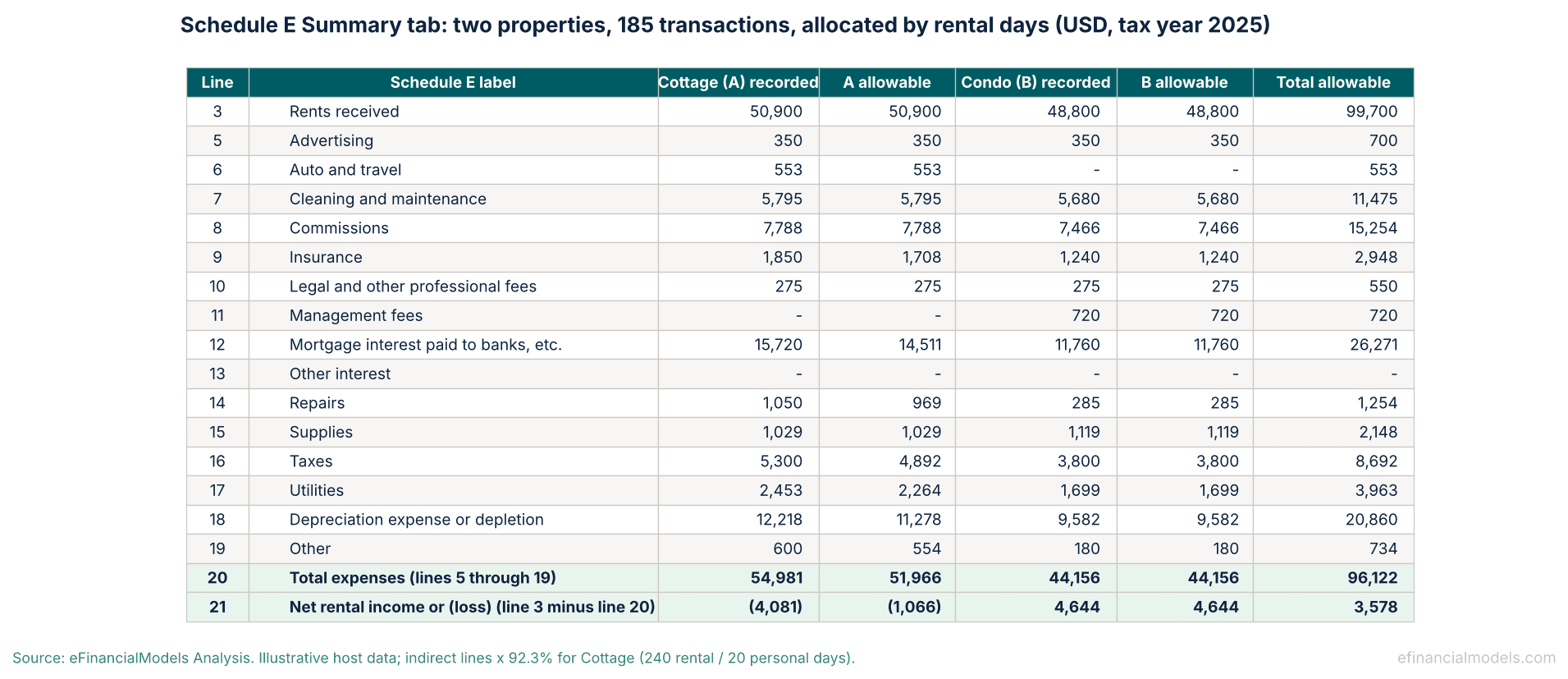
All figures below are illustrative and rounded to the nearest dollar. The cottage recorded $54,981 of expenses but only $51,966 are allowable after the 92.3 percent factor is applied to its indirect lines; the $3,015 difference is the personal-use share. The condo, with zero personal days, keeps all of its $44,156. Total allowable expenses are $51,966 plus $44,156, or $96,122, a total that already contains the $15,254 of host fees and the $20,860 of depreciation below. Gross bookings of $99,700 minus $96,122 leave $3,578 of net rental income on Schedule E; $99,700 minus the $15,254 of host fees is the $84,446 that reached the bank. Depreciation starts from the depreciable basis: the cottage’s $420,000 less 20 percent is $336,000, divided by 27.5 years is $12,218.18 a year, and $12,218.18 times 240/260 is $11,278.32 allowable; the condo’s $310,000 less a 15 percent land share is $263,500, divided by 27.5 is $9,581.82 with no reduction, so allowable depreciation totals $11,278.32 plus $9,581.82, or $20,860.14, shown as $20,860. Adding that $20,860 back to the $3,578 of net income gives cash profit (income minus cash expenses, before depreciation) of $24,438.
Seasonality decides when the spreadsheet matters
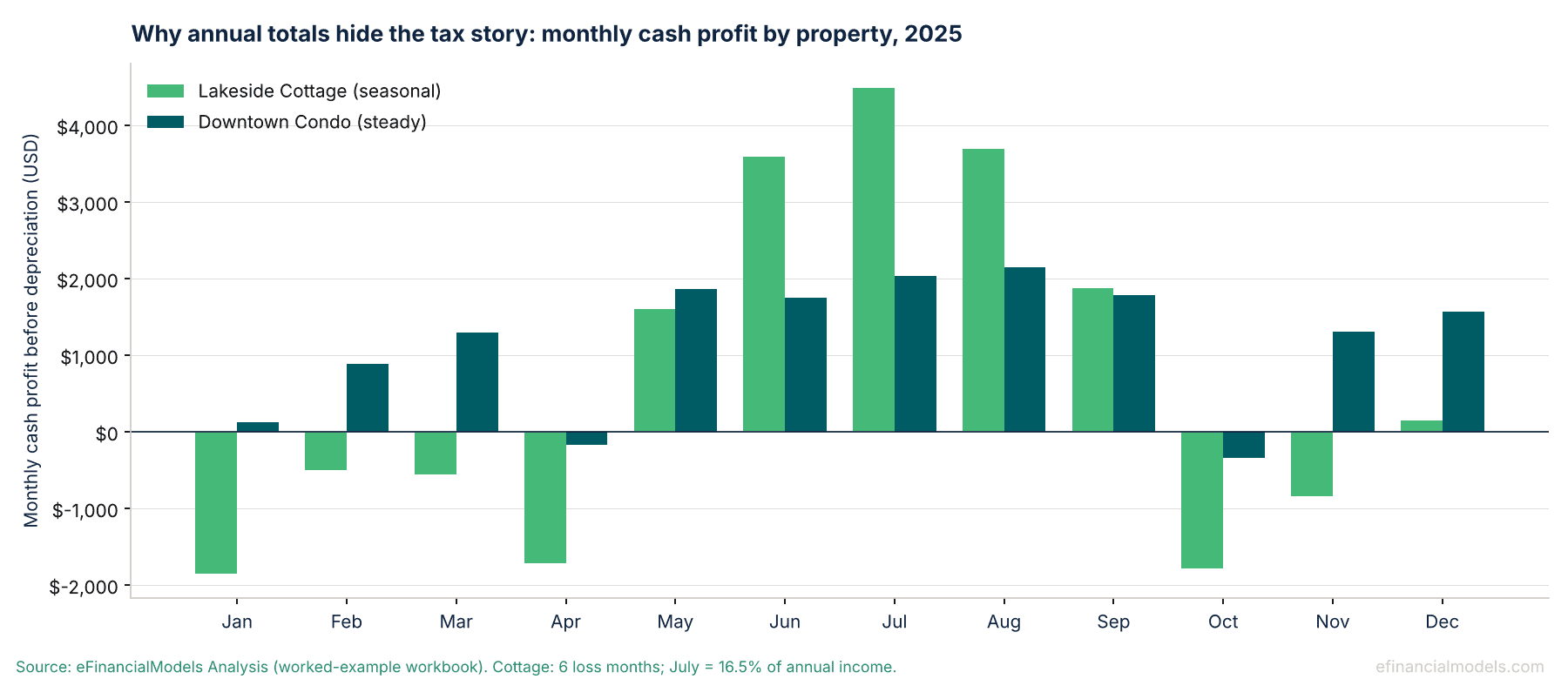
A seasonal property can lose money in six months and still be the better performer, so monthly tracking matters for estimated tax payments: the cottage earned 16.5 percent of its annual income in July; the condo never earned more than 9.8 percent in any month.
Schedule E or Schedule C changes the tax bill
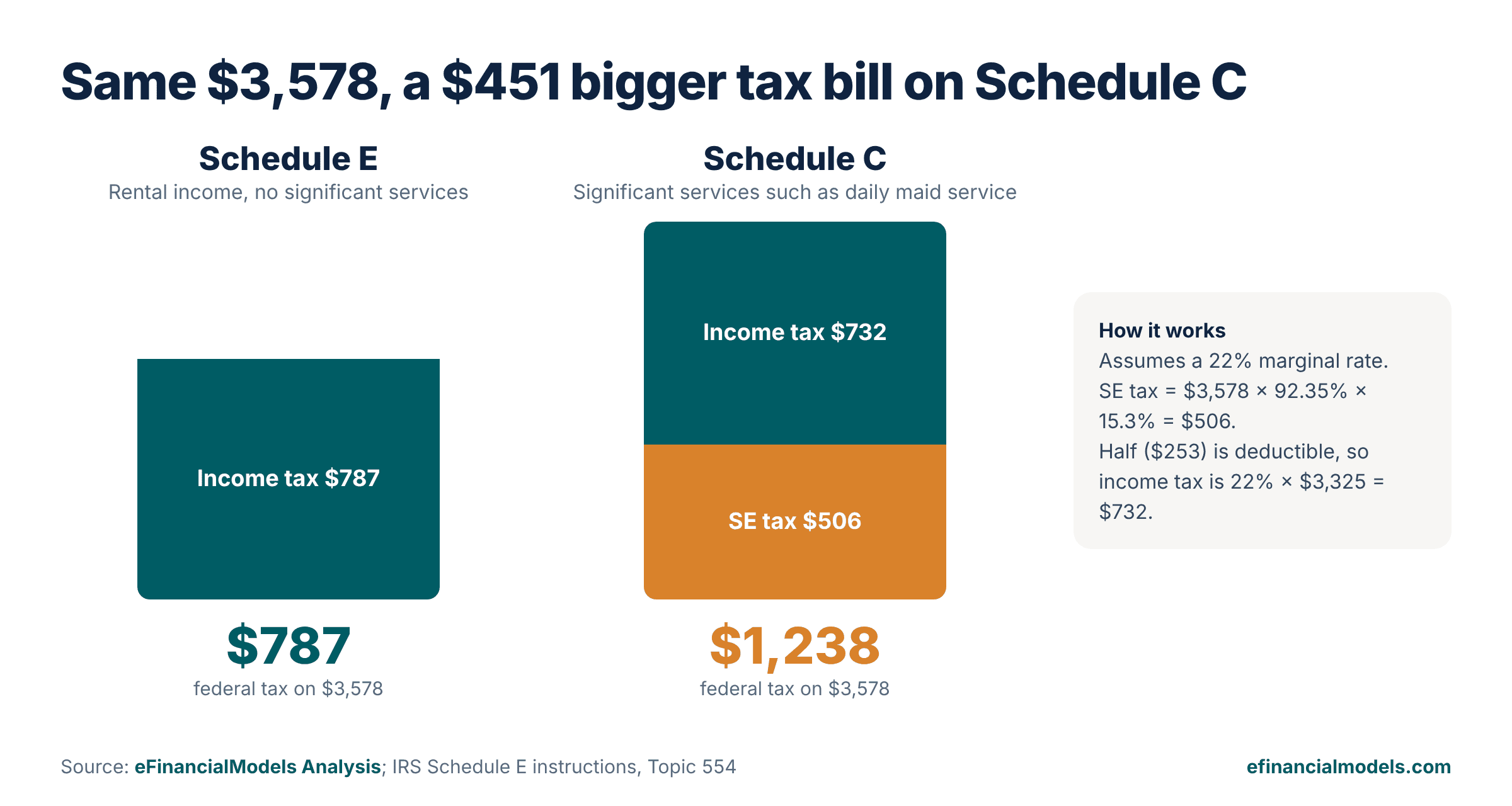
The same $3,578 of net income costs $787 of federal tax on Schedule E and $1,238 on Schedule C at an assumed 22 percent marginal rate (the rate applied to the next dollar of income), and the difference is self-employment tax, the Social Security and Medicare tax paid by the self-employed. The IRS instructions direct hosts to report on Schedule C if they provided significant services to the renter, such as maid service (Instructions for Schedule E, 2025); heat, light and cleaning of public areas do not count. Schedule C income carries self-employment tax of 12.4 percent for Social Security plus 2.9 percent for Medicare, a combined 15.3 percent, on 92.35 percent of net earnings, per IRS Topic 554. On $3,578 that is $3,304 ($3,578 times 0.9235) times 15.3 percent, or $506. The same topic allows one-half of that self-employment tax, $253, to be deducted in figuring adjusted gross income, so Schedule C income tax is 22 percent of $3,325 ($3,578 minus $253), or $732, and the Schedule C total is $506 plus $732, or $1,238, against $787 on Schedule E.
Frequently Asked Questions
Which spreadsheet template is best for Airbnb taxes?
The best spreadsheet template for Airbnb income and expenses tracking for taxes is the one that passes a five-part test, one part for each of the five jobs described above, before any number is entered. Its category list must be the Schedule E line list, every expense row must carry a direct or indirect flag, the allocation factor must be a formula driven by day-count input cells, depreciation must be a formula driven by price and land-share inputs, and a reconciliation tab must tie gross bookings to the 1099-K. A template that fails any part of that test looks complete in December and needs rebuilding in April. The test takes about ten minutes with a sample file open and applies equally to a free download and to a paid product from a template marketplace.
What records should a host keep behind the spreadsheet?
The spreadsheet is a summary rather than the evidence, so every row should point to a receipt reference that leads to a payout statement, an invoice, a bank line or a mileage log entry. Platform payout statements support lines 3 and 8, the lender’s Form 1098 supports mortgage interest, the property tax bill supports line 16, and a dated odometer log supports each mileage row. Filling the reference column as rows are entered means a preparer’s question can be answered from one file instead of a year of reconstruction. Naming each digital copy with the same reference code used in the spreadsheet lets a row and its document be matched years later without opening every scan in a folder.
What happens to depreciation when the property is sold?
Depreciation that a host claims, or could have claimed, reduces the adjusted basis of the property, which is the cost figure used to measure the gain on a sale, so a larger deduction each year produces a larger taxable gain when the property is sold. IRS Publication 527 refers to depreciation that was allowed or allowable, which means that skipping the deduction does not avoid the basis reduction later. A cumulative depreciation column per property therefore supplies line 18 each year and also keeps the running adjusted basis that will be needed in the year of sale. Hosts who never claimed depreciation should raise the point with a preparer before selling, because the basis reduction applies in any case.
What if no 1099-K arrives, or more than one does?
The income is taxable whether or not a form arrives, so the spreadsheet should record every gross booking regardless, and the reconciliation tab simply confirms that the form, when it comes, matches line 3. A host who lists on two platforms may receive two forms, or one form and none, and a cumulative gross column per platform shows which forms to expect. Recording by platform and property rather than by bank deposit is what lets several forms reconcile to one Schedule E line. When a form differs from the spreadsheet, the usual cause is a booking that straddled the year end or a refund that the platform netted against a later payout, and the transaction list exposes either one by date.
How should several properties fit in one file?
One transaction list with a property ID column, one Assumptions row per property with its own day counts and land share, and one summary column per property is the structure that scales, because adding a property means adding a row and a column rather than building a new tab. Personal-use days belong in a small calendar table per property, logged as they happen, since the allocation factor and the residence test both change with every stay. A portfolio total then becomes a single formula across the summary columns, and a property sold during the year keeps its own column with its months in service reduced on the Assumptions tab, so nothing has to be deleted or moved.
Conclusion: Choose the Template That Reproduces Schedule E
The best spreadsheet template for Airbnb income and expenses tracking for taxes reproduces Schedule E line by line, flags direct and indirect costs, allocates indirect costs by days, depreciates the building and ties to the 1099-K. Hosts ready to move from tracking last year to forecasting the next one can use the Single Airbnb Rental Unit Financial Model from eFinancialModels, which projects occupancy rate, average daily rental fee and operating expenses for one unit over a monthly 10-year horizon.