
0 ITEMS

How Strategic Financial Modeling Shifts the Power Dynamics

When a founder walks into a room — whether it’s a VC pitch, a bank loan discussion, or a PE negotiation — the quality of their financial model is rarely a footnote. It is often the deciding variable. Not because investors run every formula, but because a well-built model signals something critical: the founder understands the economics of their business, not just the story.
Giorgos Lampropoulos is the founder and CEO of Profit Vision, and one of the top-rated financial modeling experts on eFinancialModels.com. Over his career, he has built financial models for entrepreneurs, operators, investors, and lenders across sectors spanning SaaS, infrastructure, real estate, energy, and private credit. His work is rooted in a single conviction: a model should not just produce numbers — it should help decision-makers understand their business, compare options, and act with confidence.
In this exclusive interview, Giorgos speaks candidly about what separates a functional financial model from a genuinely strategic one — and what founders, CFOs, and investors lose when they settle for the former.
1. What does a financial model need to demonstrate to genuinely strengthen a founder’s position in a fundraising meeting?
According to Giorgos, the answer starts with what the model is designed to do.
“Investors and lenders want to see three things clearly: how the business makes money, what drives growth, and where the risks are. A strong model connects all of these. It should show the relationship between revenue drivers, margins, working capital, hiring, capital needs, debt capacity, and cash runway. Most importantly, it should show what happens when assumptions change.”
He draws a sharp contrast between what a basic model achieves and what a great one makes possible. A basic model answers: “What do we think will happen?” A great model answers: “What needs to happen for this business to work — how much capital do we need, what return can investors expect, and what are the key risks we must manage?”
That distinction changes the fundraising dynamic entirely. “A great model gives the founder control of the conversation. It turns fundraising from a pitch based on ambition into a discussion based on evidence, strategy, and options.”
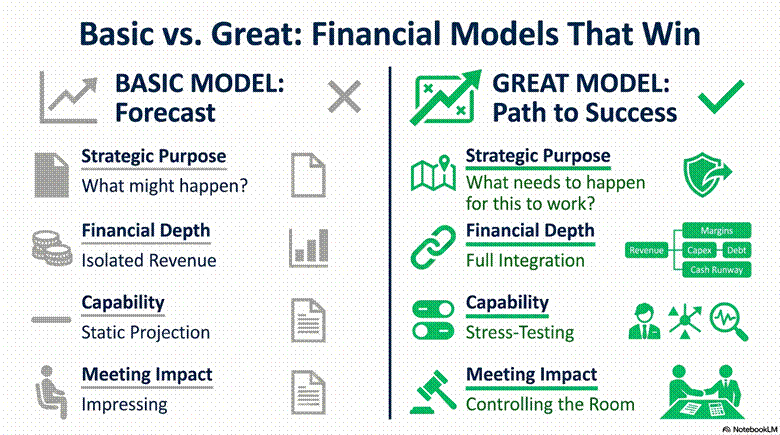
Basic vs. Great: What Your Financial Model Must Be Able to Answer
| BASIC MODEL | GREAT MODEL |
| Answers: What do we think will happen? | Answers: What needs to happen for this to work? |
| Presents a single forecast | Models multiple scenarios and stress tests |
| Shows revenue projections | Connects revenue, margins, capex, debt & cash runway |
| Asks investors for capital | Defends valuation and negotiates deal terms with evidence |
| Impresses in the pitch deck | Controls the conversation in the boardroom |
| Answers lenders reactively | Proactively demonstrates repayment capacity & downside cover |
Source: eFinancialModels.com | Expert Insights Series
2. How do you approach building models for different moments — fundraising, acquisition, and day-to-day operations?
Giorgos is precise on this point: the structure of a model should follow the decision it needs to support — and each moment demands something fundamentally different.
A fundraising model must tell a clear investment story — capital required, milestone runway, potential return for investors, and the ability to test scenarios across growth, pricing, and hiring variables. It is designed to persuade through logic, not hope.
An acquisition model shifts focus entirely to value, risk, and integration. What does the target business actually earn after normalizing for owner-specific expenses, one-offs, and seasonality? Can the deal be financed? Is the acquisition accretive? What is the sensitivity to purchase price, debt terms, and exit assumptions?
For day-to-day operations, the model becomes a management instrument — less about impressing an investor and more about helping the founder make better decisions every month. Cash management, budget-versus-actual tracking, working capital, and hiring plans.
“The structure changes depending on the moment, but the principle is the same: the model should not just produce numbers. It should help the entrepreneur understand the business, compare options, and make decisions with more confidence.”
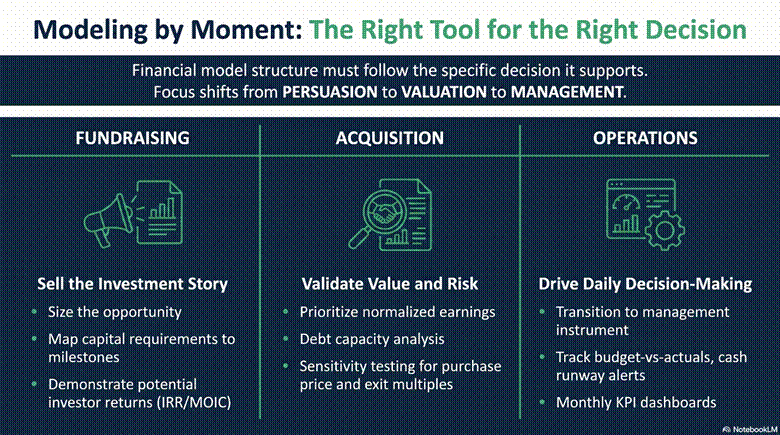
Modeling by Moment: What Each Model Must Accomplish
| FUNDRAISING | ACQUISITION | OPERATIONS |
| Investment story & opportunity sizing | Normalized earnings & target valuation | Cash tracking & monthly decision support |
| Capital required & use of funds | Accretion analysis & synergy modeling | Hiring plans & working capital management |
| Funding runway & milestone mapping | Debt capacity & downside risk analysis | Budget vs. actual performance tracking |
| Scenario testing: growth, pricing, hiring | Sensitivity: price, margins, exit multiples | Cash runway alerts & reforecasting |
| Investor return potential (IRR, MOIC) | Returns: cash-on-cash, IRR, payback | KPI dashboards for leadership |
Source: eFinancialModels.com | Expert Insights Series
3. AI can now produce a financial model in minutes. Where does human expertise still make the decisive difference?
Giorgos is measured on this question — acknowledging AI’s genuine utility while identifying precisely where it breaks down for the decisions that matter most.
“AI can be very useful for speeding up the first draft. It can help with structure, formulas, layouts, and common assumptions. But the real value of a financial model is not that it exists — it is whether it reflects the actual economics, risks, and decision points of the business.”
The decisive gap is sector knowledge and judgment. A SaaS business depends on churn, CAC, expansion revenue, and retention. A real estate model depends on lease-up timing, cap rates, and financing terms. An energy project depends on capacity, tariffs, degradation curves, O&M costs, and debt sizing. A fund model depends on deployment, recycling, defaults, fees, and waterfall structures. AI generates a generic version — it does not know which assumptions are material, which benchmarks are realistic, or which risks a sophisticated investor will scrutinize.
The conclusion Giorgos draws is unambiguous: AI can accelerate the process. Human judgment makes the model credible, decision-ready, and useful in the room where capital, risk, and strategy are actually being discussed.
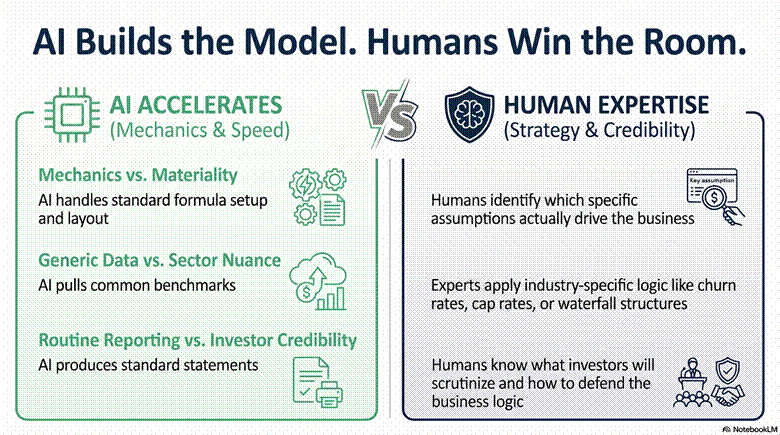
Where AI Ends and Human Expertise Begins
| What AI Can Accelerate | What Human Expertise Makes Decisive |
| First-draft model structure & layout | Identifying which assumptions are truly material |
| Standard formula setup | Sector-specific logic (churn, cap rates, tariffs, waterfalls) |
| Generic benchmarks | Benchmarks that reflect actual market conditions |
| Template formatting | Knowing what investors and lenders will scrutinize |
| Common scenario frameworks | Challenging assumptions & validating business logic |
| Routine financial statements | Translating strategy into defensible financial logic |
Source: eFinancialModels.com | Expert Insights Series
4. What should an entrepreneur’s financial model reveal before committing to an acquisition?
For acquisitions, Giorgos argues the model’s primary function is to help the buyer see whether the deal works under realistic conditions — not under the seller’s optimistic narrative.
Key things a strong acquisition model must surface:
- Normalized cash flow — adjusted for owner-specific costs, one-off items, and post-transaction changes
- Debt capacity — can the business service acquisition financing under realistic downside conditions?
- Downside sensitivity — what happens if revenue falls 10%, margins compress, or capex exceeds projections?
- Return economics — cash-on-cash return, IRR, payback period, and sensitivity to purchase price and exit multiple
- Margin of safety — what needs to be true for the deal to succeed? If returns require aggressive assumptions, that is a warning sign
“The question is not only ‘Can I afford this?’ but ‘What return am I earning for the risk I am taking?’ A strong model gives the entrepreneur the confidence to negotiate, walk away, or proceed with a clear plan.”
5. Which sectors and deal types are you finding most rewarding — and where is demand concentrating right now?
Giorgos has a clear answer. Asset-heavy and project-based models — energy, infrastructure, real estate development, hospitality, manufacturing, and specialized operating businesses — are where he finds the most intellectually demanding and commercially rewarding work.
“In these sectors, small changes in utilization, pricing, construction timing, capex, debt terms, or operating costs can completely change the outcome. That makes the model very valuable — it helps the entrepreneur see where the real value drivers are.”
On current demand, he observes a meaningful shift: founders are no longer only asking how large the business can become. They are asking how much capital is needed, what return they can offer investors, what the specific risks are, and what must happen operationally for the business to succeed. “That is where a strong model becomes extremely useful” — and where the gap between a generic template and expert-built model becomes most apparent.
Featured Financial Model Templates by Giorgos Lampropoulos (Profit Vision)
- Hotel Development Financial Model
- Solar (PV) Power Plant – Project Finance Model
- Software as a Service (SaaS) Financial Model
- Private Credit Fund Financial Model
- Office Building Acquisition Financial Model
- Advanced Financial Model (Operations & Valuation)
Browse the full Profit Vision library:















Financial models are most valuable when they help entrepreneurs make better decisions — not just present better numbers. Whether the context is capital raising, acquisition evaluation, project financing, or operational management, the model should deliver clarity on what drives value, where the risks concentrate, and what must be true for the business to succeed.
That is the standard Giorgos Lampropoulos holds his work to — and the standard eFinancialModels.com upholds in every expert-built template on the platform.


