
0 ITEMS

From Spreadsheets to Strategy: Modeling 50+ Industries and What’s Building Next

Some financial modelers pick a lane and stay there. Others, like Jason Varner — the founder of SmartHelping and a 2017 Best Financial Model Vendor award winner on eFinancialModels — build in so many directions that their portfolio reads like a directory of modern commerce: real estate waterfalls, SaaS subscription engines, data center projections, biogas plants, car washes, co-working pods, battery recycling facilities, and even a space startup model.
We sat down with Jason to understand how a modeler with a decade of experience gets up to speed on a brand-new industry, designs for uncertainty, and decides where to place his bets next. His answers are characteristically direct — but the story they tell reveals a discipline honed across hundreds of templates and thousands of client conversations.
Q1: When you decide to build a model for a new sector, how do you get up to speed — and what tells you there’s genuine demand?
Jason:
| “Extensive work with a client is how I understand unit economics. If the industry is brand new to me or involves a new way to look at a business, I use ChatGPT Pro — extensive QA and proving the business logic so I fully understand it. Doing this correctly takes time.” “The only indicator of demand is receiving many requests to build a certain type of model or seeing those requests on Upwork. In 2016 and 2017 when I first started, the only models I was asked to build were for real estate and SaaS.” |
Behind the Answer
Every great financial model begins with one thing: a deep understanding of what drives value in the business. Jason does not start building in Excel. He starts by asking questions — lots of them. What are the key revenue drivers? How do costs behave at different volumes? What does “unit economics” actually mean in this specific industry? The answers to these questions form the bedrock of every model he builds.
This scrutiny is what separates a model that merely adds up numbers from one that tells a story. A financial model is not just a spreadsheet — it is a narrative device. Every row, every assumption, every formula should contribute to a coherent storyline about how the business works, where the risks are, and what levers management can pull to improve outcomes. A good model conveys a clear message: “This is how the business operates, and here is what happens when key variables change.”
Jason’s process reflects this philosophy. Whether he is learning a brand-new industry through ChatGPT Pro or refining his understanding through client collaboration, every step is aimed at validating the assumptions that will eventually drive the model. He proves the business logic through extensive QA, stress-testing each input against what he knows about real-world operations. Only when the logic holds up does he begin to build the assumption framework — a user-friendly layer that lets operators, investors, and lenders explore their own scenarios.
The result is a model that has been scrutinized from every angle before it ever reaches a buyer. When you purchase a template from SmartHelping, you are not just getting formulas — you are getting the product of hundreds of hours of thinking about what makes that business tick.
The Product Link: Models like his 3PL Warehouse Logistics Financial Model — a bottom-up, operator-focused projection that factors warehouse sizing, labor scaling, and delivery economics — are a perfect example of this deep-scrutiny process in action.
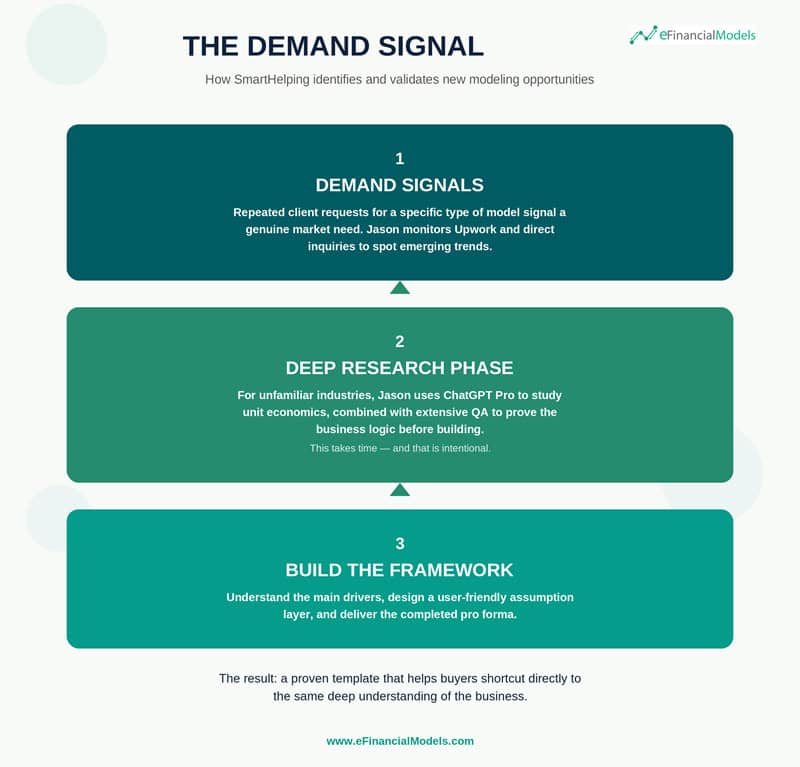
The Demand Signal
| Step | Phase | What Happens |
| 1 | Demand Signals | Repeated client requests for a specific type of model signal a genuine market need. Jason monitors Upwork and direct inquiries to spot emerging trends. |
| 2 | Deep Research Phase | For unfamiliar industries, Jason uses ChatGPT Pro to study unit economics, combined with extensive QA to prove the business logic before building. This takes time — and that is intentional. |
| 3 | Build the Framework | Understand the main drivers, design a user-friendly assumption layer, and deliver the completed pro forma. |
The result: a proven template that helps buyers shortcut directly to the same deep understanding of the business.
Q2: How do you design for decision-making under uncertainty?
Jason:
| “Generally, I try to make the assumptions as complete and variable as possible. This makes it easy to adjust inputs so the user can quickly see how shifting variables affect the bottom line. One model can’t cover all scenarios, but the goal is to provide a template that fits the majority of cases.” |
Behind the Answer
Uncertainty is not something to be eliminated from a financial model — it is something to be designed for. Jason’s approach is rooted in the understanding that no single set of assumptions can predict the future. Instead of trying to build a model that is “right,” he builds one that is flexible enough to explore multiple plausible futures.
This is where the storyline concept becomes critical. A well-designed model tells a story that holds together even when assumptions change. The narrative — “we grow revenue by expanding into these markets, our costs scale at this rate, and our margins improve as we reach these milestones” — must remain coherent whether growth is 10% or 30%. The model becomes the conveyor of that key message, not just a calculation engine.
Jason achieves this by building a variable-rich assumption layer on top of standard, battle-tested financial logic. The user can dial revenue growth up or down, adjust churn rates, or change operating cost assumptions, and the model faithfully propagates those changes through the P&L, balance sheet, and cash flow statement. The story adapts, but the structure remains sound.
He also resists the temptation to over-complicate. “One model can’t cover all scenarios,” he says, so he focuses on the most common business logic for the given industry. This discipline ensures that the model remains usable — because a model that nobody can understand is a model that nobody will use, no matter how accurate it might be.
This approach powers templates like the Turnaround & Buyout Planning Model where the same framework lets an operator stress-test a distressed acquisition and an investor evaluate the upside of a reorganized portfolio — two very different stories from the same flexible engine.
Q3: How do you build one model that speaks to operators, investors, and lenders?
Jason:
| “For most of my models, I use a standard wrapper that displays financial statements, IRR, DCF Analysis, Executive Summary, Debt Coverage, and a monthly/annual detail. Those things speak to most users of a model.” |
Behind the Answer
A financial model must serve different readers, each of whom arrives with a different question. The operator wants to know whether there will be enough cash to make payroll next month. The investor wants to understand the potential return and exit timeline. The lender needs to see debt service coverage ratios and covenant headroom. A great model answers all three questions without losing coherence.
Jason’s solution is elegant: standardize the output, customize the engine. Every model — whether it is for a data center, a car wash, or a SaaS startup — speaks the same financial language on the output side. The three-statement integration is non-negotiable. IRR and DCF are always calculated. Debt coverage ratios are always visible. This consistency means that anyone who understands finance can pick up any SmartHelping model and immediately find what they are looking for.
But beneath that consistent wrapper, the engine is entirely tailored to the business. The revenue logic for a solar farm looks completely different from the logic for a subscription software company. The cost structure for a logistics business bears no resemblance to that of a real estate development. The art lies in making the underlying complexity disappear behind a clean, familiar interface.
For a lender: debt coverage ratios and amortization schedules. For an investor: IRR, MOIC, and waterfall distributions. For an operator: monthly cash flow visibility and KPI dashboards. All from the same model, thanks to a consistent output architecture.
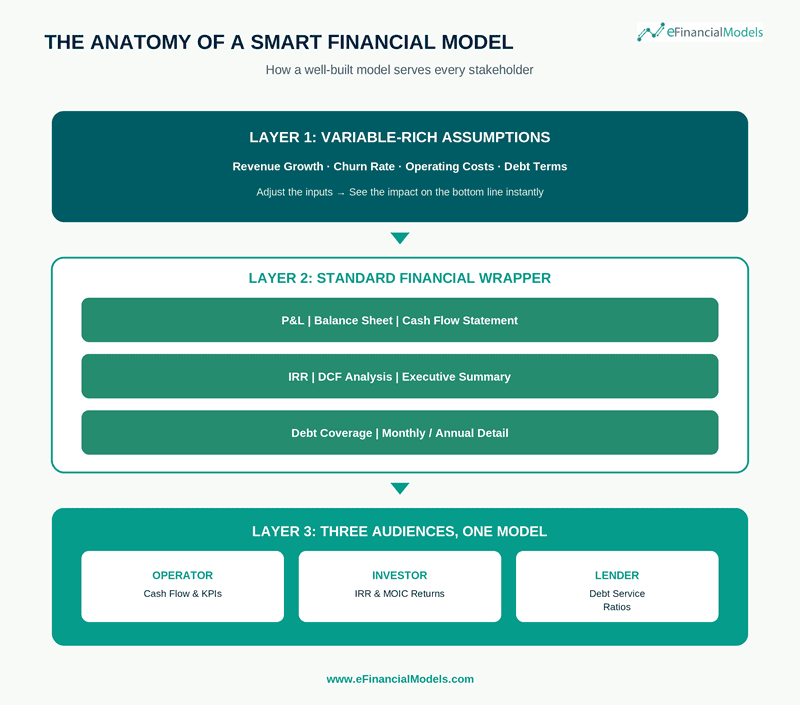
The Anatomy of a Smart Financial Model
| Layer | Component | Details |
| Layer 1 ~ | Variable-Rich Assumptions | Revenue Growth · Churn Rate · Operating Costs · Debt Terms. Adjust the inputs → see the impact on the bottom line instantly. |
| Layer 2 ~ | Standard Financial Wrapper | P&L, Balance Sheet, Cash Flow Statement · IRR, DCF Analysis, Executive Summary · Debt Coverage, Monthly / Annual Detail. |
| Layer 3 ~ | Three Audiences, One Model | Operator — Cash Flow & KPIs · Investor — IRR & MOIC Returns · Lender — Debt Service Ratios. |
How a well-built model serves every stakeholder.
Q4: What judgment calls can a tool starting from scratch simply not replicate?
Jason:
| “The biggest structural decision usually concerns the type of scaling occurring and whether cohort modeling is required. Next are the types of debt facilities. The goal is to create something that closely represents the reality of a business.” |
Behind the Answer
This is the most experience-dependent insight in the entire interview — and it goes to the heart of what makes a great financial model a genuine storytelling tool rather than a mechanical spreadsheet.
The first structural decision — cohort modeling versus aggregate forecasting — determines whether the model can tell the truth about how the business actually scales. A business that grows in discrete vintages (real estate phases, solar farm capacity additions, fund drawdowns) has fundamentally different economics from one that grows smoothly quarter over quarter. A junior modeler or an AI tool might miss this distinction entirely, producing a model that looks plausible but tells the wrong story.
The second structural decision — debt facility design — is equally consequential. The type of debt (revolver, term loan, mezzanine, SBA) changes the cash flow story in non-obvious ways. Selecting the wrong structure can make a viable deal look like a non-starter, or worse, give false confidence in a risky one. Jason’s experience across hundreds of deals means he instinctively knows which capital stack design fits which business model.
Ultimately, the goal is to “create something that closely represents the reality of a business.” That sounds simple, but it requires knowing whose reality you are modeling. A venture capitalist sees “cash flow” differently than a bank. An operator measures “margin” differently than a private equity partner. An experienced modeler understands these differences and builds the model to accommodate multiple lenses while keeping the underlying financial truth intact.
Jason’s Investor-First JV Waterfall with IRR or MOIC Floor and All-in-One SBA & Joint Venture Real Estate Underwriting Model are textbook examples of getting this structural math right — models that know which story to tell and to whom.
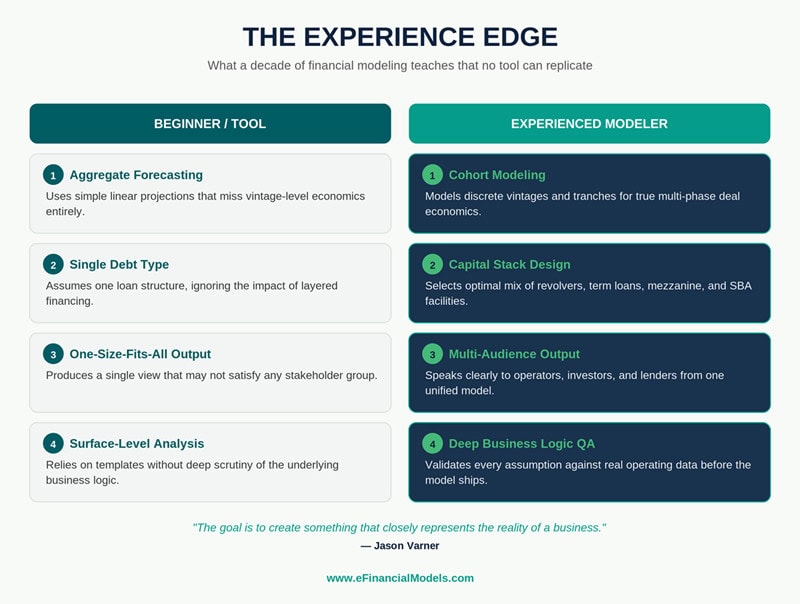
The Experience Edge
| # | Beginner / Tool | Experienced Modeler |
| 1 | Aggregate Forecasting — Uses simple linear projections that miss vintage-level economics entirely. | Cohort Modeling — Models discrete vintages and tranches for true multi-phase deal economics. |
| 2 | Single Debt Type — Assumes one loan structure, ignoring the impact of layered financing. | Capital Stack Design — Selects optimal mix of revolvers, term loans, mezzanine, and SBA facilities. |
| 3 | One-Size-Fits-All Output — Produces a single view that may not satisfy any stakeholder group. | Multi-Audience Output — Speaks clearly to operators, investors, and lenders from one unified model. |
| 4 | Surface-Level Analysis — Relies on templates without deep scrutiny of the underlying business logic. | Deep Business Logic QA — Validates every assumption against real operating data before the model ships. |
“The goal is to create something that closely represents the reality of a business.” — Jason Varner
Q5: Where are entrepreneurs most actively looking for better financial tools?
Jason:
| “Right now, data centers and anything with recurring revenue services are big. Direct lending businesses were my most popular focus for the last 3 or 4 years but that’s slowed some. I do get a lot of interest around securitization.” |
Behind the Answer
Jason’s vantage point is uniquely informative. As someone who builds financial models across dozens of industries, he sees where capital is flowing before most market observers do — because entrepreneurs and operators come to him for the tools they need to raise that capital.
The three hot zones tell a clear story about the macro environment:
1. Data Centers
The AI boom has created insatiable demand for compute capacity, and every data center developer needs a model that can handle the unique economics: multi-year construction timelines, massive upfront power infrastructure, phased leasing, and PUE (Power Usage Effectiveness) as a key operational metric. Jason’s Data Center 10-year Financial Model — now in Version 3 — has become one of his most actively maintained and updated templates.
2. Securitization & Structured Finance
As traditional lending tightens across the banking system, more entrepreneurs are exploring securitization structures — pooling receivables, creating tranches, and modeling the waterfall that governs how cash flows to each investor class. Jason has developed two dedicated tools: the Securitization Modeling Template (efinancialmodels.com/downloads/securitization-modeling-template-610890/) for standard deal structures, and the more advanced Securitization Platform Financial Model for complex multi-tranche arrangements.
3. Recurring Revenue & AI-Native Businesses
Subscription-based models remain a mainstay of his catalog, but the frontier is shifting. The Startup SaaS Model for AI-agentic Businesses reflects the next wave: AI-native businesses where unit economics must be modeled at the per-agent level, requiring a different approach to customer acquisition cost, lifetime value, and scaling dynamics than traditional SaaS.
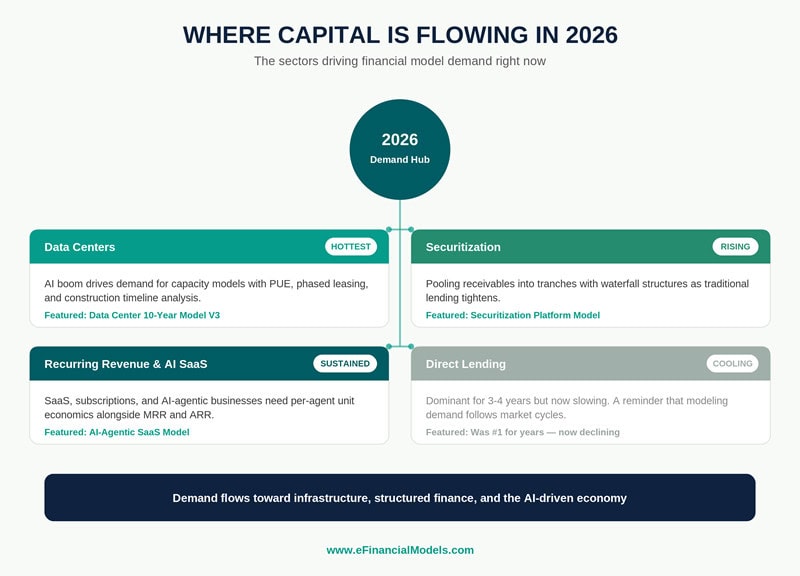
Where Capital is Flowing in 2026
| Sector | Status | Why It’s Moving | Featured Model |
| Data Centers | Hottest | AI boom drives demand for capacity models with PUE, phased leasing, and construction timeline analysis. | Data Center 10-Year Model V3 |
| Securitization | Rising | Pooling receivables into tranches with waterfall structures as traditional lending tightens. | Securitization Platform Model |
| Recurring Revenue & AI SaaS | Sustained | SaaS, subscriptions, and AI-agentic businesses need per-agent unit economics alongside MRR and ARR. | AI-Agentic SaaS Model |
| Direct Lending | Cooling | Dominant for 3-4 years but now slowing — a reminder that modeling demand follows market cycles. | Was #1 for years — now declining |
Demand flows toward infrastructure, structured finance, and the AI-driven economy.
A Look at the Portfolio
With over 50+ financial model templates on eFinancialModels, Jason Varner’s catalog reflects his willingness to go deep on any industry.
Industry-Specific Financial Model Templates Available:
No Downloads foundTemplate Bundles Available:
No Downloads foundThe Takeaway
Jason Varner’s style does not change between industries — his models do. That is the hallmark of a modeler who has internalized the craft so deeply that he can separate what is general (the financial statement architecture, the debt mechanics, the IRR math) from what is specific (the revenue drivers, the cost structure, the unit economics that tell each business’s unique story).
| “I try to build templates for things likely to remain relevant long-term, but you never know.” |
After a decade of modeling, he is still humble about it. And that humility — combined with a willingness to go deep on battery recycling, space startups, and building a better car wash P&L — is probably what has kept him at it. Every model he builds reflects thousands of hours of scrutiny: validating assumptions, understanding value drivers, and crafting a financial narrative that speaks clearly to everyone who reads it.


