
0 ITEMS

Desalination Plants
A desalination plant project can be a significant investment, but its financial feasibility depends on various factors, such as capital costs, operational expenses, and potential revenue. Evaluating these elements helps determine whether the project can generate sufficient returns to justify the investment. Key considerations include the cost of technology, energy consumption, maintenance, and local water demand. By closely analyzing these factors and projecting future cash flows, stakeholders can assess the viability of a desalination plant and decide if it makes sound financial sense for the long term.


Financial Model for a Public-Private Partnership (PPP) project outlining the…
Is a Desalination Plant Project Financially Feasible?

Ever wonder how a desert region like the Middle East sustains itself with water? Despite being surrounded by ocean, Australia frequently faces droughts and has limited freshwater resources. North American states like California, Arizona, and Nevada frequently experience water shortages due to the growing demand from agriculture and urban areas. The answer lies in the technology of a desalination plant project. It offers a potential lifeline by converting seawater into fresh water. But is building and operating a desalination plant financially feasible?
While the environmental benefits are clear for a desalination plant project, the financial hurdles can be significant. From capital costs to long-term revenue generation, assessing the financial health of a desalination plant requires a deep dive into various factors. This article explores what are desalination plants, whether these projects make sense financially, offering insights into the risks and rewards involved. Let's break down the numbers to determine if desalination is a smart investment.
What Are Desalination Plants?
Desalination plants are facilities that convert seawater into fresh water. They use various methods, like reverse osmosis, to remove salt and other impurities. These plants are crucial in areas where freshwater sources are limited or nonexistent. By turning abundant seawater into drinkable water, desalination helps supply communities, agriculture, and industries with the water they need to thrive. Despite the high costs and energy demands, desalination is a vital solution for regions facing severe water scarcity.
When answering the question: what are desalination plants? It is essential to note that it typically involves two main technologies: reverse osmosis (RO) and multi-stage flash distillation (MSF). Reverse osmosis, the most widely used method, forces seawater through a semi-permeable membrane to separate the salt and other impurities from the water. On the other hand, multi-stage flash distillation heats seawater to create steam, which is then condensed into freshwater.
Both methods effectively produce clean water, though reverse osmosis is more energy-efficient and commonly used in most modern plants. While these technologies make desalination possible, they also come with challenges, such as high energy consumption and environmental concerns related to brine disposal. Despite these issues, a desalination plant project remains crucial for addressing water scarcity in arid regions.

How Does Desalination Plant Work?
Desalination plants operate through a series of complex processes that involve advanced engineering and technology. Let’s take a closer look at how does desalination plant work, focusing on the reverse osmosis method, which accounts for most desalination capacity worldwide.
- Intake of Seawater: Seawater is drawn from the ocean or other bodies of saline water. This seawater is typically filtered to remove large debris before entering the desalination plant.
- Pre-Treatment: Before desalinating seawater, it undergoes pre-treatment to remove smaller particles and microorganisms. This step is crucial to prevent the treatment membranes used in reverse osmosis from clogging or becoming damaged.
- Desalination: The pre-treated seawater is passed through semi-permeable membranes under high pressure. The membranes allow only water molecules to pass through while blocking salts and other impurities. The result is fresh fresh water on one side of the membrane and concentrated brine on the other.
- Post-Treatment: After the desalinated water is collected, it is treated again to ensure it meets the required standards for drinking water. This can involve adding minerals or adjusting the pH to improve taste and quality.
- Disposal of Brine: The leftover concentrated brine is typically disposed of by returning it to the ocean. However, properly managing this byproduct is essential to prevent environmental damage, as high salinity can harm marine life.
How does desalination plants work for reverse osmosis and multi-stage flash (MSF) distillation have similar processes. In RO, seawater is forced through a membrane that blocks salt, while in MSF, seawater is heated to produce steam, which is then condensed into fresh water. Though the methods differ in technique—membrane filtration versus heat evaporation—they aim to produce clean, drinkable water from seawater. While the process sounds simple, the energy demands and costs make desalination complex and expensive.

Understanding the Financial Feasibility of a Desalination Plant Project
The financial feasibility of a desalination plant project depends on several factors. While desalination offers a viable solution to water scarcity, it is important to consider the costs involved, the expected return on investment, and alternative water sources when evaluating its economic viability.Cost of Desalination Plants
The cost of desalination plants varies depending on location, scale, and technology, and they are generally more expensive than traditional freshwater sources. Key costs include capital expenses for land, construction, equipment, and installation, ranging from $500 to $1,000 per cubic meter for small-scale plants, while larger plants can cost billions. Operational costs are primarily driven by energy, which accounts for 60-70% of expenses, labor, and maintenance. The estimated cost of a desalination plant per 1,000 cubic meters of daily capacity ranges from $1 million to $2.5 million, based on the capital expenditure and total plant capacity of the largest desalination plants in the world.
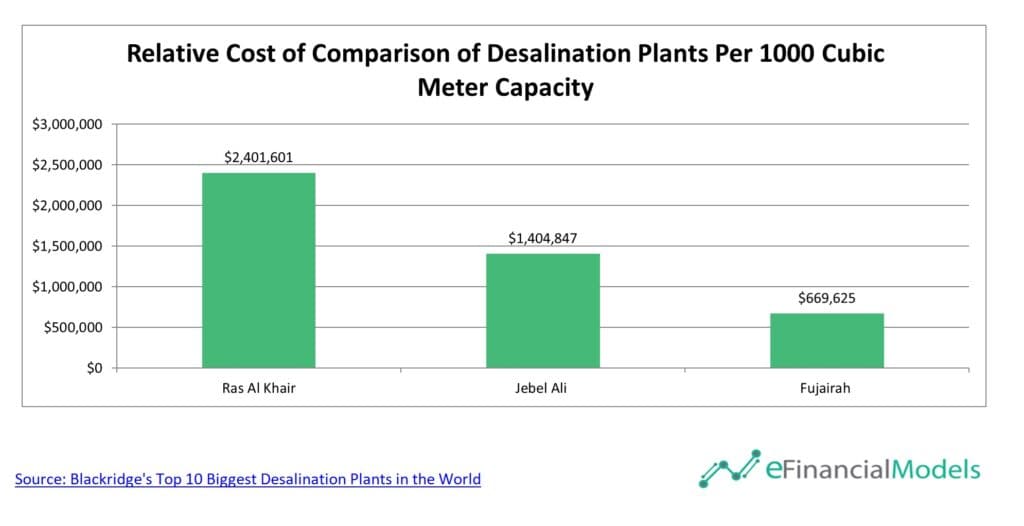
Energy consumption is also a major concern within the cost of desalination plants, prompting interest in energy-efficient technologies and renewable energy integration. Reverse osmosis desalination plants use about 3-4 kWh of electricity per cubic meter of water, making them fairly energy-efficient. In contrast, thermal desalination plants require much more energy, typically over 10 kWh per cubic meter, leading to higher operational costs. The plant's economic viability largely depends on access to affordable energy sources.
Revenue Streams for a Desalination Plant Project
Desalination plants generate revenue primarily by selling fresh water to municipalities, industries, and other consumers. Water pricing is influenced by government regulations, public demand, and production costs, with desalinated water often priced higher than traditional sources due to its expensive production. The demand for desalinated water is driven by local water scarcity and the availability of alternative sources, making it crucial in drought-prone regions. Currently, potable water from a desalination plant project costs around $0.67 per cubic meter. So, if a plant produces 100,000 cubic meters of water per day at $0.67 per cubic meter, it would generate $67,000 in revenue daily, amounting to approximately $24.45 million annually. However, these figures vary widely based on plant size, location, and demand.Desalination plants also generate revenue through government or international financial support. In regions facing severe water scarcity, governments may offer subsidies or grants to ease the high costs of desalination projects. International organizations, like the World Bank or regional development banks, may also provide grants or low-interest loans to support these projects, especially in developing countries. These financial aids help ensure the sustainability of desalination plants, making water access more reliable in areas at risk of water shortages.
Desalination plants are financially viable in areas with high water scarcity and strong demand for fresh water. While initial capital costs are significant, often reaching billions for large-scale plants, revenue from water sales can offset these expenses. Financial feasibility depends on balancing costs with sustainable pricing and meeting consistent demand, especially in drought-prone regions.
| Disclaimer: The cost and revenue estimates for desalination plants are examples to show financial feasibility. They are not guarantees or investment advice. |
Alternative Water Sources
One of the key considerations in determining a desalination project's financial feasibility is whether cheaper alternatives are available.- Recycled or Reclaimed Water: This involves treating and reusing wastewater from industries, households, and sewage systems. It can be purified to varying levels for agricultural, industrial, and even potable uses. Recycled water is more sustainable and cost-effective when managed properly. However, desalination provides a reliable and consistent source of potable water, regardless of local wastewater availability or quality.
- Rainwater Harvesting: Collecting and storing rainwater provides an effective and sustainable alternative. It can be used for irrigation, industrial processes, and potable water when properly filtered and treated. Rainwater harvesting is a more eco-friendly and affordable option for smaller-scale needs. However, its effectiveness depends on climate and storage capacity, limiting its scalability. Desalination provides a consistent and scalable water supply, regardless of rainfall patterns or seasonal variations.
- Brine Mining: This method involves extracting valuable minerals and salts from brine (saltwater), which can provide a secondary benefit to desalination operations. The process allows the water to be reused or treated for agricultural and industrial purposes. Desalination provides a more direct solution to freshwater scarcity, offering immediate access to clean water, while brine mining focuses on extracting valuable minerals from waste byproducts.
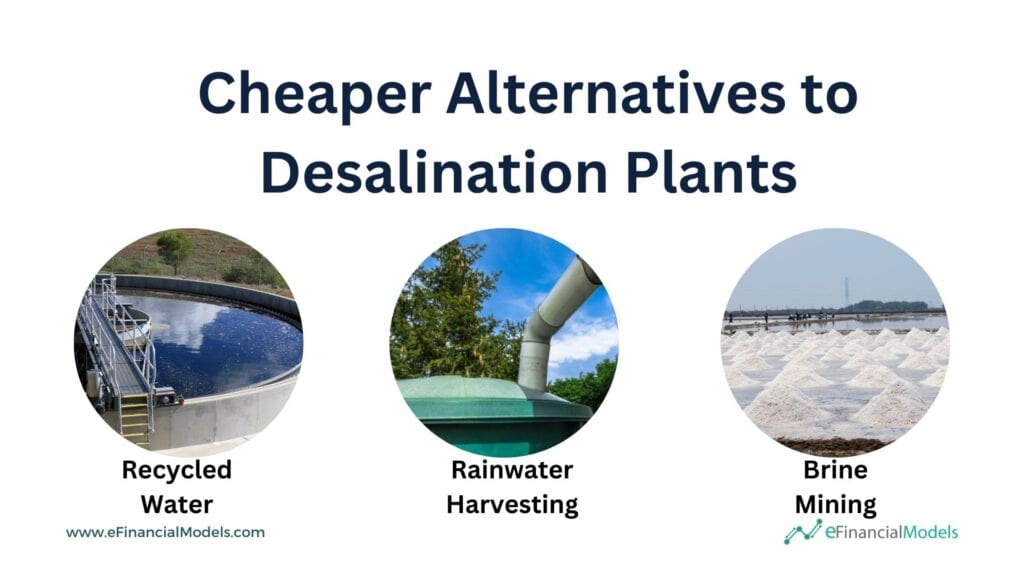
Desalination can be financially feasible but often lags behind cost efficiency in recycled water, rainwater harvesting, and brine mining. While it provides a steady water supply, desalination requires significant energy and infrastructure, leading to higher operational expenses. Recycled or reclaimed water, on the other hand, leverages existing wastewater systems, making it cheaper and more sustainable. Rainwater harvesting offers a low-cost, decentralized solution but depends heavily on rainfall patterns. Brine mining transforms waste into valuable minerals, adding an economic benefit beyond water recovery. The best option depends on regional water demand, resource availability, and environmental priorities.
Financial Metrics to Evaluate Feasibility
Evaluating the feasibility of desalination plants hinges on understanding critical financial metrics. While promising solutions to water scarcity, these facilities demand significant investment and operational costs. By focusing on financial metrics, stakeholders can uncover the economic viability of such projects. These metrics clarify whether a desalination plant can deliver long-term value and sustainability.
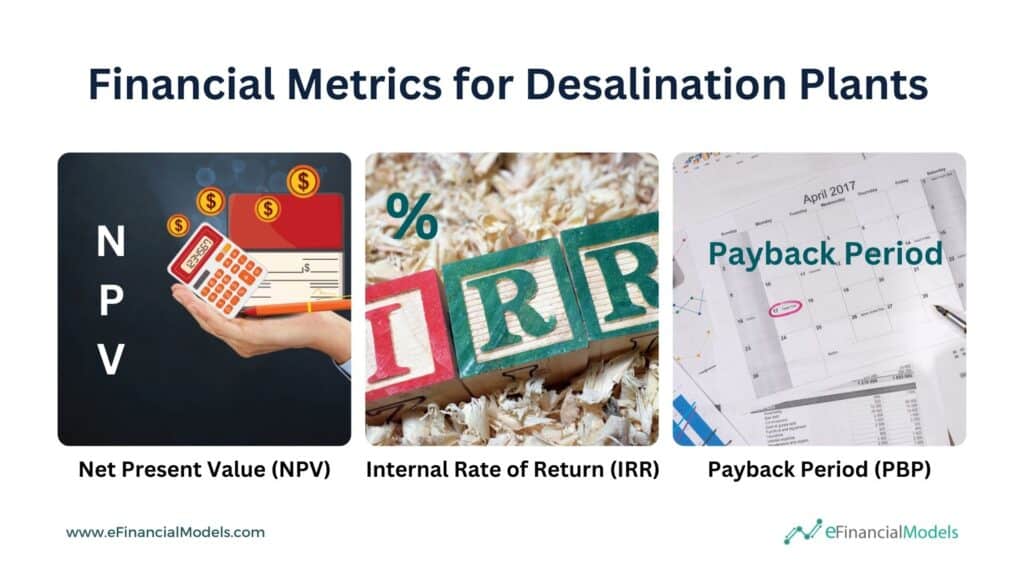
- Net Present Value (NPV) is a key financial metric used to assess the profitability of a desalination plant. NPV is calculated by subtracting the initial investment from the present value of future cash flows, discounted at an appropriate rate. A good NPV typically indicates a positive value that sufficiently exceeds the initial investment and meets stakeholders' required return on investment (ROI).
- The Internal Rate of Return (IRR) is the discount rate at which the NPV of a project equals zero. It represents the rate of return expected from the desalination project. An IRR greater than the cost of capital suggests the project is financially viable. In the renewable energy sector, where a desalination plant project belongs, industry benchmarks suggest that a commercial solar project in the United States typically achieves an IRR ranging from 10% to 15%.
- The payback period is the time it takes for a desalination plant to recover its initial capital investment through its revenues. A shorter payback period indicates a less risky project.
Desalination Projects: Why Financial Plans Matter for Feasibility
A desalination plant project can be financially feasible when carefully planned and evaluated against specific factors. While the initial investment is substantial, often in billions, revenue from water sales and potential government subsidies can offset these costs. In regions with severe water scarcity, desalination can provide a sustainable solution despite high operational expenses and environmental considerations.
The financial viability hinges on energy efficiency, consistent demand, and competitive water pricing. Metrics such as Net Present Value (NPV), Internal Rate of Return (IRR), and payback period are critical for assessing profitability and risk. Financial plans are the backbone of any successful desalination project. They help outline costs, predict revenues, and assess risks to ensure long-term feasibility. Without a solid financial strategy, even the most advanced projects can falter. Take the first step toward success—start building your financial plan today and unlock the potential of sustainable water solutions.
You might also like: