
0 ITEMS

Financial Model Template Buyer’s Checklist: 5 Checks to Run

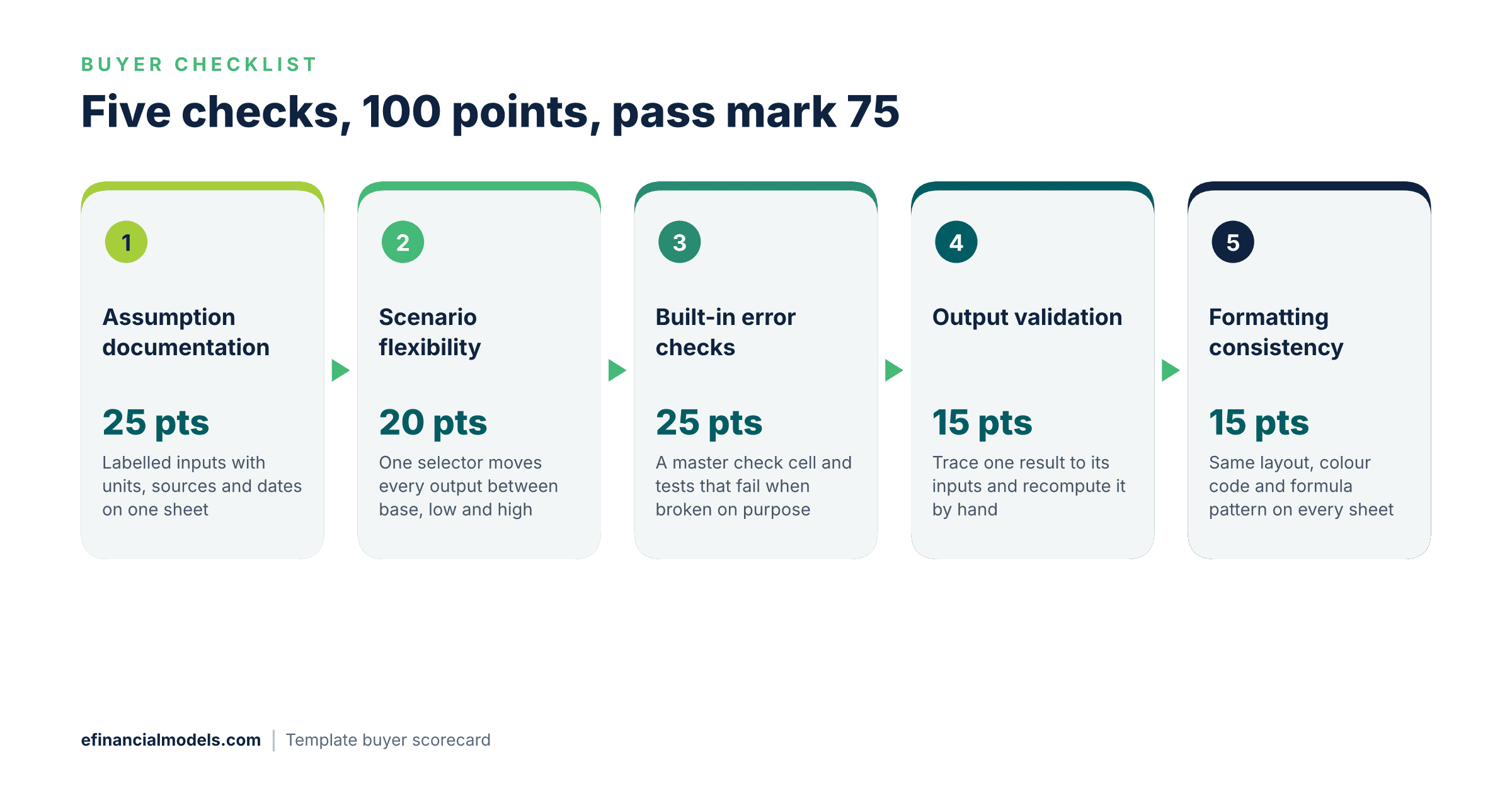
A financial model template is safe to buy when it scores well on five checks: every assumption is documented, scenarios switch live, error checks are built in, outputs trace back to inputs, and formatting is consistent. A suggested weighted 100-point scorecard turns those checks into a buy or skip decision in about an hour for a template with a handful of sheets.
Key Takeaways
- Every input needs a label, a unit and a source note, or nobody can audit the template, including its seller.
- Scenario flexibility means one selector changes every output at once; a summary tab of pasted values fails this check.
- Built-in checks belong on the first sheet: a master check cell, a balance sheet test and a cash reconciliation.
- Output validation means tracing one result back to its inputs and recomputing it by hand before any money changes hands.
- A weighted scorecard, with a suggested pass mark of 75 out of 100, makes buying decisions comparable across templates.
Five Checks, Weighted by Risk, Cover the Whole Buying Decision
In this suggested scorecard, assumption documentation and built-in error checks carry the most weight, because those two failures are the hardest to spot before purchase and the costliest afterwards. Some tests need the working file, so a buyer should ask for a demo file or confirm a refund window first; screenshots alone can only show documentation and formatting.
Spreadsheet errors are common enough to justify the effort. A 2024 study in Frontiers of Computer Science, reported by Phys.org, found that 94% of spreadsheets used in business decision-making contain errors (Phys.org, 2024). The study reviewed earlier research rather than surveying new files, so the figure shows how common errors are in the literature, not the error rate of any single template.
Spreadsheets also remain the everyday tool for finance work, which is why template structure matters. CFO Connect’s Top CFO Tools Report 2026 found that 76% of surveyed finance leaders use spreadsheets for financial planning and analysis (Spendesk, 2026).
Check 1: Assumption Documentation Decides Whether a Template Can Be Audited
A template earns full points when every input sits on one marked sheet and carries a label, a unit, a source or rationale, and a date. A buyer can apply that standard to the input sheet of any template.
Buyers can test this in five minutes:
- Pick any three inputs, such as a growth rate, a price and a tax rate, and confirm each shows a unit and a reason for its default value.
- Search the formulas for typed numbers. A formula such as
=B12*1.2hides an assumption inside a calculation. - Check whether input cells restrict entries. Data validation, which limits the type of data or values a user can enter into a cell, such as a dropdown list (Microsoft Support, 2026), stops a percentage typed as 1500 from breaking the model.
- Look for a short guide, a version date and a list of known limitations.
Check 2: Scenario Flexibility Means One Switch Changes Every Output
A template earns full points when a single selector cell moves the whole model between at least three cases, such as base, low and high, and every output updates.
Excel’s Scenario Manager defines a scenario as a set of values that Excel saves and can substitute automatically on a worksheet (Microsoft Support, 2026).
Two tests expose weak templates. First, flip the selector and confirm that revenue, costs, cash and every chart move together. Second, run a sensitivity analysis, which changes one input at a time to see how an output responds, by nudging the main price input up slightly and checking that profit changes in the expected direction.
Check 3: Built-in Error Checks Should Sit on the First Sheet
A template earns full points when a master check cell reads OK only if every individual test passes, and that cell is visible without scrolling. Typical tests confirm that the balance sheet balances, that closing cash on the cash flow statement equals cash on the balance sheet, and that monthly totals equal annual totals. A template without a balance sheet should at least reconcile cash and match monthly totals to annual totals.
Microsoft states that its error-checking rules do not guarantee a worksheet is error free but can go a long way toward finding common mistakes (Microsoft Support, 2026), so the template needs tests written for its own logic.
Break the template on purpose. Type a deliberately wrong opening balance and confirm the master check stops reading OK. A check that never fails was probably never connected.
Check 4: Output Validation Means Tracing a Result Back to Its Inputs
A template earns full points when a buyer can follow any headline output, such as profit or closing cash, back to its inputs and reproduce one result by hand. Excel’s Trace Precedents and Trace Dependents commands draw arrows between cells and the formulas that use them, which makes the trail visible.
Three habits separate careful buyers from hopeful ones:
- Enter simple round numbers, such as 100 units at a price of 10, and confirm revenue equals 1,000.
- Enter edge cases, including zero revenue, and confirm nothing returns an error value or a negative cash balance without a warning.
- Ask whether anyone independent reviewed the template, since a second reader catches errors the original builder no longer sees.
Avoid circular references, meaning formulas that depend on their own result, because they often signal a formula that is wrong.
Check 5: Formatting Consistency Shows How Carefully a Template Was Built
A template earns full points when the same layout, formula pattern and colour code repeat across every sheet.
Inputs, formulas and outputs each use one distinct colour. Time periods run left to right in the same columns on every sheet. Each row holds one formula copied across, with no overwritten cells.
Worked Example: Scoring Two Templates on a 100-Point Scorecard
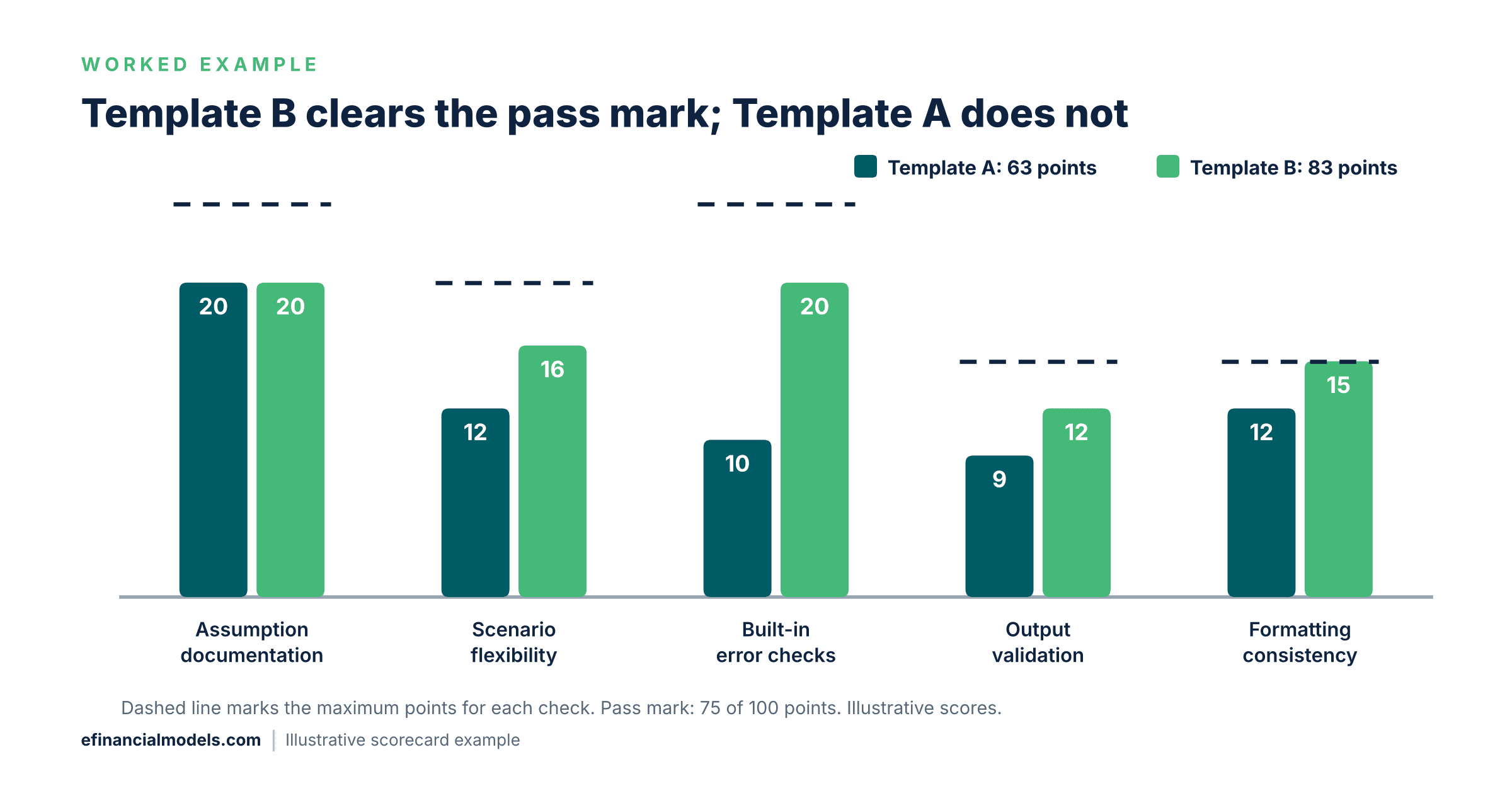
In this illustrative example, a founder weights the five checks by risk and runs five tests per check. Each of the five tests in a check is worth one fifth of that check’s points, so three tests passed in a 20-point check scores 12. The suggested pass mark is 75 points, with one override: a zero on any 25-point check fails the template whatever the total. The weights are an editorial suggestion. The scores below are assumed for demonstration, not measured from real products.
| Check | Maximum points | Template A | Template B |
|---|---|---|---|
| Assumption documentation | 25 | 20 | 20 |
| Scenario flexibility | 20 | 12 | 16 |
| Built-in error checks | 25 | 10 | 20 |
| Output validation | 15 | 9 | 12 |
| Formatting consistency | 15 | 12 | 15 |
| Total | 100 | 63 | 83 |
Template A passes four, three, two, three and four tests across the five checks, which earns 20 + 12 + 10 + 9 + 12 = 63 points, below the pass mark of 75. Template B passes four, four, four, four and five tests, which earns 20 + 16 + 20 + 12 + 15 = 83 points and clears the pass mark by 8 points. Half of the 20-point gap comes from error checks, where Template A scores 10 of 25 and Template B scores 20 of 25.
Five Red Flags Justify Walking Away
Walk away when any of these appears, whatever the total score: locked sheets that hide formulas, no inputs sheet, results that stay unchanged when inputs change, a master check that is missing, or a seller who cannot say which version the buyer receives. Free Financial Model Templates deserve the same checklist as paid ones, because price alone does not show build quality. Collections such as Startup Financial Models and General Excel Financial Models list many templates to compare side by side.
Frequently Asked Questions
Can a free template pass the checklist?
Yes, if it earns the points. Judge free and paid templates by the same checks, since price alone does not show build quality: documented inputs, live scenarios and working checks decide the result. When a free file scores below the pass mark, a founder can still use it for learning or rough sketches while avoiding it for investor materials. The scorecard keeps that distinction honest by judging structure rather than the seller.
How long does a proper evaluation take?
A first pass through all five checks usually fits inside one hour for a template with a handful of sheets. Most of that time goes on breaking the model deliberately: changing inputs, flipping scenarios and entering extreme values. Larger multi-entity files take longer. Running the same tests on two templates back to back makes differences in structure obvious, which speeds up the second review considerably.
Should a template that uses macros be avoided?
Not automatically, but macros deserve extra scrutiny. A macro is a small program, written in Visual Basic for Applications (VBA), that automates tasks inside Excel and can hide logic from a casual reader. A cautious buyer opens the file with macros disabled and confirms the core calculations still work. If the model only functions when the macros run, auditing becomes much harder.
What should a seller be able to show before a purchase?
A credible seller can show preview screenshots of the inputs sheet, a version number with a change log, a plain description of known limitations, and a support contact. A refund policy matters too, since it lets a buyer run the checks on the actual file. Gaps on these points suggest the seller may not have tested the template as carefully as the listing implies.
When is a template the wrong choice?
A template falls short when the business needs revenue logic that no standard layout offers, several legal entities with intercompany transactions, or outputs tailored to one investor’s format. The checklist still shows exactly which checks the template fails, so a founder can decide whether adapting the file or commissioning a custom build costs less in both money and time for the business at hand.
Conclusion
A financial model template earns trust through evidence: documented assumptions, a live scenario switch, passing built-in checks, traceable outputs and consistent formatting, scored against a pass mark before payment. Founders who want a template to practise on can open the eFinancialModels Free Three Statement Financial Model as a first candidate and run it through the five checks and the weighted scorecard before choosing anything.


