
0 ITEMS

How Expert Financial Modelers Build Templates That Work

Financial modeling isn’t just about spreadsheets and formulas. It’s about solving real business problems, helping entrepreneurs understand their capital needs, enabling investors to evaluate opportunities, and turning complex uncertainties into actionable decisions.
As we showcase our international network of expert vendors during this Black Friday sale, we asked several of them what they’ve learned from years of building industry-specific templates. Their insights reveal common patterns that work across industries, whether you’re modeling a private equity fund in the United States, a data center development in Europe, a lending startup in North America, or EV charging infrastructure in Asia.
Key Takeaways
- Clarity of logic is the foundation of every successful financial model. If stakeholders can’t trace how assumptions flow to results, the model fails.
- The best templates bridge the gap between theoretical frameworks and real-world application, saving weeks of work and thousands in consulting fees.
- Professional models balance robust structure with flexibility, providing solid frameworks that adapt to different scenarios and assumptions.
- Generic templates miss critical industry-specific drivers. Specialized models incorporate the unique variables, risks, and metrics that matter most to decision-makers.
- Great financial models convert uncertainty into actionable decisions by enabling “what-if” analysis and scenario testing.
- Speed and credibility work together. Quality templates let small firms access institutional-grade analysis without expensive consultants.
Here’s what they told us.
The Foundation: Clarity Wins Every Time
Ask any experienced financial modeler what matters most, and they’ll tell you the same thing: clarity.
A financial model can be mathematically perfect, but if people can’t understand how it works, it fails. This isn’t just about making things “user-friendly”, it’s about building trust. When investors, lenders, or board members can’t trace how your assumptions flow into your projections, they lose confidence in your analysis.

Pushkar Kumar, who created our Electric Vehicle Charging Station Financial Model, emphasized this point: “To me, the most important thing is clarity of logic. A financial model must reflect a transparent, traceable relationship between inputs, drivers and results. If someone (an investor, a banker or a project-owner) opens your model and cannot immediately understand how assumptions flow into revenue, costs and ultimately cash flows and returns, then you’ve missed the mark.”
Anuj Verma of Street Fox Advisors found the same when developing his Private Equity Fund Model. “Users consistently value clarity, flexibility, and reliability. They appreciate that the model is easy to customize, provides clear explanations, and instantly reflects changes to assumptions.”
The takeaway? Transparency isn’t optional. It’s what transforms a spreadsheet into a decision-making tool that stakeholders can actually use.
Bridging the Gap Between What You Learn and What You Need
Here’s a common frustration: business schools teach you the theory of discounted cash flows, waterfall structures, and project finance. But when you sit down to build a model for your actual business, you’re staring at a blank Excel sheet with no idea where to start.
This gap is especially painful in specialized industries. If you’re launching an EV charging business or developing a data center, you can’t just download a generic template. You need something that understands the specific drivers of your industry, and hiring consultants to build custom models can easily cost tens of thousands of dollars.
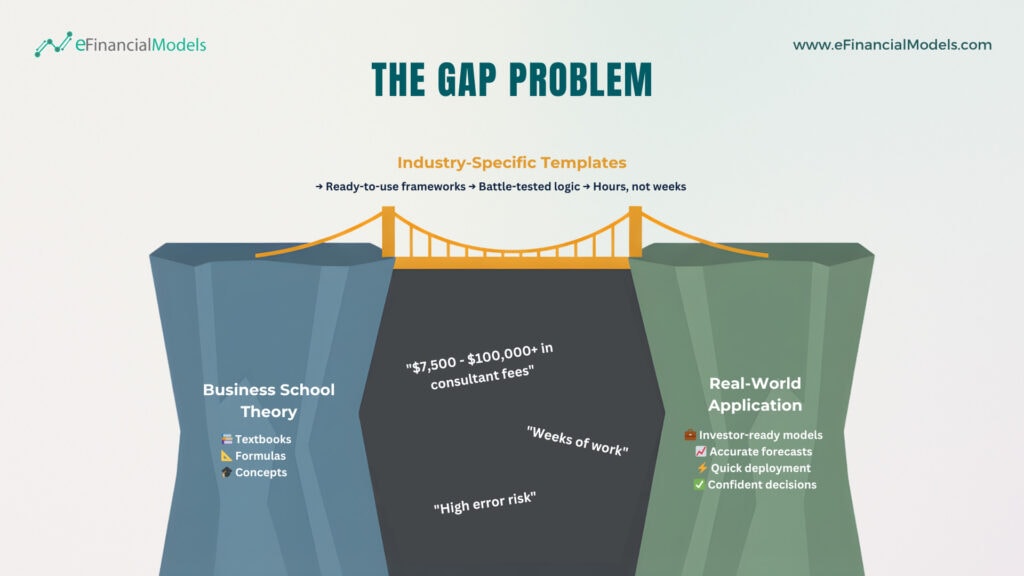
Our vendors recognized this problem because they’ve lived it.
Anuj Verma explained his motivation: “The Private Equity Fund Model was developed to bridge the gap between theoretical fund structures and real-world investor cash flow mechanics. I wanted a tool that gives fund managers, LPs, and analysts a transparent, flexible framework to evaluate performance under different assumptions.”
Pushkar Kumar saw the same issue in the EV infrastructure space: “The idea for the EV Charging Station Financial Model template sprang from witnessing a rapid shift in energy and transport markets: as electric vehicles move from niche to mainstream, developers and investors are under-equipped with credible, ready-to-use tools to project the economics of charging infrastructure. I wanted to bridge that gap — providing a structured, flexible model so decision-makers don’t start from scratch but can hit the ground running with insight and confidence.”
Giorgos from Profit Vision found it in data center development: “I developed this Data Center development model after seeing the same gap across sponsors, lenders, and hyperscale tenants: everyone had pieces of the puzzle, capacity plans, EPC budgets, energy contracts, but no single, auditable framework that connected white-space phasing, power availability, and financing terms to bankable returns.”
Cyrill, Founder of eFinancialModels, identified a similar challenge in renewable energy: “We developed the Solar BESS Financial Model after observing a significant challenge across the renewable energy sector: battery energy storage becoming more and more important since many markets are changing the way electricity prices are charged, from fixed to demand-driven dynamic electricity pricing. This market dynamic created a crucial challenge: how to quantify the value added by a BESS to a PV project for capital providers. Developers had all the technical specs (MWh capacity, degradation, etc.), but lacked a single, auditable framework to connect dynamic hourly operations, like price arbitrage and participation in ancillary services, to reliable cash flows.”
The pattern is clear: industries evolve faster than the tools available to analyze them. The best templates come from practitioners who have experienced these challenges firsthand and built comprehensive solutions that work in the real world.
The Balancing Act: Structure vs. Flexibility
One of the trickiest challenges in financial modeling is creating something that’s both robust and adaptable.
Make a model too rigid, and it becomes useless when your assumptions change. Make it too flexible, and it lacks the structural integrity to produce reliable results. This is especially critical because no two businesses are identical, even companies in the same industry have different cost structures, revenue models, and growth trajectories.
The stakes are high: errors in financial models are remarkably common. Professional model auditors often catch only 20% to 40% of all errors even during intensive single-person code inspections, according to research cited by ICAEW. Common mistakes include incorrect formulas, wrong cell references, circular references, and structural errors, all of which can significantly impact accuracy.
The best models provide a solid foundation while staying adaptable. But this requires careful decisions about what should be hard-coded and what should be adjustable. It means extensive testing across different scenarios. And it demands obsessive attention to detail.
Jason Varner, who developed our Lending Model Startup Forecast, knows this challenge well: “Modeling lending flows with adjustable loan terms and facility funding takes a lot of attention to detail, ensuring accurate cash flow logic throughout.” When asked what matters most when preparing a financial model, his answer was direct: “Usability and correct logic down to cash flow.”
Pushkar Kumar emphasized the same principle: “Beyond clarity, it’s about flexibility, the model should be robust yet adaptable to changing assumptions, and lastly accuracy: the math, linkages and error-checks must be sound, so you can trust the outputs and use them confidently for decision-making.”

Anuj Verma described the specific challenge in private equity: “Private equity models are inherently complex due to capital commitments, waterfall mechanisms, and fund- vs. deal-level returns. The challenge is integrating these elements while preserving both accuracy and transparency. Most models oversimplify or become opaque and rigid. The goal was to create a modular, auditable framework meeting institutional standards without requiring programming-heavy backgrounds.”
The insight? Flexibility without structure produces unreliable results. Structure without flexibility limits practical use. Great financial modeling means building frameworks that guide users toward accurate analysis while letting them adapt the model to their unique situations.
Why Generic Templates Miss the Mark
Every industry has its own language. Its own drivers. Its own risks.
A model designed for software companies will fundamentally miss what matters for infrastructure projects. It’s not just about changing the labels, it’s about understanding the underlying logic, the relationships between variables, and the scenarios that keep stakeholders up at night.
This becomes even more important in emerging industries where standard frameworks don’t exist yet. If you’re in EV charging or data center development, you can’t just adapt an old model. You need something built for your specific challenges.
Giorgos explained this for data centers: “It solves the challenge of translating highly technical drivers, MW capacity, racks, PUE, and utilization, into clear financial outcomes like EBITDA, IRR, and DSCR. The model turns a technically complex project into a lender-ready investment case: clear go/no-go, optimal phasing and pricing, and a capital plan that survives real-world power and timeline risk.”
Pushkar Kumar described the multi-layered complexity of EV projects: “This template addresses a clear pain point: when you look at an EV charging project, there are multiple moving parts, capital expenditure, network utilisation, tariff design, grid connectivity, O&M, regulatory incentives, throughput growth, even resale or decommissioning value. Without a robust model, you risk misestimating cash flows, missing hidden cost drivers or upside (and downside) scenarios.”
Cyrill explained the unique complexity of Solar BESS projects: “The Solar BESS model solves the critical challenge of translating highly technical, time-dependent drivers, such as battery round-trip efficiency, degradation curves, load shifting schedules, and capacity fading—into clear financial outcomes like multiple stacked revenue streams, EBITDA, IRR, and DSCR. The solar-only case is straightforward; the BESS case is not. This model allows developers to optimize the configuration (PV size vs. BESS capacity) and quantify the value from price arbitrage (charging when prices are low, discharging when high) and savings in Electricity Costs.”
For private equity, Anuj Verma highlighted what makes that industry unique: “It solves the challenge of accurately forecasting and analyzing private equity fund returns while accommodating complex waterfall structures, multiple investor classes, different portfolio company profiles, and debt components. The model simulates fund behavior over time, assesses sensitivities, and clearly visualizes cash flow distributions between LPs and GPs, all in one integrated framework.”
The lesson? Industry expertise matters as much as financial modeling skill. The most valuable models come from people who deeply understand both the financial mechanics and the operational realities of their specific sector.
From Uncertainty to Action
Here’s the real purpose of any financial model: helping people make better decisions when the future is uncertain.
Markets change. Regulations evolve. Competitors emerge. Costs fluctuate. A good model doesn’t eliminate uncertainty, but it provides a structured way to understand possible outcomes and what drives them.
The challenge is transforming qualitative uncertainty into quantitative projections that actually help. This requires identifying which variables matter most, which scenarios are worth analyzing, and how to present results that illuminate key decision points.
Pushkar Kumar captured this transformation simply: “It converts uncertainty into actionable numbers.”
Giorgos elaborated for data center projects: “The result is a transparent, lender-friendly model that turns white-space phasing, power availability, and financing terms into bankable returns, so developers can move from concept to investment committee, and into construction, with confidence.”
Anuj Verma emphasized how his model enables exploration: “It also serves as an excellent learning and analytical resource for anyone interested in understanding private equity fund dynamics. The model lets users test assumptions and instantly see how key performance metrics respond.”
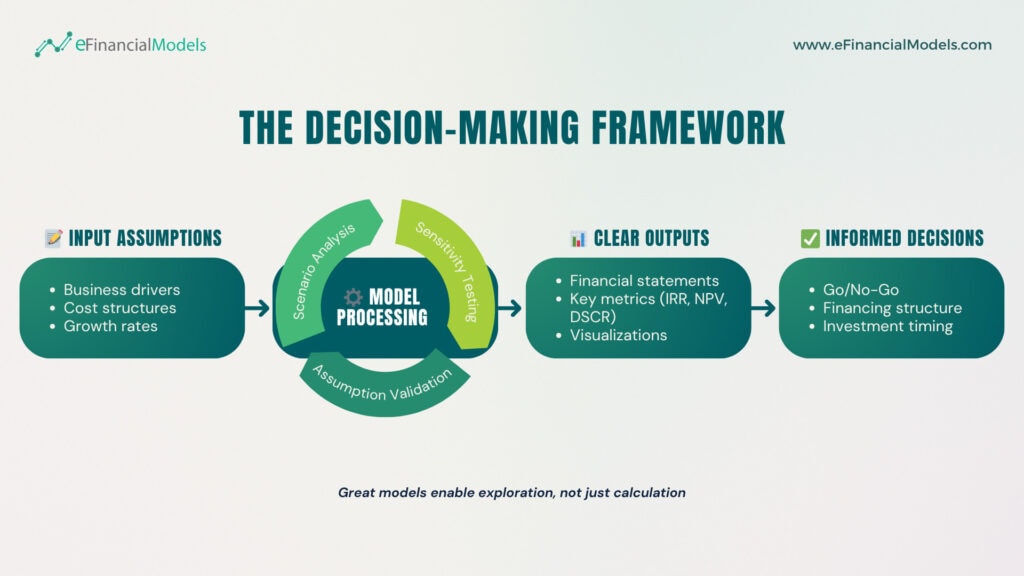
The principle: financial models serve as decision support systems. They let you ask “what if” questions, stress-test assumptions, and understand which variables have the biggest impact. That’s what transforms a spreadsheet into a strategic tool.
Speed Meets Credibility
In competitive markets, timing matters.
The ability to quickly produce credible financial analysis can mean the difference between securing funding and watching an opportunity go to someone who moved faster. But speed without credibility is worthless, stakeholders spot weak analysis immediately.
This creates tension: building comprehensive models from scratch can take more than 3 weeks, according to The Wall Street School. For complex models, particularly those of higher complexity, the process might require several months of work, as noted by Noble Desktop. For startups and smaller firms, hiring consultants to build custom models costs tens of thousands of dollars. Yet the quality bar for investor-grade analysis stays high.
Well-designed templates solve this problem. Instead of starting with a blank spreadsheet, you begin with a proven structure that incorporates industry best practices, comprehensive logic, and professional presentation. Then you customize it with your specific data and assumptions.
Giorgos described this value: “The template shortcuts weeks of modeling by giving customers a plug-and-play, audit-ready structure tailored to data centers (MW capacity, PUE, ramp, pricing). It reduces risk and elevates credibility with investors and lenders through transparent assumptions, dynamic scenarios, and clear dashboards. Customers buy it to move faster from concept to financeable deal and to standardize analysis across their pipeline.”
Pushkar Kumar explained customer appeal: “Customers appreciate that it’s not just a blank spreadsheet, but a highly tailored, sector-specific tool that reflects real industry parameters. They like how it saves time and gives them trust that the logic has been thought through (rather than building a model ad-hoc). They purchase because they want readiness, reliability and a sound framework. The template gives them a credible financial story, not just numbers.”
The Real Cost of Building Financial Models
| Building from Scratch | Using Templates | |
| Time | 3+ weeks to several months (The Wall Street School) | Hours to days |
| Cost | $7,500 – $100,000+ in consultant fees (Qubit Capital) | Template investment (fraction of custom cost) |
| Error Risk | Only 20-40% of errors caught in professional reviews (ICAEW) | Battle-tested framework with reduced errors |
| Flexibility | Custom but untested, no benchmarks, starting from zero | Industry-specific structure with built-in best practices |
Anuj Verma highlighted the democratizing effect: “It reduces reliance on expensive custom modeling teams by providing an institutional-grade, ready-to-use solution. Over several years, this model has empowered fund managers, investors, and first-time fund founders to structure and analyze funds independently, without hiring high-cost analysts or consultants.”
The insight? Professional templates don’t just save time, they level the playing field. Small firms and first-time entrepreneurs get access to the same quality of analysis that large organizations achieve through expensive consulting. This enables better capital allocation decisions across entire markets.
What This Means for You
Whether you’re building your own models or using templates, these expert insights point to universal principles:
- Prioritize transparency. If stakeholders can’t follow your logic, the model fails its purpose.
- Balance structure with flexibility. Provide a solid framework that adapts to different scenarios.
- Understand industry-specific drivers. Generic approaches miss critical nuances that matter to decision-makers.
- Focus on enabling decisions. Models should help people act, not just display calculations.
- Get the cash flow logic right. All sophistication means nothing if fundamentals are wrong.
- Design for your audience. Whether lenders, investors, or internal teams, clarity builds trust.
As Jason Varner discovered: “I wanted to do a cohort model (a method for grouping data by a shared characteristic to analyze behavior over time), and loan tranches were a really good use case to try it on. Turned out wonderful.”
Sometimes the best innovations come from applying proven methodologies to new contexts, staying curious about different approaches, and maintaining relentless focus on what actually works.
Our International Network
The financial models featured in our Black Friday sale represent years of accumulated expertise from professionals working across different industries and continents. Their shared commitment to clarity, flexibility, and practical application makes these templates valuable tools for businesses worldwide.
From private equity funds to data centers, from lending startups to EV charging infrastructure, these templates embody the lessons these experts learned through real-world application. They’re not theoretical exercises. They’re battle-tested frameworks that help businesses move from concept to execution with confidence.
Explore templates from these expert vendors and others during our Black Friday and Cyber Monday Special Sale, running through December 2, 2025. Visit eFinancialModels to discover financial models built by professionals who understand both the technical demands and practical realities of their industries.


