
0 ITEMS

Biogas Financial Model Case Study
Key Takeaways
- A US project developer needed to know whether a biogas plant fed with dairy manure is feasible under a deal with partners.
- What mattered: the gas price, fixed or volatile and for how long, followed by the premium for certified gas. Developer and partners needed the same numbers before agreeing the deal.
- The turning point: without certification as biogas, the plant would struggle to be profitable.
- The developer received a tailored model for different plant sizes and locations, with deal terms and tax credits built in.
PDF1.3 MB
Free download · No email required
Download the Biogas Financial Model Case Study
✓ Model structure✓ Key assumptions✓ Results and takeaways
Developers and partners put capital into a biogas plant on the same basis: what the project returns, how large the downside is, where the upside sits, and how revenue is shared once the plant runs. The first questions are usually about volume: cows, manure, digester size. What decides the case is the price the gas can earn, and whether the gas qualifies for the premium paid for certified biogas. The financial model is where developer and partners meet those numbers.
The Client and the Decision
The client is a project developer in the United States. It wanted to know whether a biogas plant fed with cow manure would be financially feasible, and under which deal structure with its partners. The model had to cover the whole chain, from the herd to the revenue, and to work for different plant sizes and locations. The hardest question for the partners was likely to be simple: what is the project worth if the gas does not qualify for the premium?
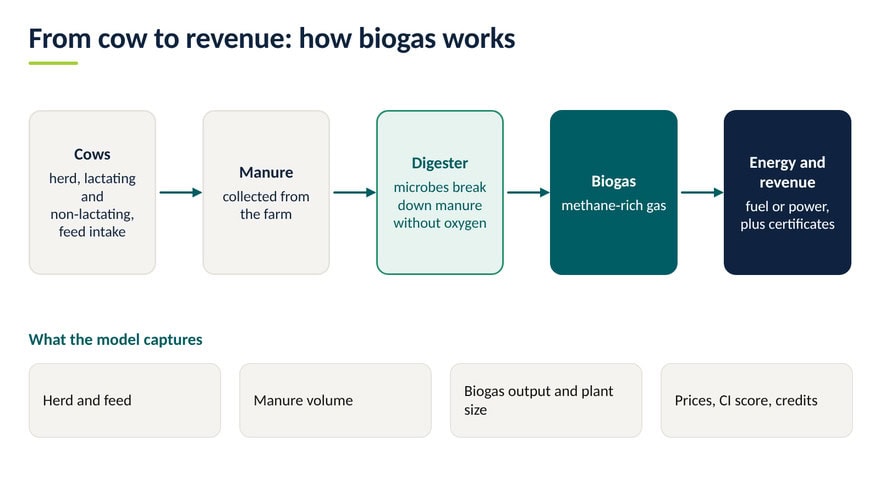
How biogas works. Manure from a dairy herd goes into a sealed digester. There, microbes break it down without oxygen and produce biogas, a methane-rich gas that can be used as fuel or to generate power. How much gas a farm delivers depends on how much manure its herd produces. The price depends on the market, the contract, and certification.
Why This Was Hard to Model
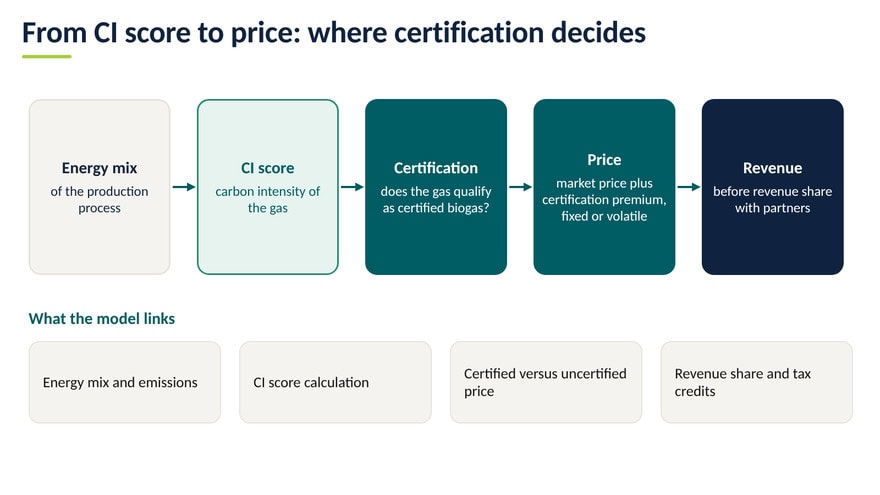
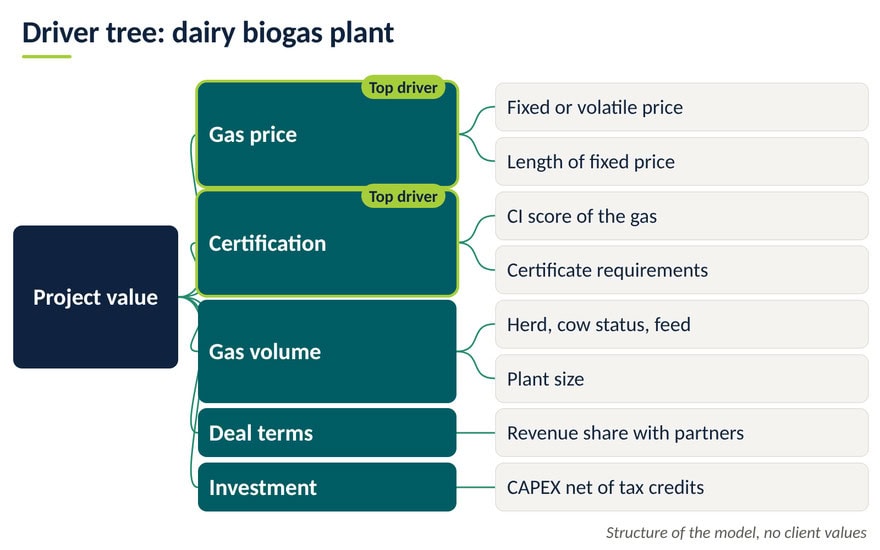
- Certification decides the price. The CI score measures the carbon intensity of the gas. It is not a revenue stream in itself. It decides whether the gas qualifies as certified biogas, and only certified gas earns the higher price. A model that treats the premium as certain would hide the biggest risk of the project. How we solved it: We modeled the CI score from the energy mix of the process and the emissions of alternative, non-green electricity, and linked it to certification and the price premium.
- Fixed or volatile gas price. Gas can be sold at a price fixed under a contract for a period, or at a market price that moves. Which applies, and for how long, moved the result more than any other input, so the price needs a structure of its own, not one number. How we solved it: We modeled fixed and market prices, including how long a fixed price applies, with upside and downside scenarios side by side.
- Plant size depends on the whole deal. The best plant size is not set by manure supply alone. It depends on the parameters of the whole deal, and those change from location to location. Fixing one size first would decide the answer in advance. How we solved it: We built the model to work for different plant sizes and locations, with manure supply, output, prices and deal terms as inputs.
- A revenue share with partners. The model had to reflect the deal between the developer and its partners. Each side carries different costs and receives a different share, so the terms need to be explicit in the numbers. How we solved it: We analyzed the terms of the agreement and modeled the additional cost items they require.
- Investment tax credits. Investment tax credits partially pay for the initial capex, which changes the funding need and the returns. Shown as a separate line, their effect on both is visible. How we solved it: We modeled the investment tax credits and their effect on the initial capex.
- From cows to manure to biogas. Gas output starts with the herd. Manure production depends on the number of cows, their status (lactating or non-lactating) and their feed consumption. The conversion from manure to gas, and the avoided carbon emissions, depend on the process. Any weakness here carries through to every revenue line. How we solved it: We mapped the whole chain and built the model along it, with the factors that drive each step, and presented herd, status and feed in an understandable way.
The Turning Point: Certification, Not Volume, Decides the Case
The model answered the volume questions first. Then it showed where the value sits. Sold as ordinary gas at market prices, the output would leave the plant struggling to be profitable. What makes the difference is certification: if the CI score qualifies the gas as certified biogas, it can be sold at a higher price. From that point on, the discussion centred on three questions: the gas price, how long a fixed price would apply, and the size of the certification premium.
What Drives the Value
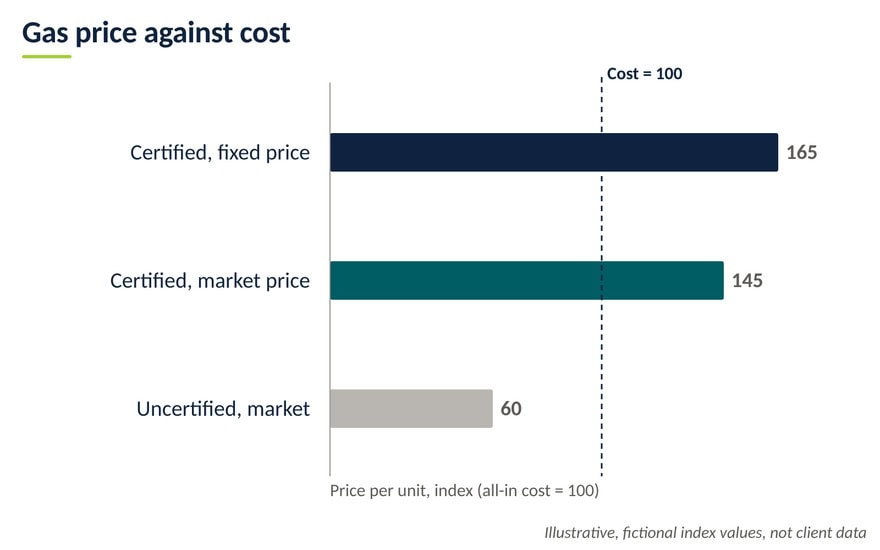
In this engagement, the gas price moved the result most, including whether it is fixed or volatile and for how long a fixed price applies. Next came the price mark-up for gas certified as biogas. When one yes-or-no gate moves the price this much, the downside case is the one partners test hardest. Showing uncertified gas at the market price as the worst case tells everyone what the project is worth if certification does not come through, and what the premium and a fixed-price contract add on top.
A worked example with fictional index values shows the logic. The three cases double as a worst, base and best scenario.
Worked example with fictional index values: price per unit of gas against cost
| Scenario | Case | Price per unit | All-in cost per unit | Margin per unit |
| Worst | Uncertified gas, market price | 60 | 100 | -40 |
| Base | Certified gas, market price | 145 | 100 | +45 |
| Best | Certified gas, fixed-price contract | 165 | 100 | +65 |
Tax credits then change the funding side. With a fictional capex of 1,000, a credit covering 20 percent leaves 800 to fund. At a yearly cash margin of 100, simple payback falls from 10.0 to 8.0 periods.
How We Worked Together and the Result
We started by analyzing how biogas is made and priced, from cows to manure to gas, and led the opening discussion with the developer. We then planned the chain and built the herd, manure, output, pricing and CI score modules, and worked through various iterations of the model together. The final model added the deal terms and the tax credits. The result: the developer received a tailored financial model of the feasibility of a biogas plant using cow manure. The developer can now test any site and any deal in one model: plant size, gas price, certification and partner terms. The model delivers:
- manure and gas output built up from herd, cow status and feed, usable for different plant sizes and locations;
- fixed and market price schemes with upside and downside scenarios, tied to the CI score and certification;
- the revenue share terms and the investment tax credits reflected in the numbers.
Lessons and Questions for Anyone Modeling a Biogas Plant
Three lessons.
- Model certification first. Without the premium for certified gas, the economics of a dairy biogas plant may not hold.
- Treat the price as a model of its own: fixed or volatile, for how long, with or without the premium.
- Build for more than one site. The best plant size depends on the deal, and deals change by location.
Questions to ask before you build a biogas model.
- What does the project return to the developer and its partners, and when?
- How large is the downside if the gas is not certified?
- Will the gas qualify for certification, and which CI score does the process reach?
- What premium does certified gas earn, and is the price fixed, and for how long?
- How is revenue shared with partners, and which costs does each side carry?
- How much of the capex do tax credits cover?
- Which plant size fits the deal at this location?
- How much manure does the herd produce, given cow status and feed?
Planning a similar project? Browse our Biogas financial models. If your plant needs something specific, we build custom financial models. Write to us at [email protected].
FAQ
Short answers to the questions readers ask most often when they plan this type of model.
What is a CI score?
A carbon intensity (CI) score measures the greenhouse gas emissions of a fuel over its life cycle, in grams of CO2 equivalent per megajoule of energy. Under California’s Low Carbon Fuel Standard, the score of dairy manure gas reflects the reduction achieved by capturing methane at the digester, and such scores can be negative.
Why does certification matter for biogas revenue?
Certification confirms that the gas meets the requirements to be sold as certified biogas, which can earn a higher price than ordinary gas. Whether the gas qualifies depends on its CI score. The premium can decide whether a dairy plant is feasible, so a model should test both cases.
How do you choose the size of a dairy biogas plant?
Start with the manure supply: herd size, cow status and feed set the volume of gas available. Then test plant sizes against the full deal: gas prices, certification, partner terms, capex and tax credits. These differ by location, so the right size can differ between sites.
How do investment tax credits affect a biogas project?
Investment tax credits reduce the net cost of the plant by covering part of the initial capex. That lowers the funding need and raises the returns for the developer and its partners. Eligibility depends on the rules that apply, so the model should show the credits as a separate line.
Sources
Client details are anonymised to protect confidentiality. Charts, schematics and worked examples are illustrative and contain no client data.


