
0 ITEMS

Nightlife Events App Financial Model Case Study

Key Takeaways
- Situation: founders of a nightlife events app, with no pilot live, planned to list events and host their own, and needed funding for a plan that rested on estimates.
- What mattered: before approaching investors, one integrated model had to show the expected return, the risk and the upside, how the funds would be used, how long the cash lasts, and what hosted events could earn meanwhile.
- Turning point: the calculation showed the plan to be vague, unproven and very risky, so the choice was to look for funding or to host events temporarily to earn income.
- Outcome: one model with scenarios of how the investment case could work out. Nothing was proven at this stage, but it laid the groundwork for the investor pitch.
PDF0.6 MB
Free download · No email required
Download the Nightlife Events App Financial Model Case Study
✓ Model structure✓ Key assumptions✓ Results and takeaways
A business plan can read well and still be vague. Screens and a pitch show what an app is meant to do, not what the plan assumes, how long the cash lasts or what a stake could earn. For a nightlife events app with no live pilot, a financial model had to carry that weight. The founders needed funding and wanted to know what the plan could realistically deliver.
The Client and the Decision
The founders were building a mobile app that lists nightlife events and also plans to host events of its own. An events app can earn from paid plans, in-app purchases, ticket fees, advertising and partner commissions. Hosting its own events adds a second business with its own margin and cost. The app pilot was not live yet, so every user, conversion and price input in the plan was an estimate. Nothing could be proven before a pilot existed. The task was to show, in scenarios, how the investment case could work out and what it depends on.
What prospective investors ask of a plan without a pilot. Investors cannot test an app that does not exist, so they judge the plan. They ask what return their stake could earn, what the risk is, how large the upside could be, how the funds would be used and how long the cash lasts. Each answer must come in numbers, with the unconfirmed inputs made visible.
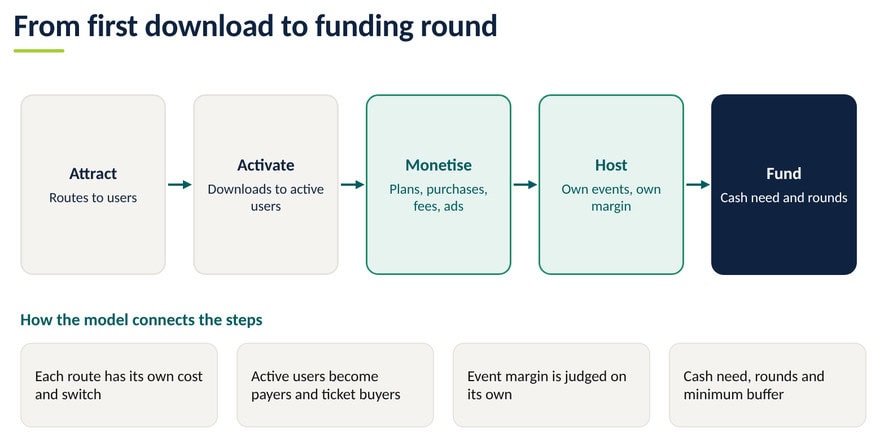
Why a preliminary analysis matters. A plan reads well on paper; only the calculation shows how it holds together. A preliminary analysis cannot prove a plan before a pilot is live, but it gives a more realistic view of its financial prospects. Sometimes the numbers are less favourable than the plan assumed, and we need to run them to see it clearly. Better before the pitch than during it.
Why This Was Hard to Model
- Every input still an estimate. With no pilot live, every user, conversion and price input is an estimate, and the result depends on all of them at once. How we solved it: Sensitivity multipliers feed a tornado diagram that ranks which estimates move the result most.
- How long the cash must last. Burn, the timing of each round and a minimum cash buffer interact, and a later round changes both spend and an investor’s stake. How we solved it: The funding need is read from the running free-cash-flow balance, and each round then feeds valuation, stakes, multiple and IRR.
- Two businesses, one model. The app lists events and hosts its own: two lines with different revenue, costs and timing, sharing one team and one budget. How we solved it: Include switches sit on every line and revenue stream, plus a master switch for events with or without the app.
- Irregular event income. A hosted event earns and spends on one date. Its costs follow different drivers: staff hours by role, fixed venue and talent costs, and a share of sales. How we solved it: An event planner with one column per event calculates revenue, costs by driver type and margin, and a calendar lookup places each result in the right period.
- Many routes to a user, one funnel. Organic reach, partners and paid clicks each grow by their own logic, so one growth rate would hide what each route costs. How we solved it: Each route has its own drivers and switch and feeds one funnel, with acquisition cost per route.
- Paid in advance, earned over time. A user who prepays brings cash now, but the revenue belongs to the period of use. How we solved it: A waterfall keeps cash received and revenue recognised apart and checks that both totals agree.
The Turning Point: A Vague, Unproven and Risky Plan
Putting the plan into numbers showed how vague it still was. With no pilot live, nothing was proven and the result rested on estimates, so the plan was very risky as it stood. The choice was either to look for funding, or to host events temporarily to earn money and keep going. The plan could not be proven at this stage, but the work laid the groundwork for the investor pitch.
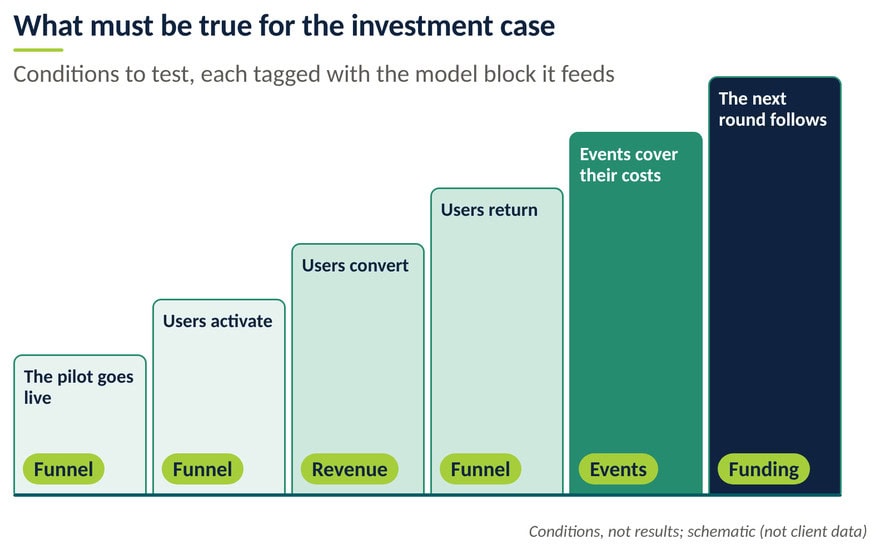
Scenarios: how the investment case could work out. Scenarios are run with the model’s switches and multipliers, and they illustrate a range of outcomes; only a live pilot can test the inputs behind them. Three illustrative readings:
- Worst case: funding takes longer and conversion stays low. The cash need rises and hosted events become the bridge that carries the founders, not a growth driver.
- Base case: inputs as planned. Funding arrives in time and events add income.
- Best case: conversion and retention beat the plan, and the investor stake looks stronger.
What Sets the Cash Need
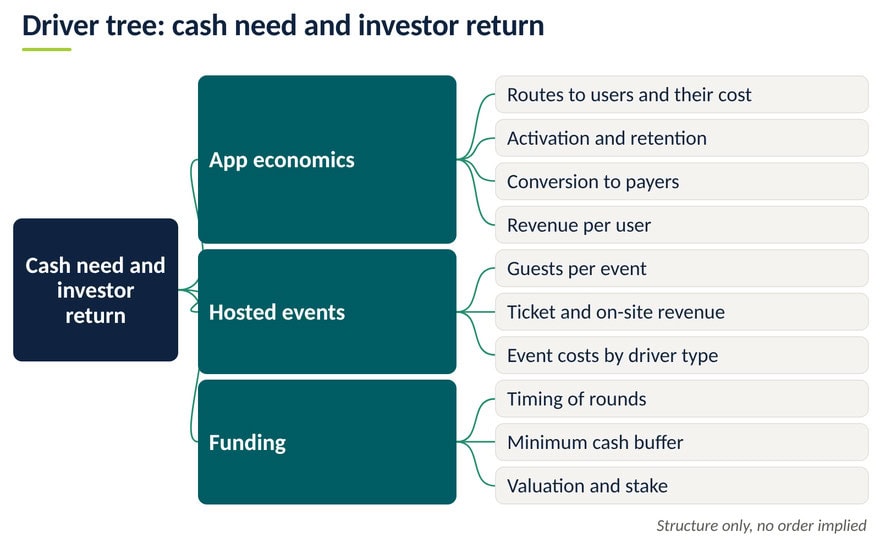
App economics, hosted events and funding terms together set the cash need and an investor’s return; the tree lists them without ranking.
A worked example: break-even attendance for one event (illustration). As a worked example with invented numbers, not a row of the client’s model, take one event. A ticket costs 34 and each guest spends 23 on site, so revenue is 57 per guest. Variable cost is 9 per guest, leaving 48 per guest. Fixed event cost is 3,984. Break-even is 3,984 divided by 48, which is 83 guests.
Worked example with fictional numbers: one event at three attendance levels
| Item | 60 guests | 83 guests | 112 guests |
| Revenue (57 per guest) | 3,420 | 4,731 | 6,384 |
| Variable cost (9 per guest) | 540 | 747 | 1,008 |
| Fixed event cost | 3,984 | 3,984 | 3,984 |
| Result | -1,104 | 0 | 1,392 |
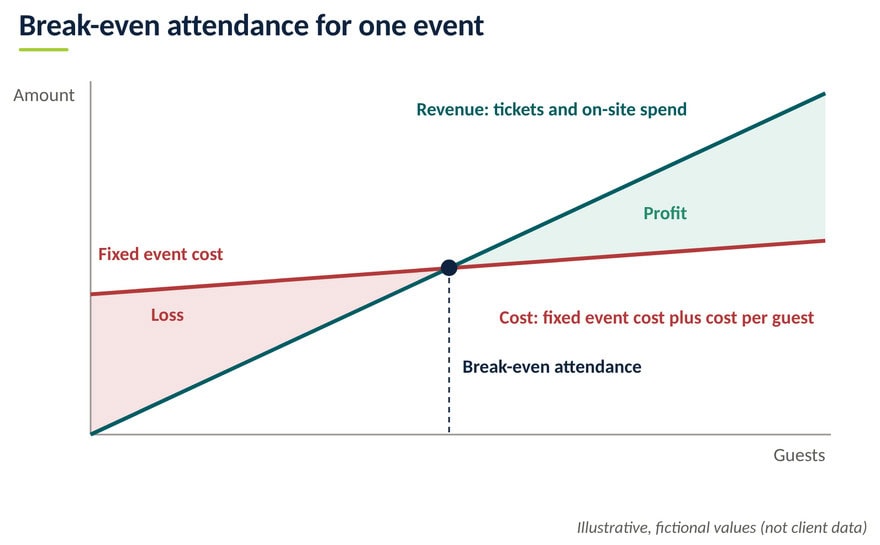
Below 83 guests the event loses money; above it each guest adds 48. Now see what three events of 112 guests each do for cash: events stretch the cash cover from 1.91 to 2.09 periods but do not replace a round.
Worked example with fictional numbers: cash cover with and without three events per period
| Item | Without events | With events |
| Cash at start | 92,400 | 92,400 |
| Planned spend per period | 48,300 | 48,300 |
| Event margin per period (3 events at 1,392) | 0 | 4,176 |
| Net spend per period | 48,300 | 44,124 |
| Periods of cash cover (cash divided by net spend) | 1.91 | 2.09 |
How We Worked Together and the Result
We started with a discussion, prepared by an analysis of the business plan: what it assumed, where it was still vague and which questions investors would ask. We then agreed the structure, built the model and reviewed the results together. The result. The model delivers:
- scenarios of how the investment case could work out, with the assumptions stated;
- revenue, costs by driver type and margin for each event;
- the funding need, the point where it ends and the minimum cash buffer;
- valuation, stakes, investor multiple and IRR from the same numbers.
Lessons and Questions for Pre-Pilot App Founders
Three lessons.
- Run a preliminary analysis before you pitch. It shows what the plan really depends on, and sometimes reality is less favourable than we thought.
- Name the assumptions the plan rests on and the cheapest way to test each. Scenarios show how a case could work out; only a live pilot can confirm the inputs.
- Plan for funding to take time. Income from your own events can bridge the gap, if each event is judged on its own margin.
Questions to ask before you build an events app model.
- What return could an investor’s stake earn in the worst, base and best case?
- What is the risk if users convert less than planned?
- How much cash does the plan need before it carries itself, and until when?
- How would the funds be deployed across app, staff and events?
- Which lines earn the money, and what does each add alone?
- Which inputs move the result most, and which are unobserved?
- What does each hosted event earn, by revenue and cost driver?
- What happens to cash and to the stake if a funding round comes later?
If you are planning an app of your own, start from our Financial Model for Mobile App or write to [email protected] for a model that also covers hosted events or your own questions.
FAQ
Short answers to the questions readers ask most often when they plan this type of model.
What does a preliminary analysis add before a pilot is live?
It gives a more realistic view of the financial prospects. It cannot prove the inputs, but it shows which of them carry the plan, how much cash is needed, until when, and how risky the plan is. That is better known before approaching investors than after.
How is break-even attendance for an event worked out?
It is the number of guests at which an event’s revenue equals its costs. Take revenue per guest (ticket plus on-site spend) less variable cost per guest, which gives the contribution per guest, then divide the fixed event costs by that contribution.
How do you model an app that has no pilot yet?
Treat every user, conversion and price input as an estimate. Keep sensitivity multipliers at neutral, rank which inputs move the result most, and show worst, base and best readings of the case. Replace estimates with real figures once a pilot runs.
Why would an events app host its own events?
Own events can earn cash while funding takes shape, but they also carry event cost and risk. Treat the income as a bridge, judge each event on its own margin, and keep it apart from the app’s economics so neither hides the other.
Client details are anonymised to protect confidentiality. Charts, schematics and worked examples are illustrative and contain no client data.


