
0 ITEMS

Gin Distillery Financial Model Case Study

Key Takeaways
- A gin distillery wanted to raise capital for growth, ending in a sale to a strategic buyer. Investor questions: can the volumes be sold at a profit, what is each stake worth after dilution, what would a buyer pay at exit?
- What mattered: profit per bottle in each sales channel and the share of sales abroad, all in one integrated model, so investors could test each round before committing.
- Turning point: growth proved far more capital-intensive than expected, so the plan has three funding rounds, each sized for what it pays for and costs in ownership.
- Outcome: a detailed model with all KPIs, investor returns for each round and a financial plan until exit.
PDF0.7 MB
Free download · No email required
Download the Gin Distillery Financial Model Case Study
✓ Model structure✓ Key assumptions✓ Results and takeaways
Investors in a distillery buy a growth story: more capacity, more channels, then an exit. What does a bottle earn in each channel? What does growth cost in capital? How much of the company must the founders give up to pay for it? A financial model puts every answer in numbers before the first meeting.
The Client and the Decision
A gin distillery with several years of operation wanted to raise capital and needed a financial plan for the road ahead. It sells through several sales channels, including sales abroad. The investment case: scale up operations until the distillery writes healthy profits, then sell to a strategic buyer. The decision was how to fund that growth. Production ramps up gradually, so the money is needed in steps.
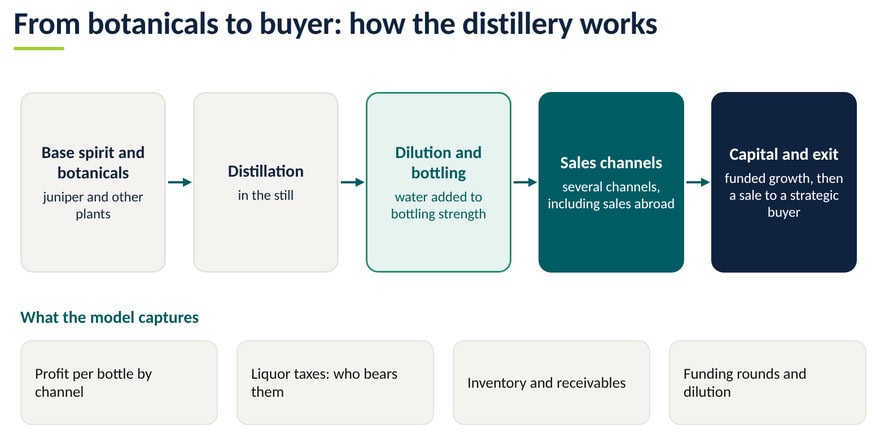
How a distillery works. Gin is a spirit flavored with juniper and other botanicals. The distillery distils them with a base spirit in the still, adds water to reach bottling strength and bottles the result. Cash leaves early: spirit, botanicals and glass bottles are bought first, liquor tax can fall due before customers pay.
Why This Was Hard to Model
- Growth needs more than capacity. Besides capex, growth needs a sales team, inventories and receivables, all funded before real cash flows appear. How we solved it: We modeled the sales team, inventory and receivables next to capacity, and used projected utilization to see when capacity must expand.
- Exports decide the growth case. Sales abroad turned out to be essential for a growth case that attracts investors. That only shows when costs and profit per bottle are known in detail. How we solved it: We detailed the cost and profit per bottle for sales abroad and compared them with the other channels.
- Exit valuation. The investment case ends with a sale to a strategic buyer, so the exit value has to rest on what such buyers pay. How we solved it: We looked up the valuation multiples that strategic buyers in spirits normally pay and used them to estimate the exit value.
The Turning Point: Growth Is More Capital-Intensive Than Expected
The founders were surprised how capital-intensive growth is. A distillery needs capex for production capacity, and also large amounts of capital for a sales team, inventories and receivables, paid before the cash comes in. Every funding round costs equity, and dilution adds up. So the funding plan covers dilution, timing and size of each round from the start, and a few scenarios show the best timing and size.
How the funding is built: three rounds. Production ramps up gradually, so one large raise would come too early and cost too much equity. The model splits the plan into three rounds, each sized from the cash need at that stage: spirit and botanicals bought, glass bottles ordered in bulk, liquor tax timing, stock waiting for sale and customer payment terms.
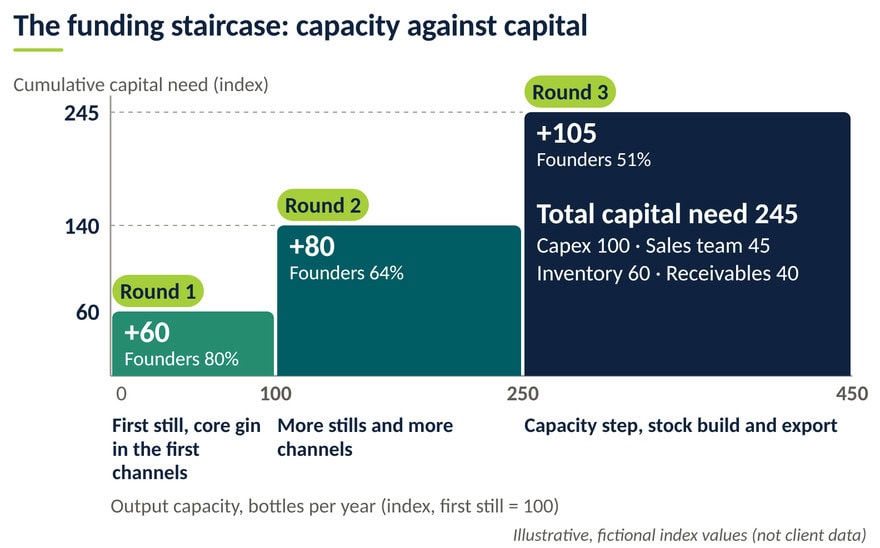
- Round 1: launch the core gin. The first round pays for the first capacity step: a still, bottling set-up, stock and a small team to launch the core gin in the first channels, for example the own shop and online. The next round opens when the still runs near full use and profit per bottle matches the plan. A loan can fund part of the still.
- Round 2: more stills and more channels. The second round pays for more stills and a larger sales team to open wholesale and first export, with the stock to supply them. The milestone: orders arrive at the modeled prices and utilization shows the next step is due. Liquor tax can fall due before the customer pays; grants reduce the equity needed.
- Round 3: capacity step, stock and export. The third round pays for a large capacity step, bigger batches with their stock, and receivables from export customers who pay later. The milestone is profit at the scale a strategic buyer pays for, which opens the exit. A loan against equipment and receivables lowers dilution but adds repayments.
Worked example with fictional index values: dilution over three rounds
| Round | Capital raised | Value before the round | New investors | Founders | Earlier investors |
| Round 1 | 60 | 240 | 20% | 80% | 0% |
| Round 2 | 80 | 320 | 20% | 64% | 16% |
| Round 3 | 105 | 420 | 20% | 51% | 29% |
In this fictional illustration each round sells 20% of the company at a rising value, yet after three rounds the founders hold just over half. This is why the funding answer decides how much equity to give up. A round that is too early or too large dilutes the founders without a matching step in value. How we solved it: We added the production capacity step by step, in three stages that line up with three funding rounds, and included grants as funding and in the profit and loss statement (P&L).
What Drives the Value
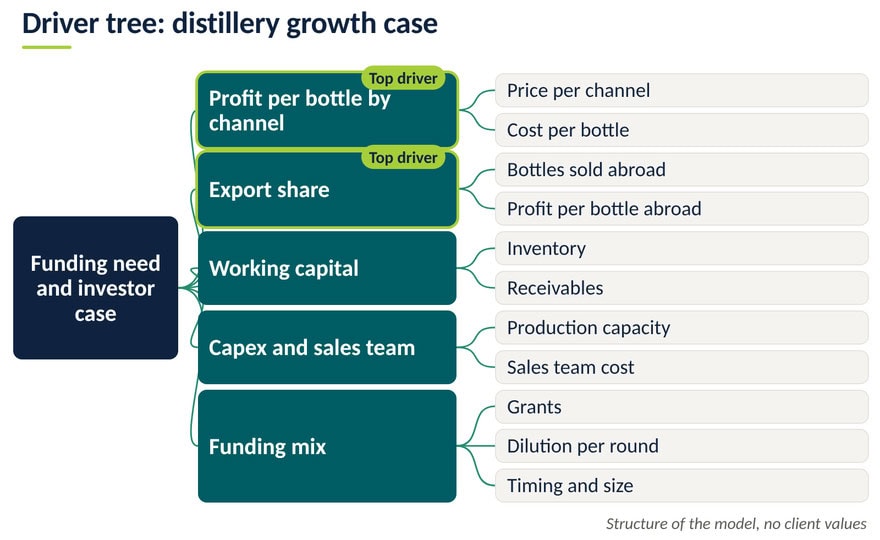
Two drivers matter most: profit per bottle in each sales channel, and the export share. Working capital, capex and sales team cost then set the capital needed; grants and dilution per round set how it is funded.
What a bottle earns in each channel. A distillery typically sells through an own shop, online, wholesale and export. The own shop sells at full retail price but carries the shop cost. Online adds packaging, postage and platform fees. Wholesale sells larger quantities at a discount. Export adds freight and an importer’s margin, and the customer often bears the liquor tax.
Worked example with fictional numbers: profit per bottle by channel
| Item per bottle | Own shop | Online | Wholesale | Export |
| Price excluding tax | 32 | 30 | 20 | 19 |
| Liquor tax borne by the distillery | 5 | 5 | 5 | 0 |
| Production cost | 9 | 9 | 9 | 9 |
| Sales and logistics cost | 4 | 8 | 2 | 5 |
| Profit per bottle | 14 | 8 | 4 | 5 |
| Profit margin on price | 44% | 27% | 20% | 26% |
The own shop earns most per bottle but is limited by volume. Wholesale and export earn less per bottle, yet carry the volume that fills new capacity and tie up cash longer. The funding plan has to price that trade-off. How we solved it: We broke down sales by channel and modeled cost, liquor tax (who bears it) and profit per bottle for each, to compare where it makes most sense to grow.
How We Worked Together and the Result
We analyzed the production process and the sales channels, then led the opening discussion on growth and funding. We planned the structure together, built the model with the funding rounds, dilution, investor returns and exit value, and reviewed the results with the founders. The founders see what each bottle earns by channel and what growth costs in capital and equity. The result: they received a financial model that delivers:
- A detailed financial model with all KPIs calculated;
- Cost and profit per bottle by sales channel, to see where it makes most sense to grow;
- A funding plan in three rounds: what each pays for, the milestone before the next and the founders’ stake;
- Investor returns calculated for each funding round;
- A financial plan until exit.
Lessons and Questions for Anyone Modeling a Distillery
Three lessons.
- Know the profit per bottle in each channel. It shows where growth makes sense.
- Count all the capital growth needs. Capacity is only part of it.
- Split growth into rounds. Size each on what it pays for and test the next one before you raise it.
Questions to ask before you build a distillery model.
- What does each round pay for, and which milestone releases the next?
- What does each round cost in ownership, and how would a loan change that?
- What does each bottle earn in each sales channel after liquor tax?
- What share of sales goes abroad, and what does a bottle earn there?
- What if a channel or the exports disappoint?
- Which grants exist, and how do they enter the profit and loss statement?
- When must capacity expand, judged by projected utilization?
- What would a strategic buyer pay at exit, and are distributions planned?
Planning a similar project? See our Distillery financial models. If your distillery needs something specific, we build custom financial models. Write to us at [email protected].
FAQ
Short answers to the questions readers ask most often when they plan this type of model.
What is profit per bottle, and why model it by channel?
Profit per bottle is the price you receive minus everything that bottle costs you: production, liquor tax if you bear it, and selling and logistics cost. Channels differ in all three, so the profit differs too. Modeling it by channel shows where each extra bottle earns most.
Why does a distillery need so much working capital?
A distillery buys raw materials and glass bottles and produces before it sells. Finished bottles sit in inventory, and customers often pay after delivery, which creates receivables. Cash goes out first and comes in later, so growth ties up money beyond the cost of the still.
How do you split growth into funding rounds?
Start from production: each capacity step needs a still, stock, people and receivables, and earns only after a delay. Size each round to the cash need until the next milestone, such as utilization or a channel at its modeled price. Then check what each round costs in ownership, with and without a loan.
What is dilution in a funding round?
Dilution is the drop in the founders’ ownership percentage when new shares are issued to investors. A larger or earlier round dilutes more. Because each round dilutes the stake again, the effects add up. Planning the rounds together shows what each party holds at exit.
Client details are anonymised to protect confidentiality. Charts, schematics and worked examples are illustrative and contain no client data.


